Showing posts sorted by relevance for query uri greenberg. Sort by date Show all posts

Thursday, November 03, 2011

On Uri Tzvi Greenberg and Jesus Affinity

Hamutal Bar-Yosef on Uriz Tvi Greenberg in this academic article:

Jewish-Christian Relations in Modern Hebrew and Yiddish Literature: A Preliminary Sketch

…The Yiddish and early Hebrew poetry of Uri Zvi Greenberg (1894-1981) radicalised the complex Jewish attitude towards Christianity.[52] In Albatros, a Yiddish literary almanac edited by Greenberg himself, he published long poems which expressed his attitude toward Christ with such force and audacity that the editorial office had to stop publication. Greenberg was a frontline soldier in the Austrian Army during the First World War, but deserted it and lived in hiding. After experiencing a pogrom in his hometown of Lemberg (L’vov, L’viv), he became an ardent Zionist.

In his early poems Greenberg often refers to Jesus as “my brother” or “our brother”.[53] In this context Jesus is a symbol of universal human suffering. In his long poem, “The Mystery Man”, published in 1922 in Warsaw in Albatros, Greenberg expressed his universalism with the words:

A man, Uri Zvi, or Ivan or Mustafa
with Shadai in his blood,
or with the cross in the head
or with half a crescent
at the trembling temple.[54]

In the poem “In the Kingdom of the Cross” (1923) Greenberg writes:

“At the churches/ Hangs my brother/ Crucified (…) Brother Jesus, a Jewish skin and bones shrinks”.

Greenberg identified himself with the historical Jesus, whom he – like Klausner – saw as a Jewish nationalist, who had been tortured and killed by the Romans because he was a leader of an anti-Roman revolt. But he detested historical Christianity, which had gone far away from Golgotha. He described Christ as being emptied from his humanity by two thousand years of distance from Jerusalem, Bethlehem and the Galilee. Jesus, who for Greenberg was a symbol of Jewish suffering, had been crucified by Christianity, and he was still being crucified in the Christian churches and cathedrals.

He gives vent to his attitude toward institutionalised Christianity with the words:

Oh Christ’s bald priests!
No man has cut the veins of your hands
And no one has driven his nails in your throats
No one has brought one of you to Golgotha
And hanged him naked on a blossoming tree.
Whose is the lament?
Not yours! It is our pain, the pain of the Jewish redeemer!
Not your agonies! It is our wound.[55]
In 1922 Greenberg published in his Albatros a “concrete” poem in the form of a cross, which was entitled Uri Zvi Before the Cross/ INRI (Jesus the Nazarene King of the Jews).[56] In this poem the poet turned to Jesus, saying:

You have become inanimate, my brother Jesus. You have two thousand years on the cross. Around you the world stopped. But you have forgotten everything. Your frozen brain does not reflect…You have become inanimate, you have tranquillity on your cross. I do not have it. Not me.[57]

The poet sees the Christian cross, a symbol of sympathy with suffering, as an empty, meaningless symbol. For him Jesus became the representative of the Jewish fate: “Ancient Jewish distress, Golgotha, my brother, don’t you see, Golgotha is here: all around.” Pilate places phylacteries on Jesus’ head, which are “a new crown of thorns”.

In the poem “A World on a Slope” (1922) the poet expressed his nihilistic loss of his former faith in Christian ideals. In this poem Jesus is fiercely attacked by a band of invalids and madmen who curse him and mock at him. They demand that he should get down from his heavenly cross to earth and join them, the real sufferes. They cry:

Get down from the cross,
you man, in our image!
Get down! The world has chimed: thirteen![58]

In this poem Christ is described as being emptied from his humanity by two thousand years of distance from Jerusalem, Bethlehem and the Galilee. Never before did any Jewish writer dare to directly attack and caricaturise the image of Christ.

At a time when many European intellectuals believed in a pacifist future, Greenberg prophesied the destruction of Europe together with the Jews. He wrote:

But I am telling you the prophecy – the black prophecy:
From our valleys a pillar of cloud will rise
From our dark breaths, woe to us how bitter they are!
And you will not realize the terror in your flesh.
And will go on prattling from burning palates
The Jews!
The Jews!
While poisonous gases will enter into palaces
And suddenly icons will scream in Yiddish.[59]
The Jews have nochance to survive in Europe. “Ten will remain, ten pain-stricken Jews … in order to prove: there was such a nation, on the Christian earth of distress”, he wrote in his “In the Kingdom of the Cross” (1923).

Greenberg describes the metamorphosis he went through:

I have been long meditating in the inwardness: is it possible
That those who kneel in Europe toward Bethlehem
And sanctify the bible – are those, these barbarians,
Whose dream is to annihilate the Jews completely?
Now he must admit that what the elders used to say about gentiles is true:
Oh, true-true-true is what my elders say:
The dead in the kloister is not my brother, he is Jezus.[60]

In 1925 Greenberg had written scathingly, “The land of enlightened Europe is not enlightened for the Jews. We are the most contemptible of humanity, as is well known”[61].

Now Greenberg perceived Christianity to be one element of a suspicious anti-Jewish world: “We [the Jews] are the only lonely ones in the world”, he wrote.
When aleady in Palestine, Greenberg wrote in a Hebrew essay (in his characteristic expressionistic style):

Hey, it should be said once and for all: the pain of the pure Christianity is the pain of the stabbed Judaism. The wound is in our flesh under the skin, not theirs. The problem: Jesus of Nazareth, who was crossed when he was thirty-three years old – this is our problem, from us it arose.[62]

His fierce attacks on Christian Europe reach their climax in his post-Shoah collection of poetry in Hebrew Streets of the River (1951). Greenberg’s emotional attitude toward the gentile world represents the psychological disastrous results of the Jewish experience in antisemitic Europe. The memory of this cruel experience is still active in the collective psychology and in political decisions in Israel and outside it.

[52] In the 1910s and early 1920s Greenberg wrote expressionist poetry mostly in Yiddish, and edited the avant-guard Yiddish almanach Albatros (Warsaw 1922- Berlin 1923). He began writing in Hebrew after his emigration to Palestine in 1924. On Greenberg’s attitude to Christ, Christians and Christianity see Noah H. Rosenblum, “Ha-Antitetiut Ha-te’ologit-Historit Shebanatsrut Beshirat Uri Zvi Greenberg” (The Theological-Historical Christian Antithesis in Uri Zvi Greenber’s Poetry), Prakim 4 (New York, 1966), pp. 263-320; S. Lindbaum, Shirat Uri Zvi Greenberg: Kavei Mit’ar [The Poetry of Uri Zvi Greenberg: Contours], (Tel-Aviv: Hadar, 1984), pp. 117-159.
[53] Lindbaum, ibid., p. 118.
[54] “Di misterie mentsch”, trans. by H. Bar-Yosef, Albatros 2 (1922), p. 14.
[55] Ibid..
[56] This poem might have been the inspiration for Chagall’s The White Crucifixion (1938) where the same letters, INRI, appear above the cross).
[57] “Uri Zvi Greenberg faren Tslav INRI”, Albatros, 2 (1922), pp. 3-4.
[58] “Velt Borg-Arop”, Kholiastre, (Warsaw 1922), p. 17.
[59] English translation quoted from Baal-Teshuva, chagall: A Retrospective (New York 1995), pp. 301-302.
[60] Here Greenberg uses the Polish pronounceation of the word “Jesus” (in contrast to the Hebrew “Yeshu”), to emphasize Jesus’ otherness.
[61] “Etsleinu ba-olam” [At our place in the world), sadan 4 (August 1925), p. 5.
[62] Editorial column of Sadan, edited by U.Z. Greenberg, 1-2 (Jerusalem, 1935), p. 2, trans. By H. Bar-Yosef.

an do you read Polish?

^

Saturday, January 25, 2014

In Literary Research: Jesus and Uri-Tzvi Greenberg

From the review by Adele Reinhartz (University of Ottawa) of Neta Stahl's "Other and Brother: Jesus in the 20th-Century Jewish Literary Landscape" which, by the way, has the infamous graphic of a Uri Tzvi Greenberg poem on the cover:


"Infamous" in that an order for his arrest was issued in Warsaw causing him to flee to Berlin.

This is was Rheinhaltz writes:

Chapter 2, "Cut off from all of his Brothers, from his Blood," turns to the poetry of Uri Zvi Greenberg (1896-1981). Stahl argues that Greenberg uses the figure of Jesus to reflect his own biography and sense of self, including his experiences in the Austria-Hungarian army during World War I, the 1918 pogrom, immigration to Palestine 1923, and most important, the Holocaust. Greenberg's poetry reflects both alienation from and kinship with Jesus, who is both indifferent to and symbolic of the suffering of European Jewry. Greenberg's poetry incorporates Christian imagery not only verbally but also typographically, a point brilliantly illustrated in his poem "Uri Zvi in front of the Cross INRI" that is used to great effect on the cover of Stahl's book. In the poignant poem "God and his Gentiles," the Christian God descends from heaven, travels through Europe, laments the absence of his Jews, and is himself destined for slaughter due to his Jewish appearance. Whereas in other works the figure of Jesus is differentiated from his Christian interpretations, these poems suggest a bifurcation within the figure of Jesus himself, as both "Other" and "Brother."  This chapter provides several illustrations of Stahl's incisive and beautifully written analyses of poetry.


And from the source:

Uri Zvi Greenberg (1896–1981) was one of the most prominent figures in twentieth century Jewish poetry. In Greenberg's poetry perhaps more than in the work of any other modern Jewish writer, the figure of Jesus reflects his own personal, literary and ideological biography, and his sense of selfhood. Greenberg's characterization of Jesus is profoundly ambivalent. His poetry merges elements of rejection and aversion, rooted in traditional Judaism, with a depiction of Jesus as a character of great charm and mystery who rebels against the social and religious conventions of his time. The chapter is divided into three sections. The first section focuses on the different literary devices Greenberg uses to express the tension between Jesus' human aspect, linked to his Jewish character, and his godly aspect, connected to his idolatrous representation within the Christian Church. The second section demonstrates how this tension becomes an actual division between two personas: the Christian Jesus is referenced by the Slavic name “Yezus,” while the “authentic” Jewish Jesus is called “Yeshu.” The third section discusses the tensions between Greenberg's divergent representations of Jesus as Exilic Jew, Zionist pioneer, and even national Messiah.

^

Friday, December 28, 2007

Uri Tzvi Greenberg Writes to Me

I was introduced to the poetry of Uri Tzvi Greenberg at YU by Nissan Teman and Reuven Genn in 1964. In 1967, during my year in Israel at the Machon L'Madrichim, I made contact with Uri Tzvi and we began an intermittant correspondence.

Toby Press is preparing an anthology of his poetry in the English translation as I learned from speaking to Aliza Tur-Malka, his widow whom I met at the Yair Stern Conference. (Here's a good site with bio info and some poetry in English and another translated poem here.) Here is the Hebrew-language site of the Uri Tzvi Greenberg House of which I am an executive board member.

So, I figured I might as well post the correspondence as that way, they won't get lost.

a) A letter from Shvat (February) 1967


b) A poem I commented on from December 12, 1971

c) And Uri Tzvi's response to my comment (translation to come later)

d) Another letter from February 1970 of Uri Tzvi reacting to a comment of mine on his poetry


e) A letter to me from May 1969 relating to his upcoming visit to New York

Tuesday, May 17, 2011

30 Years Since The Passing of Uri Tzvi Greenberg

Last night, the 30th anniversary of the death of the national poet Uri Tzvi Greenberg was marked at the Begin Heritage Center, sponsored by the Uri Tzvi Greenberg House.

Geula Cohen, Herzl Makov, Amir Benayun, Shlomo Bar, Nava Makmil-Atir, Prof. Dan Miron, Prof. Yehuda Friedlander, Dr. Tamar Monson-Wolf and Eliaz Cohen participated.

A video of Amir Benayun singing one of Uri Tzvi's poems he set to music, go here.

Pictures:


a) Geula Cohen


b) Prof. Dan Miron and Aliza Tur-Malka Greenberg


c) Dr. Tamar Monson-Wolf, Prof. Yehuda Friedlander and Eliaz Cohen

d) My wife Batya with Geula


d) Amir Benayun


e) Shlomo Bar


f) Navah Makmil-Atir

Monday, April 20, 2009

Holocaust Poem of Uri Tzvi Greenberg

Uri Tzvi Greenberg: Under the tooth of their plow


translated by Milton Teichman (with corrections by Yisrael Medad)

The American Poetry Review, July 1995
Published in Rechovot HaNahar
(*), page 279-280


Again the snows have melted there--and the murderers now are farmers.(1)

They have gone out there to plow their fields--fields that are my graveyards.

If the tooth of the plow digs up a skeleton which breaks over the furrow,

The plowman will neither grieve nor tremble

But he will smile--he will recognize the mark his implement left.

Once more a spring landscape--flowering bulbs, lilac, twittering birds.

Herds lie down by the shallow waters of the sparkling stream.

Only there are no more Jews walking by -- with their beards and sidecurls.

They are gone from the inns with their prayershawls and fringes;

Gone from the shops that sold trinkets, or cloths, or food.

Gone from their workshops, gone from the trains, the markets, the synagogues-

All, all under the tooth of the Christian plow.

With abounding grace God has visited his Gentiles.

Yes, springtime is springtime--and the summer will be bountiful.

Roadside trees swell as those in the gardens.

Never has fruit been so red now that there are no more Jews.

Jews had no bells that rang for God.

Blessed is Christianity for they have bells ringing from on high.

Even now, the voice of bells rings over the plain, flowing over a

bright and fragrant landscape.

The bells are a mighty voice, master of everything.

Once they passed over the roofs of Jews--but no more.

Blessed is Christianity for it has bells on the heights to honor

a God who is good to Christians and to all....

And all the Jews lie under the tooth of their plow,

Or under the pasture grass,

Or in forest graves,

Or on the banks of rivers, or within them,

Or on the roadsides.

Praise be to Yezunyu (2) with solemn bells: Bim-bam!

-------------------

Notes

1. The reference is to Poles who collaborated with the Nazis in the murder of Jews.

2. Diminutive for Jesus.

================================================

(*)


Wolf-Monzon, Tamar.
Livnat, Zohar.

The Poetic Codes of Rechovot ha-nahar ("Streets of the River"), pp. 19-33

Rechovot ha-nahar, Uri Zvi Greenberg's great book of lamentation over the destruction and loss of European Jewry, follows an ancient tradition of lamentation over the destruction and persecution of the Jewish people which has developed in Hebrew poetry since the era of the piyyut and medieval poetry. In this book Greenberg uses a new poetic language, including concepts and expressions such as kosef ('yearning'), nigun ('melody') and nofim ('landscapes'), which appear for the first time in this book but will reappear in other contexts in later texts. In this sense, Rehovot ha-nahar is a constitutive text, which introduces a new poetic and linguistic code.

Shofar: An Interdisciplinary Journal of Jewish Studies, Volume 23, Number 2, Winter 2005

Sunday, August 26, 2007

The Uri Tzvi Greenberg Heritage House

Among other volunteer activity, I serve on the executive board of בית מורשת אורי צבי גרינברג or the Uri Tzvi Greenberg Heritage House.

Uri Tzvi was the greatest poet of Israel and the Jewish people in the 20th century. Here are some translations. So far, 13 volumes of Hebrew poetry have appeared in the Collected Works Edition, one volume of drawings and three of newspaper articles from the 1920s. All together, there should be some 22-23 volumes.

And here are some photos of the 'gang':

At the top of the table is Geula Cohen and, to the right of the picture: Danny Dayan (newly elected chairman of the Yesha Council, Dr. Ze'ev Yeivin, son of Yehoshua Heshel Yeiven, companion of Uri Tzvi, Daisy Cohen (standing), UZG House administrator, Uri


Chaya Mira Baranas, educational coordinator, and to her left, the accounts comptroller and Rivka Sneh.


And there's me with Geula Cohen and Daisy. At far right is Advocate Naftali Wurzburger who is well known for taking on difficult nationalist causes including the disengagement cases, former Kach activitists and others.

Monday, May 07, 2012

AB Yehoshua's Warped Jabotinsky

An excerpt from the new play by A.B. Yehoshua I previously noted, translation by Dr David Janner-Klausner and adapted for stage in London for presentation on May 10 by Amy Rosenthal from the Jewish Quarterly, Can Two Walk Together?

London 1934 — two of the great Zionist leaders, Ben Gurion and Jabotinsky — meet to discuss the character of the future Jewish State

...Ben Gurion: What about Uri Zvi Greenberg? He may have defected from my labour movement but I still admire his poetry.

Jabotinsky: Uri Zvi Greenberg isn’t a moral or a spiritual authority. He’s a hysterical, humourless man still haunted by the trauma of the trenches. And I’ll let you in to a secret – unlike you, I’m not keen on his poetry. As a rule I don’t think poets and authors are useful in public life, in the end their concern is for books and poems and scholarship. Take care of Berl, he’s a precious asset. He was in the Jewish Brigade I founded, in the Great War. We had our disagreements, but I’ll always value him as a man of truth worth.

...Ben Gurion: (pensive) You return to Paris tomorrow?

Jabotinsky: Yes. Where will you be heading?

Ben Gurion: Home, to Tel Aviv.

Jabotinsky: Alas, Tel Aviv…Jerusalem…they haunt my dreams.

...Jabotinsky: So I have a question for you. Let’s assume we have our Jewish State and its Prime Minister, whomever he is, invites you to join the Cabinet. Which Ministry would attract you the most?

Ben Gurion: I’d start a Ministry for Identity.

Jabotinsky: Is there such a thing?

Ben Gurion: No, but it will be essential. We need a Ministry to straighten out our poor old Jewish identity that’s been crippled by centuries of exile. At the heart of it I would plant the words of the Prophets.

Jabotinsky: What a bold idea. It would tempt me too, although I might straighten out the warped Jewish identity in a rather different way. So if I were to join this cabinet I’d choose an easier role.

Ben Gurion: That being?

Jabotinsky: Secretary for Defence, Minister of War.

Ben Gurion: Minister of War? You, Jabotinsky? The poet, the author, the orator…

Steam is rising from the stove and there is a scorching smell.

Jabotinsky: Yes, because my wars would be shorter and more efficient than any waged by you Socialists. Fewer dead, fewer injured, less destruction on both sides.

Ben Gurion: How?

Jabotinsky: Because I wouldn’t let a single Jew or Arab harbour false illusions. I wouldn’t offer the Arabs a compromise that they won’t accept. I would speak to them clearly and honestly, without guile. They’re neither wicked nor foolish, as your friends in the Brotherhood of Nations might fancy. From the minute our feet touched the ground of Eretz Yisrael, they’ve known what our intentions are. Like some posturing virgin we persist in denying the fact that from its inception the Zionist Movement has carried in its womb the embryonic Jewish state. But the Arabs spotted this long ago and as they awake from four hundred years of Ottoman-induced slumber they will ensure that this embryo dies, along with its mother. If we don’t rush to deliver the Jewish state, this baby will die in the womb or be delivered stillborn to the English. Or it will be born a monster.

Ben Gurion: A monster???

Jabotinsky: Ambivalence, procrastination, religious extremists from all sides and enemies of Zionism will turn it into a monster. That’s why we need a state as soon as possible. An independent sovereign state with clearly charted borders and a wall of steel before its enemies. But within in: generosity, equality and respect for all. An outward wall of steel but from the inside, velvet-covered marble, embellished with images of hope...

...Ben Gurion: There’s no such thing as steel on the outside and velvet on the inside! You’ve been away from Eretz Yisrael for so long you’ve lost touch with reality. We in the workers’ parties are trying, slowly and carefully, to separate the Arabs and ourselves by securing Jewish labour in Jewish enterprises and building separate Jewish settlements in uninhabited areas. Yes, Sir, another acre and another goat, but the time is not yet ripe for the Jewish State. If we induce this premature infant of yours, the Arabs will destroy it and the English will let them, because then they won’t be responsible for our security. You’ve have been gone too long, you don’t know the situation.

Jabotinsky: And you are completely alienated from European Jewry! You have no concept of the new nationalistic anti-Semitism that’s poisoning the air. When you and your friends finally decide the time is right to bring the Jewish state into the world you’ll be too late – not enough Jews will survive.

Ben Gurion: You speak with such cruel pessimism.

Jabotinsky: It’s reality....

I left this comment there:
This is such an ideological anachronistic warping of history to suit Yehoshua's viewpoint. Of course, the entire play is unavailable to me but this: "to produce another attack on me" by DBG, when he was the one calling VJ "Hitler" and "Fuehrer" and when the Labour factions of the Histadrut were attacking VJ from 1923 on, is outlandish. To put these words in VJ's mouth on Uri Tzvi: "Uri Zvi Greenberg isn’t a moral or a spiritual authority. He’s a hysterical, humourless man still haunted by the trauma of the trenches. And I’ll let you in to a secret – unlike you, I’m not keen on his poetry." is a bit sacrilegious. In 1934, Atzag was already working for the Revisionist movement in Poland, editing journals and newspapers. Oh, and if the translator wants to be faithful, this term "a wall of steel" is mistranslated. And since it's one of Jabo's most well-known phrases, thanks to Shlaim, it should be Iron Wall - קיר הברזל, from his 1923 two-part article. But if this is sponsored by the NIF, I can understand Yehoshua's moblized literature.


And here is Yehoshua on the play:

I always had reservations about Jabotinsky, except for the saying 'if not eliminate the Diaspora - Diaspora will surely eliminate you'. Jabotinsky did not interest me - until I read the book by Dan Miron" (and see here in Hebrew)..."I felt through a literary analysis the man's tragedy and loneliness that as he was a foundation stone of his movement, so was Ben-Gurion in his".
...the Zionist movement was created by founding fathers who had an affinity for literature. A leader with the vision for the future is really a writer. Through recognition of Jabotinsky's literary personality, using the book by Dan Miron, I returned his political persona...my play turned the meeting of Ben - Gurion and Jabotinsky in 1934, part fantasy, part documentation...There is a conflict between right and left, but between two traditions, and traditions of Jabotinsky was not acceptable. Jabotinsky says' Learn to laugh, take your life like a game, and it is a spiritual testament for all of us".

(k/t=PG)
^

Sunday, January 06, 2008

Uri Tzvi Greenberg at Betar World Convention

Previously, I posted some letters Uri Tzvi Greenberg wrote to me.

While searching for Betar pictures from Europe, I found this one of the march opening the 3rd Betar World Convention in Warsaw in September 1938:-


Uri Tzvi Greenberg is just off center to the right, in the overcoat and hat between the two Betar officers.

Sunday, May 27, 2007

Strange Coincidence But...

There's a new book out, an anthology of Uri Tzvi Greenberg's poems. 610 pages.

Here's the cover:-


Maybe it's just me but what does the letter 'tzadi' (צ) remind you of?

David Tartkower is the cover designer. And who is he?

Well, he happens to be one the more outstanding radical left-wing graphic artists in Israel.

He has established a reputation for a series of politically provocative self-produced posters, some at the time of Rosh Hashanah (the Jewish new year). His compositions are driven more by content or themes than by high aesthetics.


Or this:-

What is your greatest professional achievement? The design of the logo for the Israeli peace movement "Peace Now," in 1978. Since then, it has become an icon.

Do you have a favorite cause you like to work on? In the '80s I began to initiate, design and produce personal posters dealing with my society and its politics. I relate mainly to the Israeli-Palestinian conflict, and its effect on Israeli society.


And:-

Do you have a favorite cause you like to work on? In the '80s I began to initiate, design and produce personal posters dealing with my society and its politics. I relate mainly to the Israeli-Palestinian conflict, and its effect on Israeli society.


Now, I know that people will say that this font was used by Uriz Tzvi himself, in 'Aima G'dola v'Yareiach' (An Awful Fear and the Moon). Possibly. However, that was in the early 1920s. To reuse it now, after the Holocaust, is playing fast with people's memories and impressions. I doubt if Uri Tzvi would now use that font. Of all the fonts that Uri Tzvi used, Tartkower purposefully slected this because to him it suggested a swastika.

This is subliminal propaganda.

=============

UPDATE

Okay, I've scanned the original logo that Uri Tzvi created for his 1925 book,
אימה גדולה וירח,
and here it is:-


You'll notice that all the letters are equal in size. The 'tzadi' is not emphasized and therefore, is less noticeable.

The way Tartkower has redone it is to draw your attention to it especially as it sits right smack in the middle. You can't miss it and moreso, he's turned it slightly to the left drawing you to make the swastika comparison.

Look again -


Left, in this case, is evil.

Tuesday, December 31, 2013

Uri Tzvi Greenberg Confirmed By Eichmann

I found this fascinating but why, afterwards:

Bettina Stangneth’s recent Eichmann vor Jerusalem, [the book]...comes as a shock even to those of us convinced that Eichmann was highly motivated and knew exactly what he was doing...[writing in] more than 1,300 pages of writings and transcripts from Eichmann’s Argentine period.

...Eichmann [was] at the very center of a network of unrepentant ex-Nazis there who still had supporters in the upper echelons of the Bundesrepublik...This group held regular meetings [in Argentina] where they would drink and vent their bile, but also worked methodically to extend a network of sympathizers, forged documents to exculpate themselves and National Socialism, and spoke seriously of returning to Germany and staging a coup. In this circle of friends, Stangneth concludes, Eichmann remained a “fanatical Nazi.”

...Stangneth quotes the entire rant, which takes up three densely printed pages in the German edition. What comes through is Eichmann’s intense devotion to Nazi aims and defiance in the face of the enormity of German crimes against the Jews, whose lives mean nothing to him. Denying he was a mere bureaucrat, he presents himself as an engaged fighter for his Volk and Blut, his exact words.

As for the Jews, he gives them almost cosmic significance, explaining that their dominance was secured by their vast learning and the imposition of their revelation on other peoples. He finds it “depressing” to think that the Christian Church is built on Jewish revelation and says (this is not in Life) that “it is from this awareness that I fight against this enemy”—a phrase that could have been taken from Carl Schmitt’s writings on the Jew as civilizational enemy. Eichmann comes through as a classic pro-Zionist anti-Semite, “fascinated” with Judaism—he claimed, falsely, to have learned Hebrew from Benjamin Murmelstein in Vienna—and “passionately” devoted to finding them a new homeland. So long as they were driven, by any means necessary, from their current one.

And now, why for me that was fascination.

The concept that Eichmann expresses, that it was the Judaism of the Jews that provided a religious ethic which undermined the code of behavior which he, and his fellow Nazis, sought, that our religion and culture, in its ‘weakness’, as it were, corrupted what the non-Jewish philosophy of life should be, is reflected in the poems of Uri Tzvi Greenberg published in the volume of collected poems on the Holocaust, Rehovot HaNahar (Streets of the River), that appeared in 1951.


In the poem Shir HaPanim HaKadosh: Acheinu Kol Bet Yisrael (The Holy Poem of the Faces: Our Brothers All of the House of Israel), pages 187 – 194, which originally appeared in September 1946, Greenberg asks in a multi-repeated one line refrain


Eich lo yist’munu goyim…
(“How could the non-Jews but not hate us?”)


And he bases this presumption on the fact that Jews provided the example and the standard for much of what the non-Jews inherited in their own rituals, beliefs, morals and restrictive limitations.


“The shining candelabrum that we lit in the Temple on Mount Moriah
Is that which is burning in their halls and huts;
And had it been extinguished, their souls would have been darkened, as the soul
Of their ancient elder and of the soul of the beast in their forest - -
And this they well know, they truly do!
How could the non-Jews but not hate us?”


He highlights Jewish successes in the realm of morals and spiritual achievements and each theme ends with that refrain.


In another poem, on page 32, entitled “The Poem of Avraham’s Race”, he treats his theme as one in which we liberated mankind from idolatry and slavery but nevertheless, we were not congratulated:


“From the day we overcame the nature of fire and water
And we left them behind joyfully for freedom and majesty,
The fire follows right after us: to grab us amidst the straits;
And the water is behind us: to drown us.
From the day we smashed the idols of wood and stone
And we taught that there is a God who creates all creation –
The wood of the non-Jews lies upon us in its death-shadow,
And every stone is angry at us for they do not wish to be a
Foundation for our house.
And from the day that the idolaters from the generation of Avram
Until the generation of the Cross
That received from us the knowledge of the One God alone,
That cannot be grasped in physical form
We have not known any refuge from the non-Jews’ anger;
Their blood cries out so for their ancient idol…
And in their sub-consciousness, in moments of the weakness of longing,
They come to us – to the Hebrew well
For they have no prayers of their own in their mouths,
Not on a festive day or one of mourning
Not when they crown their king or when they bury him,
Not on a day celebrating heroism or one after a battle campaign,
On land or sea,
Other than our prayers.
From our king, David,
Come the lips
In the choirs
Selah and Hallelujah and Amen – “


^

Monday, December 28, 2009

Uri Tzvi Greenberg in a NYTimes Blog

Another entry at Schott's Blog at the NYTimes.

This time a bit of Uri Tzvi Greenberg:

נאהב יהודים

…We will love ourselves: Jews who are swordless, hated!
Together we’ll pray the prayer of great fraternity,
for it is holy as the living blood running at the feet of the murderer;
for it is pure as the tear in the orphaned infant’s eye.
The non-Jews open before us the fire and the sea
and we have chosen: life and the reestablishment of our kingdom.
Shoulder to shoulder! So that there should be no space between a Jew’s body and his comrade, crowded together!!
A congregation of Jews awaiting the Messiah.

The original can be found in his Collected Works, Vol. III, p. 60.

Wednesday, January 04, 2023

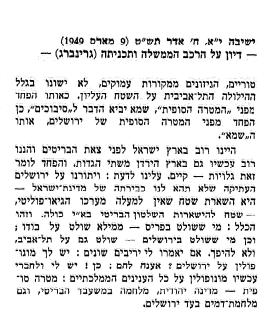
The Exact Uri Tzvi Greenberg Temple Mount Quotation

Many quote from a speech Uri Tzvi Greenberg, then a MK representing Herut, 

during a Knesset plenum debate but 'enhance' it.

Here is the headline from the Herut newspaper two days after, March 11, 1949:


and it reads:

"He who rules in Jerusalem, rules in Tel Aviv".

And from the Knesset record:


It need be recalled that at that time, Jerusalem was not yet the official capital of Israel. It became so only in December 1949 when David Ben-Gurion passed a government decision. That was why he mentioned Tel Aviv.

Another section of the speech:

^

Tuesday, January 03, 2012

Nationalist Theater

This evening I attended a theatrical interpretation of Uri Tzvi Greenberg's poem, "In The Ears of A Child I Will Relate" sponsored by the Uri Tzvi Greenberg Heritage House:


That's Elchanan Even-Chen on the left (he's the Latma news anchor) and Yaakov Brody.  Baruch Guttin is director. Dr. Baruch Pelech introduced the poet with a lecture on his approach to Jewish Messianism. Adam Yachin fashioned the backdrop and Asher Golschmidt provided original music accompaniment.


Enjoyable.  And satisfying.

^

Sunday, May 06, 2012

August 1, 1948 in Jerusalem

Here is a news item found on page 2 of the Palestine Post, the August 2,1948 edition:


Scheib is, of course, Dr. Israel Eldad.

The line - "he who rules Jerusalem, rules the Land" - is later pronounced in the Knesset by Uri Tzvi Greenberg in a 1949 speech. 

Did Eldad pick it up from Uri Tzvi or the opposite?

And six weeks later, Count Bernadotte was assassinated in Jerusalem by a Lechi front group, following an order given by the Lechi Cnetral Committee.


^

Thursday, August 12, 2010

When Art Interprets Literature


Interpretating a poem by Uri Tzvi Greenberg, "Im Malchus Fun Tzelem".


For a critical understanding. see Jesus in Greenberg's Poetry.


- - -

Thursday, June 04, 2015

A Word on Mount Zion

On the background of the contretemps there [1; 2;] -

The Franciscans' presence in the Holy Land started in the early 13th C, when they resided in a small house in via Dolorosa.  In 1333, King Robert d'Angiò of Naples bought the Cenacle from the Sultan of Egypt and gave it to the Franciscans. In 1342, Pope Clement VI declared that the Franciscans are the official custodians of the Holy places ("Custodia Terroe Sanctoe"). This custody is still in effect to date.

From 1335 to 1551, the monastery was located in the building thought to be the site of the tomb of King David and the traditional location of the Last Supper. From 1551 until 1560, they resided in a bakery nearby. Afterwards, they relocated to another site in the city.  Only many years later did they return to Mount Zion.

The reason for that hiatus in the mid-16th century was that the Jews of the city managed to reclaim the site which originally was a synagogue built at the end of the Roman period, circa the 4th century.


My Zionism is political and I am a liberal conservative.

Therefore, I would oppose awarding the Vatican sovereignty there but if they wanted, on occasion, to use a room for prayer or, better, simple meditation​, fine. That's an offer I'd approve.

However, I would then use that situation and tell them that it will happen if they convince the Waqf to permit Jewish prayer on the Temple Mount.

This has nothing to do whether King David is or is not buried there or nearby.  But that room, which I first visited in 1966, and which was highly revered by Uri Tzvi Greenberg, 

UZ Greenberg (r) at the Bar Mitzva of his son, Haim, at David's Tomb 
with Dr. Israel Eldad (far left) and Emmanuel Hanegbi (center, rear)

As a member of the Save Mt. Zion team which was founded by Shelomo Alfassa in 2005, I have no desire to yield ownership or identity yet am open to accommodation although other groups are more restrictive.

I just  wanted to clarify my position.

^

Tuesday, March 25, 2008

Aliza Tur-Malka Greenberg

The widow of Israel's greatest national poet, Uri Tzvi Greenberg, was present at an event of the Begin Center Monday night and I took the occasion to be photographed with her.


She herself is a poet in her own right.

Friday, May 12, 2006

My Appreciation to Gil Student

Just found out (I slept over at my daughter's place in Jerusalem last night as we attended, along with another daughter of mine, the event marking the 25th anniversary of the passing of the greatest Hebrew poet in the modern era, Uri Tvi Greenberg [here's the relevant UZG /pronounced A-tzag and by the way, he was the great-grandson of R' Uri of Stelisk, the 'Saraf'/ website] and only opened the computer late here in Shiloh), that Gil Student included my blog in his presentation at the Rabbinical Council of America on Jewish blogging.

(see here which I located going from Renegade Rebbitzen [which I checked, along with OrthoMom, to see if anybody was discussing the tragic incident at Lakewood - they weren't strangely enough; here's my posting)

I am schepping nachas and feel honored.

Thanks.

Monday, April 20, 2009

The Term 'Holocaust' and Elie Weisel

In an interview conducted by Jonathan Mahler with Elie Weisel at The Daily Beast (now, that's a mouthful):-

The word “Holocaust” is interesting in itself. Explain for you what it means.

I think I was one of the first, if not the first, to use it publicly [to describe the murder of six million Jews during World War II]. I’m sorry, but I regret it now, because there are no words. I did it because strangely enough I was working on a text on the sacrifice of Isaac. The word itself means a burnt offering. It’s a good word because it ends with fire. A total burning. A burnt offering. But of course why I feel bad about it is because it has a religious connotation and there are no words. So if I have to speak about it [the Nazis’ attempts to destroy European Jewry] today I don’t use it. I prefer not to. I use the word “Auschwitz” instead. The name “Auschwitz” should be the one in the conscience, or whatever, that people need to remember.

So you really don’t use the word?

Rarely.


My first comment is that the poet Uri Tzvi Greenberg never used the term 'holocaust' but preferred Churban Beit Yisrael B'Airopa or The Destruction of the House of Israel in Europe.

This entry supports this:

Most of these usages arose after World War II, but it is unclear whether they permitted or resulted from the use of holocaust in reference to the mass murder of European Jews and others by the Nazis. This application of the word occurred as early as 1942, but the phrase the Holocaust did not become established until the late 1950s. Here it parallels and may have been influenced by another Hebrew word, שואה(“catastrophe,” in English, Shoah). In the Bible שואה has a range of meanings including “personal ruin or devastation” and “a wasteland or desert.” שואה was first used to refer to the Nazi slaughter of Jews in 1939, but the phrase השואה (“the catastrophe”) became established only after World War II. Holocaust has also been used to translate ḥurbān (“destruction”), another Hebrew word used to summarize the genocide of Jews by the Nazis.


And secondly, who was first, read on:

Holocaust was adopted as a translation of Shoah—a Hebrew word connoting catastrophe, calamity, disaster, and destruction[12]—which was used in 1940 in Jerusalem in a booklet called Sho'at Yehudei Polin, and translated as The Holocaust of the Jews of Poland. Shoah had earlier been used in the context of the Nazis as a translation of catastrophe; for example, in 1934, Chaim Weizmann told the Zionist Action Committee that Hitler's rise to power was an "unvorhergesehene Katastrophe, etwa ein neuer Weltkrieg" ("an unforeseen catastrophe, perhaps even a new world war"); the Hebrew press translated Katastrophe as Shoah.[13] In the spring of 1942, the Jerusalem historian BenZion Dinur (Dinaburg) used Shoah in a book published by the United Aid Committee for the Jews in Poland to describe the extermination of Europe's Jews, calling it a "catastrophe" that symbolized the unique situation of the Jewish people.[12][14] The word Shoah was chosen in Israel to describe the Holocaust, the term institutionalized by the Knesset on April 12, 1951, when it established Yom Ha-Shoah Ve Mered Ha-Getaot, the national day of remembrance.

12 Holocaust, Yad Vashem
13 Setbon, Jessica. "Who Beat My Father? Issues of Terminology and Translation in Teaching the Holocaust", workshop from a May 2006 conference; see Yad Vashem website.
14 "Holocaust—Definition", Encyclopedia of the Holocaust, Vol. II, MacMillan.