Wednesday, January 24, 2007

Refreshing Intellectual Honesty

Sometimes, one finds a refreshing breeze of intellectual honesty.

After Carter, Anan, Finkelstein, Chomsky and others who have appeared in this blog - all negative, of course, try this analysis I plucked from this article:-

The Framers of the American Constitution, steeped in the majesty of British law and tradition, understood that real security required an accountability nexus between the political actors wielding power and the public whose lives hung in the balance. Today, by contrast, UN Secretary General Kofi Annan, reading Article 51, claims the Security Council is “pre-eminent”—“the sole source of legitimacy on the use of force,” based on a Charter which, alone, “provides a universally legal basis for the use of force.”

The fallout abounds. For example, the Special Rapporteur of the United Nations’ new Human Rights Council recently released a report on the “Prevention of Human Rights Violations Committed with Small Arms and Light Weapons.” In its haste to rid the world of guns, regardless of contrary national laws (such as the Second Amendment to the U.S. Constitution), the report breezily contradicts international law’s ancient origins, declaring there is no right to self-defense—neither for the individual nor for the nation state. At best, self-defense was said to be available in most jurisdictions as a defense to be interposed, not a privilege (much less a natural right) to be guaranteed. Thus, there is a right to life, but not to preserve that life.

This can have come as no surprise to Israel, a perennial victim of transnational progressivism’s infatuation with self-styled “freedom fighters” and “national liberation movements”—which is to say, leftist insurgents and jihadists. In 2004, the UN’s International Court of Justice (known, in its solipsism, as “the World Court”), ruled by a lopsided fourteen-to-one that the barrier constructed to shield Israelis from relentless terrorist assault—reducing suicide-bombing murders by over 90 percent and thus minimizing the need for Israeli Defense Forces to conduct responsive operations in the West Bank and Gaza—was an affront to international law. The tribunal reasoned that the fence, transparently derided as “the wall,” created disproportionate hardship for Palestinians. In the true spirit of Animal Farm, the ruling, rendered by justices hailing from countries that routinely repress various minorities, came just as the UN itself was burdening Manhattan’s already harried commuters by constructing a security fence around its headquarters.

How surprising was it, then, during this summer’s siege of civilian bombing by Hezbollah—an international terrorist organization whose animating purpose is the destruction of the Jewish state—that it was Israel, the victim, which Secretary General Annan chose to accuse of war crimes? And for what? For unintentionally striking UN forces that had, for years, enabled Hezbollah’s offensive operations.


Go on, read it all.

36 - Can You Believe It?

Two reviews of this book:-

The Book of Names
by Jill Gregory, Karen Tintori
St. Martin's Press (January 9, 2007)

According to Jewish tradition, each generation produces 36 righteous souls who hold up the universe. In this page-turner, a Gnostic group that wants the world to end, thus defeating God and paving the way for their own spiritual ascension, has murdered 33 of the 36.

Ever since he was involved in a childhood accident, David Shepherd has been compulsively writing down names. When he learns through a kabbalistic rabbi that he is the keeper of the names of righteous souls (and realizes that his stepdaughter is one of them), he finds himself in the middle of a nightmare filled with killings, natural disasters, and the knowledge that the fate of the world in his hands. Coauthors Gregory and Tintori use the now-common Da Vinci Code formula of short chapters and steadily building suspense, but their intriguing premise--also behind Sam Bourne's The Righteous Men (2006)--helps separate this tale from garden-variety religious thrillers. And where others have tried and usually failed, the authors give succinct explanations of the principles of kabbalah and Gnosticism, both complex and often misunderstood.


Even readers not yet sated with apocalyptic thrillers may be disappointed by Gregory and Tintori's first collaborative novel, which attempts to use the Jewish tradition of the Lamed-Vovniks, the 36 pure souls whose existence protects all of humanity, as the catalyst for a Da Vinci Code–like plot. Georgetown University professor David Shepherd, who routinely rubs elbows with the high and mighty, finds himself haunted by strange images of names.

When an old friend's suggestion leads him to a rabbi in Brooklyn, Shepherd learns that the rabbi possesses an ancient biblical gemstone linked to the Lamed-Vovniks, and that a mysterious cabal has been systematically killing those righteous figures to usher in a new satanic age. Thin characterizations, rampant clichés and unlikely action sequences make for a less than satisfying read. Under the pseudonym Jillian Karr, the authors have written two suspense novels, Something Borrowed, Something Blue, which was made into a CBS-TV movie, and Catch Me if You Can.

Yaalon Makes It Clear

Moshe Yaalon is forthright:

A two-state solution based on Israeli territorial concessions to the Palestinians will not lead to broader stability in the Middle East

The story:-

"The resolution of the Israeli-Palestinian conflict -- which I wish we could resolve and I cannot see it being solved in the near future -- will not lead to stability in the Middle East," he told an annual conference on Israeli national security in Herzliya, north of Tel Aviv Monday.

"International pressure on the state of Israel for territorial concessions will only strengthen the jihadi threat being led by Iran today and encourage them to continue to attack Israel and the West," Yaalon said.

"The two-state paradigm as a solution to the conflict is irrelevant at this stage. The solution of the conflict will not solve the Islamic attack against the West."

The former chief of staff was referring to a report published in December by the US Iraq Study Group led by James Baker and Lee Hamilton which stressed the need to resolve the Israeli-Palestinian conflict in order to resolve the wider problems in the Middle East, especially in Iraq.

...Yaalon also said Israel's unilateral withdrawals from Gaza and from southern Lebanon proved that the conflict was not territorial but ideological after last summer's conflict with Hezbollah in Lebanon and the Palestinians in Gaza.

"The fact that Israel was attacked last summer on two fronts and continues to be hit by rockets strengthens the sense of a dead-end and proves that the root cause of the conflict is not the occupation of territory," he said.

The cause of the instability in the Middle East is Iran's Islamic regime, which fosters "a clash of civilisations between the West and the radical Islam", Yaalon said.

"We cannot avoid confronting the Iranian regime without which we will not be able to defeat the Jihadi Islam ... I cannot see any change in Iran without external intervention," he said.

Duh?

Am I missing something here?

Critics were particularly frustrated that Dershowitz was not allowed to debate Carter. "It's puzzling because he said that he wants to have a discussion of his book and then refused to appear with Professor Dershowitz," said retired Brandeis history professor Morton Keller.

Gordon Fellman, a sociology professor and a member of the committee that arranged the visit, said Dershowitz is neither a student nor faculty member at Brandeis and therefore "he can't get in - and it's not anti-Dershowitz.


But neither is Carter a student nor faculty member.

If he got in, why can't someone invite Alan to enter - in the name of academic freedom, rationality and philosophical openess?

Tuesday, January 23, 2007

What We Have to Put Up With

Just recently we had Tomy Lapid lambasting us as those who recall to him exactly how his antisemitic neighbor used to curse him and scare him when he was a little boy.

Next now is Danny Rubinstein of Haaretz who doesn't like the way we react to our Arab neighbors' life situation. Here:-

In the settlers' community, life is exemplary. There is a high level of solidarity and mutual aid. This is perhaps the only place in the land where drivers pick up hitchhikers. The settlers pay great attention to the details of life in their settlements, especially with regard to religious matters. They ask their rabbis whether there is a risk of slander in one act, or of theft in another, at least when it has to do with their colleagues. But if these things have to do with Arabs, it is a different story. Then they are insensitive and cruel.

Every day, as they drive on the roads, the settlers see the distress of their neighbors from the villages suffering at the roadblocks and trailing along the tracks in the hills to scrape out a living, or to get to a field, to school or to a clinic. Their claim is that it is all the fault of terror. And when they are told that it is wrong to punish an entire population, they say anyone who feels pity for the cruel will end up being cruel to those who deserve pity.


Danny, after being called pigs, monkeys and pygmies by some of these people, after being stoned by them, after having my bus set alight in Ramallah by a Molotov cocktail, been shot at, having my neighbors, including a 5-month old, killed by them, let me say that my sympathy is a bit out of sync. I am so sorry.

I am so sorry that these people have, since 1920, denied our right to a homeland and rioted and slaughtered us.

I am so sorry that they have placed their trust in Muftis, Immams and preachers. And in one Yasser Arafat.

I am so sorry that they refused the offer of autonomy of Menachem Begin.

That they refused the Olso process and began suicide bombing.

That they refused Barak's offer at Camp David II.

But, come to think of it, I am not really that sorry that they have refused our reaching out to peace because I now know that their intent is not peaceful.

So, until the people, the sha'ab, realize that there's another way out of their mess, one of coexistence and coming to terms with the Jewish national rights, I am not going to feel guilty by your base and manipulative conclusions about our behavior and our attitude out here in Yesha.

Monday, January 22, 2007

Instead of Spain - Israel; Instead of ETA - PLO

If only our politicians would be so gallant.

Spain's premier addresses ETA problem

The prime minister apologized Monday for putting his faith in a Basque peace process that collapsed in a deadly car bombing, but he insisted he was right to have sought negotiations with separatist group and appealed to his political foes for unity at a time of crisis.

In a speech to parliament often interrupted by jeers from conservative lawmakers, Prime Minister Jose Luis Rodriguez Zapatero did not announce any new measures against the separatist group ETA. He said police pressure and court trials continued during the now-ended ETA cease-fire and will proceed as usual.

Instead, he focused on defending his record and seeking to muster support for his government as conservatives have called him naive for seeking to negotiate with what they called an active terrorist group that could not be trusted.

The Socialist leader said that with the Dec. 30 bombing at Madrid's airport that killed two people, ETA had shattered a nine-month cease-fire and a nascent peace process.

"It made the worst decision, a criminal, mistaken and useless one. It chose the path of terror," Zapatero told a crowded, special session of the Congress of Deputies, the lower chamber of parliament.

"I want to recognize the clear mistake I made before all Spanish citizens," Zapatero said.

Opposition leader Mariano Rajoy wasted no time in attacking Zapatero, saying the premier had lost all credibility for saying before the bombing that the peace process had left Spain better off than it was a year ago and that better times awaited it.

"What is your word worth after all this?" Rajoy said. "You have been fooled by a pack of murderers."

In one of his hardest-hitting remarks, he accused Zapatero of giving in to the terrorists.

"If you don't please them, they place bombs, and if there are no bombs, it's because you have given in to them," said Rajoy, whose party demands defeating ETA purely by police action.

He said his predecessors have tried to negotiate with ETA — talks in 1989 and 1999 went nowhere — and that as ETA had not staged a deadly attack in more than three years when it called a "permanent" cease-fire in March 2006, he felt conditions were adequate to attempt another peace process.

"I did what most Spaniards wanted — try to use the truce to end the violence," he said.

A Rabbi Who Isn't An Optimist

A story on The Rabbi With Little to Do.

Excerpts:-

RABBI BRIAN KENT has been predicting for hours that the weather will improve. At 4:20 p.m. he decides, one last time, to push open one of the tall glass doors to his synagogue and poke his head out to peek at the skies. He gazes at deep sidewalk puddles and watches the cars splash by. Quarter-size raindrops fall from the gray sky.

“I’m not optimistic,” he says in his thin Brooklyn accent. “These people can barely walk in the first place. They’ll never make it in the rain.” He is referring to his congregation, none of whose members have yet appeared.

It turns out the rabbi is right. In a moment of total silence, when cars cease to pass and the nearby No. 7 subway train is back on its way into Manhattan, he closes his eyes and listens for the people he hopes will finally show up for the inaugural 4 p.m. Interfaith Healing Service he has planned. There are none. The service is over before it begins.

Rabbi Kent, 43, is the spiritual leader of the Jewish Center of Jackson Heights, a Conservative synagogue on 37th Avenue and 77th Street that, like many houses of worship in changing communities, is on its last legs. Since 2002 he has served a community that now has only a little over 100 official members; their average age is 82.

The center was founded as the Queens Independence Society in 1919, when a few Jewish families, most German immigrants, began meeting in a dingy bungalow. It took its current name in 1927. In the 1940s, with the arrival of European immigrants fleeing the war, the center moved into its own building; by 1970 there would be weekly bar mitzvahs and a Hebrew school of 300 students. But after the boom came the bust, prompted by migration to the suburbs and the aging of the congregation.

...Rabbi Kent puts on his leather jacket and prepares to leave. He is not married and usually spends his nights studying Talmud or watching television. But tonight he stays to chat.

...There is some income, too. Steve Knobel, the center’s president, rents the building to Pentecostal and Hindu groups for their own religious services, and the synagogue’s small thrift shop sells, among other things, televisions, china dishes and dresses. Much of the merchandise belonged to members who died.

But the direction of the synagogue is decidedly not up. Mr. Knobel predicts that it will lose 10 to 15 members within five years and the congregation will need to sell the building and hold services in someone’s house.

As the evening comes to a close, Rabbi Kent takes a slow sip of ice water and collects his heavy books and untidy papers. He turns off the lights, locks the doors and walks out into the chilly wet street.

“I’ve never regretted it,” he says, the words emerging from his mouth in a warm pale cloud amid frosty Queens air. “My salary is pitiful and I don’t even know what I’ll be doing next year, because who knows about this place? But I’ve never regretted it.”

He’ll be back tomorrow morning, bright and early, to lead a 7 o’clock prayer. He hopes someone will come.

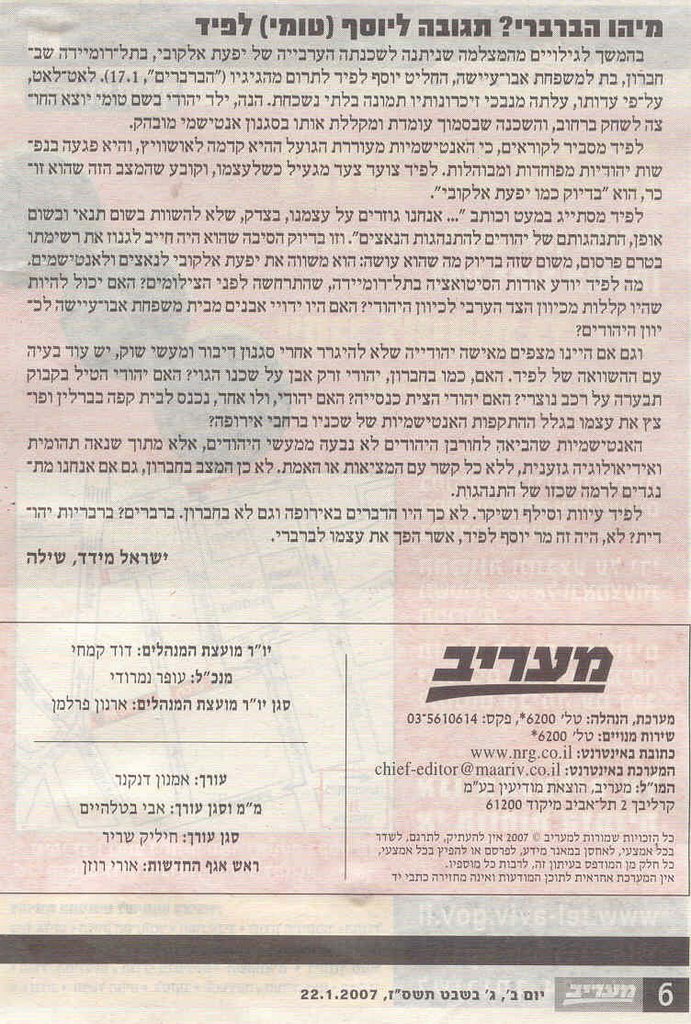
My Anti-Lapid Comment Printed in Maariv

In a previous posting (here), I lashed out, as is my wont, at Mr. Yosef (Tomy) Lapid. His comments, especially as head of Yad Vashem, on the Alkobi affair in Tel Rumeidah, were so off-base - not becuase of his political opinions about Jews and Arabs in Hebron, but because the parallel he drew with antisemitism and European antisemites was factually incorrect and basically evil.

Well, I sent in a long comment to Maariv hoping they'd print it as an op-ed but it appeared today as a long letter.

Here it is:-

Sunday, January 21, 2007

You Wanted To Know More About Borat (aka Sasha Cohen)?

From the London Times:-


Baron Cohen was born in 1971 into a middle-class Jewish family, one of three sons (one of his brothers wrote the music for Borat). His father runs a menswear shop and his maternal grandmother trained as a ballet dancer in Nazi Germany. She fled in 1936 to Israel, where she set up a fitness centre. “She was the last Jewish girl to be taught ballet in Germany,” says her grandson.

Religion is observed in the Baron Cohen family but does not dominate. “I wouldn’t say I am a religious Jew,” he told NPR. “I am proud of my Jewish identity and there are certain things I do and customs I keep.”

It’s what you might call Church of England Jewish: he tries to keep kosher and attends synagogue about twice a year. Where possible he goes home on Fridays to observe the Sabbath with his family. Not that he gets home very often. He lives in Los Angeles with his fiancée, the Australian actress Isla Fisher (perhaps best known as Shannon from Home and Away).

It was thanks to one Jewish tradition that he got his first taste of showbiz: his breakdancing group provided the entertainment at his bar mitzvah. “As a kid I was very into rap,” he told Rolling Stone. “I used to breakdance. Starting at the age of 12 my mother would take me and my crew in the back of her Volvo. We had the linoleum in the back, and she’d drive us to Covent Garden in the dead middle of winter. We’d pull out the lino and start breaking.

“Essentially we were middle-class Jewish boys who were adopting this culture, which we thought was very cool. That was sort of the origins of Ali G.”

By then he had also discovered the joy of comedy. At eight years old he began a life-long admiration for Peter Sellers after seeing one of the Pink Panther films. Later his brothers sneaked him into a cinema — underage — to see Monty Python’s Life of Brian.

The embarrassing secret of the young breakdance posse was that they were actually pupils at Haberdashers’ Aske’s, a private school on the outskirts of north London. Baron Cohen left there to enjoy a gap year on a kibbutz and then went on to study history at Cambridge, where he wrote a dissertation on Jews in the US civil rights movement, joined the Footlights and honed his acting skills in less conventional ways.

“I started developing characters partly as a way to get into places without paying,” he says. “At Cambridge there was something called the Cambridge balls, which at that time cost about £120 per head. I would try to get myself and other people in pretending to be the band or something. I remember when I came to New York at the age of 23 me and my friends would get into clubs claiming we were bouncers or drug dealers.”

On graduating from Cambridge he gave himself five years to make it in show business before getting a proper job, probably training as a barrister. He found work on an obscure satellite station before moving to London Weekend Television, where he credits director Mike Toppin — a veteran of Ealing comedy — with encouraging him to develop comic characters.

The first was MC Jocelyn Cheadle-Hume, an Ali G-style figure loosely based on the Radio 1 DJ Tim Westwood, who affects a gangsta rapper style despite being white and the son of a bishop.

- - -

The success of Borat now means that Baron Cohen will have to rethink his comedy style. “It has been a total disaster,” he says. “It has totally destroyed any opportunity for me to make a film like this again. I am going to have to start doing my scripted comedy.”

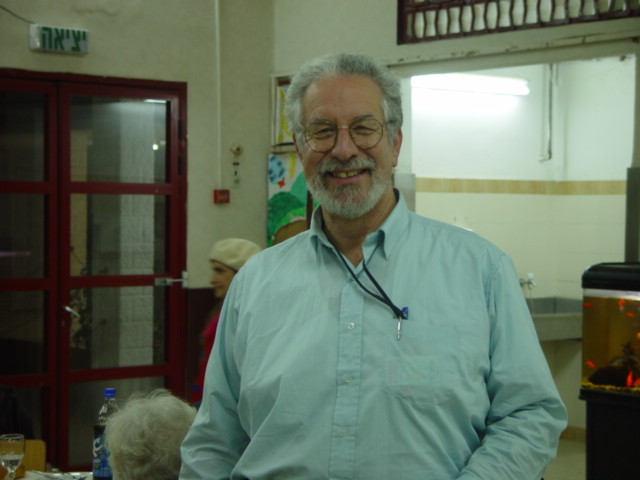
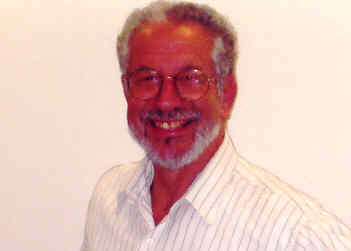
A Recent Me


At the 60th birthday party of my fellow high school classmate.


Previous post here.

It's Offical - Kvetch

January 21, 2007
On Language
Kvetch
By WILLIAM SAFIRE


“Republicans,” wrote Mark Leibovich and Anne Kornblut in The Times, “suddenly facing a minimum two-year sentence out of power, coalesced around a message of kvetching.”

“It’s not whining,” insisted Representative Pat McHenry of North Carolina, irritated at the way Democrats were driving the early legislative agenda without permitting Republicans to utter a peep (much as the G.O.P. members did when they were in the majority). “It’s a matter of calling them out on their rhetoric.”

The use of kvetching in The Times not as a part of a quotation — nor, for that matter, within quotation marks to indicate a slang or dialect expression — is clear evidence that the word has been absorbed into the English language. Merriam-Webster’s 11th Collegiate defines the verb kvetching as “to complain habitually”; it appeared in its citation files in 1952, the same year as its near-opposite, kvell, “to be delighted,” from the German quellen, “to gush, swell,” in most cases with pride. But within a decade, the grim kvetching, unlike the joyous kvell, made it as a noun.

It met a linguistic need that reflects the temper of contentious times: a kvetching is not merely “a complainer, nag, sulker, grumbler, grouser, griper, whiner, moaner” or the more formal “malcontent.” Like most words imported to convey an especially vivid feeling, kvetch seems to sound like the quality it describes in a person. There is a lower-lip-biting itchiness to it; extended exposure to someone who is a kvetch may be subliminally related to the rhyming retch, or at least evokes the urge to spew out the onomatopoeic imprecation yecch!

Usage of the word in all its forms — verb, participle, now strongly noun — has been assisted by “Born to Kvetch: Yiddish Language and Culture in All of Its Moods,” by Michael Wex, and by what is described as “a music/comedy CD” by Freddy and the Froy Boys titled “Kvetch 22,” the name a pun on the unforgettable name of the 1961 novel by Joseph Heller. If The Times is willing to adopt this Yiddishism as both verb and noun (from kvetshn, from the German quetschen, literally “to squeeze, pinch,” the feeling you get from extended exposure to a kvetching), it is a breakthrough for color in reportage. Makes every language maven kvell.

Friday, January 19, 2007

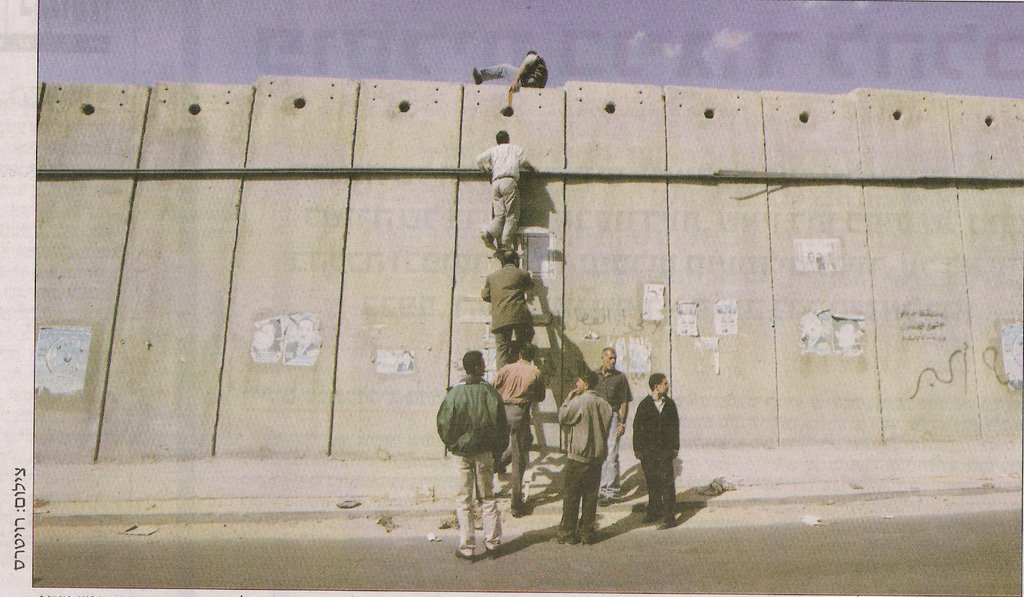
Do You Feel Safer and More Secure Now?


Pals. displaying the efficiency, effectiveness and efficacy of the Barrier.

A Blogger Should Merit Solidarity

An Egyptian blogger, Abdel Kareem Nabil, went on trial in Alexandria on charges of insulting Islam, inciting sedition and insulting the president through his Internet writings. It is Egypt’s first prosecution of a blogger. Mr. Nabil often denounced Islamic authorities and criticized President Hosni Mubarak on his Arabic-language blog. He has been in detention since November and faces up to nine years in prison if convicted.


Anyone seen any sympathy support movement gathering steam?

Ah, here's one.

UPDATE

Here's the proactive site of support.

And here's an example of his opinions:

The Muslims have taken the mask off to show their true hateful face, and they have shown the world that they are at the top of their brutality, inhumanity, and thievery. They have clearly shown their worst features and have shown that in dealing with others they are not governed by any moral codes.

From what I have seen yesterday of the events at Maharram Beh, which were quite shameful, and have shown me more facts that they have tried to cover over the centuries.

They have indicated that Islam is a religion of peace and forgiveness, but their true face has been uncovered to show barbarism and thievery and fanaticism and not acknowledging others, and attempting to remove them from existence.

Some may think that the actions of the Moslems does not represent Islam and has no relationship with the teachings of Islam that was brought by Mohamed 14 centuries ago, but the truth is that their actions is not different from the Islamic teachings in its original form when it has urged people to deny others and hate them and kill them and take their property, things that they know well but they try to deceive people by falsely defending the teachings of Islam by extremists and they are hiding from the truth and they prefer living a lie
.


His blog, Arabic and English combined.

A Matter of Democracy

I don't think I've mentioned here at the blog that I have returned to post-graduate studies and am doing a MA in Political Science at the Gilo Center for Citizenship, Democracy and Civic Education at the Hebrew University of Jerusalem.

This item is then quite relevant:-

Ambush Kills an American Teaching Democracy to Iraqis

Details:-

An American woman killed here on Wednesday when gunmen fired on her convoy of vehicles was ambushed just minutes after leaving the headquarters of a prominent Sunni Arab political party, where she had been teaching a class on democracy, party members said Thursday.

They said the woman — Andrea Parhamovich, 28, of Perry, Ohio — left the party’s fortified compound in western Baghdad around 4 p.m., heading east to her group’s offices outside the Green Zone, when she and her armed guards came under attack from all sides...during the fierce firefight, guards tried to escape, fought back, then called for reinforcements from other private security contractors.

The attackers — perhaps as many as 30 men, according to witness accounts passed on to Mr. Campbell — used heavy weapons, possibly rocket-propelled grenades, destroying the armored sedan that Ms. Parhamovich was in and killing three of her armed guards: a Croatian, a Hungarian and an Iraqi. Two other security contractors were wounded. The attackers then scattered back into the neighborhood...Ms. Parhamovich [w]as a driven young woman, inspired by politics and a desire to help Iraqis connect with their newly elected government.

He said she joined the National Democratic Institute, a nonprofit organization based in Washington that has worked in Iraq since 2003, after working for a few months with a similar group in Baghdad.


The NDI, by the way, has Madeline K. Albright as its president.

And it has a program in the "West Bank & Gaza".

And what is their Program Overview in this area of the world?

NDI provides training and support to democrats and civic organizations throughout the West Bank and Gaza. Through cooperation with local partners, NDI programs aim to enhance multiparty pluralism by providing assistance to democratic political movements, to ensure free and fair elections through monitoring and observation, and to enhance political competition and representative governance through trainings in campaign organization and platform development.

The recent municipal and presidential elections provided important opportunities and training for NDI's political party partners. The development of Palestinian political parties, which includes the active participation of women activists, is a long-term endeavor. The elections of the past two years provided Palestinian political parties with meaningful opportunities to reengage with one another, reinvigorating the political process and furthering party development.

Throughout the elections, NDI conducted a variety of campaign schools and consultations that concentrated on applicable skills such as: organizing a campaign team, building a field organization, campaign planning, targeting and research, developing and implementing a voter contact strategy, communications strategies, selecting and preparing candidates, and fundraising. Additionally, NDI provided training programs in campaign management and candidate training for the 2006 parliamentary elections.


But, what to do -

Despite the existence of multiple political parties, Palestinian society remains largely polarized between the ruling Hamas movement and its foremost rival, Fateh. During the January 2006 parliamentary elections, Hamas upset decades of Fateh political dominance when it won 74 out of 132 seats in the Palestinian Legislative Council (PLC). The broader international community has refused to recognize Hamas's control over the Palestinian Authority (PA), since the party does not recognize Israel and has refused to renounce violence as a means to achieve political goals. Fateh, whose leadership recognizes Israel, forswears violence, and endorses preexisting agreements, remains notorious among Palestinians for endemic corruption and ineptitude. Tension between the two parties remains high and eclipses smaller, reform-minded parties eager to initiate progressive policies.


I hope my academic grounding in democracy education will prove to be more adept at fixing the world.

Thursday, January 18, 2007

Art Buchwald's Final Column

Art Buchwald, who died last night at age 81, was one of the icons of any aspiring writer who sort the crave a niche in the political-satire-humor section of penning one's way to fame.

His leg had been amputated due to his health problems and he had decided not to continue dialysis last year and moved into a hospice expecting to die within a few weeks. He then began to receive a stream of big-name visitors and old friends, reminisced about life and ended up writing a book about the experience, "Too Soon to Say Goodbye," which was published in November and included eulogies that friends had planned to deliver at his expected funeral a year ago.

Here's his final column which he wrote on February 8, 2006 but which he asked not be distributed until after he died.

***

GOODBYE, MY FRIENDS

By Art Buchwald

Several of my friends have persuaded me to write this final column, which is something they claim I shouldn't leave without doing.

There comes a time when you start adding up all the pluses and minuses of your life. In my case I'd like to add up all the great tennis games I played and all of the great players I overcame with my now famous "lob." I will always believe that my tennis game was one of the greatest of all time. Even Kay Graham, who couldn't stand being on the other side of the net from me, in the end forgave me.

I can't cover all the subjects I want to in one final column, but I would just like to say what a great pleasure it has been knowing all of you and being a part of your lives. Each of you has, in your own way, contributed to my life.

Now, to get down to the business at hand, I have had many choices concerning how I wanted to go. Most of them are very civilized, particularly hospice care. A hospice makes it very easy for you when you decide to go.

What's interesting is that everybody has his or her own opinion as to how you should go out. All my loved ones became very upset because they thought I should brave it out -- which meant more dialysis.

But here is the most important thing: This has been my decision. And it's a healthy one.

The person who was the most supportive at the end was my doctor, Mike Newman. Members of my family, while they didn't want me to go, were supportive, too. But I'm putting it down on paper, so there should be no question the decision was mine.

I chose to spend my final days in a hospice because it sounded like the most painless way to go, and you don't have to take a lot of stuff with you.

For some reason my mind keeps turning to food. I know I have not eaten all the eclairs I always wanted. In recent months, I have found it hard to go past the Cheesecake Factory without at least having one profiterole and a banana split.

I know it's a rather silly thing at this stage of the game to spend so much time on food. But then again, as life went on and there were fewer and fewer things I could eat, I am now punishing myself for having passed up so many good things earlier in the trip.

I think of a song lyric, "What's it all about, Alfie?" I don't know how well I've done while I was here, but I'd like to think some of my printed works will persevere -- at least for three years.

I know it's very egocentric to believe that someone is put on earth for a reason. In my case, I like to think I was. And after this column appears in the paper following my passing, I would like to think it will either wind up on a cereal box top or be repeated every Thanksgiving Day.

So, "What's it all about, Alfie?" is my way of saying goodbye.

Soccer is a Jewish Sport, No?

Plotz Like Beckham

Soccer Jews of New York in World Cup Frenzy; Luftmensch Wingmen: Stewart, Foer, Hirshey, Mass White-Collar Exodus to Watch U.S. Flop

By Lizzy Ratner

David Hirshey, soccer fan, HarperCollins heavyweight and regular Jewish mensch, had taken the better part of the afternoon off from work. So had such landsmen as Little, Brown editor in chief Geoff Shandler, author David Friedman and Gui Stampur, a former Columbia soccer captain with a wiry frame and European hair.

It was approaching noon on Monday, the fourth day of the international sweat fest known as the FIFA World Cup, and the four men had gathered with a minion’s worth of other literary types at an Irish joint called the Playwright Tavern. Mr. Hirshey had invited them there for a kind of ritual watching of the first United States game, an anticipated if uneven matchup against the Czech Republic. On normal occasions, these men would never take an afternoon off for the home team—what home team?—but the World Cup inspires strange fits of passion and patriotism in even the soberest of soccer fans. So they slapped each other’s backs and ordered up drinks and awaited the first kick with the high spirits of yeshiva boys ogling a shiksa.

But six minutes into the game, just after the towering Czech striker Jan Koller headed the ball into the American’s under-guarded goal, the projection TV went dead. “Noooo!” shouted the fans, before launching into a din of grumbles and moans and the occasional “Kill Hirshey!”

“This reminds me of my daughter’s bat mitzvah, when the rabbi showed up late,” said Mr. Hirshey. “I had all these people sipping Manischevitz and eating pigs in the blanket.”

Laydees (and gents), meet the Soccer Jew, that intellectual, kvetchy, Granta-reading guy who also happens to possess an encyclopedic knowledge of Ronaldinho’s every kick. With one foot planted firmly in the nerd camp and at least a few toes dangling in the jock sphere, he is the strange, hybrid Creature of the Moment. He is Mr. Friedman and Mr. Hirshey, as well as late-night hero Jon Stewart, former Cosmos goalie Shep Messing and Nixon-era powerhouse Henry Kissinger (though, politically speaking, Mr. Kissinger resembles less a liberal-leaning Soccer Jew than a conservative golf-club goy). Perhaps the Soccer Jew’s most abiding characteristic is that he never roots for Germany.

Up until recently, the Soccer Jew was a rare and unfamiliar being, ignored by sports-page editors and scorned by the average beer-guzzling sports fan. He practiced his soccer worship in solitary anonymity. But with this year’s World Cup, with the advent of soccer parties and power blogs and a small pantheon of celebrity soccer bochers, his moment seems to have arrived. These are his Days of Awe.

“It’s considered a fashionable sport again,” said the mustachioed Mr. Hirshey, who came dressed for the game in khaki shorts, a black polo and New Balance sneakers. “It was fashionable in the late 70’s, and now, after almost 30 years, it’s somehow reignited again in a different generation of fans.

“Now it constitutes this entire movement,” he added. “It’s like Purim, only 10 times better.”

Mr. Hirshey is widely considered the Grand Rebbe of the New York Soccer Jew movement, a diehard from an earlier era who can still remember those glorious 1970’s days when Pele tore up turf for the New York Cosmos. Heck, he used to hang with him at Studio 54. Back in those days, Mr. Hirshey was a young reporter for the Daily News, living out every fan’s fantasy during what turned out to be the golden age of professional American soccer. When that hazy disco moment ended, he refused to give it up. Instead, he held on, writing books, coaching teams and, in a rather un-Jewish move, converting friends like New Yorker scribe Jeffrey Toobin and VH1 exec Michael Hirschorn to the religion of soccer.

Now, to his glee, a new generation of soccerniks is on the rise. These are men in their 20’s and 30’s, like Mr. Stampur, as well as The New Republic’s boy-editor Franklin Foer and Slate’s deputy editor David Plotz. Raised in the post-Pele moment, this new Soccer Jew grew up dribbling, kicking and scrimmaging his way across the soccer field, or at least knowing kids who did. For him, it was a bona fide high-school sport—and, as important, one that his overprotective mother would actually let him play.

“I played [football] for a little while, but … it was a violent sport, so my mom didn’t want me to play it,” said Ethan Zohn, a Vassar-educated former soccer pro who played for, among others, the 1997 and 2001 U.S. National Maccabiah Team. Of course. “And then I broke my collarbone, so she was like, ‘No, I don’t think so.’”

In 2002, Mr. Zohn, 32, achieved mild fame when he became the last man standing on Survivor: Africa—a triumph that earned him $1 million and a place in the ranks of the growing Soccer Jew subcategory, the Hot Soccer Jew. It was a distinction that the curly-haired soccernik would have thought impossible back when he was still a prepubescent goalie with “big glasses, braces and a mustache.” (The mustache, he said, was because his father refused to let him shave before his bar mitzvah out of some superstitious fear that he wouldn’t grow if he did.) “It was not a pretty sight,” said Mr. Zohn.

But in a way, isn’t that the whole point of the Soccer Jew? The unexpected mix of bookishness and sportiness? Awkwardness and wit?

Perhaps no one captures this better than Jon Stewart, jokester, media mensch and devout soccer fiend. Long before he emerged as the wise-cracking icon of the liberal set, Mr. Stewart spent four years as a wing for the College of William and Mary soccer team—a fact that might just make him the Moses of the Soccer Jews. To this day, the team still hands out an award called the Liebo (Mr. Stewart’s pre-celebrity name was Liebowitz) in honor of the old team cutup.

(It’s worth noting that David Beckham, the golden-calved British soccer god, reportedly has a Jewish grandfather and was raised “somewhat Jewish,” according to one Web site. By some definitions, this might in fact make him the greatest living Soccer Jew. But does a man who is married to Posh Spice really have enough of a sense of irony to be a Soccer Jew?)

TO THE ENDURING FRUSTRATION OF SPORTY JEWS, the People of the Book have long been perceived as a decidedly unathletic type. The Nazis and their sundry vicious spin-off movements certainly promoted that stereotype during the 20th century, but Jews themselves have long traded in the nebbish shtick. Never mind Woody Allen; among the first pieces of modern Jewish literature is Der Ershter Yidisher Rekrut (early-mid 19th century), the story of a bumbling army recruit who “can’t do anything right,” said Yiddish translator and scholar Michael Wex.

“[Jews] weren’t perceived as being athletic, as being outdoorsy,” said Mr. Wex, whose recent book, Born to Kvetch, chronicles one of the few acknowledged sports in which Jews have excelled. “Remember, they weren’t farmers, for the most part. They had indoor occupations …. And among more religious people, they just figured [sports were] a waste of time and they tended not to do it.”

For all this, there is a surprisingly rich soccer tradition among recent generations of European and Eastern European tribesmen. Old-country Jewish culture tended to reflect the sporting habits of the “host” country, said Mr. Wex, and by the early 20th century, Europeans were all about that raucous, hands-free game with the funny shoes and fast-moving ball. One by one, Jewish soccer leagues began cropping up across the shtetl-scape, many of them a deliberate rebuke to that persistent stereotype of the nebbishy Yid. Many of the leagues were Zionist; a few even managed to produce a serious athlete, like the famed Danish brothers—and geniuses—Neils and Harald Bohr. (A Jew named Neils? … Never mind.) When Jews began fleeing Europe, they took the leagues with them, planting them in the soil of their adoptive countries.

“The game has soaked into our genes,” said Roger Bennett, a British transplant who grew up cheering the blue-colored shirts of Everton and just completed a documentary about soccer and Israel called Sons of Sakhnin. (His other claim to fame is that he co-edited the instant kitsch classic Bar Mitzvah Disco.) “Our European routes come seeping through via tales of grandpas who played against the Pope in a Polish village, or of our families being forced to run in the face of marauding Cossacks and being able to take only their most valuable possessions.

“The hockey pads and stick were too cumbersome to schlep,” he added wryly, “but the soccer ball fit into the samovar just fine.”

Over in the United States, the beautiful game didn’t take root so much as incubate, flaring up here and there every generation or so like some strange dribbling cicada. For Mr. Hirshey, for instance, the passion was passed down Dor-leDor style through his father, a Lithuanian immigrant who played competitive soccer back in the old country and wanted his son to “experience the joy he did,” said Hirshey the younger. “I spent hours learning to spin an in-swerving corner kick as expertly as I learned to spin a dreidel.”

He also learned to run, a skill, he said, that might explain the Soccer Jew’s attraction to the sport as much as any. “One of the reasons that Jews gravitate to soccer is that we have to run to survive, so we have to get very good at running,” Mr. Hirshey explained in his rabbinic baritone.

But even among those who had no soccer-star dad, where there was no latent impulse to bounce a whizzing inflated ball off one’s head, there were other, perhaps equally Jewish reasons for the love of the game. Mr. Foer, for instance, is the first to admit that the dribbling gene didn’t make it into his DNA. But what ancestry couldn’t provide, a culture of, say, studiousness helped create.

“I think that nerdy kids have a classic response to their sporting disasters as kids: What they can’t master physically they try to master intellectually, and certainly that’s the case with my soccer experience,” said Mr. Foer, whose 2004 book, How Soccer Explains the World: An Unlikely Theory of Globalization, is a clear testament to that impulse. “I think a lot of it is, the thrill of soccer, to me, was like the thrill of opening up an atlas, where you were exposed to all these foreign countries, foreign names—and that was the appeal.”

Soccer Jews are big on geopolitical analyses of the game (though they also tend to deny that it is a particularly “intellectual” one). Much like that earlier generation, the Baseball Jews, they enjoy the chatter around the sport almost as much as they enjoy the sport itself, though there is a key difference: While baseball is the American-as-apple-pie game of assimilation, soccer is a post-assimilation sport (in the U.S., at least, if not the rest of the world). It’s about internationalism, and daring to enter a world where anti-Semitism is still raw, as the presence of protesting neo-Nazis at this year’s tournament has shown.

“It’s been a way of resisting assimilation, because it’s always been such a foreign phenomenon in the country,” said Mr. Foer. “If you’re born in the 1970’s, I think you feel pretty comfortable being an American and being an American Jew … and in that way, it becomes a lot easier to embrace something like soccer, which is not the most American of sports.”

This kind of self-conscious chatter is common in this season of high-intensity soccery, particularly on the various invite-only World Cup blogs, like Mr. Foer’s the Goal Post, which read like Talmudic commentaries on every team, player, kick and tumble of the tournament. Call them virtual soccer yeshivas (they even don’t let in girls!). On these blogs, soccer fiends can proffer their theories, indulge their brainy urges and yet still be guys, which is perhaps the ultimate sign of the Soccer Jew. They can be dorky and sporty all at once.

Both of these qualities were on display at the Playwright Tavern, as Mr. Hirshey and his fellow Soccer Jews (and a gaggle of non-denominational fans) watched the first U.S. game on a small TV, barely three soccer balls wide. For 90 minutes, they gasped and squirmed as the U.S. struggled—or was it that they didn’t struggle?—against the Czech machine, finally succumbing to a humiliating 3-0 defeat. When the game ended, they kibitzed mournfully and then shuffled quietly off to work, just like their zaydes in generations past.

Said Mr. Hirshey: “I’ll be sitting shiva tonight for the U.S. team.”


P.S. Beckham is Jewish.

BBC Blasted

From Daniel Finkelstein's column in the London Times:-

My old barber is as biased as the BBC

I used to have an angry barber. How’s that for an enticing piece of information? Anyway, every time I went to have a haircut, the man with the scissors was seething. It was the situation in Cyprus that had got him going and he was sure to tell me all about it. I was constantly reminded of Enoch Powell, who, when asked how he would like his hair cut, replied “in complete silence”.

After a few cuts my barber realised that I worked in politics and kept trying to enlist my help. But there was a problem. I am sure that on my first visit he had told me, but I remained unclear whether he was a Turkish Cypriot or a Greek one.

...For years I’ve been relating my barber story to Jewish audiences. I explain that for most people the dispute between the Israelis and the Palestinians is like that between the Cypriots. It’s a complicated row between two sets of foreigners making competing claims that are hard for anyone except an expert or a participant to evaluate.

For years that didn’t matter much. A few overexcited people (mark me down as one) arguing about a country the size of a pocket handkerchief somewhere miles away. Israel, Shmisrael. Who cares?

But now things are different. A few days after 9/11 I watched a television reporter wandering through a street in the Israeli capital. He was telling viewers: “I am here in Jerusalem where it all began and where it will all have to end.” That remark, hotly though I might dispute it (9/11 did not start there and won’t end there), has become the consensus — the road to peace in the world runs through Jerusalem.

And for that reason all those obscure little arguments, all those tit-or-tat arguments between indistinguishable groups that used to seem so boring, are now of first-rate political importance. It really matters whether people understand enough to form a view of their own.

Which brings me to the BBC. Unlike a lot of columnists, I like the BBC. I think its reporting is generally excellent, its news programmes are of high quality and its foreign correspondents are usually both brave and illuminating. Although the corporation can be high-handed in dealing with complaints (the theory that if both sides complain they must be getting something right is absurd) I think its staff does genuinely wish to be politically unbiased.

If only they always knew how. For on Israel, they (not everyone, of course, but too many reporters and too often) sadly get it wrong over and over again. They mistake reporting equal numbers of deaths from both sides with giving people a complete appreciation of the arguments involved. They tell you how, when, who and how many. All this is balanced. As to why, you are often left with a very one-sided view.

Let me provide an eloquent example. One of the biggest stories in the Middle East is the civil disorder in Gaza. Last week on his website, the journalist Stephen Pollard reproduced an internal memo from the BBC’s Middle East editor, Jeremy Bowen, to his colleagues. It contained a passage in which Bowen explains “the way that Palestinian society, which used to draw strength from resistance to the occupation, is now fragmenting.

“The reason is the death of hope, caused by a cocktail of Israel’s military activities, land expropriation and settlement building — and the financial sanctions imposed on the Hamas-led Government which are destroying Palestinian institutions that were anyway flawed and fragile.”

Now this is certainly one explanation of the reason why members of Fatah and Hamas are killing each other. No one can object that this argument is put before the BBC’s audience. But for the BBC’s Middle East editor to believe that it constitutes the sole explanation and to offer it up alone to his colleagues? Now that’s a different matter.

Here are a few alternatives to Bowen’s offering. Some of us argue that instead of the tough Israeli security measures causing Hamas and Fatah militants to kill people and each other, the killing of people by Hamas and Fatah militants causes the tough security measures. Hamas in particular is a dangerous, intolerant, murderous organisation that threatens the lives of innocent people and needs to be resisted.

And what about this? Fatah and Hamas are engaged in a power struggle and an ideological dispute. Fatah claims that its rivals have been plotting to assassinate President Mahmoud Abbas because the President supports the so-called Prisoners’ Document. This document proposes a unified resistance to Israel, but Hamas is suspicious of the terms of such unity and believes that its vague language could mean recognition of Israel.

Or this? In a superb column last week in the Financial Times, Christopher Caldwell pointed out that are there are 67 countries in the world where 15 to 29-year-olds make up more than 30 per cent of the population and 60 of them are undergoing some sort of civil war or mass killing. Gaza has just such a youth bulge. Perhaps the violence has no political cause; it is just, well, boys being boys.

I know, I know. You may regard these alternatives as absurd, even offensive. I don’t, but that’s not my point. If you want to report the Middle East in an unbiased fashion, then these arguments must be put before the BBC audience. And how can they be if the Middle East editor doesn’t even acknowledge them? People rely on the BBC. They can’t just get another hairdresser.

Disaster Interactive Map

Did you know that the Hungarian National Association of Radio-Distress Signalling and Infocommunications has a great disaster map?

Check it out (and keep scrolling down for all info).

I mIssed This Onion Satire Piece

Israel Bombs Anti-Semitism Out Of Lebanon

December 18, 2006 | Issue 42•51

After decades of periodic conflict with Lebanon that cost thousands of lives, Israel successfully eradicated all traces of anti-Semitism from its northern neighbor with a series of heavy bombing attacks in July.

"Israel really turned us around on the whole Jew-hating thing," said Hezbollah leader Sheikh Sayyed Hassan Nasrallah, shortly after a U.N.–brokered ceasefire was declared on Aug. 14. "After destroying much of our infrastructure and displacing nearly 1 million civilians, we've come to respect Israel as a legitimate power and a beacon of democracy, and not a pack of lying, usurping, hook-nosed dogs."

The last-ever Israel–Lebanon conflict began on July 12, when Hezbollah militants launched Katyusha missiles into Northern Israel, killed three Israeli soldiers, and kidnapped two others. Despite this initial success, Israel eventually prevailed in ridding the majority-Arab nation of a pervasive prejudice, the roots of which extend to Phoenician times.

Many in the international community were greatly surprised by the development. "We assumed this was just another regional war of attrition, a short-term, semi-effective defensive measure at best, a conflict-feeding 'eye for an eye' tactic at worst," French Foreign Minister Philippe Douste-Blazy said. "But we see that we were being far too cynical. It's basically resolved now."

Strobe Talbott, president of the Brookings Institution, a Washington–based think tank, said that there was "very strong" evidence that not only was a virulent anti-Jewish sentiment completely wiped out in Israel's bombing campaign against Lebanon, but so was any hard-line political opposition to Israel's existence or its annexing of the West Bank, Gaza Strip, and Golan Heights following the Six-Day War in 1967, and general anger over Israel's treatment of Palestinians.

"It's remarkable to think that, had Hezbollah been capable of making surgical pre-emptive strikes against Israeli military installations and densely populated urban centers, Israel would most likely be renouncing Zionism and abandoning the region at this very moment," Talbott said in August.

The bombings have had the most significant impact on Lebanon's youth. Many who saw parents and friends killed in the attacks said they will now spend the rest of their lives supporting Israel.

"I was upset at first when a bomb destroyed my school and killed many of my schoolmates and left me without legs," said Tyre bombing victim Sherifa Ayoub, 14, as she wheeled down her rubble-strewn street. "But as the days went on, and the bombs continued to fall, I began to realize that I had spent my whole young life arbitrarily lashing out at a people I thought I hated, when, all along, what I really hated was myself."

Israel's crushing victory has led Talbott and other Mideast experts to speculate that the nation may go on to bomb the anti-Semitism out of such hostile neighbors as Syria, Saudi Arabia, and Yemen.

Yiddish in...India

Seems there's a bit of hullabaloo in Bollywood country.

Here's what I found at the BBC:-

Bollywood filmmaker Mahesh Bhatt in Mumbai's DNA newspaper clearly thinks not.

"Why do we go on bended knees and lick their boots?" he asks.

"I believe no one can insult you without your permission. Shilpa Shetty has paid the price for trying to desperately seek the approval of the West."

"It is pathetic how we can go on bended knees and lick the boots of Westerners in an effort to be part of their world."

In its editorial, the newspaper said "Shetty has to find the attitude and the chutzpah to face the comments - racially pejorative or just downright bitchy - from her 'friends' in the house [because] Big Brother is all about running the other contestants down in order to get on top."


I didn't know what this was about but found this:-

Celebrity Big Brother contestant Shilpa Shetty has spoken for the first time of her fears she is a victim of racism.

After a row over stock cubes, the actress was comforted by fellow housemate Cleo Rocos who said: "I don't think there's anything racist in it."

But Shetty said: "It is, I'm telling you." Channel 4 has insisted there has been "no overt racial abuse".

Housemates Jade Goody, Danielle Lloyd and Jo O'Meara have been seen making fun of Shetty's accent.

On Monday night's episode, former S Club 7 star O'Meara reportedly suggested that Indians were thin because they were always ill as a result of undercooking their food.

The trio also complained that Shetty had touched other housemates' food with her hands.

Leo Sayer, who left the house last week, said the alleged bullies were "all being very stupid, but I think basically they are good people".

"I wouldn't put them down as nasty people," the singer told Capital Radio.

O'Meara was defended by her former S Club 7 band mate Bradley McIntosh, who said: "she's not racist".

But he admitted he was "kind of disappointed" in the singer, since she had once been the victim of bullying herself.

"Some of the things she's said, I've just thought: 'Oh my God, what have you said that for?'"