Showing posts with label binationalism. Show all posts

Wednesday, April 22, 2026

David Ben-Gurion Talking with Brit Shalom

David Ben-Gurion to the members of the binationalist "Brit Shalom" in November 1929:

"But if in your formula you want to establish the equal value of the land for Jews and Arabs, then you are again missing the point and distorting the truth. Israel for the Jewish people and Israel for the Arab people are not the same thing.

The Arab nation is holding a multitude of vast countries, whose area in Asia alone is about a third of the area of ​​all of Europe. The economic, cultural and political existence of the Arab nation, its national identity and statehood are not tied to and do not depend on the Land of Israel. Our country is but a small region in the vast and gigantic territory inhabited by Arabs – and, by the way, exceptionally sparsely. Only one fragment of the Arab people – perhaps seven or eight percent (if we consider only the Arabs of Asian countries), lives in the Land of Israel and is tied to it. This is not the case with the Jewish people.

For the entire Jewish nation – in all its generations and diasporas – this is the one and only land with which its fate and historical future as a nation are tied. Only in this land can it renew and sustain its own life, its national spirit and its unique culture, only here could it establish its sovereignty and state freedom. And whoever obscures this truth – determines the soul of the nation.

We are commanded to preserve the rights and equality of our Arab neighbors, but we would be lying to ourselves if we said that Israel is the same for the Arab people as Israel is for the Hebrew people. If this comparison is what the formula of binationalism refers to, then it is nothing but a distortion of the truth and a neutering of the purpose. Instead of this distorted formula, I say: Israel is destined for the Hebrew people and the Arabs who live within it."

Sounds like Jabotinsky to me.

^

Tuesday, January 18, 2022

Saluting Two Arab Palestinian Martyrs

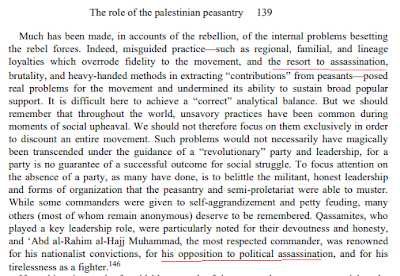
I found myself directed to Walter Laqueur's A History of Zionism, p 267, where he mentions two of the many assassinations of Arabs who opposed the Mufti Amin Al-Husseini, espeially if they were binationalists.

Jewish minimalists, after Brit Shalom, now the Ihud led by a ‘Committee of Five’ - Magnes, Szold, Buber, Smilansky and Simon, and other groups sought out a partner (see here for all the convoluted history).

Lacquer writes that "with the blessing of the Jewish agency", contacts were made by them with leading Arab personalities to find a common language. They met and talked and prepared more blueprints, only to realize in the end that in spite of all the outward civilities there was no common ground. 

On July 15, 1947, a binationalist testified to the UN Special Committee on Palestine that

Mr. COHEN (Interpretation from Hebrew): Concerning the question of the programme of the League, it was presented to you in the memorandum which was given before the hearing. This programme was crystallized after direct contact with certain Arab groups. These negotiations which have taken place between certain groups of Arabs and Jews have proved more than once that this programme has considerable chance of success, 

Success?

The Ihud found Fawzi Darwish Hussaini, a labor activist and a cousin of the mufti. He was willing to sign an agreement with his Jewish friends providing for a bi-national state based on the principle of no domination of one nation over the other. He suggested the immediate establishment of political clubs and a daily newspaper to combat the influence of the Arab war party. 

On 11 November 1946, five members of Young Palestine, Fawzi’s group, signed an agreement concerning common political action with Ihud representatives, but this promising initiative came to a sudden and tragic end. Twelve days later Fawzi was killed by Arab terrorists and his group dispersed. ‘My cousin stumbled and received his proper punishment’, Jamal Hussaini, one of the leaders of the extremist party, declared a few days later. 


Laquer goes on and relates that in September 1947, Sami Taha, a prominent Haifa trade resident, was killed. His society had declared itself in favor of a Palestinian, not an Arab state, acknowledging that Jews too had certain rights. He had become a target for extremists. 

More names:


They should be saluted, not as much as for their politics as for simply trying to be independent thinkers.

____________

UPDATED

Even the NYTimes knew, early on, of the Mufti's political assassinations of Arab rivals:


From THE ISRAEL/PALESTINE QUESTION
Edited by Ilan PappĂ© 


^


Friday, February 28, 2020

Bernie’s Kibbutz – A Research Challenge


As we know, the known extent of Senator Bernie Sanders’ Israel connection was a stay of a few months at Kibbutz Sha’ar HaAmakim in 1963. A report notes he was “a guest”. In other words, he may not have been a volunteer picking apples or pears but there was a specific reach-out, either by him or by the kibbutz or the Mapam Marxist party that supervised the affairs of the kibbutz, a member of Mapam’s Kibbutz Artzi Federation. But that is just a supposition. 

On the other hand, married couples usually did not come together as part of the ethos of going to kibbutz was the less-than-stringent sexual mores practiced at such places.

Perhaps either he or his then wife, Deborah Shiling now Messing, have friends or relatives there? It is claimed his older brother, Larry, was spending some time there. Had either of them been a member of the HaShomer HaTzair Zionist youth movement that commited its member to settle on kibbutz? If, indeed, his brother was there, perhaps he was in HaShaomer HaTzair and Bernie followed.

Sha’ar Ha’Amakim celebrated 25 years of its founder settling on the land and the headline of the article in the Mapam daily, “Al HaMishmar, of May 27, 1958, reviewing its history, read “25 Years to the Settlement”. As noted in The Forward, “The kibbutz founders had a strong admiration for the Communist system in the Soviet Union.”


But the author of that article, Aharon Cohen, adds another mystery to Sanders’ kibbutz stay. His biography includes several interesting aspects. He set up Hakibbutz Ha'artzi's Arab Department. Mapam advocated an undivided and Socialist Palestine and he went around lecturing and publishing articles in favor of good relations with Arabs. 

In 1942, he was responsible for having Mapam joining the League for Jewish Arab Rapprochement and Cooperation. In July 1947, he testified before the UNSCOP as the League’s official spokesperson and its secretary and got into an argument, demanding his right to read out a 20-page document that had already been presented to the committee members. As regards the territorial question of the future state of Palestine, Cohen added that “the relationship between Jews and Arabs and their problem has to be solved in a non-partitioned Palestine.”

Oddly enough, the English-language Wikipedia biography does not contain any reference to Cohen’s jail term. Details are in the Hebrew version.  And a Jake Pickering mentions the incident.


In 1958, he was arrested on suspicion of maintaining contact with a foreign agent, a member of the Soviet consular staff. He was charged with passing information and was sentenced in 1961 to a five-year jail term. He was pardoned and released early in 1963. Many believed he was simply continuing his pre-state idealistic vision, attempting to convince the Soviets that Jews and Arabs could reside peacefully in a bi-national state. Others, that Cohen was a victim of the GSS (then, the Shabak).

Could Sanders have been attracted by the affair? Did he come specifically to gain an impression of Cohen and his vision?

The research continues.

^

Wednesday, July 31, 2019

Shumsky's Fooling Us on Jabotinsky


The chapter on Jabotinsky permits a different reading from the usual interpretation. In 1906, at the Helsingfors Zionist Conference (which took place right after the failed Russian Revolution of 1905), Jabotinsky formulated a conception of minority rights based on the writings of Rudolph Springer (Karl Renner). In this conception, minorities would have full national autonomy to develop their character through separate cultural, educational, and legal institutions. Although these ideas were designed to reconfigure the Russian Empire along national lines, Jabotinsky saw them as applicable to any multicultural politic. Thus, he conceived of Jewish-Arab coexistence in the Ottoman Empire during the period of the Young Turk Revolution, and then in Mandate Palestine. Jabotinsky placed his stress on the development of the nation in concrete territory rather than the construction of a nation-state. In this interpretation, Jabotinsky showed himself as a believer in something like a binational Palestine in which the country would contain Arabs who would have equal civil and national rights, albeit as a national minority.

That is misleading.

Jabotinsky forcefully oppose binationalism (I have just translated two of his articles on the subject).

I also have posted on his famous 1940 article, "The Arab Angle - Undramatized". Here is a copy and the article begins on page 211.

His willingness to afford national minorities rights extended to the non-political for those who refused to see themselves as part of the political entity they resided in.

The Arabs, and others, were not nationalities but ethno-communitites.  And these are the areas of activity:

The following matters shall be delegated by the State to each ethno-community with regard to its members: 
(a) religion and personal status; 
(b) education in all its branches and grades, especially in the compulsory elementary stages; 
(c) public relief, including all forms of social assistance; 
(d) settlement of ordinary law cases arising out of the above-mentioned matters. 
3. Each ethno-community shall elect its National Diet with the right to issue ordinances and levy taxes within the limits of its autonomy, and to appoint a national executive responsible before the Diet. 
4. A permanent Minister of Cabinet rank, independent of all parties, shall represent each ethno-community in the country's government. 

And he added this:

Whether the Arabs would find all this a sufficient inducement to remain in a Jewish country is another question. Even if they did not, the author would refuse to see a tragedy or a disaster in their willingness to emigrate. The Palestine Royal Commission did not shrink from the suggestion. Courage is infectious. Since we have this great moral authority for calmly envisaging the exodus of 350,000 Arabs from one corner of Palestine, we need not regard the possible departure of 900,000 with dismay. The writer, as he has already said, cannot see any necessity for this exodus: it would even be undesirable from many points of view; but if it should appear that the Arabs would prefer to migrate, the prospect can be discussed without any pretence of concern.

Sorry, but he is reinterpreting Jabotinsky according to his own world-view.

Sunday, July 08, 2018

IfNotNow's Historical Roots - A Note

From "Central European Ethnonationalism and Zionist Binationalism" by Yfaat Weiss published in Jewish Social Studies, New Series, Vol. 11, No. 1 (Autumn, 2004), pp. 93-117:


and


Sound familiar?

^

Tuesday, June 11, 2013

Sand Is Running Out

Dmitry Shumsky has a "thing" for Ze'ev Jabotinsky. Shumsky, appointed to the Department of History of the Jewish People at The Hebrew University Jerusalem and a former Fellow of The Van Leer Jerusalem Institute, has been termed by David Myers (on page 397) as among the "post-post-Zionists" who seek to recontextualize Zionist history, being detached from the political ramifications of the "New Historians" and their research but seeking out "new angles of observation  that yield a more complex, fractious and multi-faceted picture of Zionism".  With others in Israel and abroad, this is a group, he writes, that reinterprets Jewish nationalism and does not see Zionism as fully triumphant in matters of Jewish nationalism.

This last February, he lectured at a Jewish Secularism conference at Tulane University on “Neither Pragmatism Nor Utopia: Vladimir Jabotinsky's Nationalitaetenstaat Political Zionism, and Its Eastern European Roots”.  You can hear him, in Hebrew, in this video.  And one of his many Hebrew op-eds is here;.


Jacob Tubi, noting himself in Haaretz as "a scholar of the Revisionist movement and of Ze'ev Jabotinsky", has attacked him for promoting Jabotinsky as a binationalist:.


...Dmitry Shumsky even seeks to recruit the founder and creator of the Revisionist movement, the progenitor of today's Likud movement, to this cause (“In rejecting Arab MK, Yair Lapid also rejects Jewish values,” February 3). To do so he makes use of two articles written by Ze'ev Jabotinsky on the issue, summing up the Revisionist leader's stance with a sentence from one of these articles that ostensibly argues that the future Jewish state “should be constructed legally as a ‘binational’ state.” From this sentence, especially in an age in which the judiciary determines the national character, it is a small leap to concluding that Jabotinsky was willing to have a binational, Arab-Jewish state in which both national identities were equal. (*)

But anyone who is deeply acquainted with Jabotinsky's thought and who studies these two articles knows that this Zionist leader certainly did not envision the “binational state” imagined by the contemporary proponents of the idea...Jabotinsky makes it clear that the Jewish demographic majority – a majority that the Jewish state will endeavor to establish and to maintain at all costs – will guarantee that the binational state will in effect be a “national state of the Jews.” This, because “the entire spirit of legislation, which tempers the lives of the inhabitants beyond the narrow preserves of school, religion, family and charity; the state's social discipline …all of the methods of agriculture, industry and commerce shall be marked by the stamp of the Jewish majority.” In this he included even the art created in the state. The Jewish character of the state will be so strong, wrote Jabotinsky, that non-Jewish characteristics will play only the tiniest role. He even went as far as to hope, or imagine, that the Arab majority, despite all the rights extended to it, would eventually assimilate within the Jewish majority, that is, to adopt the perspectives and habits characteristic of Jews and even to incorporate Hebrew into their daily language...

Of course, Jabotinsky opposed what today is understood as bi-nationalism.  He made fun of all "peace nowers" of his time.

Here's Jabo in 1930:

Some obstinate lovers of political twaddle come out, from time to time, touting again and again this panacea which must reconcile the Arabs with Zionism: the Bi-national State theory.

and
...Any Arab who has heard or is likely to hear about a bi-national constitution will immediately and instinctively, without any need for prompting or coaching by me, answer that it may all be very well
but quite beside the point. The only point is majority. Why, I have heard of Arab nationalists being quite prepared to offer us Jews all the guarantees of a bi-national regime provided we agree to remain arithmetically a minority.

and

To sum up the bi-national state trick is worthless

In any case, as for binationalism, Shumsky now attacks "Shlomo Sand’s false illusion" on the matter:

In the binational reality of Israeli society, the vision of a single Israeli nation-state is delusional.

The theoretical research philosophy of Prof. Shlomo Sand, which he has laid out in his three most recent books and also in an interview and op-ed in Haaretz, does not meet the empirical reality test of the phenomena of nations and nationalism...While Sands’ research insights have the most dubious scientific standing, his declared political intentions − undermining the exclusive reservation of sovereignty in Israel for one group of its citizens and endeavoring to transfer sovereignty to all the state’s citizens − are very admirable...[however the real problem is that]  Sand’s academic objectives and causes inestimable harm to promoting the advancing the idea of Israel as a state for all of its citizens...

...Israel’s civil community thus includes both the “individual” Jewish national community and the “individual” Palestinian national community. As such, the only realistic step that could further the building of the joint Israeli civil-political entity in practice is to validate, as part of the basic human rights of Israelis, the collective national rights of Jewish Israelis and of Palestinian Israelis.

But Sand, similar to the 20th-century Caananites, wants just the opposite. He completely severs Israeliness from its concrete, human manifestations − the Jewish and Palestinian national groups − thus leaving the concept “Israeli people” an empty category, detached from the concrete Israeli experience...In the binational reality of Israeli society the vision of a single Israeli nation-state based on the French model, which purports to inherit the unique identities of Jewish Israelis and Palestinian Israelis, is delusional.

Shumsky does have an option:

But there is a practical way to advance the idea of Israeli sovereignty of all citizens, and that is to strive to establish an Israeli federation and will agree to a covenant on the basis of joint Israeli citizenship, and out of the mutual recognition of the unique collective national rights of each group...It is clear that the Palestinian citizens of the state, who join together in a covenant with the Jewish citizens within the framework of the “Israeli federation,” will be required to yield a much larger emotional concession than the Jews.
...it is first necessary to abandon Sand’s false illusion, in which the idea of the Israeli state can be advanced only by wiping out the concrete national identities that compose Israeli society.

________________

(*)
The relevant extract from Shumsky:

Ze’ev Jabotinsky, undoubtedly a Jewish nationalist through and through, looked at the world around him, openly and without apology, through the prism of his Jewish national identity. An essential component of his Jewish national identity was his fight for the rights of the Jewish minority in czarist Russia. It was from his ongoing and open relationship with the memory of this Jewish past that Jabotinsky spoke of the rights of all minorities, no matter who they might be, as a sacred political principle. He felt that in a state where several minority groups lived, “multi-national equality should apply strictly to all races throughout the state, large and small alike, whether they made up 90 percent of the population or a tiny, scattered minority within it” (“The ‘bi-national’ Land of Israel,” 1930).

This statement shows Jabotinsky believed that the future Jewish state, in which two nationalities would always dwell, should “be constructed legally as a ‘bi-national’ state” (“On the Land of Israel as a ‘bi-national’ state,” 1926).

_________________

UPDATE

Sand responds.

Tuesday, February 09, 2010

Bi-Nationalism? Or Bi-Polar?

The American Task Force on Palestine – ATFP couldn't wait and here is the (English) translation by Zalman Amit and Daphna Levitt of Meron Benvenesti's essay in last week's Haaretz Magazine, on "The Inevitable Bi-national Regime" and here are excerpts:-


...The settlers argued that from the very beginning, Zionism flew in the face of reality. It succeeded, they said, precisely because it ignored reality. Therefore, the demographic and geographic arguments used against the settlers evaporated in the fervor of their fantasies.

Sometime in the late 1980s, the settlements crossed the critical threshold beyond which continued demographic and urban growth were assured...In the new paradigm the settlements no longer have importance as instruments of spatial control...The age of ideology is over and erecting settlements, as well as dismantling them, has become an outdated pastime with no real impact on political developments, except as a symbol and a mobilizing device for both right and left.

The attempt to mark the settlements—and the settlers—as the major impediment to peace is a convenient alibi, obfuscating the involvement of the entire Israeli body politic in maintaining and expanding the regime of coercion and discrimination in the occupied territories, and benefiting from it...Defining the territories as “occupied” is, in fact, an attempt to depict it as a temporary condition that will end “when peace comes,” and is designed to avoid resolving, “in the meantime”, immediate dilemmas. The term is a crutch for those who seek optimistic precedents...

...Fragmentation became the major tool of Israeli control, to preserve their rule over Israel/Palestine from the river to the sea. Fragmentation serves them as insurance against the “demographic threat” when, very soon, the Palestinians achieve a numerical majority in the region. The ruling Jewish community will continue, even when it becomes a minority, to force this split on the Palestinians...

...they are unwittingly assisted by leftist circles and the “Peace Camp” that remain steadfast to the romantic notion about a cohesive Palestinian people, united in its struggle for freedom...

The traditional Zionist stance of denying the very existence of a Palestinian nation cannot serve as a response to the Palestinian demand for self determination in the occupied territories. Still the Israelis seek to limit their conception to a mere quarter of Palestinians, those who live in the West Bank. For them they have invented a unique concept of a “state”...

Large segments of the Israeli “Peace Camp”, who staunchly believe in “Partition of the Land” as a meta-political tenet, are gratified; they believe that they won the ideological, historical, debate with the Right. Now they can load the entire Palestinian tragedy on an entity that comprises less than 10% of the area of historic Palestine. Moreover it is supposed to offer a solution to all refugees outside Palestine “who can return to the Palestinian mini-state”, and also provide remedy to the Israeli –Palestinians who can achieve their collective rights in the Palestinian State. Indeed, a cheap and convenient solution; after all, it is seemingly based on the venerable model of the “national conflict” and the classic solution of two states for two peoples...

The conclusion that Israel will continue to manage the conflict by fragmenting the Palestinians is realistic. The status quo will endure as long as the forces wishing to preserve it are stronger than those wishing to undermine it, and that is the situation today in Israel/Palestine...This status quo, which appears to be chaotic and unstable, is much sturdier than the conventional description of the situation as “a temporary military occupation” would indicate. Precisely because it is constitutionally murky and ill defined, its ambiguity supports its durability: it is open to different and conflicting interpretations and seems preferable to apocalyptic scenarios, therefore persuasive.

...more than forty years after Israel/Palestine became one geopolitical unit again, after nineteen years of partition. The term “de facto bi-national regime” is preferable to the occupier/occupied paradigm, because it describes the mutual dependence of both societies, as well as the physical, economic, symbolic and cultural ties that cannot be severed without an intolerable cost. Describing the situation as de facto bi-national does not indicate parity between Israelis and Palestinians–on the contrary, it stresses the total dominance of the Jewish-Israeli nation, which controls a Palestinian nation that is fragmented both territorially and socially...

After the 1967 war the Israeli political Right played with the concept of bi-nationalism, in the shape that suited its ideology (the Autonomy Plan). Likud ideology rejected the” transitory” nature of Israeli occupation but its belief in “Greater Israel” clashed with the demographic reality, and liberal circles in Likud (led by Menachem Begin) struggled with the famous dilemma: a Jewish or democratic state? Begin’s answer was based on the (failed) system known to him in Eastern Europe after WW1—non-territorial, cultural and communal autonomy for ethnic minorities under the League of Nations minority treaties. Begin’s Autonomy Plan had been modified in the Camp David (1978) accords and territorial components were added. The Oslo model used many components (with major changes) of Begin’s Autonomy Plan, and the Oslo accords can be viewed as bi-national arrangements, because the territorial and legal powers of the Palestinian Authority are intentionally vague; the external envelope of the international boundaries , the economic system, even the registration of population, remained under Israeli control. Moreover, the complex agreements of Oslo necessitated close cooperation with Israel which, considering the huge power disparity between the PA and Israel, meant that the PA was merely a glorified municipal or provincial authority. So, in the absence of any political process, a de-facto bi-national structure, was willy-nilly, entrenched.

...bi-nationalism is not a political or ideological program so much as a de facto reality masquerading as a temporary state of affairs. It is a description of the current condition, not a prescription.


There's a lot to discuss and argue about but nevertheless, there is a convergence of left-right herein which should lead to more sensible planning based not only wushes but probabilities.

Monday, August 11, 2008

And If We Don't Award It?

"If Israel continues to reject our propositions regarding the borders [of a future Palestinian state], we might demand Israeli citizenship," top Palestinian negotiator Ahmed Qurei (Abu Ala) was quoted


And who says you'll get it?

Why not ask for Jordanian citizenship?

And this:

A top negotiator said on Sunday Palestinians may demand to become part of a binational state with Israel, if the Jewish state continued to reject the borders they propose for a separate country.


Some people think

"Awarding citizenship can only take place at the end of a successful integration process, certainly not at the beginning. The state cannot offer citizenship as a concession."


How many could pass a citizenship course like this?

Naturalization is not that easy. Even Bahrain is problematic. Canada also.

Wednesday, February 28, 2007

Self-Destructive Democracy in Action

Unlike most other blogs I see, my blog is, shall we say, pithy and concise.

I take it for granted that all I need to do is make a short introduction, point you in the right direction, show you the 'evidence' and more or less, ask you to draw the conclusion that is the obvious one.

Of course, if you need any more info, you can always comment or write to me.

I hope you don't mind this way of blogging. I assume you have the sense to realize what I realize from most of my postings, that logic and reasonableness are not quite that self-evident amdist the issues I deal with.

I presented you the document in question below earlier and here's a follow-up story:-

Noted Arab citizens call on Israel to shed Jewish identity

A group of prominent Israeli Arabs has called on Israel to stop defining itself as a Jewish state and become a "consensual democracy for both Arabs and Jews," prompting consternation and debate across the country.

Their contention is part of "The Future Vision of the Palestinian Arabs in Israel"...

The authors propose a form of government, "consensual democracy," akin to the Belgian model for Flemish- and French-speakers, involving proportional representation and power-sharing in a central government and autonomy for the Arab community in areas like education, culture and religious affairs.

...Many of the Future Vision participants are affiliated with elite Israeli academic institutions. For example, Asad Ghanem, one of the document's principal authors, is head of the Government and Political Theory Department at Haifa University's School of Political Science.

As such, both Jewish conservatives and liberals have been taken aback by some propositions in the document. Many are angered by its description of Israel as the outcome of a "settlement process initiated by the Zionist Jewish elite" in the West and realized by "colonial countries" in the wake of the Holocaust.