Saturday, November 20, 2021

Now, the 'in-term' is "Spiking"

Always pay attention to the use of words and terms as part of the semantic wars.

For example:

Settler attacks on Palestinian spike, reflecting Israel's systemic failure by Amos Harel in Haaretz, Nov. 19, 2021

Shall we review the use of "spike"?

Spike in Israeli settler attacks serves Bennett government policy: Terrorize Palestinians and take more land on Otober 18, 2021.

On January 28, 2021, we read: Spike in settler violence backed and encouraged by state and on April 14, 2021, the UN 'says': Israeli settler attacks on Palestinians spike to 210 so far this year. And on February 2020, a year earlier, the EU spoke out against Israeli settler spike.

Back in the Fall of 2012, you could have read in an academic article of "The spike in assaults on Palestinians".

Given that "spike" means a sharp increase in the magnitude or concentration of something, obviously, there is usually a reason for that increase and it behooves those who use it to explain why. Or even prove there is an actual spike.

That, I fear, would then defeat the whole purpose of emplying the term "spike" for it is used more as a scare tactic than anything else.

^

Sunday, November 14, 2021

How the PLO Alters History in Magid's Book Review

Originally published at the +972 site (and republished by the PLO's Department of Culture and Information which found it worthy), Shaul Magid's review of Mikhael Manekin's “The Dawn of Redemption: Ethics and Tradition in a Time of Power” provides insight not only into a leader of the "Breaking the Silence" group but for purposes of this blogpost, Maggid himself.

Manekin, a Jerusalemite, attended the Maaleh Gilboa Yeshiva, was diretor of "Breaking the Silence", then of Avrum Burg's "Molad" institute and now the "Nationalism and Partnership" group linked to the NGO "Cooperation for the Future" or The Alliance, as well as the joint Arab-Israel Van Leer Institute section. The raison d'etre is a 

"striving for a formulation of a shared political syntax; a toolbox that includes a bridging narrative; formulas for political and ethical justification; and social, cultural, and political frameworks. All of these aspects will join into a subset that can be called 'binational interventional politics'...The moral demand of the group’s members is an increase in equality and civil and national justice and the development of a political tradition of respectful national partnership".

Note the "binational".

A bit more of how Magid sees the book:

“The Dawn of Redemption” reflects on the power, abuses, and failure of religious Zionism as an institution of power in Israel today...the brutality of Israel’s ribonut...a new monstrous “national religious Jew” has been created...theological chauvinism and secular violence, messianism enacted through subjugation. In short, unadulterated ribonut.

Now that we are clear as to the book itself, I want to point something out regarding Magid. He recalls a 1953 incident so:

the infamous October 1953 massacre in the West Bank village of Qibya, which was then occupied by Jordan. On orders from above, a group of Israeli soldiers led by Ariel Sharon slaughtered at least 69 Palestinian civilians in the village, the majority of them women and children. 

The repraisal raid on Qibya did indeed occur and it happened on October 14. It was led by Sharon. "Slaughtered", however, is not the correct term. The assault details are quite well known:

IDF soldiers encountered resistance from soldiers and village guards, and in the gunbattle that followed, 10–12 soldiers and guards defending the village were killed and an Israeli soldier was lightly wounded. The soldiers did not thoroughly inspect the homes in the village for the presence of residents, and when military engineers dynamited dozens of buildings across the village, scores of civilians were killed.

This, to be fair, was a basic repeat of the Palmah operation in February 1948 at Sasa*.

But the review was tampered with by the PLO.

After the words: "the majority of them women and children," 

they insert: 

"who were coming home from their fields after transgressing a curfew that they didn’t even know existed"

Screen shot:

That, of course, is another unfortunate incident, from the 1956 Sinai Campaign.

Now, ask yourselves, why would the PLO do that?

Are they not knowledgeable?

Do they presume their audience is not knowledgeable?

Will Magid complain?

Will +972?


______

*

On February 15, 1948, a Palmach unit entered the village during the night and, without resistance, planted explosives against some of the houses. It was reported at the time that ten or more houses were totally or partially destroyed and 11 villagers were killed (5 of them small children). According to the official history of the Haganah, the village had been used as a base for Arab fighters...According to Benvenisti (who gives the date of the attack as 14 February), the Palmach units that raided Sa'sa' killed 60 people and demolished 16 houses.

^


Monday, November 08, 2021

Lebanon - A Christian Nation

The Maronite expatriates from Lebanon were quite active in the Detroit area of the United States. I recall hearing about their strong anti-Moslem stand and the cooperation that developed between them and the Revisionist Party in he US.

Here is from a memo of A. Richards, General Director, "Friends of Lebanon", Detroit/New Mexio, June 1955, that Eri Jabotinsky was involved in and recently upload by the Israel State Archives:


The file contains much additional material for background.


The idea that Israel could cooperate with these elements was not new to Menachem Begin when the First Lebanese War began later in 1981.

^

Seidemann Corrupting History

In a recent mailing sent out by Kares Shapiro and Mark Gold of "Partners for Progressive Israel" on the issue of Sheikh Jarrah, they include an appeal by Danny Seidmann 


along with
a clip of him speaking, ominously, about a renewal of the "Naqba" and quoting him about the legal aspect of the property dispute so:

They purchased the claims to the East Jerusalem property from the earlier Jewish owners and took the Palestinian residents to court in order to evict them—to make way, it must be noted, not for descendants of the Jewish residents, but for settlers who never lived there, and who ultimately seek to drive out Palestinian presence from the city.

The Arabs living there at present, it should be noted have no connection to that area of Jerusalem or the former resident either. They were resettled from other areas in the city. In fact, the history of Silwan itself, Kfar Shiloah in the Hebrew, is one of ethnic-leansing of its Jewish residents - not during the 1948 war, when the aggressive Arabs lost their intended war of Jewish extinction - but during the 1930s, during yet another round of Arab terror.

In other words, the Jewish expulsion resulted not from mutual hostilities or an attack by Jews on Arabs but by Arab aggression on Jewish civilians seeking to eradicate their existence in the neighborhood a decade prior to the Naqba situation (itself brought upon the Arabs by their lawlessness, their violence, their rejection of diplomacy and compromise).

I am no lawyer but I do know the history of the conflict and Seidemann is corrupting our understanding of what happened, when it happened and for what purpose. When that happens, the law becomes irrelvant.


Monday, November 01, 2021

Islamist Voice: Not Containment but Confronation

I am excerpting from "The Silent Zionist Prayers - Containment Instead of Confrontation" by Ahmed Samir Quneita, published on October 31, 2021 in Arabic. Quenita 


is a Master's student in Diplomacy and International Relations and who specializes in Syrian matters.

I post his writing so that we all are presented with the terminology and the framing of the true conceptualization of the Islamic opposition to Zionism.

He is bothered by "Zionist plans to Judaize Jerusalem and Al-Aqsa Mosque, through a series of provocative activities against Muslims and Arabs" so as "to impose a new reality that enhances the Zionist presence inside the courtyards of the blessed Al-Aqsa Mosque at the expense of the original Palestinian right". The goal is "temporal and spatial division of the Al-Aqsa Mosque - similar to what is happening in the Ibrahimi Mosque in the city of Hebron - marking the establishment of the alleged temple on the ruins of the blessed Al-Aqsa Mosque".

He is upset with "the official Arab political apostasy and the rush towards normalization with the occupying Zionist entity":

"What is new this time...is allowing the establishment of 'silent Talmudic prayers' inside the courtyards of Al-Aqsa Mosque, after these rituals were forbidden to the herds of rapists who stormed Al-Aqsa...this prohibition of 'silent prayers' was not related to Zionist judicial rulings or legal regulations, but rather in response to security assessments presented by the occupation police to the official authorities regarding the possibility of confrontations between Al-Mourabitat al-Quds and the Zionist police forces...such rituals provoke the religious feelings of Palestinians, Arabs and Muslims."

"A judge in the 'Zionist Magistrate’s Court' in Jerusalem had ruled at the beginning of October that silent prayer at Al-Aqsa Mosque “cannot be interpreted as a criminal act,” and that there was nothing to prevent 'the natural right of the Jews to pray on the Temple Mount'.”

"...the Zionist occupation seeks to make a milestone in the series of Judaizing the Holy City, by achieving a qualitative achievement represented in allowing the performance of "silent prayers" and with the support and blessing of the 'Zionist Magistrate's Court'...we are facing a dangerous stage entitled to allow the settlers’ flocks to perform their prayers 'but silently', and that the issue of temporal and spatial division is around the corner if the enemy succeeds in passing this malicious scheme against the Arabs and Muslims."

The Jordanian side, which is entrusted with the Department of Islamic Endowments in occupied Jerusalem, did not issue any reaction commensurate with the size of the Zionist crime, the 'silent prayer' permit, except for the statement issued by the Jordanian Foreign Ministry on October 6, which stated that 'the decision is null and without effect.'...

Saturday, October 30, 2021

Responding to the Jabotinsky Fascist Claim

I see that in the new issue, my letter does not appear (not that I expected it).

An extract from a review of Tom Segev's biography of David Ben-Gurion in the New York Review of Books:

Segev consistently opts for the less charitable interpretation...A more significant example is the conflict with the Revisionists, a militant, nationalist faction of the Zionist movement, which later evolved into the Likud party. Ben-Gurion described them as an enemy and the fight against them as a war. He called the Revisionist party “a Jewish Nazi party” and its leader, the Odessa-born writer Vladimir Jabotinsky, “Vladimir Hitler.” For Segev, this was all “verbal acrobatics.” In November 1944, following a series of terrorist attacks by the Revisionist underground organizations against British targets, Ben-Gurion ordered Haganah forces to crack down on them. Surrendering Jewish fighters to the resented Mandate authorities was no more popular among his ranks than restraint in the face of Arab violence had been a decade earlier. But he insisted: “The two are incompatible—either the way of the terrorists or the way of Zionism.”

According to Segev, this too was merely a political power play, “a struggle over who would rule the Jewish state that would be born after the war.” The differences between them—differences that arguably shape the political landscape in Israel to this day—are in his account negligible:

Jabotinsky was not a fascist any more than Ben-Gurion was a Marxist. Ben-Gurion was no less nationalist or militarist than Jabotinsky. The right-left divide in the Zionist movement was largely a matter of style and modes of operation, not of fundamental values. In the large picture, it was a fight over power more than it was over ideas.

It is true that Labor Zionists and Revisionists had the same goal: an independent state with a Jewish majority in historic Palestine. (Though arguably they had very different ideas about the character this state should have; the sympathy expressed by prominent Revisionists for fascism—saluting their leader as “Duce” and their unscrupulous targeting of civilians—might plausibly be taken to indicate differences in “fundamental values.”) Indeed, both parties were opposed to binationalism—the creation of a single state for both Jews and Arabs in Palestine—which was advocated in one form by the Communists and in another by a group of utopian intellectuals known as Brit Shalom. But the ideological conflicts in the Zionist movement cannot be reduced to the question of binationalism (a fanciful idea even by Segev’s account).

At a high enough altitude all differences disappear. For Segev, it seems, ideas belong to the sublime realm of fundamental values or goals. Everything else is just power, by which he means the struggle for personal gain and position. But between values and egos lies the domain of what is to be done—the domain of politics. That is where Ben-Gurion excelled.

I sent this letter to the editor:

In Assaf Sharon's review of Tom Segev's biography of David Ben-Gurion (‘This Obstinate Little Man’, Nov. 4), he refers to the clash between Ben-Gurion and Ze'ev (Vladimir) Jabotinsky. Sharon notes Segev's opinion that "Jabotinsky was not a fascist any more than Ben-Gurion was a Marxist" yet adds his own view that Jabotinsky's followers were "saluting their leader as 'Duce'" and engaged in "unscrupulous targeting of civilians".

Only one member of Jabotinsky's Revisionist Party, Dr. Abba Ahimeir, suggested such behavior but Jabotinsky rejected the idea. Only amongst members in the Italian branch of his movement was he called 'Duce' due to the political atmosphere in that country. As Avishai Margalit explained in these pages (NYRB, "The Spell of Jabotinsky", Nov. 6, 2014), Jabotinsky repudiated fascism. He refused to meet Mussolini (although Chaim Weizmann did so, four times).

It need also be clarified that the "civilians" targeted were Arabs during the 1937-1939 years of the Arab Revolt when, after Arab terror gangs attacked Jewish civilians in their homes, in marketplaces and on public transportation, the Revisionist militia, the Irgun, retaliated in kind.

^


Friday, October 29, 2021

Letter to the Editor Re: Temple Mount

Jerusalem Post Weekend Magazine, Otober 29, 2021

Jeremy Sharon’s excellent overview of the Temple Mount situation at present should have recalled four background essentials for a fuller understanding of the issue.

Firstly, the sanctified Jewish “Temple Mount” area is smaller than the Muslim al-Haram al-Sharif, and Jews do not seek to enter Muslim buildings. There is enough room for Muslims, Jews and Christians to pray without “invading” another’s territory.

The second is that Jewish prayer is recognized as a basic right by decisions of the High Court of Justice based on the 1967 Law for the Preservation of Holy Places. Prayer is not illegal.

Third, the status quo of 1967 is not upheld by the Muslim Wakf, which has built three new mosques within the compound, destroyed historical and archaeological artifacts and altered administrative customs.

Fourth, Jordan, which is responsible for the (Jerusalem) Wakf Islamic religious trust and funds it, refuses to fulfill its obligations as per the 1994 Peace Treaty with Israel. Article 9 reads: “Each Party will provide freedom of access to places of religious and historical significance... The Parties will act together to promote interfaith relations among the three monotheistic religions, with the aim of working towards religious understanding, moral commitment, freedom of religious worship, and tolerance and peace.” Even the positioning of surveillance cameras that could help prevent violence at the Temple Mount was sabotaged by Jordan.

YISRAEL MEDAD

Shiloh

^

Tuesday, October 26, 2021

Thursday, October 07, 2021

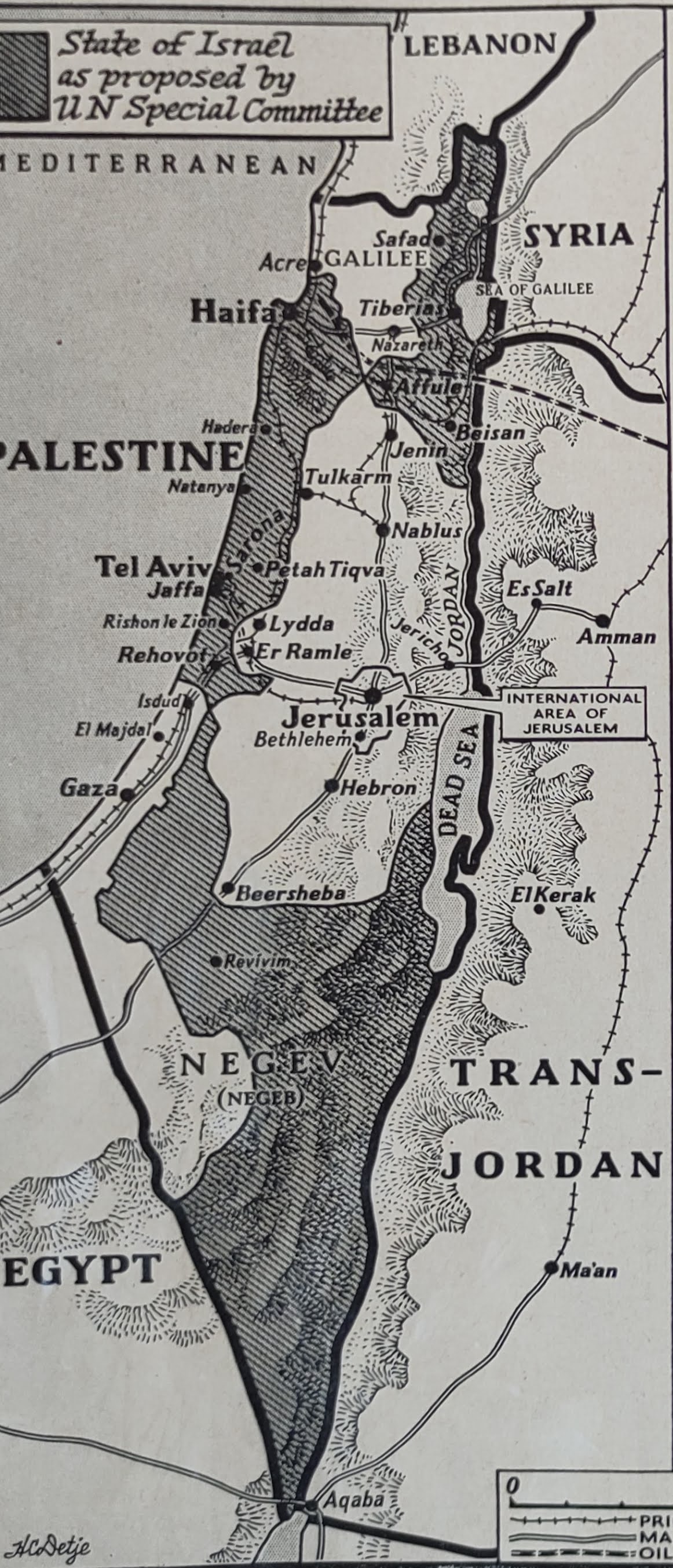
Another Set of Mandate of Palestine Maps

Visiting the offices of the Israel Resource Center, I found another set of Mandate of Palestine maps in this 1948 book:

which even the NYTimes reviewed.

There is a set of maps illustrating the minimizing of the territory of the promised Jewish National Home, ratified by the League of Nations:

And what is unique is that it inludes the summer of 1948 Bernadotte Plan proposal and see here also.

Here is that map in detail:


and here are two others:


Provides more visual perspective on what was being drawn as the borders for the future Jewish and Arab states.

^

Monday, September 13, 2021

What happened to Solomon Jacobson, an Interesting Jew?

What happened to Solomon Jacobson?

Who is Solomon Jacobson?

MP Josiah Wedgwood asked about him:

PALESTINE (CONVICTION OF JEW).

HC Deb 08 May 1935 

Colonel WEDGWOOD asked the Secretary of State for the Colonies whether his attention has been called to the sentence of 7½ years' imprisonment passed on Solomon Jacobson, aged 18, a Jewish national fund watchman, for shooting an Arab trespasser who was stealing stones from the quarry where he was on guard; and will he call for a report and consider revision of the sentence?

Sir P. CUNLIFFE-LISTER I have asked the High Commissioner for Palestine for a report on this case.

What were the details? According to the local newspaper:


He was released only in June 1938.

He became a seaman, was mobilized for work in Syria 1941-1942 by Yigal Allon disguised as a Moslem preligious official and later served in the Navy.

Interesting Jew.

^

Sunday, August 22, 2021

A 1934 'Either...Or'

In the David Ben-Gurion Archives, you can find a summary of a conversation between two Arabs from Mandate Palestine with Israel Cohen, general secretary of the World Zionist Organization headquarted in Great Britain, which took place in London in June 1934.

As you can see, the only choice the Arab spokesman offered was that between the Balfour Declaration or Arab friendship:


Who was that Totah who thought so highly of "Arab friendship" for the Jews rather than a statement of diplomatic intent?

Khalil Totah was an Arab-American Quaker Educator and Palestinian Nationalist Crusader who married an American Quaker and Amy Smith writes:

Dr. Khalil Totah belonged to a generation of Syrians who grew up with an appreciation for the “modern” spirit that was sweeping the world...Totah and his fellow intellectuals were not so much inspired by [US President Woodrow[ Wilson’s words, but rather they viewed them as support of a pre-existing sentiment. Greater Syrians had been developing ideas of freedom and democracy since their cultural and intellectual renaissance in the mid-19th century... Dr. Khalil Totah provides one small piece of a larger transformation in Syria. His writings show the evolution of Arab nationalism in Palestine during a transformative era.

Smith's dissertation further informs, p. 134, that as regards that 1934 trip:

The Friends’ Committee requested that in 1934 Totah travel with an American Quaker from Lebanon, Daniel Oliver, to an annual Friends Meeting in London. He was to meet with British Quakers and plead the case for Palestine. The Quaker organization also arranged for him to meet with government officials to discuss “The Question of Palestine.” 

From the rest of Cohen's report, we can see that as Arab propaganda then, so today:


^

Saturday, August 21, 2021

"The Palestinian Side of the Suez Canal"

I found the following in Hansard, the record of Bitish Parliamentary debates. The referred to Milner Mission was to make recommendations for the future relationship between Egypt and England after World War One when Egypt came under British martial law when a temporary Protectorate was declared. Its recommendations were to end that status and the negotiation of a treaty. It was published in February 1921.

The debate was held on March 14, 1922.

The following extract is from the words of John Mills. In 1923, he served as Parliamentary Private Secretary to the pro-Zionist Josiah Wedgwood.

Mills make the point that Egypt really never was any part of the British Empire and in doing so, makes reference to the concept that Palestine should extend well into Sinai, right up to the Suez Canal:
This point is specifically alluded to on page 6 of the Milner Report. I am quoting from the Report of the Special Mission, and it says: It appears to be frequently assumed in current talk and writing in this country that Egypt is part of the British Empire. That is not, and never has been, the case. That is most explicit, and to gentlemen of military experience who talk to us about the tactical value of this or that part of a country, I would suggest that on the Palestinian side of the Suez Canal you have a population who at the moment are welcoming British occupation, and, under the pledge given to the Zionists, it makes it a desirable circumstance for the transfer of the garrison; that in itself is an alternative place where troops can be kept if the Suez Canal is deemed to be such a dangerous part of our communication. Personally I think that the international pact which guaranteed the international character of the Suez Canal makes a very large number of these assertions valueless even if they ever contained some, amount of value. Having regard to the changed circumstances in the East, having regard to the changed circumstances on the Palestinian side of the Canal, we are justified in asking this Government and its military advisers to consider the alternative garrison for the troops, if they are necessary, in order that we may in fact as well as in word carry out this generation-long pledge to the Egyptian people.

Later in the debate Colonel Wedgewood notes:

Indeed, I think it is worth considering whether it would not be possible even to have the troops on the Eastern bank of the Canal instead of on the Western bank, provided that the Palestine-Egyptian frontier were shifted from the Akaba line up to the Suez Canal. That shift in the frontier would put us on the Suez Canal, in a position where we could adequately protect that Canal, with a base in the mandated country of Palestine, where we should be permanently on the spot to protect the Canal and look after our interests.

He is referring to the October 1, 1906, Separating Administrative Line between the Ottoman province of the Hejaz, the governorate of Jerusalem and the Sinai Peninsula which was agreed upon, following nine months of military action and diplomatic activity which nearly brought the British and the Ottoman empires to the verge of war. See here


It began in January that year when British forces from Egypt 
to build up a small post for the Egyptian border police at Umm Rashrash (now Eilat) in Naqb al-Aqaba. Their presumption was that "Naqb el-Akaba... is well within the frontier line settled upon between Turkey and Egypt" after the Wedj incident. 


Taba was then occupied by Turkish troops.

Oddly enough, one of the elements involved in the background to all this dispute was an

"1892 incident [that] was caused, according to Cromer, by the suspicions of the Sultan with regard to planned Jewish settlement on the shores of Aqaba: ‘...The result was that the Firman laid down the Egyptian frontier as drawn from Suez to El-Arish. The peninsula of Sinai, which had been administered by the Khedives of Egypt for the last forty years, would thus have reverted to Turkey... ’

Tuesday, August 17, 2021

Rabbi Herschel Schachter and I

I was quite active, starting in 1964, on behalf of the liberation of Soviet Jewry through Betar, SSSJ and others in America and later in Israel and England.


At a Soviet Jewry Rally in 1965 at Seward Park [I think], me at right

I participated in the May 1, 1964 demonstration across from the Soviet UN Legation in Manhattan. In November 1976 I was in Mosow for three days, meeting Sharansky, Ida Nudel, Alexander Lerner, the Beilins and others.

Much later with Natan Sharansky in Jerusalem 
at the premiere of "The Refuseniks" 
(I always preferred "Refusedniks")

Raphael Medoff now has published a new biography of Rabbi Herschel Shachter. On his life here. Here is a discussion of the book held at YU.

I appear in it, as a writer of a column (and thanks to Rebbitzen Penner for informing of that).

The background was the first International Conference on the Soviet Jewry struggle conducted in late February 1971 in Brussels. That was when Rabbi Meir Kahane was arrested on orders by Shachter (as the book proves) and his contretemps with Menachem Begin.

The quoted section appears on pages 294-297.

And by the way, it happened again at the Second Conference in Belgium in February 1976.

And without further ado, the text:

"The Jewish Free Press (Columbia University) published a 1,500-word “open letter” to Schacter and Wexler by Yisrael Winkelman [me], a Zionist student activist. Addressing himself directly to the two Jewish leaders, Winkelman began by asserting that in his seven years of Soviet Jewry activism, during which he had taken part in numerous marches, all-night vigils, meetings, and leafletting, “I have never heard your names mentioned, never saw you holding a protest sign, never marched with you nor found you doing anything for the cause of Soviet Jewry.” Winkelman went on to accuse Schacter of “lying and besmirching a fellow Jew” when the rabbi recently told the Israeli newspaper Ha’aretz, regarding Rabbi Kahane, “How much money does he make? What does he do with the money? I’m not saying he is a thief, but a lot of money stands at his service.” Winkelman also cited an incident in 1970, in which the national coordinator of the American Conference, Abraham Bayer, physically blocked the door at a Soviet Jewry seminar to prevent the entry of Dov Sperling, a Soviet Jewish émigré who had publicly praised the JDL. A photo of Bayer standing in front of the door, with Sperling peering through the window behind him, accompanied Winkelman’s Jewish Free Press article.102

Winkelman concluded his “open letter” by challenging what he saw as a mindset among established Jewish leaders to exclude dissenting voices. He pointed to the fact that Schacter was quoted in Ha’aretz as calling the Brussels conference “my wedding,” in the context of accusing Rabbi Kahane of attempting to enter without an invitation. “Perhaps,” Winkelman wrote, “the anti-democratic procedures [in Brussels] were an expression of the ‘my wedding’ philosophy of the American Jewish Establishment that has tragically hindered and delayed the development of a true forceful protest movement.”103

Rabbi Schacter was not a writer. He delivered countless sermons and speeches over the years; he also conducted eloquent correspondence with a few close friends. But except for a few rare instances (such as his Journal-American article about his trip to the USSR), he did not author essays for the press. In the case of the Winkelman episode, however, he made an exception. 

His rebuttal to Winkelman, which extended to more than 2,000 words, was published alongside Winkelman’s critique in the Jewish Free Press. Schacter’s decision to engage Winkelman, rather than ignore him, echoed his invitation to the SSSJ hecklers at Hunter College to speak from the stage just a few months earlier. The article offered a rare look at how Rabbi Schacter handled criticism and how he perceived the Soviet Jewry struggle and his role in it.

Schacter began by objecting to what he called the “insolent aspersions” Winkelman had cast on him. “Since my various humble efforts in behalf of Jews have escaped your notice until recently, let me tell you something about myself,” he began. “When I was younger than you are today, although already a rabbi in a substantial congregation, I volunteered for active duty in the U.S. Army and served with front-line combat troops across Europe.” He then described his experiences in Buchenwald, emphasizing, “I organized Kibbutz Buchenwald and was personally responsible for transporting over 500 Jewish children” from Germany to Switzerland. Schacter continued with a summary of his 1956 trip as part of “the very first select American rabbinic delegation” to the Soviet Union. “Since then I have been constantly ‘on the road’ preaching and teaching; bringing the message of Russian Jewry; rousing and calling Jews in America and various parts of the world to focus American and world attention on the plight of Soviet Jewry.”104

If the term “since then” was intended to suggest that he had been continuously engaged in such activities since 1956, then Rabbi Schacter’s assertion was something of an overstatement. The late 1950s and early 1960s were a time during which there was little public activity in the United States, by Schacter or anyone else, concerning Soviet Jewry. But that began to change in 1963–1964, and Rabbi Schacter cited his connection to SSSJ at that time as evidence that he, like Winkelman, was critical of the established Jewish leadership. “I do share your frustration and impatience with the much maligned establishment,” he wrote. “Ask Yaacov Birnbaum how many years ago it was when I worked hard with him to organize and chair the Bronx Council to Aid Soviet Jewry, how we mounted an impressive rally on the Grand Concourse, before it became popular to do so.” He continued: “Long before I reached my present position of leadership and many times since, I marched and carried protest signs. I may very well have been marching alongside of you without our being aware of each other’s presence. Do you still question my own personal commitment to Soviet Jewry?”105

After highlighting the anti-establishment orientation of the SSSJ and the Bronx Council to demonstrate his credentials as an activist, Schacter shifted gears and declared that “it was the American Conference on Soviet Jewry – and not Rabbi Kahane and JDL – [that was] responsible for most of what has been done in America for Soviet Jewry over the last seven years.” Just in the previous five months, he asserted, the American Conference was responsible for “literally millions of pieces of materials, fact sheets, bumper stickers, posters, Passover statements, etc. and large newspaper advertisements.” He was not at liberty to disclose that he had just authorized a $1,200 behind-the-scenes payment by the American Conference to SSSJ to underwrite a one-day “Student Strike for Soviet Jewry,” in which several thousand Jewish public and private school students in New York City left their classes to hold a rally at the United Nations, followed by a march to the Soviet Mission.106

With regard to the arrest of Rabbi Kahane, Schacter wrote:

The Belgian government . . . was determined to avoid any exacerbation of Soviet feelings, which it felt might result from Rabbi Kahane’s presence and activities in Brussels. The Belgian government alone determined, therefore, to ask him to leave the country. The Conference Presidium at no time, individually or collectively, made any representations to the Belgian government about Rabbi Kahane and was in no way involved in his detention and expulsion [that was less than true YM]. No matter how many times this lie is repeated, it remains just that.107

As for the quotations attributed to him in Ha’aretz, Schacter said that his statements about Kahane were “reported in a manner calculated to convey an impression different from what was intended.” He denied that he ever called Brussels “my wedding,” and added that far from “lying and besmirching” anyone, it was “your [Winkelman’s] camp” that was guilty of spreading “accusations, allegations and calumnies” that were “totally unfounded, false and unwarranted.” Rabbi Schacter did not, however, deny or explain the barring of Dov Sperling by the American Conference’s director.108

Concerning Kahane, Schacter wrote that the Brussels conference was “not a public mass meeting,” but was restricted to “accredited delegates and individual invited guests,” and Kahane was neither. Although he and his colleagues had nothing to do with the Belgian decision to detain the JDL leader, Schacter wrote, it was clear that since Kahane’s application had been rejected prior to the conference, his decision to go to Brussels proved he intended to “create a diversion and disturb or disrupt the Conference” – an argument that seemingly justified the arrest. To defend himself against the suggestion that he had acted in an anti-democratic fashion, Schacter charged that Winkelman’s camp was no more democratic: “Why do you deem our procedure any less democratic than yours? How long would I last if I appeared at a JDL meeting to denounce its program?”109

Schacter concluded his essay by citing a statement made by Menachem Begin in Ma’ariv after the conference: “I know Rabbi Schacter well. Today again I repeat and state he is a faithful Jew, dedicated to his people, a person of whom I am fond.” Presumably such words from Begin, who was both the leader of the Israeli right and a critic of the Kahane arrest, would prove beyond a doubt to Jewish Free Press readers that Winkelman’s accusations were unfair and inaccurate. Schacter likely assumed that few American Jews would have access to the full Ma’ariv article. If they had, they might have been surprised to see what followed Begin’s praise of Schacter. The next sentence in Begin’s op-ed read: 

“Precisely because of this, I asked him how he could have had a hand in issuing [the press release condemning Kahane].”110 

Rabbi Schacter’s bitterness over the Kahane episode lingered for many years. In an interview about Brussels nearly twenty years later, he recalled “that whole sordid chapter” of “the trouble that we had with Kahane and with the JDL”:

There are still Jews in America who think that Meir Kahane was the one who awakened American Jewry to the plight of the Jews in the Soviet Union. All he did was create a lot of noise. . . . We kept following everything that was happening the Soviet Union. We were involved in organizing civilized demonstrations, not the mishegoss of Meir Kahane and his few crazy followers. [H]e made a lot of noise and got a lot of publicity for himself, and, you know people – the old story of “man bites dog” makes news, and he did a lot of things that we thought were counterproductive. [T]he real efforts on behalf of Soviet Jewry, which led to the beginnings of the Soviet Jewry movement and the response of the Soviet government, were not launched by Kahane. They were launched by the organized, authentic spokesmen of the American Jewish, if you will, establishment. . . . Civilized, meaningful  demonstrations were definitely helpful. . . . Do it like menschen [gentlemen]. Not like Meir Kahane, don’t throw bombs, but with tact and with diplomacy".111

----------------

102. “Winkelman’s Letter: Activist Scores Jewish Leaders’ Commitment,” Jewish Free

Press, May 1971, 4.

103. Ibid.

104. “Schacter’s Reply,” Jewish Free Press, May 1971, 4–5.

105. Ibid.

106. Ibid.; Marc Schulman interview with Rafael Medoff, March 4, 2019; “2,000 Public

School, Yeshiva Students Leave Classes to Hold Strike for Soviet Jewry,” JTA, May 28,

1971; “Student Strike for Soviet Jewry” (leaflet), Box 8, Folder 12, SSSJ: Richter to Bayer,

June 30, 1971, Box 8, Folder 12, SSSJ.

107. “Schacter’s Reply,” op. cit.

108. Ibid.

109. Ibid.

110. Begin, “On the Brussels Conference.”

111. Wiener Oral History interview (1989), 4–6.

_____________________________________________

The PDF images:


^

Sunday, August 08, 2021

Do You Know about Iltyd Nicholl Clayton?

Iltyd Nicholl Clayton cannot be ignored if one wishes to comprehend post-WW II British stratgey and diplomacy in the Middle East.

Offically, he was  Advisor on Arab Affairs to the British Government (1943–45). He was later Special Advisor to Head of British Middle East Office and served as Minister attached to the British Embassy in Cairo (1947–48). Between 1920-1928 he was in Iraq.

Just by the by, his older brother, Gilbert, was also a British Army intelligence officer and colonial administrator who served in the famous Arab Bureau, was Civil Secretary of Palestine from 1922 to 1925 and at one point briefly acted as High Commissioner.

Let me expand on him:

Daniel Rickenbacher

The Middle East Intelligence Centre (MEIC) was headed by Brigadier Iltyd Clayton, a mysterious figure, whose influential role in determining Britain’s Middle East policy has until recently been underestimated due to its clandestine character. The historian of British Arabists McLoughlin calls him “the greatest mover and shaker in planning Britain’s future role in the Arab world.” Clayton pursued a grand imperial strategy to secure Britain’s dominating influence in the Middle East in the post WWII era. His plans aimed at expelling France from the region and establishing a regional military alliance against the Soviet Union. Clayton opposed an independent Jewish State in the Middle East. Instead he envisaged a Jewish entity in a Greater Syrian state, which was to enter into a confederation with Iraq.

He had a hand in establishing the  Arab Office in Jerusalem and having Albert Hourani head its propaganda division. It targeted a Western educated and liberal minded audience. Hourani:

addressed them in a scholarly tone, using rational arguments rather than emotions to press his case. In ‘Is Zionism the Solution of the Jewish Problem’, one of the first publications authored by Hourani for the Arab Office, he contended that Zionism offers no solution to the ‘Jewish Problem’. Instead, Hourani opts for assimilation of Jews into Western societies.

Asher Susser's book review of Meir Zamir's

The French passed on to the Jewish Agency information on the plans of “the Arabists,” led by Brigadier Clayton, to partition Palestine between the neighboring Arab states and to encourage the Arabs to “join forces to prevent a Jewish state” (164). French and Zionist sources from late 1947 and early 1948 point to Clayton’s “key role in instigating the Arab-Jewish conflict in 1948”

From Meir Zamir 

The fact that the French followed closely the exploits of both Clayton and Azzam against France in North Africa is significant, as they both played key roles in provoking King Faruq to participate in the war against Israel...Nuri al-Sa’id, who had coordinated his initiative with Clayton, proposed that Britain persuade the US to withdraw its support for an independent Jewish state and renew its efforts to implement the 1946 Anglo-American Morrison-Grady cantonization plan...In coordination with Clayton, Azzam, Syrian Prime Minister Jamil Mardam and Lebanese Prime Minister Riad al-Sulh, they began a campaign to amend the Arab League Pact in order to consolidate military ties between its member states against the Zionist threat...In early January 1948, the Russian newspaper Izvestia warned that British agents, Clayton in particular – ‘the notorious British intelligence agent’ – were provoking an Arab-Jewish conflict in Palestine to further Britain’s interests. Referring to criticism in the Arab world against the Soviet Union’s support for the UN Partition Plan, the article asserted that ‘..by creating this artificial tension regarding the Palestinian problem, colonial reactionaries, like Clayton, are attempting to use it in order to slander the Soviet Union in the eyes of the Arab people’.

and

The Zionists saw Clayton as their most dangerous enemy. In reports from Eliyahu Sasson, Reuven Zaslani/Shiloah (Ben-Gurion’s Chief Intelligence Adviser) and from the Hagana’s intelligence, Clayton emerges as a key figure in the formation of the Arab war coalition. In fact, Ben-Gurion and his advisers directly warned MI6 in London of the possible outcome of the activities of their Arabist officers against the Jewish state. In a report sent by an MI6 officer to MI5 on his meeting with Zaslani on 16 February 1948, he wrote that the latter had stated: The immediate Jewish aim is to localize the conflict in Palestine, but if they fail in this because of – for instance – tacit British encouragement of the Arabs, and the surrounding Arab countries extend the area of conflict by participating actively in the operations against the Jewish state, the Jews will themselves make arrangements with minorities, such as the  Kurds, to stir up trouble to keep the Iraqis and other armies occupied.’ Zaslani then warned that ‘if this happened, the Russians would be sure to try and take advantage of the general state of unrest in the Middle East’.

Coming a month after Britain’s failure to ratify its treaty with Iraq, Zaslani’s warning, especially his allusion to the Soviet Union and the Kurds, should have carried some weight, yet Clayton in Cairo, Stirling in Damascus, Ambassador Alec Kirkbride and Glubb Pasha, Commander of the Jordanian Arab Legion, in Amman, Azzam in Cairo, and Nuri al-Sa’id in Baghdad, continued their efforts to form a coalition against the Jewish state. 

And

In discussions with Prime Minister Sidqi in August–October 1946, Eliyahu Sasson had made a similar proposal as part of his efforts to gain Egypt’s support for a Jewish state. Sasson had submitted his plan to Clayton, who thwarted it.

And

Azzam and Clayton coordinated their moves in the inter-Arab arena and in fomenting the conflict, first against the Zionist movement and later against the State of Israel. Azzam’s role, from September 1947 until May 1948, in forming the Arab war coalition and bridging the gap between Faruq and Ibn Sa’ud, on the one hand, and Abdullah and Abd al-Ilah, on the other, enabled Clayton and other Arabist intelligence officers to operate behind the scenes. A pamphlet sent to the French Embassy in Cairo, titled The Tragedy of Palestine, signed by ‘the National Guard’, sharply criticized Azzam for his role in Egypt’s defeat: We can finally establish that Glubb Pasha, the British Head of the Transjordanian Army, was given the responsibility to lead the Palestinian affair from the military perspective, and that General Clayton, with Azzam Pasha, was charged to lead it from the political perspective and through their malice, they compelled the President of the Egyptian Council to give in to their pernicious will.

And

Already in October 1947, French intelligence had reported to Zionist agents that Clayton and Sulh were instigating the organization of irregular forces under Qawuqji’s command to invade Palestine and attack Jewish settlements. At the December 1947 Arab League Conference in Cairo, Sulh told a French informer that ‘Clayton had proposed the establishment of ties between the British headquarters in Palestine and Fawzi al-Qawuqji, in such a way as to avoid a clash between Arab irregular forces and English Police forces, thus facilitating guerilla operations against the Zionists.’

And from the archives:

January 1, 1946 

President Quwatli to Cabinet members

Secret

From the President of the Syrian Republic to the noble Council of Ministers

The mission of General Clayton, head of the Special Section of Arab Middle Eastern Affairs, has two aims:

First: to convince us that Syrian unity will come about;...As for unity, he presents us with two plans: - Syrian unity including Syria, Transjordan and part of Palestine with a plebiscite on the nature of the regime and on the choice of king if the regime is a monarchy.

Quite a fellow.

Saturday, August 07, 2021

The Jews to Go into the Sea

Tracking down statements can be difficult at times. Everyone "heard"/"read" it but years later, no one can find its source.

One such issue is, did Arabs threaten to throw the Jews into the sea, and when?

EOZ had this published tracing the history whether in 1948 or during the 1950s or on the eve of the 1967 war.


Of course, the "Palestine from the River to the Sea" chant basically means destroying Israel but it is not the same as actually throwing Jews into the sea. I noted previouslycaricature of Israel as a ship sinking. Still, not exactly the same.

Well, we now have a testimony in real time, from August 1948*.

In this academic article on the machinations of British Intelligence Services during the 1940s, I read, on page 14, that England's Foreign Secretary Ernest Bevin, "After being notified that the Arab leaders were blaming Britain for their defeat", instructed his diplomats in the Arab capitals, as well as in Washington and the UN, to respond that:

It is quite untrue to suggest that we have let the Arabs down or failed in any obligations towards them. We did not urge them to intervene by force in Palestine, nor did we promise them support if they did so. They went in of their own accord, in most cases without telling us beforehand. Very small measure of military successes which they achieved shows that their forces, while capable perhaps of occupying friendly territory, were not prepared for and incapable of undertaking major military operations, which would have been necessary to achieve the announced object of the Arab states, namely to drive the Jews into the sea.

I think that should settle matters.

__________________________

* The footnote reads: 

TNA, FO141/1247, no. 1454, London, 25 August 1948, Bevin to Cairo, and no. 821, August 21, Bevin to Kirkbride; Louis, Ends of British Imperialism, 635-6, 694-8 

_____________________________

UPDATE

EOZ in a follow-up.

Monday, July 05, 2021

Julius Kahn, His 1919 Letter and the Irony

In a (Hebrew-language) tweet, I mentioned the 1919 letter of 299 Reform Rabbis to President Woodrow Wilson not to support the Zionism, the Balfour Declaration and a decision to reestablish the Jewish Nation Home.

I had previously included the episode in this previous blog post in 2017.

As some people asked my for sources, I simply upload here more material from the Hebrew Standard, The Sentinel and the New York Times as well as a book and an academic article. The episode is also mentioned here and here.


And just by the way, the  Julius Kahn Park in San Fransisco, so named in 1926, had it named changed.


members of the Chinese community...announced the effort to remove Kahn’s name — and his racist legacy — from a 92-year-old city playground.

Julius Kahn led the effort in 1902 to make permanent the Chinese Exclusion Act, which barred Chinese laborers from entering the United States. Members of the Chinese community today say that decision, rooted in racism, tore families apart. The act was finally repealed in 1943.

In calling for the Chinese Exclusion Act’s passage, Kahn called Chinese people “morally the most debased people on the face of the Earth,” and portrayed them as criminals. The rhetoric echoes our current national struggles.

Irony of ironies.

^