Monday, December 11, 2006

This Should Be My Sole Christmas Blog Post

Have you ever asked yourself "Why has the portrayal of Jesus in art drifted far from the likelihood he was a brown-skinned Semitic Jew?"

Matthew Philips has the answer:-

Whitewashing Jesus

An excerpt:

While we can never be exactly sure of what Jesus, Mary and Joseph actually looked like, we know they were not fair-skinned, flaxen-haired Europeans...In all likelihood, what they were was something in between: olive-skinned, dark-featured Semitic Jews living in Israel...

...With New Line Cinema’s new movie, “The Nativity Story,” we finally get what many historians agree is a more accurate representation of the Holy Family. Cast with a group of dark-haired, dark-complexioned actors whose nationalities range from Guatemalan to Australian and Irish to Israeli—those who aren’t Middle Eastern certainly look like they could be—the movie strives for physical accuracy...

...The mainstreaming of a white Jesus began in earnest during the early Middle Ages in Europe, a time and place where darkness had a powerfully negative connotation. Eighth and ninth century European theologians, obsessed with the symbolism of the Passion, began ascribing blame to the Jews. As such, Judas and King Herod and eventually Pontius Pilate came to be represented in dark, sinister hues while Jesus became increasingly white.

“The oldest basis of all Christian art is the clash of good versus evil, light versus dark,” said Colum Hourihane, director of the Index of Christian Art at Princeton University. “This was particularly the case in the ninth and tenth centuries, when basically the Jews assumed a dark coloration [in art] while Christ became radiantly white, illuminated.”


Ah, the dark side of history and hate.

I Agree with Mahmud Abbas

This indeed is quite terrible. Without if, ands & buts.

Abbas condemns killing of children of PA official

Palestinian Authority Chairman Mahmoud Abbas condemned as an "ugly and inhuman crime" the killing of three young children of a senior PA intelligence official outside their school in Gaza City Monday morning.

A bystander, 25, was also killed in the drive-by shooting, in which Palestinian gunmen opened fire in a street crowded with hundreds of school children. It was an unprecedented attack that could ignite widespread factional fighting.

There was no immediate claim of responsibility.

In the attack, the gunmen pumped dozens of bullets into a car carrying the children of intelligence officer Baha Balousheh, a loyalist of Palestinian Authority Chairman Mahmoud Abbas' Fatah movement.


Still, I have a queasy feeling that some Arab, somewhere, is going to try to blame this on Israel.

When Satire Boomerangs

Idan Landau had a good idea. Take the criticism of Yuli Tamir's idea to put back the "green Line" into schoolbooks and show up the Right by making fun of their positions. Nothing works like ridicule we all know.

So here is how it looked, in part:-

Here's a summary of the next decisions to be taken by the consensus and government, on your behalf:

There are no "settlements," there are "communities." On second thought, there are settlements: The settlement of Nablus, the settlement of Ramallah, and the settlement of Beit-Hanoun. Hopefully soon they too will turn into communities.

There are no illegal outposts. What do you mean "illegal?" Who makes the laws? A bunch of leftist attorneys wearing glasses? What do they know about the law of the earth or the law of the jungle?

There are no roadblocks. There are no obstacles placed between villages and towns. There are no roads for Jews only, no economic isolation of villages along the Green Line, and no expropriation of private land for Jewish construction. No, no, no. Maybe you dreamed about all this, but it's on its way out. In a year or two you will see no word about it in newspapers or books.

There are no negotiations. It's a dirty word, "negotiations." We should get rid of it as soon as possible. It implies, by mistake of course, that there are two sides to the conflict and people on both sides who all have needs and fears, and that we need to talk to each other. But after all, this is merely an illusion. There's only us and our bombs. There's nothing to talk about and nobody to talk to. We only need to pulverize.

There are no "Palestinians." Not every odd and insignificant group of people who decide to unite deserves a name. Tomorrow all the redheaded people with a mole on their shoulder and who love white chocolate will decide to set up a political party. So what, we'll recognize them? We'll write articles about them in the newspaper? We'll give them a platform?

There are no Arabs who want peace. There was never a historic decision by the Arab League in 2002 calling for two states for the two people without the Right of Return; there was no proposal from Syria's president for a comprehensive peace in exchange for full withdrawal; there was no approach by the Lebanese prime minister regarding peace talks.

Maybe you read all kinds of reports about this, but you apparently imagined it. And if you didn't imagine, you apparently didn't understand. And if you did understand, you're apparently not part of the consensus. And if you're not part of the consensus - you don't exist.

Soon, all those deviations will be fixed. We have a government, and consensus, and textbooks, and everyone will adopt the new lines – not the 1967 lines; we won't go back to them. We left them far behind, along with all the other foolishness produced by this treacherous mole, reality.

(Coming soon: There is no "reality.")


Of course, Landua's problem is that a great deal of what he is satirizing (is that a word?) is quite open for debate and there is a large body politic as well as public opinion nthat would go either way.

He is on dangerous water walking.

Yehiel Spira - We Appreciate

From Yehiel Spira:-

For close to 12 years, my life involved being at the helm of what we commonly call “breaking news,” which in essence means living the most horrible/tragic events of the Jewish People’s history.

Yes, there was an occasional good report, but by-and-large, by definition, “news” has come to spell tragedy, events that make us stop and take notice, events that provoke an upward Heavenly gaze, seeking assistance as we struggle to understand that which transpires around us.

Having been privileged to live in the Holy Land for almost 23 years, I have learned the meaning of living in the ‘eye of the storm,’ where seemingly mundane events are indeed at the core of world politics. Our tiny Holy Land remains at the epicenter of world focus, leaving us with the responsibility of being a light unto the nations. Sadly, we have failed too often.

Well, due to reasons that are not relevant to this forum, the day-to-day news events are now a thing of my past. I am no longer associated with Israel National News.com, AKA Arutz-7. No more beepers, no more round-the-clock ‘on-call’ and no more being the first to know. Been there – done that!! ENOUGH

Permit me a moment to boast, for reflecting back; it was I who launched Israel’s first English language electronic news from Israel – back on erev Pessach 1994. The first piece was labeled “Bread of Affliction,” following a murderous suicide bombing attack in Afula.

That once-a-week fax turned into the SNS Service, then to Shomron News Service, IINS (Israel Internet News Service), IsraelWire, and then, INN. There have been and still are many wonderful people, dedicated Jews whose concern for Am Yisrael supersedes all else. Financial backers, moral supporters, and those who guided me, teaching me the ins-and-outs of finding a story, confirming the facts, and getting out to the world with minimal delay.

Anyway, I will make a concerted effort to distance myself from the ‘hand-on-the-pulse’ news coverage [at least for the indefinite future], while maintaining a self-perceived knowledgebase of goings-on in Israel. I plan to use some of the time to enjoy life with my wife, Sharon, selfish as it may sound, and see the children a great deal more than the rigid news schedule permitted in the past. Yes, I am keenly aware that putting one’s head in the sand does not prevent events from taking place, but quite honestly, it is time for a long overdue break. It’s that simple.


If you are interested in joining his Yahoo newsgroup consisting of a periodic email expressing his views, political analysis, permitting him a forum to express some viewpoints, an area that was generally ‘off limits’ in the breaking news field, drop me a line.

Shlomo Ben-Ami Shame

Looking for some educational material for a program I am conceptualizing on Israel: Democracy and Jewishness, I came across this:-

SHLOMO BEN-AMI: On questions of anti-Semitism? Well, Israel is the result of the Jewish catastrophe. There is no doubt about it. If there were no Jewish catastrophe, there would not be a state of Israel. And I think that during the first years of — or before the creation of the state, especially for the figure of Ben-Gurion, the Jewish catastrophe needed to be enlisted for the cause of the creation of the state.


It's out of the transcript of a 2005 debate between Norman Finkelstein and Former Israeli Foreign Minister Shlomo Ben-Ami.

My Zionist approach is Jabotinskyian and Yair Stern. The Jewish state is justified and legitimate because we are jewish and the Jewish people's notmal existence demands a state and the sovereignty that goes with it. That demand is predicated on Jewish reilgion, Jewish history and Jewish normality. The need for a state is the same if there is quiet or catastrophe.

The Left in Zionism couldn't accept that. It had to be because of socialism and then because of the post-Shoah reality. They called Jabotinsky's Zionism "catastrophic", to chide him for being too excited about antisemitism.

Now, Ben-Ami, as before him, have turned the argument on its head.

As we used to say, we have to "thank" Hitler for giving us a reason to have a state otherwise no one would have been convinced - or rather, the Left-wing in Zionism could not come up with a good reason for statehood.

What a Shlomo Ben-Ami shame.

Google Earth Images of Shiloh

I'll start off with a Kippah tip to Jameel at the Muqata for guiding me to Google Earth.

And now, three images of my home at Shiloh:


Isn't that fantastic?

Jeff's Wanderings

An excerpt from a mailing reporting on the BAPA Meeting at the Royal Society of Medicine, London. 30.11.06, and Prof. (???) Jeff Halper's (*) talk:

Perceptions of the Current Catastrophe in Gaza and the West Bank

In Jeffs' view, there could not be a single-state solution, because Israel is unable to assimilate 4 million Palestinians into its territories. Nor is a two-state solution now possible: to detach a viable Palestinian state cannot be done because Palestinian land has been seriously fragmented by the building of the Wall, Roads and Settler communities (whose populations - like those of Maale Adumin in Jerusalem are too big to uproot).

Israel, he claimed, avoids accountability by presenting itself as a victim: all its measures, it proclaims, are in self-defence. It is in their interest to present themselves as weak and vulnerable. We must counter this image by showing how
powerful Israel is, especially militarily. Israel specialises in counter-insurgency warfare in which cities have become the battleground; counter-insurgency is the cutting-edge of the work there. The OT provide a laboratory for Israel to experiment with high-tech weaponry.

Bi'lin is being used for the testing of sprays and chemicals in crowd -control - invariably the IOF/ police inflicting violence on non-violent protestors. The W. Bank is used for experimentation in urban-space warfare and these Israeli methods are then transported: the USA army was trained for the Iraq war in the Negev Desert. There is no international monitoring or oversight of these training grounds, equipment or methods. The BMA, Jeff suggested, could initiate a medical researcher to investigate these "experiments".


Source: here.

(*)
Jeff Halper (57) is the Coordinator of the Israeli Committee Against House demolitions (ICAHD) and a Professor of Anthropology at Ben Gurion University. He has lived in Israel since 1973. He blogs at Tikkun.

Sunday, December 10, 2006

I was Never Good at Games but I've Been Tagged

My wife tagged me.

I have (in bold):
01. Bought everyone in the bar a drink
02. Swam with wild dolphins (wadded through water)
03. Climbed a mountain
04. Taken a Ferrari for a test drive
05. Been inside the Great Pyramid
06. Held a tarantula
07. Taken a candlelit bath with someone
08. Said "I love you" and meant it
09. Hugged a tree (while climbing it)
10. Bungee jumped
11. Visited Paris (at least twice)
12. Watched a lightning storm at sea
13. Stayed up all night long and saw the sun rise (the special Chama once-in-24-years ceremony)
14. Seen the Northern Lights
15. Gone to a huge sports game
16. Walked the stairs to the top of the leaning Tower of Pisa (does Statue of Liberty count?)
17. Grown and eaten your own vegetables (with my wife's help)
18. Touched an iceberg
19. Slept under the stars
20. Changed a baby's diaper
21. Taken a trip in a hot air balloon
22. Watched a meteor shower
23. Gotten drunk on champagne
24. Given more than you can afford to charity
25. Looked up at the night sky through a telescope
26. Had an uncontrollable giggling fit at the worst possible moment
27. Had a food fight
28. Bet on a winning horse
29. Asked out a stranger
30. Had a snowball fight
31. Screamed as loudly as you possibly can
32. Held a lamb (and a calf)
33. Seen a total eclipse of the moon.
34. Ridden a roller coaster
35. Hit a home run
36. Danced like a fool and not cared who was looking
37. Adopted an accent for an entire day
38. Actually felt happy about your life, even for just a moment
39. Had two hard drives for your computer (office)
40. Visited all 50 states
41. Taken care of someone who was drunk
42. Had amazing friends (and still have)
43. Danced with a stranger in a foreign country
44. Watched wild whales
45. Stolen a sign
46. Backpacked in Europe
47. Taken a road-trip
48. Gone rock climbing
49. Midnight walk on the beach
50. Gone sky diving
51. Visited Ireland (airport only)
52. Been heartbroken longer than you were actually in love
53. In a restaurant, sat at a stranger's table and had a meal with them
54. Visited Japan
55. Milked a cow (and a goat)
56. Alphabetized your CDs
57. Pretended to be a superhero
58. Sung karaoke
59. Lounged around in bed all day
60. Played touch football
61. Gone scuba diving
62. Kissed in the rain (at least I think so)
63. Played in the mud
64. Played in the rain
65. Gone to a drive-in theater (but I wasn't the driver)
66. Visited the Great Wall of China
67. Started a business
68. Fallen in love and not had your heart broken
69. Toured ancient sites (just last Friday at Tel Shiloh)
70. Taken a martial arts class
71. Played D&D for more than 6 hours straight
72. Gotten married
73. Been in a movie (both home and TV news)
74. Crashed a party (a Shlomo Carlebach on in 1961)
75. Gotten divorced
76. Gone without food for 5 days
77. Made cookies from scratch
78. Won first prize in a costume contest
79. Ridden a gondola in Venice
80. Gotten a tattoo
81. Rafted the Snake River
82. Been on television news programs as an "expert"
83. Got flowers for no reason
84. Performed on stage
85. Been to Las Vegas
86. Recorded music
87. Eaten shark
88. Kissed on the first date
89. Gone to Thailand
90. Bought a house
91. Been in a combat zone
92. Buried one/both of your parents (they are both buried here in Shiloh)
93. Been on a cruise ship (our Aliyah)
94. Spoken more than one language fluently
95. Performed in Rocky Horror
96. Raised children
97. Followed your favorite band/singer on tour
99. Taken an exotic bicycle tour in a foreign country
100. Picked up and moved to another city to just start over
101. Walked the Golden Gate Bridge
102. Sang loudly in the car, and didn't stop when you knew someone was looking
103. Had plastic surgery
104. Survived an accident that you shouldn't have survived
105. Wrote articles for a large publication
106. Lost over 100 pounds
107. Held someone while they were having a flashback
108. Piloted an airplane
109. Touched a stingray
110. Broken someone's heart (in the 6th grade, I think)
111. Helped an animal give birth (at Amatziah)
112. Won money on a T.V. game show (on a radio show, yes - history quiz)
113. Broken a bone
114. Gone on an African photo safari
115. Had a facial part pierced other than your ears
116. Fired a rifle, shotgun, or pistol (and various machineguns)
117. Eaten mushrooms that were gathered in the wild
118. Ridden a horse (daily for a month or so as a cowboy at Amatziah)
119. Had major surgery
120. Had a snake as a pet
121. Hiked to the bottom of the Grand Canyon
122. Slept for more than 30 hours over the course of 48 hours
123. Visited more foreign countries than U.S. states
124. Visited all 7 continents
125. Taken a canoe trip that lasted more than 2 days
126. Eaten kangaroo meat
127. Eaten sushi
128. Had your picture in the newspaper
129. Changed someone's mind about something you care deeply about
130. Gone back to school (doing my MA now)
131. Parasailed
132. Touched a cockroach
133. Eaten fried green tomatoes
134. Read The Iliad - and the Odyssey
135. Selected one "important" author who you missed in school, and read (but in Hebrew)
136. Killed and prepared an animal for eating
137. Skipped all your school reunions
138. Communicated with someone without sharing a common spoken language
139. Been elected to public office
140. Written your own computer language
141. Thought to yourself that you're living your dream
142. Had to put someone you love into hospice care
143. Built your own PC from parts
144. Sold your own artwork to someone who didn't know you
145. Had a booth at a street fair
146. Dyed your hair
147. Been a DJ
148. Shaved your head (totally bald, in a 'previous life')
149. Caused a car accident
150. Saved someone's life

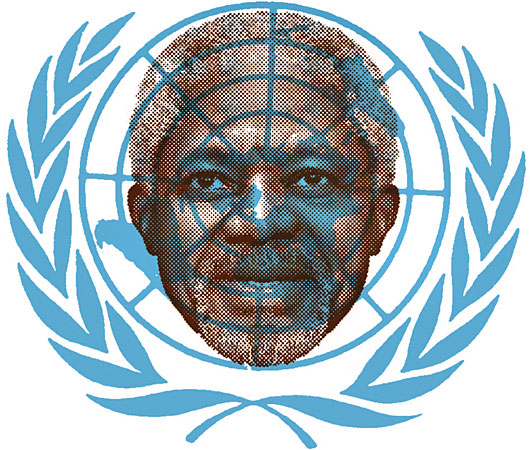
Kofi Anan - On Sight

The New York Times Sunday Magazine has this illustration of the anti-Israel Kofi Anan:-


That wouldn't be a bull's-eye in disguise, now, would it?

Help Is On the Way - Anti-Kassam Shootdown

Lookee here.

The Mobile Tactical High-Energy Laser is a short-range weapon being developed with Israel, which wants it to destroy Katyusha rockets fired at its border villages by Hezbollah guerrillas in Lebanon. The weapon looks like a searchlight. In tests during late 2002, the Army used the high-energy laser to heat artillery shells, which exploded in flight. In earlier tests, the laser shot down 25 Katyushas, both singly and in salvos. Artillery shells generate far less heat than rockets do and are more difficult to track. Also, because rockets are pressurized, they are easier to blow up than shells.


And Jane's too:-

Skyshield tried against Qassam

Lockheed Martin has modified Oerlikon Contraves' Skyshield 35 mm Advanced Hit Efficiency And Destruction (AHEAD) air-defence system to better deal with Katyusha and Qassam rockets.

A Lockheed Martin representative told Jane's that in a recent series of laboratory tests, the system successfully neutralised 122 mm Katyusha warheads and an exact copy of the Palestinian indigenous Qassam rockets.

Carter's "Cutie"

The book describes the abominable oppression and persecution in the occupied Palestinian territories, with a rigid system of required passes and strict segregation between Palestine's citizens and Jewish settlers in the West Bank.


Thta's what Jimmy Carter published in the LATimes on December 8.

abominable
oppression
persecution
occupied
Palestinian
rigid
strict
segregation


Those are loaded words. Words that really are expressions of emotion and less fact.

I live in an area surrounded by several Arab villages - Sinjil, Turmos Aya, Jalud, Hirbet Abu Falah, Talfit, Karyut.

When they have traffic accidents, our ambulances picked up the pieces.

That's good news.

Of course, there has also been thieving from their side, that they don't 'segregate' themselves from.

Carter was invited by me personally twice to come and visit the community he specifically wanted destroyed by Menachem Begin in 1978.

We're still here and look where he is.

Dore Strikes Gold

Here's Dore Gold's position peaper on the Iraq Study Group and its implications for Israel:-

Israel should not try to second-guess U.S. decisions about putting American soldiers in harm’s way. However, the specific strategy that the Baker-Hamilton report proposes for facilitating an American pullback in Iraq – the use of an international support group including Iran and Syria – poses serious problems that affect vital Israeli interests.

Baker confirmed on December 6, 2006, that the Iraq Study Group derived some of its inspiration from the “six-plus-two” talks on the future of Afghanistan at the UN. But in Afghanistan, back in the 1990s, Iran sought to contain a radical Sunni regime under the Taliban. In 2006, in contrast, Iran seeks to dominate Iraq through its Shiite majority. The two situations are entirely different.

Obtaining a constructive approach from Iran and Syria would involve a 180-degree shift in their policies. Clearly the authors of the report have no awareness of the ideological commitment of the Iranian regime to export its revolution to Shiite communities throughout the Middle East as it seeks to achieve regional hegemony.

Should the Bush administration adopt this approach from the Iraq Study Group, it would not be seeking a radical shift in Iranian and Syrian policies from a position of strength. From the perspective of Teheran and Damascus, the U.S. would be seeking their help after they had succeeded in defeating coalition forces. As a result, the price for their cooperation would be exorbitant.

The Iraq Study Group suggests that “the Israelis should return the Golan Heights.” There is no negotiation over the withdrawal as in UN Security Council Resolutions 242 and 338. It appears that the Golan Heights are being used as an inducement to obtain cooperative Syrian behavior on Iraq. On the Palestinian track, the Baker-Hamilton report does not call for talks over “refugees,” but rather over “the right of return,” adopting Palestinian legal nomenclature and undermining Israel’s legal position.


Read the entire piece here.

Mt. Zion Threatened by Olmert in Rome

Quite possibly, Mount Zion is being bargained away.

Some items:-

In a move that surprised observers, Israel has agreed to re-launch negotiations with the Holy See over church status in the Holy Land that have been stalled since the Olmert government came to power.

AsiaNews reports that an Israeli delegation will visit the Vatican Secretariat of State in December and January to hold negotiating sessions of the "Bilateral Permanent Working Commission" that has not met since the Olmert Government came to office early this year.

The officials of Israel's Foreign Ministry had just concluded a previously unannounced visit to the Holy See's Secretariat of State, at the Vatican Palace.

The news is being received with relief, and with cautious optimism, in Church circles, according to AsiaNews.

Ever since the incoming Israeli Government cancelled the negotiating sessions that had been planned for May this year - required under the Fundamental Agreement 1993 which seeks to establish formal relations between the two states - there were fears that the protracted negotiations which began in 1999 would be suspended indefinitely.

No reasons were given to explain the Israeli government's sudden change of attitude, though AsiaNews says that the Holy See never gave up on its steady but discreet diplomatic efforts.

The AsiaNews report also says that the US bishops and influential members of the US Government have been encouraging Israel to make sure it is faithful to its international commitments vis-a-vis the Holy See and the Catholic Church.

"The announced resumption of the negotiations is very important, and gives reason for renewed hope," says its President, Franciscan Fr David-Maria A Jaeger, who admits happily that he is "delighted" with Israel's own announcement of the imminent re-starting of the talks.

"Whatever the difficulties," says Fr Jaeger - himself an experienced negotiator, who is much respected in Israel, and elsewhere, for his role in helping to shape the historic Vatican-Israeli accord of 1993 - "everything can always be resolved by negotiating, while nothing can be resolved by not negotiating...".

The future agreement is mainly intended to safeguard the Church's ownership of her places of worship, and to confirm the centuries-old tax exemptions on donations to the Church.


And for the background:-

Pope Clement VI purchased the site of the Last Supper, known throughout Christendom as the Cenacle Shrine of the Upper Room, November 21, 1342. The Shrine however was lost to the Ottoman Empire in 1551. With the establishment of the State of Israel the Shrine fell under the control of the Israeli government in 1948 where it remains unused to this day.

The Shrine has no religious significance to Jews but as the third most important shrine in Christianity, it's return for Christian use, will serve as an immeasurable gesture of Good will to Christians around the World. Pave the Way has been suggesting, to Israeli government officials, to simply allow the use of the Shrine, rather then any property turnover. This use will not disturb the Tomb of King David below or the Yeshiva on the ground level.

This simple gesture will give a sorely needed boost to the tourism industry, by sending a signal to the Christian world, that they are welcome in Israel.
This will be helping all the people in the region.

Friday, December 08, 2006

Not Since Eban

Not since Lyndon Johnson's Meeting with Abba Eban on 26 May 1967 (see article on it referenced here) has a meeting between Israel and the U.S. carried such import.

What meeting?

This one:-

Israel's foreign minister has arrived in the United States amid worries that the Jewish state's main ally could shift course after a report urged Washington to redouble Mideast peacemeaking efforts. Tzipi Livni will meet with US Secretary of State Condoleezza Rice and other officials during her visit, which will focus on the repercussions of a report released Wednesday by the Iraq Study Group, her office said.

"This trip will be an occasion to review with her counterparts the report and to discuss its meaning," a foreign ministry spokesman said.

That report said progress towards Arab-Israeli peace was key to saving Iraq. It also called for direct US talks with two of Israel's most fearsome foes, Syria and Iran, the latter of which is believed to be steaming ahead in its bid for nuclear weapons.

A day after receiving the top-level commission's report, the United States and Britain signalled the start of a renewed diplomatic push in the region.


Here are Eban's reminisces:

I made what turned out to be a very crucial visit to the United States; also to France and to the United Kingdom. In the month of May, ahead of the Six-Day War, the objective was to examine whether the powers were willing to carry out what had been their commitment to support Israel if we were blockaded again by the stoppage of our traffic in the Gulf of Aqaba and in the Suez Canal. And when it was obvious that that was going to be the Arab attitude, we could see that there was a casus belli in every sense of the word. Now, in France I received a douche of cold water from President de Gaulle.

I hardly had time to sit down, let alone to exchange any pleasantries, before he bellowed at me, "Ne faites pas la guerre!" - "Don't make war," or in any case, "Don't be the first to make war." And he then said, "My solution is this: it's important that the four great powers should get together" - "Il faut que les quatre se concertent." When I said that to President Johnson, who asked me what President de Gaulle had said to me, he said, rather irritably, "What did he mean by 'the four great powers'? Who the hell are the other two?" So that was the reaction of the United States to the idea that there were four great powers.

In Britain, surprisingly... I expected a colder response, but the response was very warm, and Prime Minister Harold Wilson gave me a very gossip-ridden account of how his ministers had voted that morning, saying he... I would be astonished if he [sic] knew how people voted: that my friend Crossman was actually against us, and that his friend George Brown was for us. But it was quite clear that their attitude would be totally dependent upon whether they were with or without American cover; and therefore everything now depended on President Johnson. He expressed to me a sense of his own impotence, that I never heard either before or since from an American leader. He said that he was actually confined, contained and frustrated by the Vietnam War. He said, "Without the Congress, I am nothing but a 6-foot-4 Texan. And unless you people move your anatomies up on the Hill and start getting some votes, I will not be able to carry out..." what was then his policy of forcing the straits with American power.

That could have been done: the United States only had to send one ship through, and I believe that Nasser could have capitulated. He was not able to do that, and he kept talking about the limitations of his own power in words which almost made me compassionate towards him. And he then said, in a kind of Delphic oratory [sic] sort of mood: "Israel will not be alone unless it decides to be alone." And we in Israel started trying to solve that particular acronym so far as we could.

It didn't seem to me very much; but there was a period when he really thought of forcing the straits, then a period in which he recognized his own limitations; and a third, a sense of intense relief when Israel solved the problem itself, not only by surviving but by winning the war. And when I went back after the war had been won, he didn't even try to conceal his relief at what had happened. He said, "Of course, our generals always said that you would win the war in any case, either in seven days if you had the first strike, or in 12 days if the Egyptians had the first strike." But Johnson went on, "My generals are always right about other people's wars."


What will Tzippi tell us a few years hence?

Imus - Eppes an Antisemite?

Radio personality Don Imus let loose with his own barrage of antisemitic vitriol on the November 30 broadcast of his “Imus in the Morning” show.

That morning, the program, which is produced in New York by WFAN and simulcast on MSNBC, was going to host a group of gospel singers known as the Blind Boys of Alabama. In anticipation of their appearance, Imus recalled reservations voiced by station supervisors prior to an earlier appearance by the group.

“I remember when I first had ’em on a few years ago,” Imus said. “The Jewish management at, whoever we work for, CBS, were bitchin’ at me about it.” “We had a meeting in my office,” Imus continued. “They were furious, but of course I don’t care what they say and never have.”

At this point, the show’s executive producer, Bernard McGuirk, a regular on-air presence, said of the Blind Boys, “Even if you wear a beanie, how can you not love these guys?”

“I tried to put it in terms that these money-grubbing bastards could understand,” Imus replied. “I said: ‘They’re handicapped, they’re black and they’re blind. How do we lose here?’ And then a light bulb went off over their scummy little heads.”

Imus co-host Larry Kenney, an impressionist who appeared earlier in the program as the Rev. Jerry Falwell, then said: “They probably were trying to push a more Semitic group on you. I don’t know, maybe the Paralyzed Putzes of Poland, or something like that.”

“You can’t believe what goes on behind the scenes, at least with me with these people,” Imus said. “And fortunately, I don’t care.”


Ah, America.

Land of the Free.

Is David Twersky Going Twerpy?

Is my friend David Twersky (director of international affairs of the American Jewish Congress) going twerpy(*)?

Here's part of his The Forward op-ed:-

There’s Little Hope for Peace if Occupation Is a Proper Noun
Opinion

I hate the Occupation and I hate the occupation.

I hate them both equally...Let me explain.

I hate the Occupation, the invented brutal and apartheid-like [David - how "like" is it? Like South Africa? Like the American South?] regime whereby Jewish Israelis systematically [wow, we got a system? do you have a system for opposing nationalist Zionism or is it just sporadic?] mistreat indigenous Palestinian inhabitants of the West Bank and Gaza Strip.

...I hate the Occupation because it denies history, assuming that the Arabs were willing to accept Israel before the 1967 war and refusing to acknowledge Jewish claims to the land of Israel, which if they are theoretically inapplicable to the West Bank are also offensive and unjust with regard to the pre-1967 core area of the Jewish state. [huh? do you mean that it's our fault for living in the heart of our homeland that this blinds people to the fact that Arab opposition to Zionist endeavors never gave a hoot for any boundaries or territories?] I hate the Occupation because the Israelis can’t get any credit even when they, as in the cases of Gaza and Lebanon, withdraw to the borders the international community claims as rightfully Israeli, while Arabs continue to “resist the occupation” under the absurd conditions that nothing is being occupied any longer and that, in any event, Israeli extra-1967 claims are now limited to less than 10% of the area of the West Bank...

...So I hate the Occupation and I hate the occupation, because generally one is either pulled to one side or the other and rare is the person who is able to simultaneously grasp the incomplete truths in each that form a whole truth only when held together by a complex sense of proportion.

Given the choice, most Israelis have demonstrated a desire to see an end to the occupation, [er when? which election?]...

...But unless the Israel question is settled in such a way so that Arab moderates [moderates? where? when?] can claim that a measure of justice has been achieved for their side and that the question of Israel’s continued existence is now off the table, Islamic extremists will continue to wage war against any deal with the Jewish state.


-------------
(*)
twerp also twirp
n. Slang
A person regarded as insignificant and contemptible.

Thursday, December 07, 2006

The Police Really Have Time on Their Hands

Rabbi Yisrael Ariel was arrested for several hours today because of a letter he wrote recommending that an IDF officer not be called up to the Torah.

Rabbi Ariel is a member of the seven-man leadership council of the recently-formed "Sanhedrin" in Jerusalem. Today's arrest is connected with the administrative orders forbidding some 20 men of Judea and Samaria from living in their homes for between three and twelve months. Signed on the original orders was an IDF Prosecution officer who lives in one of the Binyamin area communities.

The Sanhedrin Rabbinical Court summoned the officer to appear before the court for a Din Torah - a Torah trial - to explain why he issued the orders seemingly in contrast to Torah law. The officer repeatedly refused to show up, and the Court considered taking the measures usually taken in such cases: placing the subject in herem, or excommunicating him. However, in the event, the Court, of which Rabbi Ariel is a leading member, merely sent a letter to the IDF officer's community's secretariat recommending that he not be called up to the Torah until he complies with the Court's order.

The police [then] called him two or three times, informing him that he must show up for questioning on this matter. The rabbi said he would be willing to be questioned, but not at the police station. Finally, five policemen showed up at his door today, with an order for the rabbi's arrest. They took him to the Russian Compound in Jerusalem.

"The orders said 'arrest warrant,'" Mrs. Ariel later told Arutz-7, "but the leading investigator who came said that it was really not an arrest warrant."

Adding to the confusion, someone who later phoned Rabbi Ariel told this story: "I was able to reach him in the police station. I asked him if he was under arrest, and he said no. Suddenly, I heard someone yelling in the background, 'What are you doing on the phone?! You can't do that, you're under arrest!' And then the phone went dead."

Rabbi Ariel was released around three hours after he was arrested.

Follow-up to the Baker Bumrap

Reported:

A reference to Palestinians' "right of return" in the report issued by the high-level Iraq Study Group broke a diplomatic taboo which sparked immediate concern in Israel and surprise among Middle East policy experts.

The reference was buried deep inside a 160-page report that urged US President George W. Bush to renew efforts to revive Israel-Palestinian peace talks as part of a region-wide bid to end the chaos in Iraq.

"This report is worrisome for Israel particularly because, for the first time, it mentions the question of the 'right of return' for the Palestinian refugees of 1948," said a senior Israeli official, who was reacting to the US policy report on condition he not be identified.

A Middle East analyst who was involved in the Iraq Study Group discussions but did not participate in drafting the report expressed surprise when the reference was pointed out to him by a reporter.

"It's hard to know whether that language got in there because of carelessness -- I know there were many revisions up to the very last minute -- or whether it was a deliberate attempt to fuse something to the Bush rhetoric which wasn't there before," the analyst said.

Israel Harel Redraws Lines

Israel Harel's response to Yuli Tamir's realignment of borders:-


Jewish naivete

Now, when the Arab Israeli sector's distinguished public institutions present plans whose not-hidden goal is practical separation from the democratic Jewish state (like return to villages destroyed in the War of Independence and the demand for "cultural autonomy"), Education Minister Yuli Tamir orders the Green Line be redrawn in textbooks. She attributes the decision to three reasons, all of which she calls educational: "the fact there was once a border there cannot be denied," in education "we must begin with the facts" and the education system cannot "ignore international lines."

The education minister is permitted to err, but not to mislead. The Green Line, after all, was never a border. It was, at most, the cease-fire line between Israel and Jordan (and Ehud Olmert, back in the day when he still touted, "Liberated territory shall not be returned" was fond of declaring that very correct claim). The Armistice Agreements noted that the sides viewed the lines as temporary, something to be changed in peace talks slated to take place shortly after the cease-fire.

If the Arabs were to agree that these lines would become the permanent border, Israel would take to the streets dancing with joy. But the Arabs, who did not agree to a Jewish presence in the "Arab space," weren't willing to convert the Armistice Agreements into peace agreements. These facts, to quote Professor Yuli Tamir, "cannot be denied."

It also "cannot be denied" that there are not and never were "international lines" between us and the Palestinians. With Jordan, like with Egypt, Israel agreed on "international lines," and those are drawn on maps. The Green Line, in contrast, is nothing but wishful thinking on the part of the minister and her supporters. And hence, the controversy.

There is a camp, much larger than Tamir's camp, that does not see Judea and Samaria as occupied territory, but as the birthplace of the Jewish people, in which it forged its identity and national, religious and cultural heritage. From where the Jewish people set forth "exiled from our land because of our sins" to a long and difficult exile. That camp cannot agree - certainly not when the conscious concession of parts of the birthplace comes at the initiative of the education minister - to the visual/educational expression of that concession.

Tamir's supporters in academia provide "research" as proof that most textbooks - pity the eyes that read this - say "Judea and Samaria" instead of the accepted "West Bank." The researchers, such as Professor Yoram Bar-Gal, even express academic concern regarding the damage caused children's souls by this "mental map."

And what kind of border is it when the Green Line is marked and the maps read the "West Bank"? Won't that be a "mental border" rooted in ideology? And what damage will be done then? How will those markings advance Tamir's ideology?

After all, the leading forces in Arab Israeli society - like the Islamic Movement and secular intellectuals interwoven in the fabric of Israeli academia - do not recognize the Jewish identity of the state even within the Green Line.

The 1967 lines, we are told, are the lines of Israeliness. So long as we squeezed inside, we were able to build a new, lively, progressive society. Indeed, there were small movements that hyped up the idea of disengagement from the Jewish people and of making its birthplace "Israeli." But the people of the land didn't want the Jews even in the detached form of being "Israelis". And the secular Jewish public, the only place "Israeliness" could come from, also rejected the hybrid.

It is enough to read literature and poetry from those days to know that - exceptions aside - Jewish and Zionist continuity was entrenched and dominant not only in the writings of S.Y. Agnon, Nathan Alterman, Haim Hazaz and Esther Raab. The writers of the Palmach and its poets, S. Yizhar, Moshe Shamir, Haim Gouri, Amir Gilboa and others, like their heirs, the statehood generation, expressed in their writing the desires of all generations of the Jewish people, including support for Zionism and the struggle for sovereignty and political independence. And so it was in academia.

The "Israeliness" of the Green Line lacks the cultural span, and certainly stable national roots, to create an alternative entrenched in Jewish national identity, even in secular dress. The "Israeli" element, if it exists at all outside narrow intellectual borders, is also not built (and not just because of its diminutive stature) to launch a battle for survival when it becomes clear, that despite returning to the Green Line, a battle is still necessary.

In order to have a state in the face of Arab opposition to any non-Arab sovereignty, an indigenous identity lacking a unified national basis will not be enough. If native-born is the key to your right, the Arabs will claim: It is ours first and more just than yours.

An educator, especially the education minister, is supposed to understand these things.

Peace Index Plummets

Peace Index: November 2006

Prof. Ephraim Yaar and Prof. Tamar Hermann

And these are the main findings of the Peace Index survey that was carried out on 28-29 November 2006:


Expectations that the present ceasefire will lead to calm in the region are very low, apparently because of the prevailing view in the Israeli- Jewish public that the Palestinians will most likely violate the truce. It is commonly believed that Israel agreed to the ceasefire— even though its real implication is negotiating with Hamas—because the military measures that were taken did not stop the Qassam fire. At the same time, a clear majority rejects the idea that Israel should reoccupy the Gaza Strip even if it is the only way to end the shelling. Moreover, now as in the past we found broad support for holding talks with the Palestinian Authority despite the fact that only a minority believes it would eventually lead to a peace agreement.

There is sweeping criticism, cutting across the camps, for how the government has
dealt with the residents of Sderot and the other communities subjected to Qassam fire.

Nevertheless, the majority rejects the idea of evacuating the Sderot residents from
their homes, or evacuating just their children. Given the criticism of the government’s failures, it is no surprise that the majority supports the involvement of businesspeople like Arkady Gaydamak in giving aid to the residents, although there is disagreement about their motives. Essentially, though, a broad consensus believes it is the state and not civic bodies that should tend to a wide variety of social needs.

When it comes to assessing the role of major institutions, governmental and
extragovernmental, in terms of their contribution to Israeli society, it turns out the public clearly distinguishes between institutions it sees as doing more harm than good and vice versa. The institutions whose contribution was seen as more positive than negative included the universities, the civil society organizations, the IDF, and the High Court of Justice; the political parties, the Knesset, the banks, and the Chief Rabbinate are seen as playing more of a negative role. For two institutions, the police and the media, the assessments are quite balanced with a slight leaning to the positive side.

Ken Stein Resigns From the Carter Center

Date: Wed, 06 Dec 2006 15:57:44 -0500
To:
Subject: Fwd: Resignation from Carter Center

Friends,

Please note and distribute widely.

This note is to inform you that yesterday, I sent letters to President Jimmy Carter, Emory University President Jim Wagner, and Dr. John Hardman, Executive Director of the Carter Center resigning my position, effectively immediately, as Middle East Fellow of the Carter Center of Emory University. This ends my 23 year association with an institution that in some small way I helped shape and develop.

My joint academic position in Emory College in the History and Political Science Departments, and, as Director of the Emory Institute for the Study of Modern Israel remains unchanged.

Since I left the Center physically thirteen years ago, the Middle East program of the Center has waned as has my status as a Carter Center Fellow. For the record, I had nothing to do with the research, preparation, writing, or review of President Carter's recent publication. Any material which he used from the book we did together in 1984, The Blood of Abraham, he used unilaterally.

President Carter's [new] book on the Middle East, a title too inflammatory to even print, is not based on unvarnished analyses; it is replete with factual errors, copied materials not cited, superficialities, glaring omissions, and simply
invented segments. Aside from the one-sided nature of the book, meant to provoke, there are recollections cited from meetings where I was the third person in the room, and my notes of those meetings show little similarity to points claimed in the book. Being a former President does not give one a unique privilege to invent information or to unpack it with cuts, deftly slanted to provide a particular outlook. Having little access to Arabic and Hebrew sources, I believe, clearly handicapped his understanding and analyses of how history has unfolded over the last
decade. Falsehoods, if repeated often enough become meta-truths, and they then can become the erroneous baseline for shaping and reinforcing attitudes and for policy-making. The history and interpretation of the Arab-Israeli conflict is already drowning in half-truths, suppositions, and self-serving myths; more are not necessary.

In due course, I shall detail these points and reflect on their origins.

The decade I spent at the Carter Center (1983-1993) as the first permanent Executive Director and as the first Fellow were intellectually enriching for Emory ... There was mutual respect for all views; we carefully avoided polemics or special pleading. This book does not hold to those standards. My continued association with the
Center leaves the impression that I am sanctioning a series of egregious errors and polemical conclusions which appeared in President Carter's book. I can not allow that impression to stand.

I hold fast to the notion that academic settings and those in positions of influence
must teach and not preach. Through Emory College, in public lectures, and in OPED writings, I have adhered to the strong belief that history must be presented in context, and understood the way it was, not the way we wish it to be.

As ever,
Ken

--------------------------------------
Dr. Kenneth W. Stein,
Professor of Contemporary Middle Eastern History, Political Science, and Israeli Studies, Director, Middle East Research Program and Emory Institute for the Study of Modern Israel
1256 Briarcliff Road Suite A-427N
Atlanta, Georgia 30306

Wednesday, December 06, 2006

James ("F*ck the Jews") Baker Repeats Himself

Well, he's doing it all over again.

This time, it's not figurative and its Israeli Jews he's doing it to.

From the report:-

The United States cannot achieve its goals in the Middle East unless it deals directly with the Arab-Israeli conflict and regional instability. There must be a renewed and sustained commitment by the United States to a comprehensive Arab-
Israeli peace on all fronts: Lebanon, Syria, and President Bush’s June 2002 commitment to a two-state solution for Israel and Palestine. This commitment must include direct talks with, by, and between Israel, Lebanon, Palestinians (those who accept Israel’s right to exist), and Syria.


and in detail:-

4. The Wider Regional Context

The United States will not be able to achieve its goals in the Middle East unless the United States deals directly with the Arab-Israeli conflict.

There must be a renewed and sustained commitment by the United States to a comprehensive Arab-Israeli peace on all fronts: Lebanon, Syria, and President Bush’s June 2002 commitment to a two-state solution for Israel and Palestine. This
commitment must include direct talks with, by, and between Israel, Lebanon, Palestinians (those who accept Israel’s right to exist), and particularly Syria—which is the principal transit point for shipments of weapons to Hezbollah, and which supports radical Palestinian groups.

The United States does its ally Israel no favors in avoiding direct involvement to solve the Arab-Israeli conflict. For several reasons, we should act boldly:
(54)

• There is no military solution to this conflict.
• The vast majority of the Israeli body politic is tired of being a nation perpetually at war.
• No American administration—Democratic or Republican—will ever abandon Israel.
• Political engagement and dialogue are essential in the Arab-Israeli dispute because it is an axiom that when the political process breaks down there will be violence on the ground.
• The only basis on which peace can be achieved is that set forth in UN Security Council Resolutions 242 and 338 and in the principle of “land for peace.”
• The only lasting and secure peace will be a negotiated peace such as Israel has achieved with Egypt and Jordan.

This effort would strongly support moderate Arab governments in the region, especially the democratically elected government of Lebanon, and the Palestinian Authority under President Mahmoud Abbas.

RECOMMENDATION 13: There must be a renewed and sustained commitment by the United States to a comprehensive Arab-Israeli peace on all fronts: Lebanon and Syria, and
President Bush’s June 2002 commitment to a two-state solution for Israel and Palestine.

RECOMMENDATION 14: This effort should include—as soon as possible—the unconditional calling and holding of
(55)

meetings, under the auspices of the United States or the Quartet (i.e., the United States, Russia, European Union, and the United Nations), between Israel and Lebanon and Syria on the one hand, and Israel and Palestinians (who acknowledge Israel’s right to exist) on the other. The purpose of these meetings would be to negotiate peace as was done at the Madrid Conference in 1991, and on two separate tracks—
one Syrian/Lebanese, and the other Palestinian.

RECOMMENDATION 15: Concerning Syria, some elements of that negotiated peace should be:
• Syria’s full adherence to UN Security Council Resolution 1701 of August 2006, which provides the framework for Lebanon to regain sovereign control over its territory.
• Syria’s full cooperation with all investigations into political assassinations in Lebanon, especially those of Rafik Hariri and Pierre Gemayel.
• A verifiable cessation of Syrian aid to Hezbollah and the use of Syrian territory for transshipment of Iranian weapons and aid to Hezbollah. (This step would do much to solve Israel’s problem with Hezbollah.)
• Syria’s use of its influence with Hamas and Hezbollah for the release of the captured Israeli Defense Force soldiers.
• A verifiable cessation of Syrian efforts to undermine the democratically elected government of Lebanon.
(56)

• A verifiable cessation of arms shipments from or transiting through Syria for Hamas and other radical Palestinian groups.
• A Syrian commitment to help obtain from Hamas an acknowledgment of Israel’s right to exist.
• Greater Syrian efforts to seal its border with Iraq.

RECOMMENDATION 16: In exchange for these actions and in the context of a full and secure peace agreement, the Israelis should return the Golan Heights, with a U.S. security guarantee for Israel that could include an international force on the
border, including U.S. troops if requested by both parties.

RECOMMENDATION 17: Concerning the Palestinian issue, elements of that negotiated peace should include:
• Adherence to UN Security Council Resolutions 242 and 338 and to the principle of land for peace, which are the only bases for achieving peace.
• Strong support for Palestinian President Mahmoud Abbas and the Palestinian Authority to take the lead in preparing the way for negotiations with Israel.
• A major effort to move from the current hostilities by consolidating the cease-fire reached between the Palestinians and the Israelis in November 2006.
• Support for a Palestinian national unity government.
(57)

• Sustainable negotiations leading to a final peace settlement along the lines of President Bush’s two-state solution, which would address the key final status issues of borders, settlements, Jerusalem, the right of return, and the end of conflict.


Did you all notice the use of "tired"?

Like "Israelis are tired of fighting..." used by one Ehud Olmert in June 2005?

It all comes back to roost.

Looking at Maps

Education Ministress Professor Yuli Tamir wants the "Green Line" map back in the school books (actually there are no "school books" like we used to know in the States, here in Israel, i'ts all private publishers and parents have to buy all the kids' books).

A storm is brewing but actually, I'm not that perturbed. In fact, at the urging of RA, I wrote a letter to Haaretz in Hebrew (if it gets published, I'll put it up at my Hebrew blog and I'll send you there at the time).

I wrote that it's high time the kids, who for almost 40 years don't really know what is this "second state" that Yuli (Peace Now founder) wants us to be a part of when they trumpet the "two state solution", actually see the visual of the borders that cut Jerusdalem in half, are 9 miles from Netanya and much less than that near Kfar Saba. Then they'll realize that this withdrawal business is dangerous and Tamir is being a messianic peacenik at the expense of the lives of Israel's schoolchildren - and their parents.

And for fun, they could show the maps of David's kingdom, and Solomon's and the Hasmonean state. Why not see history?

Why not see the map of Zionist territorial aspirations presented by Chaim Weizmann, the great pacifist and partitionist, to the Peace Conference of 1919 in Paris.

And here it is:-

We Got Him - Bad, Bad Ahmadinejad

President Mahmoud Ahmadinejad of Iran, who flaunts his ideological fervour, has been accused of undermining Iran's Islamic revolution after television footage appeared to show him watching a female song and dance show.

The famously austere Mr Ahmadinejad has been criticised by his own allies after attending the lavish opening ceremony of the Asian games in Qatar, a sporting competition involving 13,000 athletes from 39 countries. The ceremony featured Indian and Egyptian dancers and female vocalists. Many were not wearing veils.


Read on:

The Baztab website, considered close to Mohsen Rezaee, a former revolutionary guard commander with links to powerful sections of Iran's political hierarchy, said Mr Ahmadinejad's presence had offended Shias in Iran and elsewhere. "The failure of Ahmadinejad to object and his constant presence has damaged the image of Iran's Islamic revolution and its commitment to Islamic rules in contrast with the Arab countries in the Gulf," it said.

The president's aides insist he was not present during the singing and dancing. His press secretary, Ali Akbar Javanfekr, claimed Mr Ahmadinejad had left for Doha airport before the performance.

However, Baztab posted footage which purported to show Mr Ahmadinejad in his seat after the show. Jalal Yahyazadeh, a rightwing MP, said: "We have heard from some sources that Ahmadinejad was in the stadium at the time. Those who created the conditions for his presence should be investigated as quickly as possible."

Tuesday, December 05, 2006

No Assurance

Gates said he was not sure Iran would attack Israel with such weapons because "the risks for them (Iran) are enormously high."

But he also said the United States could not assure Israel that a nuclear attack by Iran would not happen. "I don't think anybody can provide that assurance," he told the committee.


"Behold, you rely on the staff of this snipped reed" - Isaiah 36:6

UPDATE
------


The full transcript:

SEN. LINDSEY GRAHAM (R-SC): Thank you, Mr. Chairman. I’d like to add my voice to many others who have praised you for your leadership. I’ve really enjoyed being on this committee, and you’ve made it a real pleasure to serve here.

Dr. Gates, thank you for your willingness to serve. It looks like we’re going to be working together for at least a couple more years. Things are going pretty well for you right now.

Iran. Do you believe the Iranians are trying to acquire nuclear weapons capability?

MR. GATES: Yes, sir, I do.

SEN. GRAHAM: Do you believe the president of Iran is lying when he says he’s not?

MR. GATES: Yes, sir.

SEN. GRAHAM: Do you believe the Iranians would consider using that nuclear weapons capability against the nation of Israel?

MR. GATES: I don’t know that they would do that, Senator. I think that the risks for them obviously are enormously high. I think that they see value --

SEN. GRAHAM: If I may?

MR. GATES: Yes, sir.

SEN. GRAHAM: The president of Iran has publicly disavowed the existence of the Holocaust, he has publicly stated that he would like to wipe Israel off the map. Do you think he’s kidding?

MR. GATES: No, I don’t think he’s kidding. And -- but I think that there are, in fact, higher powers in Iran than he, than the president. And I think that while they are certainly pressing, in my opinion, for a nuclear capability, I think that they would see it in the first instance as a deterrent. They are surrounded by powers with nuclear weapons -- Pakistan to their east, the Russians to the north, the Israelis to the west, and us in the Persian Gulf --

SEN. GRAHAM: Can you assure the Israelis that they will not attack Israel with a nuclear weapon, if they acquire one?

MR. GATES: No, sir, I don’t think that anybody can provide that assurance.

More Books on "Palestine"

The very, very far out Left The Nation has a book review on two new books on that mythical geopolitical replacement for Israel.

Some excerpts [with my comments in brackets]:-

In Palestine, a Dream Deferred
by BASHIR ABU-MANNEH

Since occupying the West Bank and Gaza in 1967, Israel has been the only sovereign state in British Mandate Palestine. [and Jordan was never part of the Mandate?]Palestinians have been living either as second-class citizens in the Jewish state; [there are no Jews in Jordan byt the way] or as colonized residents of the West Bank and Gaza with no human or political rights; or as refugees dispersed and stranded in neighboring Arab countries, in often extremely difficult conditions [actually, Pals. are Jordanian citizens by special entitlement in the 50s]. The chances of Palestinians overcoming exile and exercising their right of return seem as far away as ever [whew]. Hardly more promising are the immediate prospects for ending the Israeli occupation and establishing an independent Palestinian state in the West Bank and Gaza in accordance with the international and Arab consensus, in place since at least 1976 and rejected by the United States and Israel.

Neither armed struggle from bordering Arab countries and the occupied territories nor popular mobilization and political struggle have brought liberation and decolonization. The defeat or containment of one intifada after another has only strengthened the Israeli colonial presence in the West Bank. Despite the withdrawal of 8,000 settlers from Gaza, the area's 1.3 million Palestinians are under intensified blockade and siege. Since the summer nearly 400 Palestinians have been killed, many of them civilians, as in the recent Beit Hanoun massacre. Haughtily told by the United States that the lack of Palestinian "democracy" was the main obstacle to peace, Palestinians freely cast their ballots in the legislative elections in January, only to be punished for their democratic choice: threatened by Israel with "starvation" and denied the funds needed to pay the salaries of civil servants, the breadwinners for much of Palestinian society. Walls, checkpoints, closures, collective punishments, roadblocks, Jewish-only roads, massacres by shelling, assassinations, mass imprisonment and a poverty rate of 70 percent have come to define the Palestinian condition under occupation.

The diplomacy of the Oslo period has also failed to restitute--even some--Palestinian national rights. In fact, as far as the Israeli elite were concerned, the Oslo framework was never intended to end the occupation or to bring about withdrawal to the 1967 borders. Oslo has proved to be yet another version of the Allon Plan, first presented after the 1967 war by Israeli Deputy Prime Minister Yigal Allon to Prime Minister Levi Eshkol. The Allon Plan proposed a truncated autonomy for Palestinians in the West Bank (Allon suggested that Arab-majority areas be placed under Jordanian jurisdiction), with substantial quantities of their land annexed to Israel, which would control all borders and entry points to the territory as a whole.

Since 1993, under the guise of peacemaking, Israel has doubled the number of settlements and settlers (around 400,000) [that high? oh, including Jerusalem. well then, if so, it should be higher]...

This bleak picture is compounded by grave internal divisions between Fatah and Hamas, which in the past year have spilled over into street confrontations and killings. For the first time in Palestinian history there looms the possibility of civil war.

The new books by Rashid Khalidi and Ali Abunimah are important in this regard...Khalidi's The Iron Cage examines the causes of the Palestinian failure to achieve statehood, from the British Mandate in 1922 to Hamas's recent electoral victory, while Abunimah's One Country makes the case for the creation of one state for Arabs and Jews in all of Israel-Palestine.

Why did the Palestinians fail to achieve statehood before 1948, and what impact did their defeat have on their national prospects thereafter? This is the main question that Khalidi tackles in The Iron Cage, a work of forceful historical analysis written in a spirit of self-examination. If the Palestinians take center stage in this critical survey of their leadership, it's not because Khalidi is "blaming the victims." Rather, he is holding them "accountable for their actions and decisions," as he puts it. Ridiculing Palestinian leadership has long been a veritable pastime in the West, from Abba Eban's oft-quoted line "The Palestinians never miss an opportunity to miss an opportunity" to the myth that Arafat consigned his people to continuing occupation by rejecting Ehud Barak's "generous offer" at Camp David. Khalidi, in contrast, never loses sight of the fact that the Palestinians had few good choices, and that the odds against their struggle for self-determination may have been insurmountable. Those odds are well suggested by a remark made in 1919 by British Foreign Secretary Arthur James Balfour, author of the 1917 Balfour Declaration supporting a Jewish "national home" in Palestine: "Zionism, be it right or wrong, good or bad, is rooted in age-long traditions, in present needs, in future hopes, of far greater import than the desires and prejudices of the 700,000 Arabs who now inhabit that ancient land." Since then, denial of Palestinian national aspirations has been a constant of Western and Zionist policy in the region, and Khalidi emphasizes its crucial significance. He minces no words appraising the US record: "In practice the United States is, and for over sixty years has been, one of the most determined opponents of Palestinian self-determination and independence."

...Even more than this dependence on the Mandatory system, what set the Palestinian leadership apart from other Arab nationalist elites was its specifically religious character. These were, in fact, intertwined, as Khalidi demonstrates in a striking discussion of the role played by Haj Amin al-Husayni, the Grand Mufti of Palestine. The British created his office--raising his stature in order to help them administer the Mandate--and invested it with powers that no mufti had ever enjoyed in the history of Islamic religious institutions. This put the Palestinian national movement at a severe disadvantage: "Lacking effective vehicles for building toward statehood, either pre-existing, provided by the British, or developed by the Palestinians themselves, the Arab population of Palestine was instead granted a religious leadership, authorized, encouraged, legitimated, subsidized, and always in the end controlled by the British..."


It's a long article but worth the read.

Here's Carter Promoting His New Book

I posted yesterday the C-Span video clip of former President Jimmy Carter being called vile and an antisemite.

Here's another look and the man and his book:-

...on the second day of Carter’s latest book tour. The book, his twenty-first, is “Palestine Peace Not Apartheid,” a provocation that had him parsing words, especially that last one, all week: “I’m not alleging racism, and I’m not referring to Israel. I’m talking about Palestine.” It is his contention that the situation in the Occupied Territories “is not debated or acknowledged or even known in this country,” and that the “tremendous aversion” here to criticism of Israel’s policies has contributed to the disintegration of the peace process. “I can’t imagine a Presidential candidate saying, ‘I’m going to take a balanced position toward the Israelis and the Palestinians,’ and getting elected,” he said. “It’s inconceivable. AIPAC is smart enough to penetrate any sort of circumlocutions.”

...The plane had been delayed by an hour. When it took off, Carter reached across and lowered the window shade. He kept talking, over the announcements from the flight deck, about the privations of the Palestinians, each grim factual citation made in a clipped but doleful manner that he has perfected over the years. (It is the antidote to his famous grin, which is now deployed in rare instances of mirthful circumspection, such as when he is asked why it might be that, as he put it, “you won’t read any of this stuff in the New York Times.” Cue smile: “I need to ask you that.”) As he lamented the West Bank wall, he drew a map of it on the cover of an in-flight magazine.

...He talked a little about the Iraq Study Group. He said that James Baker had asked him to testify before the group, but that he had declined. “I’ve been so adamantly opposed to the war, since before it started, that there’s nothing I could really add.” Still, he said, “I think it’s unquestionable—and I know how Baker feels, but I’m not going to say how he feels—that one of the main obstacles to any progress in Iraq is the lack of any progress in Palestine.”


He's just so much bull.

Lines Are Being Drawn

Education Minister: Put the Green Line back in textbooks

Education Minister Yuli Tamir issued instructions to reinstate the Green Line in all the new editions of study books featuring maps of Israel.

Tamir said Israel could not demand of its Arab neighbors to mark the June 4, 1967 borders, while the Israeli education system erased them from its textbooks and from children's awareness.

Professor Yoram Bar-Gal, head of Geography and Environmental Studies at Haifa University, said Tamir's directive to bring the Green Line back to the maps would be hard to follow. He said that most study books were issued by private publishers, who would not be keen on changing the plates at their expense.

Two years ago Dr. Nurit Peled-Elhanan, a lecturer in language and education at Hebrew University, published research on six study books that had been published after the Oslo agreement. Some of these books were officially endorsed by the Education Ministry. Many teachers adopted other books even without the ministry's approval.

Her main findings included the disappearance of the Green Line and Arab cities in Israel from the maps in these books, and their presentation of sites and settlements in "Judea and Samaria," rather than in the "West Bank," as an integral part of Israel.


Yuli Tamir should not begin mopping up operations quite yet. Her Peace Now origins philosophy has not become the dominant ideology of the state. Next she'll be wiping out other extended borders throughout history. I think she should better work on getting Arab acquaintances to stop publishing maps wherein Israel doesn't even appear.

Monday, December 04, 2006

Betting on the Winning Numbers

It is reported that

For the first time ever, in 2005 the Arab and Jewish birthrates in Jerusalem were equivalent at 3.9 children per woman. An American-Israeli research report recently submitted to Jerusalem Mayor Uri Lupolianski found that the Arab fertility rate in Jerusalem has dropped in recent years, while the fertility rate among Jewish women in the capital has risen.

Dr. Maya Choshen of the Jerusalem Institute for Israel Studies, who edits the Statistical Yearbook of Jerusalem, confirmed that the data used to compare Jewish and Arab birthrates was accurate, but noted it only covered one year. "Statistical trends must be examined over a number of years before reaching conclusions," Choshen added.


Well, well, now.

Mazuz Believes in Conspiracies

But the ones that are the other-way-around.

Seems the Knesset has decided to set up a parliamentary committee of investigation into the police's alleged wiretapping during the case. Regarding this decision on the wiretapping investigation committee, Mazuz insisted that the Knesset must wait until the case was finished to hear from the sources involved, and then make its decision.

Mazuz called the wiretapping investigation a "conspiracy" and refused to associate it with the law enforcement establishment.

Oh, so there are conspiracies?

So, maybe Avishai Raviv was part of a conspiracy?

Carter is Called a "Vile, Antisemite" on C-Span TV


But they give him all the time in the world to slip out of it.

The peace with Egypt has never been violated? Come on, where are the Pals. getting their ammo smuggled in from? Georgia?

He never mentions Israel? The title of the book is "Palestine: Peace Not Apartheid" so who is supposed to be apartheiding "Palestine"? Georgia?

A Bit of Yiddish

A where was this Yiddish used?

Mehta was described by violinist Itzhak Perlman as "what we call in Yiddish a mensch" - someone who is worthy and full of good deeds. The Israel Philharmonic Orchestra performed, accompanied by violinist Pinchas Zuckerman.


In the John F. Kennedy Center for the Performing Arts in Washington.

I'm sure old man Joseph, the antisemite (*), would have really choked on that one.


---------

(*)

In the late 1930s, the Kennedys settled in London, where Joseph Kennedy, Sr., was serving as ambassador. A virulent anti-Semite and isolationist, Kennedy relentlessly and ruthlessly fought to keep America out of the war in Europe.

and see this article:
Norwood, Stephen H., "Marauding Youth and the Christian Front: Antisemitic Violence in Boston and New York During World War II", American Jewish History - Volume 91, Number 2, June 2003, pp. 233-267

Cutting Down trees - but Pals.?

IMRA asks - Cutting trees and blaming the settlers?

Inspector caught Palestinian youths in the act as they were cutting olive trees, claiming they did it at the request of the owner of the grove. The police suspect that he did it for compensation. Now additional Palestinian complaints will be investigated

Tal Yamin-Walbowitz Maariv website (Maariv NRG) 22 November 2006

[Translation by IMRA]

Are the settlers hurting the Palestinians or are the Palestinians hurting themselves?

Frequently Palestinians farmers complain that settlers cut their trees and hurt them and their livelihoods. At times even IDF soldiers and police had to protect the Palestinians farmers in the territories during the olive harvest season. But the police suspect now that in some cases the Palestinians themselves are those cutting the trees and then blamed the settlers and demanded compensation from the Civil Authority.

Foresters of the JNF patrolling the Shaar Efraim area today noticed to their surprise a number of Palestinians cutting olive trees in violation of the law as they were damaging scores of olive trees. The foresters hurried to call the police who arrived and held four of them for questioning.

The four were transferred to the police station in Kedumim and in their interrogation they said that the owner of the property invited them to cut the trees for firewood. A police spokesman for the Judea-Samaria District, Superintendent Pintzi Mor, told Maariv NRG that the owner of the area would be called in for questioning.

Sources in the police said that over the years the police have experienced a phenomenon of the filing of complaints to the Civil Authority regarding the destruction of olive trees, along with a claim for financial compensation.
In the last year alone the Palestinians in the area of Judea and Samaria filed claims for 350 thousand shekels for the destruction of olive trees.

The police now intend to check the complaints in detail. A senior source in the police told Maariv NRG that "most of the complaints for damage to olive trees were filed in recent years at the end of the harvest season or towards the end, something that increase the suspicion that this is a cooked deal."

Sunday, December 03, 2006

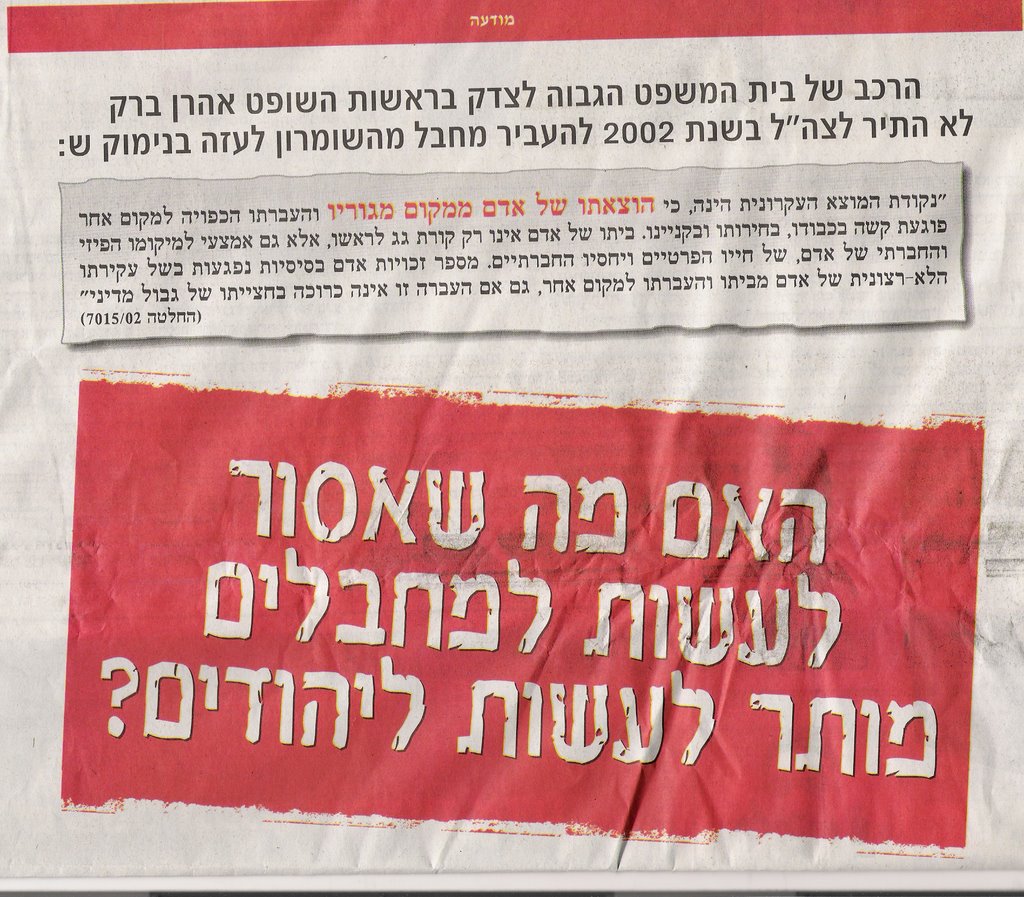
What is Prohibited for a Terrorist is Permitted for a Jew?

Below is a scanned image of the advert that appeared in Firday's Ha'aretz signed by some 120 professors, lawyers, fomrer senior military officers and others protesting against the orders presented to Jewish residents of Judea and Samaria estranging them from their homes. It is sponsored by the Professors for a Strong Israel, the Land of Israel Legal Forum and the Security Forum for National Endurance

It is based on a Supreme Court decision, 7015/02, to wit, removing a person from his home forcibly is injurious to his honor, his freedom and his property rights.

The ad's message is:

What is Prohibited to Do to a Terrorist is Permitted to be Done to a Jew?


What Israel Wouldn't Dare Do

Israel wouldn't dare demolish an Arab village and transfer 3200 residents, now, would it?

But Egypt would and for archeology.


Bulldozers have moved in to demolish houses in the Egyptian village of Qurna which sits on top of dozens of pharaonic tombs in Luxor.
The Egyptian government is determined to move the 3,200 families of the village to an alternative settlement it has built a few kilometres away.

Officials say emptying out the village will enable them to explore the tombs and to protect them from water damage.

An official ceremony was held and the bulldozers moved in.

They demolished four uninhabited mud brick houses in the village of Qurna, very near the Valley of the Kings in Luxor.

Many villagers have already left to the new settlement of Taref built by the Egyptian government at a cost of $31m (£15.6m).

Qurna sits above dozens of ancient Egyptian tombs, part of the huge necropolis of Thebes on the west bank of Luxor.

Over the years, the villagers are believed to have dug many of the tombs under their houses and to have sold much of what was in them.

But officials say now they will be able to further explore the tombs and to protect them from water damage coming from the village.

The government has wanted to move the Qurnawis for 60 years but it is only now that it has completed an alternative village for them.

Many villagers, however, complained that the new houses are too small for their families and that they are being cut off from their fields and their livelihoods in the tourist trade.

The governor of Luxor says it will take a month and a half to demolish the village but some Qurnawis insist they will not leave.

The Not (too) Gay Arab

The NYTimes Sunday Magazine takes on the subject.

The opening:-

Mostafa Bakry has a knack for reinventing himself. He is an old-school Arab nationalist, newspaper editor and parliamentarian, and has managed to keep himself in the middle of the Egyptian political scene for almost two decades. He rails against decadence, against corruption — anything that can get the otherwise sleepy Egyptian public excited. This past July, he took on the issue of homosexuality, introducing a motion in Parliament calling for censorship of several scenes in a popular new film, “The Yacoubian Building,” and denouncing the racier parts of the movie as “spreading obscenity and debauchery.” One of the central characters in the story — a mosaic of downtown Cairo life complete with political intrigue, love triangles, the specter of extremism and more — is an affluent, dashing, Francophone newspaper editor who happens to be gay. He has an affair with a simple soldier from the countryside, and thus begins a tale of lust that ends in murder.

“It is a travesty,” Bakry told me not long ago when we met in the downtown Cairo office of his newspaper, Al Osboa (“The Week”). Shelves around his desk were stuffed with plaques, honorary degrees and dozens of gilt replicas of Jerusalem’s Dome of the Rock. He fingered fancy prayer beads as he expounded in the way one would to an adoring crowd. “The American agenda is promoting the rights of homosexuals,” he said in Arabic. “I am not against freedom of expression, but this abnormal phenomenon should not be presented as natural. Even if it has roots here, it is rejected by society. And by Islam.”


and the end:-

As I prepared to leave Cairo at the beginning of the fall, I received an e-mail message from M., the businessman from the Queen Boat, since relocated to the States. “I sit here, and the Americans talk about something called Islamic fascism, the Arabs go on about their values,” he wrote. “All of us, and I don’t mean gay men, I mean all of us who don’t fit the norm — democracy activists, queens, anything — it’s us who get branded as Western, fifth columnists. We pay the price.”

The rest.

Compromise?!

Well, now we know:-

According to a position paper written by Mossawa - the Advocacy Center for Arab Citizens in Israel and presented in a conference in Nazareth on Friday, Israeli Arabs want the right to return to villages abandoned in 1948, educational autonomy and changes to the Israeli flag and national anthem.

The paper, written in close coordination with the Israel Higher Arab Monitoring Committee, was presented as part of the week-long Second Annual Days of Mossawa Festival and Nazareth Film Festival, which ended Saturday.

"Our goal is to achieve a historic compromise with the Jewish community in Israel," Mossawa Center director Jafar Farah told the conference. "The move by refugees of 1948 to their villages will not change the demographic balance or endanger the Jews. Unlike the refugees in Arab states, we are [already] here," Farah said. "The internal refugees [residents forced to leave their villages in 1948 who moved to other Arab communities within Israel] represent about one-fourth of the Arab population in Israel today."


From Mossawa's website:-

The formal legal status of the Arab citizens of Israel has always been unclear, in a large part due to the double definition of the state as both Jewish and democratic. Although one in every five Israeli citizens is a Palestinian Arab, the Israeli government has yet to recognize this group as a national minority. Instead, the government refers to the Arab minority as "non-Jews", or generally as "minorities". The tensions between the Jewish and democratic aspects of the state have existed since the Proclamation of Independence, which simultaneously declared the historic right of the Jewish people to Israel as a homeland and called upon the Arab inhabitants of Israel to "participate in the up building of the State on the basis of full and equal citizenship."

The double definition of the state as both Jewish and democratic is problematic. Many theorists argue that these definitions are mutually exclusive, and point out that neither definition has been fully realized. For while Israel is defined as the Jewish state, the defining culture of Israel is secular, and the political and legal systems are largely independent of Jewish tradition. Judaism has come to play a symbolic role in Israel, expressed in the national holidays, in the flag and other national symbols, and in terms of demographics. At the same time, Israel cannot be understood as a complete democracy. Despite the electoral system of proportional representation, the Arab minority in Israel has never gained "full and equal citizenship", and a complete democracy requires equal rights for all of its citizens.


Well, I'm glad that's all clear.

A Friday Morning Picture


I took the above picture on Agron Street in Jerusalem this past Friday.

A group of bartender novices were practicing tossing around bottles in a sort of attempt to become proficient at juggling.

The two Orthodox people passing by were a bit astounded.

The Condi Robust Rice Report

Another follow up on the Secretary of States' opinion:

SECRETARY RICE: Back to the question of the territories for the Palestinian state. First of all, the United States has made clear that we expect it to be a viable and contiguous state when it is created. Secondly, that no actions that are being taken now should prejudge the outcome of a final status agreement; that means, very clearly, that if actions are being taken now, they will not be considered by the United States to have prejudged the outcome of final status. The third point is that we have made very clear that Israel has obligations under the roadmap and that the obligations on settlements are clearly articulated in the roadmap. And so those principles guide American policy, they guide our discussions with the Israelis just as obligations under the roadmap guide our discussions with our Palestinian partners as well.


From Secretary of State Condoleezza Rice's remarks at her meeting with Mahmoud Abbas at Jericho on November 30, 2006

Friday, December 01, 2006

Taliban Justice

Disembowelled, then torn apart: The price of daring to teach girls

The gunmen came at night to drag Mohammed Halim away from his home, in front of his crying children and his wife begging for mercy.

The 46-year-old schoolteacher tried to reassure his family that he would return safely. But his life was over, he was part-disembowelled and then torn apart with his arms and legs tied to motorbikes, the remains put on display as a warning to others against defying Taliban orders to stop educating girls.

Mr Halim was one of four teachers killed in rapid succession by the Islamists at Ghazni, a strategic point on the routes from Kabul to the south and east which has become the scene of fierce clashes between the Taliban and US and Afghan forces.

More Archeological Discoveries At Shiloh

Another section of the mosaic floor:


And another:


And, of all things, a baptismal fount:


We're talking about a Byzantine Basilica built around 385 CE.

And there's more to come.

Palestinian Democracy? Really Now, Rice

Interview With Katie Couric of CBS News

Secretary Condoleezza Rice
Dead Sea, Jordan
November 30, 2006

QUESTION: Meanwhile, I (inaudible), but I have one question about the Palestinian situation. You have had separate meetings today with Israeli Prime Minister Olmert and Palestinian President Abbas. Is there any progress being made in that, and do you, in any way, feel that solving the Israeli-Palestinian issue is even more important than solving Iraq?

SECRETARY RICE: Oh, I think these are both important on their own merits. And they are both a part of a different kind of Middle East in which you would have a Palestinian state, Israel and Palestine living side by side in democracy and peace; and Iraq democratic and able to be a positive force in the region, unlike Saddam Hussein's regime that has been such a negative force, ever since that regime was in power.

Those are both pillars of a different and truly stable Middle East that has a democratic future. So we will spend every effort -- and I said to Prime Minister Olmert and to President Abbas today, the President is committed and I am personally committed to accelerating, to intensifying our efforts to try and help the Palestinians and the Israelis advance toward a two-state solution. There's a little opening today as a result of the ceasefire which we hope will be consolidated and extended; as a result of Prime Minister Olmert's positive speech and offering a hand to their Palestinian partner; and as a result of the very strong leadership efforts that President Abbas is making to try to resolve the Palestinian political process. These are elements of an opening. It's going to take hard work. It's going to take good will and heart, but we will do everything that we can to try and make progress towards a two-state solution.

Rose Mattus o"h

Rose Mattus has died.

Rose Mattus, co-founder of Haagen-Dazs, dies at 90

Rose Mattus, who launched Haagen-Dazs ice cream with her husband more than four decades ago, has died. She was 90.

Mattus died Tuesday, according to Gutterman-Musicant Funeral Directors in Hackensack, where the funeral was held Thursday. Her cause of death was not immediately available.

Her husband, Reuben Mattus, died in 1994.

Mattus, who lived in Cresskill, had been the controller of Haagen-Dazs Inc., which by 1961 had morphed from her husband's family's decades-old Bronx, N.Y., business into a new company now known for its rich desserts with high butterfat and little air.


Rose was a supporter of Yesha projects.

Here's a plaque in Hebron:


There's a book on her: The Emperor of Ice Cream by Rose Mattus with Jeanette Friedman, The True Story of Haagen Dazs Ice Cream and here's a picture of her with the benefactors of Beth El:


She was also a great fan and supporter of Bibi Netanyahu.