
In Balfour's mind, did a Jewish national "home" mean a "state"?
Showing posts with label Arthur Balfour. Show all posts
Showing posts with label Arthur Balfour. Show all posts
Sunday, March 21, 2021


Saturday, November 04, 2017
Balfour Day 1921
On Balfour Day 1921, Arabs in Jerusalem rioted.
They threw stones at Jewish shops in the Old City after exiting the Temple Mount.
And they killed Jews. The report in Davar from a summary made on July 17, 1936:
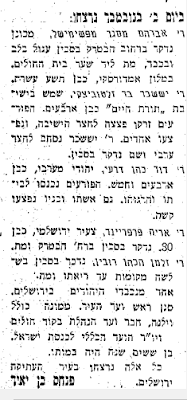
Avraham Messner had served as a defense volunteer the previous evening and the next day was accompanying a woman and her daughter in Batrak Street (today's David Street) in the Old City when he was stabbed in the heart and liver. He was 25.
David Yeshayhu Cohen Deri was 45 and a shoe repairer. Arabs broke into his house near the Western Wall and killed him.
Yissacher Dov Zlatovitsky was 40 and was studying at the Torat Hayyim Yeshiva in the Muslim Quarter. He was wounded when Arabs threw a bomb into the courtyard and then was dragged outside where he was stabbed to death.
Aaron Aryeh Freind, 18, was seriously wounded while walking outside the Amdursky Hotel, located, today's Petra Hotel. He died in the lobby.
Zalman Baruch Rubin, at 60 the oldest victim, was hit over the head and then stabbed three times in the chest. He died a week later from his wounds.
Balfour Day: Arabs killing Jews for a century.
^
They threw stones at Jewish shops in the Old City after exiting the Temple Mount.
And they killed Jews. The report in Davar from a summary made on July 17, 1936:

Avraham Messner had served as a defense volunteer the previous evening and the next day was accompanying a woman and her daughter in Batrak Street (today's David Street) in the Old City when he was stabbed in the heart and liver. He was 25.
David Yeshayhu Cohen Deri was 45 and a shoe repairer. Arabs broke into his house near the Western Wall and killed him.
Yissacher Dov Zlatovitsky was 40 and was studying at the Torat Hayyim Yeshiva in the Muslim Quarter. He was wounded when Arabs threw a bomb into the courtyard and then was dragged outside where he was stabbed to death.
Aaron Aryeh Freind, 18, was seriously wounded while walking outside the Amdursky Hotel, located, today's Petra Hotel. He died in the lobby.
Zalman Baruch Rubin, at 60 the oldest victim, was hit over the head and then stabbed three times in the chest. He died a week later from his wounds.
Balfour Day: Arabs killing Jews for a century.
^
Friday, August 24, 2012
On Cogan's Bluff - Huffington Post Comments
These three comments of mine were left at a Huffington Post article by one Dr. Charles G. Cogan, Associate, Belfer Center for Science and International Affairs at Harvard's Kennedy School (his site is here)
And to someone who wrote:
I commented:
And to another who wrote:
I responded:
The last two are your regular anti-Zionist trollers but that Cogan should ...compose such inanities? Worse, having had a "37-year career in the CIA, ...23 of them overseas...in India, Congo, Sudan, Morocco, Jordan and France. From 1979-1984, ...chief of the Near East and South Asia Division in the Directorate of Operations, and from 1984-1989, ...CIA chief in Paris", it is now obvious how administrations could be misled and ill-advised.
For example, on the definition of Palestine, Cogan writes:
First of all, indeed, it was only the Jewish people who had any definition of the country as a geo-political entity which we termed Eretz-Yisrael. The Ottoman administrative boundaries changed and surely did not create a recognizable "country" per se. The Arabs were not "Palestinians" but until the early 1920s, and even later, considered themselves as "Southern Syrians" and demanded the Mandate be joined to that of Syria under France.
Secondly, Transjordan, which surely did not exist, as implied, as a country, was actually part of the Palestine Mandate until 1946 at which time, when applying for acceptance to the UN as an independent country, was refused because the US State Department accepted the Zionist argument that only when the Mandate ended and the Jewish national home was reconstituted could any part of the original territory be separated from what should become the Jewish national home.
Thirdly, Cogan's bluff, that "the Balfour Declaration called for a Jewish national home in 'Palestine' which later became defined, per above, as ending at the Jordan River" is untrue.
Article 25 of the Mandate decision reads:
There was no 'ending' at the Jordan River. In addition to the continued administration of that area by the High Commissioner sitting in Jerusalem, as mentioned previously, there was an acquiescence to Britain's move in March 1921, first at the Cairo Conference and then in Jerusalem at the end of the month, to 'postpone' and to 'withhold application of provisions' but that was but a temporary situation, at least as conceived in 1922.
Even the September 1922 memorandum reads ""In the application of the Mandate to Transjordan, the action which, in Palestine, is taken by the Administration of the latter country will be taken by the Administration of Transjordan under the general supervision of the Mandatory." And also, "From that point onwards, Britain administered the part west of the Jordan as Palestine, and the part east of the Jordan as Transjordan. Technically they remained one mandate...".
Is Cogan truly knowledgeable of such matters or is more a propagandist?
Moreover, as Eli Hertz points out, The Mandate for Palestine "laid down the Jewish legal right under international law to settle anywhere in western Palestine, the area between the Jordan River and the Mediterranean Sea, an entitlement unaltered in international law [done by] Fifty-one member countries - the entire League of Nations - unanimously...on June 30, 1922, a joint resolution of both Houses of Congress of the United States unanimously endorsed the 'Mandate for Palestine'...". And there was the Anglo-American Convention of 1924 which repeated the commitment.
So, whether Cogan likes it, or not, the Balfour Declaration was part of the sense of the US Congress, too.
It is sorrowful that the Kennedy Center thinks Cogan is employable.
^
This assertion is woefully inadequate for a scholar: "But how could a mass influx of Jews into Palestine not prejudice the "civil and religious rights" of existing non-Jewish communities there? The Balfour Declaration stands, along with the partition of India, as an icon to the micawberish policies of the British Empire at the start of its decline."
How? By they becoming citizens of the Jewish state which is what happened to the Arabs that stayed in the borders of Israel after 1948, preferring not to run away nor fight in a war of aggression in violation of the UN recommendation that indeed a Jewish state be established. That the state was to be Jewish was not in doubt; its borders in the end depended on Arabs losses after they sought to eradicate the nascent state.
"Civil and religious rights" are quite obviously not national nor political rights. The Arabs (actually the non-Jews, since that is the term used; Arabs never even being mentioned and that was purposeful) were not to gain such rights but only civil, personal and religious.
Mr. Cochran is subverting the history as well as the language employed.
And to someone who wrote:
For the record:
The 1922 League of Nations British Mandate for Palestine was a Class A Mandate, i. e, Palestine was to be administered by Britain AS A WHOLE until its citizens were able to assume democratic self-rule. By incorporating the Balfour Declaration the mandate did facilitate Jewish immigration to "secure the establishment of the Jewish National Home," but it did not call for the creation of a Jewish state or homeland in Palestine or any form of partition. As declared in the Churchill Memorandum (1 July 1922), "the status of all citizens of Palestine in the eyes of the law shall be Palestinian, and it has never been intended that they, or any section of them, should possess any other juridical status."
Furthermore, regarding the British Mandate, as approved by the Council of the League of nations, the British government declared: "His Majesty’s Government therefore now declare unequivocally that it is not part of their policy that Palestine should become a Jewish State." (Command Paper, 1922)
I commented:
That the Balfour Declaration "did not call for the creation of a Jewish state or homeland in Palestine" is a mis-comprehension of the legal process which decreed very much so that a Jewish homeland was to be established. That process was (a) Balfour declaration.; (b) deliberations at Versailles peace Conference 1919; (c) attempted Feisal-Weizmann agreement 1919; (d) San Remo Conference decision, April 1919; (e) League of Nations awarding of Mandate, July 1922, Sept. 1923. It was this string of decisions that decided that no Arab state would arise in Palestine but in Syria, Lebanon, Mesopotamia in addition to Egypt and Saudi Arabia.
And again, British policy could not override League of nations and in 1939, Zionists went to Geneva to appeal against the British White Paper which completely subverted the essence of the Mandate. But WW II broke out, halting procedure.
And to another who wrote:
Both Churchill and the MacDonald White paper rendered Balfour moot.
I responded:
Ridiculous. British statements of colonial office or foreign office policies could not override a decision of a body such as the League of Nations. even the 1947 Partition plan of the UN was but a recommendation.
The last two are your regular anti-Zionist trollers but that Cogan should ...compose such inanities? Worse, having had a "37-year career in the CIA, ...23 of them overseas...in India, Congo, Sudan, Morocco, Jordan and France. From 1979-1984, ...chief of the Near East and South Asia Division in the Directorate of Operations, and from 1984-1989, ...CIA chief in Paris", it is now obvious how administrations could be misled and ill-advised.
For example, on the definition of Palestine, Cogan writes:
"The territory of Palestine was not defined until September 1, 1922 as a line "drawn from a point two miles west of... [Aqaba] up the center of the Wadi Araba, Dead Sea and River Jordan to its juncture with the River Yarmuk; thence up the centre of the river to the Syrian frontier." This was the boundary between Palestine and Transjordan... the Balfour Declaration called for a Jewish national home in "Palestine" which later became defined, per above, as ending at the Jordan River..."
First of all, indeed, it was only the Jewish people who had any definition of the country as a geo-political entity which we termed Eretz-Yisrael. The Ottoman administrative boundaries changed and surely did not create a recognizable "country" per se. The Arabs were not "Palestinians" but until the early 1920s, and even later, considered themselves as "Southern Syrians" and demanded the Mandate be joined to that of Syria under France.
Secondly, Transjordan, which surely did not exist, as implied, as a country, was actually part of the Palestine Mandate until 1946 at which time, when applying for acceptance to the UN as an independent country, was refused because the US State Department accepted the Zionist argument that only when the Mandate ended and the Jewish national home was reconstituted could any part of the original territory be separated from what should become the Jewish national home.
Thirdly, Cogan's bluff, that "the Balfour Declaration called for a Jewish national home in 'Palestine' which later became defined, per above, as ending at the Jordan River" is untrue.
Article 25 of the Mandate decision reads:
In the territories lying between the Jordan and the eastern boundary of Palestine as ultimately determined, the Mandatory shall be entitled, with the consent of the Council of the League of Nations, to postpone or withhold application of such provisions of this mandate as he may consider inapplicable to the existing local conditions, and to make such provision for the administration of the territories as he may consider suitable to those conditions...
There was no 'ending' at the Jordan River. In addition to the continued administration of that area by the High Commissioner sitting in Jerusalem, as mentioned previously, there was an acquiescence to Britain's move in March 1921, first at the Cairo Conference and then in Jerusalem at the end of the month, to 'postpone' and to 'withhold application of provisions' but that was but a temporary situation, at least as conceived in 1922.
Even the September 1922 memorandum reads ""In the application of the Mandate to Transjordan, the action which, in Palestine, is taken by the Administration of the latter country will be taken by the Administration of Transjordan under the general supervision of the Mandatory." And also, "From that point onwards, Britain administered the part west of the Jordan as Palestine, and the part east of the Jordan as Transjordan. Technically they remained one mandate...".
Is Cogan truly knowledgeable of such matters or is more a propagandist?
Moreover, as Eli Hertz points out, The Mandate for Palestine "laid down the Jewish legal right under international law to settle anywhere in western Palestine, the area between the Jordan River and the Mediterranean Sea, an entitlement unaltered in international law [done by] Fifty-one member countries - the entire League of Nations - unanimously...on June 30, 1922, a joint resolution of both Houses of Congress of the United States unanimously endorsed the 'Mandate for Palestine'...". And there was the Anglo-American Convention of 1924 which repeated the commitment.
So, whether Cogan likes it, or not, the Balfour Declaration was part of the sense of the US Congress, too.
It is sorrowful that the Kennedy Center thinks Cogan is employable.
^
Sunday, August 22, 2010
Schneer Sneers
I am not spending $30 for this book, "THE BALFOUR DECLARATION: The Origins of the Arab-Israeli Conflict" by Jonathan Schneer.
Even Tom Segev notes:
But with only one (!) reference to Jabotinsky, and that only in direct connection with the Jewish Legion and not any diplomatic work of Jabotinsky of which there is a record, the book is worthless as an academic source.
As long ago as 1956, Jabo's first biographer, Joseph Schechtman, in Vol. 1, pgs. 250- 253, brings documents and quotations including Weizmann's remark that his diplomacy for the Balfour Declaration was construcrted on the Jewish Legion:
Schneer could have argued against this interpretation but to ignore it?
That would be sneering in my book, Mr. Schneer.
- - -
Even Tom Segev notes:
The other part, which Schneer neglects to explore, was the genuine admiration many of Britain’s leaders, including Prime Minister David Lloyd George and Balfour himself, felt for the Jews and their history. These men were deeply religious Christian Zionists. They had grown up on the Bible; the Holy Land was their spiritual home. Modern Zionism, they believed, would fulfill a divine promise and resettle the Jews in the land of their ancient fathers.
As part of this context, Schneer expertly analyzes the passionate and fascinating controversy between non-Zionist and Zionist Jews that preceded the Balfour declaration. The Zionists spoke in the name of Jewish nationhood; their Jewish opponents denied that Jews even constituted a separate nation.
But with only one (!) reference to Jabotinsky, and that only in direct connection with the Jewish Legion and not any diplomatic work of Jabotinsky of which there is a record, the book is worthless as an academic source.
As long ago as 1956, Jabo's first biographer, Joseph Schechtman, in Vol. 1, pgs. 250- 253, brings documents and quotations including Weizmann's remark that his diplomacy for the Balfour Declaration was construcrted on the Jewish Legion:
I built on this foundation
Schneer could have argued against this interpretation but to ignore it?
That would be sneering in my book, Mr. Schneer.
- - -
Thursday, November 15, 2007
Balfour Made No Blunder
There's a new book out in England, "BALFOUR: The Last Grandee" by RJQ Adams J Murray.
The reviewer has this to say about the famous declaration:-
Here's the rather short comment I sent (as I was limited in characters):-
The reviewer has this to say about the famous declaration:-
...Curzon subsequently became the most travelled man who ever sat in a British cabinet, a statesman with an unsurpassed knowledge of foreign affairs. Yet on nearly all the Asian questions that divided the two men between 1903 and 1925, it was Balfour’s views that prevailed with their colleagues.
History has revealed the folly of this, most notably over the 1917 Balfour Declaration that advocated a Jewish “national home” in Palestine, where 90% of the population was Arab. Curzon knew Palestine, he had governed Muslims, and he realised that Zionism could be implemented only through a combination of oppression and expulsion of the native population. But Balfour, who knew little about Arabs or the Middle East, was determined to pursue a policy that has produced conflict and misery ever since.
For someone with experience of sectarian problems in Ireland, it seems incredible that he did not foresee what would happen in Jerusalem. His biographer, who likes to see the brighter side of his subject’s mistakes, admits here that Balfour’s “reasoning failed him”, but he does not quote the letter to Curzon in which the foreign secretary confessed that he did not care about “the desires and prejudices” of the Palestinian Arabs. Perhaps he would have worried more about the verdict of the distinguished Israeli historian, Avi Shlaim, who – as recounted on this page – has recently described the declaration as “crooked”, “catastrophic” and a “colossal blunder”.
Here's the rather short comment I sent (as I was limited in characters):-
Assigning David Gilmour to review a book on Balfour to run amuck on the 1917 Declaration recognizing the reconstitution of the Jewish National home is akin to handing a pyromaniac a lit candle in a gunpowder storeroom.
Besides Gilmour being anachronistic (in 1917 there were no "Palestinian Arabs" as they referred to themselves as Southern Syrians), his broadside about 'failed reasoning' is misplaced. The Declaration was a Cabinet statement and had been revised many, many times with the views of allies and others taken into consideration. British sympathy for Jewish restoration in the Land of Israel preceded Balfour by more than century and it was thought the correct thing to do morally and historically.
The Arabs spurned all compromise, turned to terror attacks on innocent civilians as early as 1920 and sought the politicide of a country. That was not crooked but criminal.
Subscribe to:
Posts (Atom)







 Posts
Posts


