Showing posts with label Palestinianism. Show all posts

Sunday, December 07, 2025

How Oren Yiftachel Sees Zionism

How do Israeli academic anti-colonialists who identify with the cause of a liberated Palestine view Zionism? What is their conceptual thinking? How do they grasp the historical record?

One prominent such figure is Oren Yiftachel. As his biography attests, he is a product of Australia's higher education, home to the deveklopment of post-colonial studies.

I have selected an excerpt from a recent article, published in Hebrew in the Van Leer Institute's journal Theory and Criticism that recently appeared. Even the most cursory reading as well as a nominal knowledge of Jewish nationalism can easily notice that Yiftachel chooses to denude all historic depth of Jewish attachment to, residence in and returning to the Land of Israel over a 3,000 year period.

There is an absence of the literature, the religious rituals and cultural customs attached to the land, the various Returns of Zion, prayers and poetry, laws and commandments, financial support for the communities living in the Land during the centuries of Exile and so much more. He adopts fully the approach poularized by A.B. Yehoshua in his essay "Between Right and Right" [translated from his Hebrew Bein Zechut Le-Zechut], Doubleday, 1981 in which, as one reviewer puts it, he "proposes justifications for Israeli statehood in terms of universal morality rather than particularistic religious entitlement.".

On the other hand, the Palestinian narrative, all theoretical, lacks any critical review or detailed attention from Yiftachel. They, in good part, are "liberal".

The excerpt:

There is a clear disregard in Palestinian academic and political discourse in the Diaspora and the occupied territories for the tragic fate of Jews in the twentieth century and the need to discuss their future in the Middle East, most of which is hostile to Zionism. Zionism is perceived by many Palestinians primarily as an ideology of taking over the land, and not as much of its members formulated it — a national movement to save Jews from anti-Semitism and persecution. Palestinian discourse sometimes lacks the understanding that Israel served and still serves as a land of refuge in a historical homeland, and is characterized by frequent disregard for the legitimate rights of Jews the Israelis have earned them from the family of nations. 

The Zionist project is perceived as one-dimensional – an occupying homogeneous power of which the Palestinians are eternal victims. The critical discussion of the active part of the Palestinians in the disaster that rages upon their people is extremely poor, except for a few exceptions such as the researchers Salim Tamari, Rama Hammami, Asaad Ghanem or Yazid Sayigh, and its lack of an internal critical discussion on the devastating consequences of Palestinian defiance and terrorism in the century of struggle. Also, from the Palestinian discourse is almost completely absent an examining of non-colonial structural factors, such as Israeli nationalism and liberalism, which also shape the conflict and sometimes even moderate it.

And yet, it is important to note that throughout a century of conflict there have been Palestinian voices calling for mutual recognition and division of the land, led by communist leaders such as Emil Habibi and Tawfik Ziad but also prominent figures from the Nashashibi and Dajani families or relatively liberal  organizations led by leaders like Hanan Ashrawi or Mustafa Barghouti.

^


Tuesday, November 26, 2024

Introducing Rashid Rida on Zionism

Anyone who follows pro-'Palestine' Islamic propaganda will recognzie in the excerpts below the source material for the virulent antisemitism, exaggerations and misrepresentations emanating from the Palestinian National Authgority official bodies as well as activists on behalf on 'Palestine'.

They originate from Rashid Rida.

Another scholar claims "As one of the most influential advocates of Arab nationalism and pan-Islamism, we shall argue, Riḍā’s critiques of Zionism and Jewish expansion in Palestine were part of his anti-colonial activities against the ‘Christian’ west." Nevertheless, he notes that Rida asserted as to Jewish goals, "allegedly, they schemed to possess Jerusalem and its neighbouring regions to establish their Kingdom of Israel and turn it into the Temple of Solomon, against the desire of Christians and Muslims (ʿAbduh and Riḍā [1328] 1910, V:139–140)."

He further quotes Rida "Under the title “King of the Jews, their Temple, their Messiah and the True Messiah,” Riḍā stated that the Jews arrogantly disobeyed their prophets, who regularly warned them against God’s punishment if they abandoned His commandments (Al-Manār 30/7: 546–556)."

And Rida becomes starkly clear in this excerpt:

One of Islam’s greatest manifestations, according to Riḍā, was the confirmation of glad tidings of Jesus as a prophet of God and not his son. In this reading, God entitled Muslims to inherit the Holy Land and to build the Al-Aqsa Mosque in the place of the destroyed temple in order to establish the worship of God alone. Riḍā repeated the traditional Muslim view that God placed those who believe in Jesus above the unbelievers (Qur’an Āl ʿImrān 3:55), but that He had struck the Jews with humiliation by making them lose their kingdom until the Day of Resurrection. The Jews, Riḍā said, would follow the Antichrist as their assumed king fighting under his banner in the Holy Land, but Muslims would finally achieve victory upon them and kill them, and the true Messiah would appear and reveal the truth by destroying the Antichrist (Al-Manār 30/7: 554).

And in this:

Muslims did not persecute the Jews but treated them with justice and mercy. He observed that the Jews started to permit each other to reside in Jerusalem around the western side of the wall of the Al-Aqsa Mosque (Al-Buraq), performing the rituals and sacrifices against the will of Muslims and Christians in the world. They had strong hope to multiply their numbers to own the Holy City and the rest of Palestine in preparation for the appearance of the Messiah again as the King of Israel (Al-Manār 30/5: 391). 

Rida also employed the term nakba already in early 1935:

A few months before Riḍā’s death, the Egyptian historian and religious scholar ʻAbd al-Wahhāb al-Najjār (1862–1941) gave a lecture at Jamʿiyyat al-Shubbān al-Muslimīn (Association of Young Muslim Men) in which he maintained that the Jewish Zionist presence in Palestine was to be like a short “summer cloud” that would clear up soon after a great shock, followed by the defeat of the Jews after the restoration of the kingdom of David and the appearance of the Messiah (Al-Manār 34/8: 607–612)...After the lecture, Riḍā stood up and disagreed with al-Najjār in his arguments. Instead of following this apocalyptic way of thinking, Riḍā requested Arabs and Muslims to “take admonition in the Jewish Zionist nakba (catastrophe) by means of the worldly affairs and social natural laws” (Al-Manār 34/8: 608). By this he urged his Muslim readers not to see the Jewish success on the basis of their religious zeal but due to their work to achieve their political goals. 

Rida "called upon Arab Christians and Arab Muslims, supported by other Muslims in the world, to get the benefit of uniting themselves against the growing power of the Jews. In his own words: The doctrine of the Jews in restoring the King of Israel by means of the Messiah is [39] a denial of the religion of Islam and a clear rejection of Christ Jesus, Son of Mary, may blessings and peace be upon him. It was, however, Christ with whom their prophets had preached, but they had denied him. It was also him who warned them against the ruin of their Temple of Solomon so that there would not remain any stone of it."


Here are more excerpts of another researcher:

A reading of Rida’s depictions of Jews as the embodiment of vices and the orchestrators of global-scale conspiracies is useful to the broader discussion on the proliferation of anti-Semitic ideas in the contemporary Arab world. Translations of the Protocols of the Elders of Zion have been available in Arabic since the mid-1920s, and by the late 1920s they were already incorporated as an argument against Zionism. Following the 1948 war, the Protocols proliferated as an explanation for the Arab defeat. However, Rida viewed Jews as the masters of anti-Christian and anti-Muslim conspiracies already at the turn of the century, with no experience of defeat in mind and no foundational hateful European textbook to guide him. It appears that he was acquainted, albeit not through primary sources, with French anti-Semitic expressions as well as with their refutations in France. Anti-Semitic allegations in Istanbul also did not escape him. Ironically and to a large measure, Rida’s developed anti-Semitism reads as accommodation of his original admiration of Jewish virtues with his realization that Zionism was a serious threat...

...Under the title “The Life of a Nation after Its Death: The Zionist Association of the Jews,” Rida revised his earliest impression of Jewish nationalism, and, always the journalist, flattered himself (without justification in this case), for having already written about the Zionist movement in 1898, “when no one else took notice of it.” His analysis failed to distinguish between Zionists and Jews, and disclosed that he was unaware that the movement had won the hearts of only a minority of Jews around the world....

...Apparently confusing, at least in part, Herzl (whose name was not mentioned in the entire article) with the British-Jewish author and Zionist leader Israel Zangwill (1864 – 1926), Rida wrote that Zangwill had recently negotiated the purchase of Jerusalem as well as predicted a massive Jewish return to Palestine and the transformation of the land by the people of Israel into a shining lighthouse in all fields – social, political, judicial, cultural, and agricultural. Rida went as far as positing that Zangwill was wrong in reprimanding the rich Jews for not donating to Zionism...

In 1903, Rida addressed the Jews again...He wrote that no people in the world demonstrated such communal unity and ethnic solidarity as the People of Israel (Sha‘b Isra’il); however, he added that the Jews tended to divert the resources of the nations among which they lived to their own benefit, and harmed themselves by their excessive egotism. This, he argued, was the reason for the persecution of the Jews and their expulsion by all the peoples and nations. Hinting at Jewish ungratefulness, he concluded that while they could find a safe haven only in the Ottoman Empire, they now sought to gain independence and renew their sovereignty in Palestine...

...On January 1908, following a long period of silence, Rida addressed Zionism again, although indirectly. In a Quran exegesis, he disputed the Jewish hope for a Messiah who would renew Jewish sovereignty. He also suggested that the Jews’ dispersion throughout the world, their lack of expertise in warfare and agriculture, and their focus on professions that required little effort, like charging interest-based loans, were impediments that would prevent the realization of their dream of renewed sovereignty. The weakness of the Jews, he argued, was a punishment from God for their infidelity. Only two years later, Rida changed his mind about the potential of Zionism...In December 1910, he presented the Zionist danger in even graver terms: should the Jews realize their plan to take over alAqsa, they would expel the Muslims and the Christians from the Holy Land...

...[In 1914 he wrote] that if Zionist ambitions were ever realized, they would not allow a single Muslim or Christian to remain in Palestine, as they believed that it belonged to the Israelites alone. Furthermore, the Promised Land that the Zionists sought to conquer was not what Muslims defined as Palestine; rather, according to Jewish scriptures and conventions, Palestine stretched to Syria and the Euphrates. Rida based his warning of the prospect of ethnic cleansing on the argument that in the book of Deuteronomy God ordered the Jews not to spare a single soul upon entering the land...


...in an appendix to a Quranic exegesis from 1924, he cautioned that the “Arabs of Palestine,” who were confronted by “two of the world’s strongest nations [the British and the Jews],” could only be saved if they united with the rest of the Arab peoples and tribes to defend Palestine as well as the holy shrines in Mecca and Medina. Yet the underlying objective of this warning – in itself exceptional for his writing during the early 1920s – was not to call for action, but to denounce Sharif Hussein and his family and praise the Sa‘uds. Rida portrayed Hussein’s family as supporters of those who were seeking to implement the “satanic plan” to deprive the Palestinians of their land, i.e., the British and the Zionists. He cautioned the Palestinians against cooperating with the Sharifian family, explaining that while they could boast a distinguished lineage (as descendents of the Prophet Muhammad), they lacked knowledge and honesty...

...until mid-1920...he noted, in an objective manner, that the Jews considered Palestine as their sacred, ancestral land, but neither debated that claim nor insisted that Palestine was a Muslim land that must never be conceded to the Jews as such. That changed in 1924, but in a way that was far from affirming that Muslims were the rightful owners of the land or would eventually have the upper hand against the Zionists. In a Quranic exegesis, Rida suggested in an almost even-handed manner that God had promised the land to both the Israelite sons of Abraham and to the Arab sons of Abraham, who had also been promised additional lands. The promises were kept for both Israelites and Arabs when they acted righteously, but when they sinned they were punished and the land was taken from them...

...Already in October 1928, only days after the tensions over the Wailing Wall began, Rida portrayed events in Palestine as a struggle between Judaism and Islam, as well as between Britain and Islam. In this struggle, the British were assisting the Jews as part of Britains’s “ambitious” and uncharacteristically illconceived plan to subordinate the Arab nation and impose British rule on the Arabian Peninsula and the three holiest shrines – in Mecca, Medina, and Jerusalem. In this struggle, the ultimate goal of the Jews was the destruction of al-Aqsa, the third holiest shrine in Islam, and its replacement with a new Jewish temple...

...Rida elaborated [in December 1929] on the prophecies of a Muslim victory over the Jews, reiterating that those were more reliable than the Jewish prophets’ prophecies of Jewish victory. He mentioned the prophecy that the Jews would give fanatic loyalty to the Dajal, a false Messiah, fight against Muslims and Christians in Palestine and other lands, and be defeated, as well as the Prophet’s words, narrated by ‘Abdullah b. ‘Umar: “I heard Allah’s Messenger saying, ‘The Jews will fight with you, and you will be given victory over them so that a stone will say, ‘O Muslim! There is a Jew behind me, kill him!’”...Zionism, he argued, was a striking example of Western moral corruption, because in Palestine the English had done something they had not done anywhere else: they had created a new people based on the ingathering of a rabble from all corners of the earth, allowing the rabble to usurp the land of another people and to exploit and discriminate against the population in a historically unprecedented way. Thus, for the first time, in late 1929, the Jews were denied in Rida’s journal not only a right to Palestine, but also the right to be considered a nation.

^

Tuesday, October 26, 2021

Sunday, November 17, 2019

Palestinism and Palestinianism

As Vic Rosenthal writes

Palestinism? It is the belief that the Palestinian Arabs were unfairly victimized, dispossessed, colonized, raped, punished, expelled, murdered, degraded, castrated, etc. by the Zionist Jews who created the State of Israel, which continues to do all these things to them. Palestinism holds that this is the single greatest injustice in the world today, and only the replacement of the world’s only Jewish state by an Arab state can rectify it.

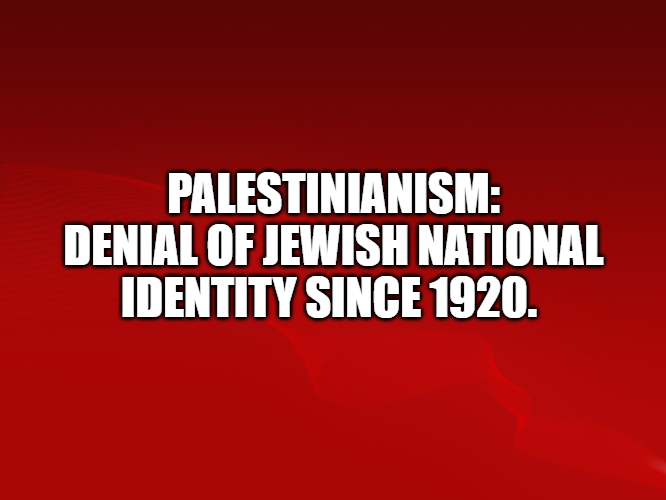
I use a parallell term, Palestinianism, since at least 2011.

Palestinianism is that ideology which promotes a nationalist myth that there is an Arab Palestinian nation.  It is different from all other Arabs.

That they have resided in the area of Palestine for 5000 years.

That Palestine was never a Jewish homeland. 

That, for example, the Temple never existed. And if it did, it was not erected in Jerusalem.

And on and on.

^

Saturday, September 14, 2019

Extinctification


When pro-Palestinian groups use the word "peace", what do they mean?

Well, in the case of this campaign of "Wear the Peace", which pushes clothing, jewellry and accesories, it can mean "eradicate Israel".

How?

Check out this necklace:


(I love how the Hebrew shows up thanks to whatever engine is involved).

Do you see any geographical illustration/representation of Israel in that map?


That's what I meant when I used the word "extinctify" in a tweet.

^

Thursday, October 11, 2018

Again, Is "Palestine" Really Part of Syria?

As Zachary J. Foster details in his 2011 Georgetown University MA thesis, "Arab Historiography in Mandatory Palestine, 1920--1948", many Arab historians

considered Palestine a constitutive part of Syria. Bahri, for instance, writes that Haifa is among the “mother cities of Syria broadly and Palestine specifically.” In his brief biography of Abid Baha’ Abbas, the founder of the Bahai faith, Bahri also lists all of the countries or regions with Bahai populations: Iran, Japan, China, India, Egypt, Syria (Suriyya), Europe and America. Insofar as there were many Bahai in “Palestine,” it only makes sense that Palestine was assumed as part of Syria in Bahri’s laundry list, or else it would have been an embarrassing oversight to neglect Palestine. Barghouthi and Totah add that Palestine “remained part of Syria, and a natural border did not separate it (Palestine) from it(Syria), and was not distant from it racially or historically, and therefore historians have not singled it [Palestine] out with a distinct name but rather they have related to it [i.e. naming, in terms of] the peoples and tribes living in it.”


If you are worried that his sources are not solid, a footnote there reads:

On the proposals for a Syria (including Palestine) -- Egypt union before the war, see Ayyad, Arab Nationalism,59; Lunts, “Shorishayha ve-Mekorotayha,” 34; Gooch and Temperley, British Documents, 824-5; During the war:Tamari, Am al-Jarad, 75-6; Blyth, “The Future of Palestine,” 85; And after the war: Mir’at al-Sharq, 23 December 1926. The proposals for a Palestine-Syria unification all come after the war and extend well into the late 1920s: see the resolution of the First Palestinian National Congress; responses in Palestine to the King-Crane Commission; petitions of the Muslim-Christian Associations; Resolution of the First Syrian National Congress in 1919, petitions produced by Nablusite notables, all of which opted for unity with Syria in the 1918-1920 period. On these proposals, See Porath, The Emergence, 81-2; Muslih,The Origins 131-154; Qasmiyya, “Suriyya wa al-Qadiyya al-Filastiniyya”; For more pro-Syrian unity rhetoric in the post 1920 period, see resolutions of the fifth Palestinian National Congress in 1922, cited in Kimmerling, “Process of Formation,” 80, n.62; Mir’at al-Sharq, 24 May 1925, 4 November 1926; Mansur, Tarikh Nasira, 120; Zionist report on the Third Palestinian National Conference, CZA,L4/768; Zionist report on Palestinian Activities in America. New York, 28 March 1922, CZA A185/56; ZionistReport on the Arab Movement, 1928, CZA, L9/349; For unity with the Hijaz, see Filastin, 10 September 1921; 14 March 1924; 19 June 1925

Quite simply, Foster considers the writing of a unique "Palestine history" to be


the projection of contemporary prerogatives on to the past.

Foster continues his review of the geography and history books written and published at the time and adds

in 1938 George Antonius uses the word Syria to describe the entire Bilad al-Sham region throughout his book. “Of the countries surrounding Egypt, Syria was the most important from a military point of view.” That is to say, it was still perfectly natural for him to write Syria to refer to places like Bir Sab’ and Ghazza. al-Nimr adds in 1938 that Nablus is located in the heart of Southern Syria (qalb Suriyya al-Janubiyya).

He continues

the tendency to consider Palestine a part of Syria that was suggested in Bahri, al-Barghouthi and Totah, Antonious and Canaan is consistent with the geographical studies of the period written by Arabs residing in both Palestine and Syria. In the first place, let us recall that discussions of Palestine are included in the classic histories of Syria written by Yusuf Dibbs and Jurji Yanni in late nineteenth and early twentieth centuries. The first Jughrafiyat Filastin was published in 1921 and seems to have been destined for the Mandatory education system. The authors, Totah and Khuri, write that there is no natural border between Syria and Palestine...For Sabri Sharif Abd al-Hadi’s Jughrafiyat Suriyya wa Filastin al-Tabi‘iyya, publishedin 1923—six years after the British arrived in Jerusalem—there is no neat border between Syria and Palestine. In some cases, the plains and mountains of Palestine and Syria bleed into one another.

By the way, on this book, Foster observes

It is worth noting that Rashid Khalidi misinterprets this book, claiming that its importance lies in“the fact that all over Palestine, students were already learning that Palestine was a separate entity, a unit whose geography requires separate treatment [from Syria].” Khalidi, Palestinian Identity, 174. As we indicated above,however, this book suggests much the opposite: that there was great confusion over what was Palestine and what was Syria, and that Palestine was a region within Syria. We must be careful to go to the primary sources before accepting Khalidi’s interpretation of the evidence..

Foster pursues the subject further and as it is important, here is another longish excerpt from his academic study:

Palestine was inextricably tied to a larger territorial unit, Syria. In some cases it was a constitutive part of it and in other cases Palestine did not include Haifa, Acre, Tiberias, Tzfat, Nazareth, the Bisan valley and other areas. When we consider that,in the late Ottoman period, “Palestine” had no administrative status and “Palestinians” called themselves “Syrians,” this is not so surprising. The attempt by the British and French to transform much older conceptions of space and self, usually by resort to force of arms, did not happen overnight. I would suggest that the attempt to trace the “earliest manifestations” of the national or proto-national identity, as Khalidi, Gerber and Fishman have done, has inadvertently reified the naturalness and inevitableness of the development of nation-state borders, geographies and loyalties in the region, things that were simply not indigenous to the region and were brought to the region by the colonial use of force.Another implication of this section is that the various pro-Syrian unity positions taken by theArabs of Palestine from 1918-1920 were probably not as “fleeting” and “ephemeral” as everyone seems to believe. The decision of the First Palestinian National Congress to call Palestine“Southern Syria” in hopes of uniting with Faysal’s government in Syria, may itself have been an innovation, but in name rather than substance. The idea that Palestine was a part of Syria continues to be perfectly acceptable to Palestine’s Arabs in the 1920s and even as late as the 1930s and 1940s. We have examined city-loyalties, Arab and Islamic loyalties and the role of the regional epicenters.

As Foster concludes this chapter in his study

Today scholars want to know when a Palestinian identity first emerged, but they seem much less interested in determining what people themselves in the 1920s and 1930s actually cared about.

And then makes sure we are clear about the facts and how Arab historians today interpret them
while Khalidi is right to point to the existence of an incipient Palestine loyalty in the 1914-1923 period, he grossly over exaggerates both its importance for the people who felt it and its prevalence in the general population. The historical works would seem to support what Salim Tamari has described as a kind of “cultural nihilism” – the idea that Palestine was not particularly important or distinct apart from its Bilad al-Sham context, at least in the 1920s and also in the early 1930s...not a single book was written on the history of Palestine out of sheer passion and love for Palestine until the 1930s. As we stated previously, this is in complete contrast to the city histories – all of which seem to have been written out of the authors devotion and love for the home town. Continuing along to the 1930s, regional, Arab and Palestine histories remain roughly equal in number until 1936, at which point the conflict among the British, Zionists and Palestinians reached a breaking point with the outbreak of the General Strike in Palestine in the Spring of 1936, the first phase in a 3-year long revolt, today known as the “Great Arab Revolt.” Only then did interest in Palestine soar and come to dominate historical writing, alongside with Arab histories.

My take from this is that my outlook remains unchanged from when I first began blogging on this aspect: for Arabs, Palestine was a region, not a country. It was not a separate geopolitical entity except as part of Syria. Local patriotism was a result of the clash with Zionism which had a 3000-year history of a concrete conceptualization of what the Jewish homeland's borders were and which the Arabs did not possess.

This is part of what I term "Palestinianism" which is the fabrication, caused by competitiveness with the challenge Zionism confronts the local Arabs, of a history, an identity and a geography.

And from The Invention of PalestineZachary J. Foster, A DISSERTATION
PRESENTED TO THE FACULTY OF PRINCETON UNIVERSITY IN CANDIDACY FOR THE DEGREE OF DOCTOR OF PHILOSOPHY RECOMMENDED FOR ACCEPTANCE
BY THE DEPARTMENT OF NEAR EASTERN STUDIES, November 2017, page 53-54:


_____________

P.S.  Some previous posts:

Here;

Here;

Here;

and an important one here.

_____________

P.P.S.

Foster thought I "politicized" his research.


^

Friday, March 17, 2017

Settling An Argument: Palestine, Palestinians, Palestinization, Palestinianism

I use Palestinianism to describe a phenomenon of an Arab people who never in history shared any specific national identity characteristics that would set them off and make them a special case as a "people".  See here, and also here, for example, and also here for Bat-Yeor.

Palestinianism is


self-mythologising [as in the case of] Palestinianism...the ideology which suggest there is a nationalism for a group of Arabs-who-refer-to-themselves-as-'Palestinians' and which, at its essence, denies the existence of a Jewish People, with its history, religion, culture and history who possess an historic homeland.

No defined national homeland.

So-called national homeland never existed as a political or even an administrative entity.

The name "Palestine" came from the Roman rule over the Land of Israel after 135 CE, although previously a region by that name did exist but was not applied to what is know as Palestine today, whereas Judea was.

Arabs have a non-Arabic name for their national homeland.  Really?

Now see this I caught (red from bottom up):


His conclusion?


"the Palestinisation issue started after the Green Line was erased"


Argument settled?

^

Saturday, November 30, 2013

'Palestinian' Irredentism Tour

Daoud Kuttab writes (thanks to JW) in a story on tourism and the Palestinian Authority

According to the Palestinian ministry, the Israeli tourism office in Rome has published touristic literature stating that “Israel, thanks to a wide range of unique sites such as the old port of Jaffa, and Nazareth, Jerusalem and Tiberias, Bethlehem, Capernaum, Masada, the Dead Sea, Fort Herod and caves near Qumran …” Four of the sites mentioned lie in the Palestinian territories, but Israel is advertising them as part of Israel in an attempt to attract Christian pilgrims from Italy.

Okay, of this list, which four "lie in the Palestinian territories"?


Jaffa
Nazareth
Jerusalem
Tiberias
Bethlehem
Capernaum
Masada
Dead Sea
Fort Herod
Qumran


Bethlehem. Herodian.

I guess "east Jerusalem" would be included. 

But I can't figure out the rest.

Israel had most of the western shore of the Dead Sea, the Qurmran site as well as Masada.

Ah, Daoud makes it clear for us:-

While Palestinian diplomatic and public efforts have focused on Israeli attempts to misrepresent Bethlehem, the announcement by the Israeli tourism office in Italy also names other sites that are clearly part of Palestine. The location of Masada, the Herodian castle and the Qumran caves are all part of the West Bank. These locations constitute what Palestinians hope will become their independent state as part of the universally accepted two-state solution.

This, I would term, is "Palestinian territorial aggrandizement" or, if you wish, "irredentism".   It is also part of the mechanism of Palestinianism - the denial of Jewish national ethos and history.

It also indicates that the 1967 lines do not mean a thing because Masada was always within 1967 Israel. As was Qumran.  I would think that at this rate, Tel Aviv is "part of the West Bank".

As we always suspected and as I always said in my debates with Daoud, "Palestinians" seek Israel's disappearance and that is the true meaning behind the "stages" policy.

Two-state equals one state: Palestine.


^


Monday, October 14, 2013

Yesterday's Three-Thousand Year Old Lie

This appeared on my screen:

Palestinian village continuously inhabited for 3,000 about to be destroyed by Israel

October 14, 2013

The Israeli High Court is set to rule on the forced expulsion of all of the residents of the village of Khirbat Zanuta, southwest of Hebron in the southern West Bank on Monday.

Where is Khirbet Zanuta?

I learn that

Khirbet Zanuta is a Palestinian village in the Hebron Governorate in the southern West Bank, located 20 kilometers south of Hebron. Nearby localities include ad-Dhahiriya to the northwest, Khirbet Shweika to the northwest and the Israeli settlements of Teneh Omarim to the west and Shim'a to the east. The village is adjacent to the Green Line.


And how many people in that 3,000-year old village?

According to the Palestinian Central Bureau of Statistics (PCBS), Khirbet Zanuta had a population of 60 in the 2007 census, an increase from 1997 when six residents were recorded...In 2012 the number of families registered at Zanuta was 27.


In 3,000 years, that's it?  Less than a hundred, I approximate?
 

How large is the village?

The total land area is approximately 12,000 dunams, of which roughly 3,000 are cultivated, mostly with field crops. Much of the remaining land area is considered "open spaces," while one dunam is classified as built-up areas.

Built-up area is ... one dunam?  That's a quarter of an acre?  That's one house.

Odd.  Maybe this is an answer:

Zanuta was a cave settlement of local peoples

That's a lot of cultivated agriculture land for that amount of people, too.

Let's go back to that 3,000-year old claim:

Pottery shards at Zanuta indicate continuous settlement since the Iron Age, and archeologist Avi Ofer has proposed an identification of the site with Dana in the fifth group of Judean cities in the south Hebron hills


Joshua 15: 48-49

And in the hill-country: Shamir, and Jattir, and Socoh; 49 and Dannah, and Kiriath-sannah--the same is Debir; 

Ah, so "Palestinian" doesn't mean a nationality or ethnicity but is simply a term of geography.  After all this, those "Judean cities" were not Arab or Muslim but Jewish. Judah; son of Jacob.  You know, the tribe.

A three-thousand year lie.  From yesterday.

Another "Palestinianism inventivity" fabrication.

________________


UPDATE


a.  Maybe the Khirbeh is akin to an "outpost"?

b.  Seems Amira Hass copied the headline or is that plagiarism?
^

Thursday, May 30, 2013

Jewish Identity vs. Palestinian Disinventivity

You are aware that I have suggested that the Arabs who presume to call themselves "Palestinians" in a paradigm sense of "inventivity" promote an ideology I term "Palestinianism" which is predicated on the disinventivity model of nationalism.

In other words, these Arabs claim to be who they aren't and assert that Jews aren't who they actually are.  In short, they deny the ethos of Jewish nationalism.

In brief:
 
Inventivity is the foundation necessity of Palestinianism

They do that by basically fabricating history, ignoring history and denying history and all the facts thereof.

Identity theft.

Dore Gold wrote Jerusalem Denial.

I have been recording the outrageous statements about the Temple Mount.

And now this:

Al-Quds international institution initiated its global campaign “It is Al-Quds…It will never be Yerushalem”...Yasin Hamoud, director-general of the institution, told a news conference on Wednesday in Cairo that the campaign is aimed at shedding light on the status of Jerusalem (Al-Quds) following 46 years of its occupation.  Hamoud added that the campaign would work on actively involving the issue of Jerusalem in the political and media discourse and rallying the Arab and Muslim streets to provide moral and financial support for the holy city and its people...

...Hamid Al-Ahmer, chairman of Al-Quds institution, stated that the Aqsa Mosque is being exposed to Judaization attempts to build the so called Jewish temple in place of the Dome of the Rock, warning that the daily violations at the Mosque is aimed at dividing it between Muslims and Jews.  Al-Ahmer called on the Arab and Islamic governments and peoples to show firm stance against Israel’s violations in Jerusalem and to adopt a comprehensive strategy to consolidate the Arab and Islamic identity of the holy city.

See what I mean?

^

Tuesday, October 09, 2012

State Department Creationism

Is this discriminatory?


Women in Science Hall of Fame 2013 Program
Deadline for Applications:  October 10, 2012
Description:
The American Consulate General in Jerusalem is seeking outstanding female Palestinian
scientists to honor in the 2013 Women in Science Hall of Fame program.
The U.S. Department of State created the annual Arab Women in Science Hall of Fame program in 2010 to honor accomplished scientists in disparate disciplines ranging from marine science to nuclear physics. For the last two years, U.S. Embassies and Consulates in the Middle East and North Africa (MENA) have identified and honored outstanding Arab women involved in medicine, science, engineering, technology, math, and other fields. These role models have served to inspire girls across the region to study science and pursue scientific careers.
The selected honoree will have her biography and photo posted along with other MENA region
scientists on the web sites of U.S. Embassies and Consulates in the MENA region, including the web page of the American Consulate General in Jerusalem.  She will also be featured in a 2013 calendar and have opportunities to promote the program in the media, mentor other Palestinian women and girls, and participate in a trip to the United States to network with other MENA scientists and learn about the contribution of American women  to scientific innovation,
education, leadership, and public policy formation.
Eligibility Requirements:
This program is open to Palestinian women working in any scientific, medical, technological,
engineering, or mathematical disciplines.
Candidates must:
 Be fluent in English, but not hold U.S. citizenship or be a U.S. legal permanent resident.
 Be willing to participate in exchange programs and welcome opportunities to mentor
women and girls.
 Be a citizen and resident of West Bank, Gaza, or Jerusalem at the time of application and
while participating in the program.

Why?

Because it is only for women?

Of course not.

Because of English language fluency?

Actually, why must English fluency be a requirement?

Is it because one cannot be an American citizen or legal permanent resident?

I don't think so, although can you be an illegal resident of the US?

Because it disallows the "Palestinian diaspora"?  Naw.

But what really puzzles me is how can one be a "Palestinian citizen"?

A citizen usually is understood to be


Is the United States State Department creating, again, a Palestinian state, when there is none existing?

^

Wednesday, May 02, 2012

Jerusalem, Sepharadim and Christians

From a book review of Abigail Jacobson's From Empire to Empire: Jerusalem Between Ottoman and British Rule. reviewed by Thomas Philipp

...Jerusalem('s) importance derived strictly from its assumed holiness...Only with the Crimean War, Jerusalem reappeared in the consciousness of the European powers and it became – via interference with various Christian communities – the object of international relations. Zionist immigration complicated [???] the picture further. The city’s population grew to more than 40,000 at the eve of World War I. This study focuses on a very few but fateful years in the long history of Jerusalem, from the Balkan Wars in 1912 to the establishment of the British Mandate in 1920...her aim (is) to provide a more differentiating picture of three presumably monolithical monotheistic communities or the simplistic dichotomy “Jews vs. Arabs”. She does that mainly by looking at the internal political discussions within each community and ethnicity...

...The hostility between Arab Christians and Jews, for instance, did not arise only with the Zionist issue but was the result of the loss of old trade routes and commercial connections by the Jews throughout the 19th century and a concomitant ascent of some Christian communities in local trade and new export trade in raw materials. Muslim commerce underwent a decline similar to that of the Jews, while European merchants were advancing and with them the Christian Arabs, hence a certain alliance between Muslims and local Jews.

Internal differences in politics within the Jewish community and in the relations to the Arabs are discussed in the third chapter. It throws new light on an aspect that the typical Zionist-Arab narrative is not aware of. At issue is the position of local and usually young Sephardic Jews who enjoyed a modern secular education, knew a variety of languages, including Arabic and Hebrew, and supported the Zionist movement in Jerusalem. But this support never let them become oblivious of the need to foster good relations with the Muslim Arabs and seek their support. There were influential Sephardic communities in other cities, especially in Aleppo, but this group in Jerusalem seems quite unique. They actively – through a newspaper, articles, speeches, and meetings with the Muslims – tried to seek their support or at least their understanding. At the same time they again and again pointed out to the immigrant Zionists that the Arab population had to be considered in their plans. Jacobson’s relational model proves its usefulness also for the period after the Balfour Declaration when a rapprochement between Muslim and Christian Arabs occurred against a newly strengthened Zionism, while the Sephardim Zionist position lost ground between the hardening fronts.


I presume, not having read the book, that the Sepharadi Jews are the heroes, even trying to cooperate with the locals where those European Jews, the 'newcomers', messed things up. Of course, this is a well-known and well-trod approach.
True, Sepharadi Jews did manage to acculturate to the Muslim general society btter than the Ashkenazim - in the early 19th century, Ashkenazi Jews from Safad trying to move to Jerusalem had to disguise themselves as Sephardim. But to employ a term like "complication"?

Nevertheless, the idea that Arab nationalism in the country owes much, if not the utmost, to Christians is to be welcomed. From Antonius on to Habash, if it were not for them, no one would have heard of Palestinianism.


P.S.  EG adds:

let's bear in mind as apparently Ms Jacobson does not, that the British occupying forces fostered "Muslim-Christian Associations" [think Ronald Storrs & Ernest Richmond, as I recall], so the rapprochement between the two groups was not simply a natural result of shared antipathy with the Jewish National Home. [in re this see Porat's book on pal Arab nationalism]. Also recall that Brit officials [Col. Waters-Taylor, etc] encouraged the Nebi Musa pogrom of April 1920.


The term "Zionist immigration" is anachronistic for any period up to 1882. Jews were already a majority in Jerusalem by 1853 but not or not yet political Zionists.

^

Tuesday, May 01, 2012

Benzion Netanyahu on a 'Palestinian Arab People'

In an interview in Haaretz in 1998 (shown here in Hebrew), and passed over in yesterday's obit in Haaretz, Professor Benzion Netanyahu was quite explicit about his thinking on  a so-called 'Palestinian Arab people':-

איני חושב שלערבים המכנים עצמם פלשתינים יש זכות לדרוש מדינה. לי ברור לגמרי שאין עם פלשתיני כלל. אין ולא היה. הקיבוץ הערבי החי בארץ הוא חלק מן האוכלוסייה הערבית הרחבה המכנה את עצמה האומה הערבית. כלומר מה שיש כאן הוא פשוט שלוחה של העולם הערבי. מעולם לא היה קיים עם פלשתיני נפרד. הטענה שקיים עם כזה לא באה אלא כדי להצדיק את התביעה לחיסול מדינת היהודים. ומכיוון שהמציאו לאום, מנסים כיום להמציא לו היסטוריה. מנסים ליצור אילוזיה של עם שלא היה ולא נברא


and in my translation:
 
I do not think that those Arabs referring to themselves as Palestinians possess a right to a state.  For me it is quite clear that there is no such thing as a Palestinian people. There isn't - and there wasn't. The Arab grouping that resides in the Land of Israel is part of a wider Arab population that calls itself the Arab nation/ummah. That is, what is here is simply an extension of the Arab world.  There never existed a separate Palestinian people.  The claim that there is such a nation resulted from the need to justify the demand to extinguish the Jewish state.  And since they created a nation, they niow seek to create a history for it, to formulate the illusion of a people that never existed.

^

Wednesday, April 11, 2012

The Obsequious Lecturer

Found in a news report on a debate held between Peter Beinart and Barry Schrage at Harvard:-
Mitchell Silver, a philosophy lecturer at the University of Massachusetts Boston, called Beinart “a great Jewish patriot” for speaking up about Palestinian needs. “People who are concerned with the welfare of the Jewish people, with the future of Israel as the homeland of the Jewish people, need to take seriously the needs of the Palestinian people, the need to end the occupation of the West Bank that denies Palestinians rights,” Silver said.
I would suggest that Silver be a bit more serious about the conflict, its origins, the character of Palestinianism and the real facts and data rather than adopt an obsequious attitude. ^

Tuesday, March 06, 2012

Al-Yafai Tells It As It Is

Faisal Al Yafai (whoever he is) writes

There were two words notably absent from President Barack Obama's speech to a prominent pro-Israel lobby group on Sunday, two words without which it is impossible to understand the discussion about Iran's nuclear programme. Those words are "settlements" and "Iraq".  Not once in his address to the American Israel Public Affairs Committee (Aipac), the largest pro-Israel lobby in the United States, did Mr Obama mention either the Israeli occupation or the Iraq war, although he mentioned Iran 40 times.

...Mr Obama talked of pursuing peace in Palestine, but did not mention the illegal settlements that crowd the West Bank. These settlements are the core of Israel's occupation; their endless expansion, in the face of international and even US condemnation, are the reason for the continued hostilities and for Israel's isolation.

Mr Obama's failure to mention settlements demonstrates how skewed the debate is about Israel and Palestine in the United States, where Palestinians lack the influence that Aipac and other advocates of Israel have with Washington. Without addressing the settlement issue, there is no chance of a lasting peace between Israel and its neighbours...

He displays the Arab disconnect with political reality as well as misrepresenting the issue of Jewish residency rights in their national homeland.  He ignores the overwhelming American people's support for Israel.  He ignores the inherent errors of the Arabs and the ideology of the Arabs of the former territory of the Palestine Mandate who foremost wanted not a state but to deny the Jews one and secondly, simply sought to kill Jews, using terror not as a weapon of tactics but adopting murder as an expression of the false nationalist aspirations.

Comforting to know our enemies, who espouse a "Palestinianism", that invented model of nationalism, so misunderstand the issues.

^

Tuesday, February 28, 2012

A Matter of Political Theory Retardation

I have found a progressive in the process of retardation.

No, not mental retardation. A cross between intellectual and anthropological retardation. First, a spin-off of neoteny:

...J.B.S. Haldane [states that] a "major evolutionary trend in human beings" is "greater prolongation of childhood and retardation of maturity."

Or, to use a metaphor closer to our subject - which is the ability of a progressive to completely and even purposely misinterpret an issue all the while providing seemingly logical reasons that are cognitivitely misconstruing the problem and therefore the solution - there are those who suffer from a second type of retardation factor, one similar to what's know as the Rf, or, the Retardation factor (a slower rate, basically) in chemistry whereby

for a particular chemical species [it] is the ratio of solution velocity and species velocity or in other words the ratio between the rate of groundwater movement and rate of contaminant movement.

The progressive is Dahlia Scheindlin. In Israel, she works for local and international organizations dealing with Israeli-Palestinian conflict issues, peacemaking, democracy, religious identity and internal social issues in Israeli society. She is writing her doctoral dissertation in comparative politics at Tel Aviv University. The focus of her research is unrecognized (de facto) states. She is an adjunct lecturer at the Department of Politics and Government at Ben Gurion University.

To her mind, for example. what was important about the flotilla effort two years ago was the need to deconstruct the myths Israel had propogated. And just recently she's discovered two observations:

...First, the understanding that Israel is committing terrible deeds that are destroying itself and its neighbors, has penetrated among you, my American Jewish friends, family and colleagues, who now speak of this more openly and bluntly than in the past...My second observation is that because of your fear – not of the goyim or the anti-Semites, but of yourselves! – you are keeping a low public profile.

Now she's into apologetica, on behalf of another mythmaker - Mahmoud Abbas.

Over at 972+ Mag, she has penned a Response to Abbas.

As we all know today, that speech of his at the Doha Jerusalem Conference (and here is an analysis) has all but sunk Abbas, especially among the liberal Jewish cult (Peace Now-J Street-Beinart-et al.).  It has also generated an intra-Islamic dispute with
Minister of Waqf (Islamic endowments) and Religious Affairs Mahmoud al-Habbash having to stress that visiting Jerusalem is a religious duty in Islam, while needing to describe a fatwa issued byt the head of the international union of Muslim scholars Sheikh Yousef al-Qaradawi Qaradawi's as "bizarre."

...al-Habbash stressed that the Prophet was speaking while the city was under the control of the Roman Empire...Al-Habbash added: "When Muslims and Christians visit Jerusalem, they are actually challenging the Israeli policies aimed at isolating the holy city. Such visits represent material and moral support to the Jerusalemites who insist on remaining in Jerusalem so that they will not feel they were left alone to defend the Arab and Islamic identity of Jerusalem and its Islamic and Christian holy places."

Note that Jews and Judaism have no place in the future "Palestine".

And to return to Scheindlin, first off she employs condescension:

Palestinian President Mahmoud Abbas’ speech at the International Conference on Jerusalem in Doha on Saturday set off the most proverbial alarm bells in Israel...

and then pooh-poohs it all:

Abbas’ general theme seemed to be raising awareness of the grave injustices perpetrated on the Palestinian population of East Jerusalem, such as Israel’s attempt to build walls to keep them in or out, Judaize the eastern part, and use archeological/historical research to justify the Jewish claim to the city.

then mocks:

On cue, Prime Minister Netanyahu called the speech “lies” and “severe incitement.”

And what really upsets here is a Yediot Ahronot piece

The headline read: “Abu Mazen: Israel wants to establish the Temple on the ruins of al-Aqsa.” This sounds like unnecessary religious incitement [there is "necessary incitement"].

And then asks for understanding for her positions:

I am not sympathetic to claims that there is no Jewish connection to Jerusalem, that the Temple is a fiction and by implication, that Jerusalem belongs only to Muslims and Christians. Leaving the Jewish heritage out of his UN speech was one thing [???]; actively denying the Jewish spiritual connection is another.

And then she twists Abbas upside-down:

...It’s time to stop this absurd belief that ancient historical facts are at issue. Peoplehood, the weight of history, emotional bonds to a cultural, spiritual and yes, religious axis mundi are at issue and I believe passionately in the need for Jews to accept those aspects of Palestinian life.

In other words, all this 'crap' of 'narrative' is good because it supports and props up "Palestinianism". It's another contribution to inventivity and even if she has to now swallow the Zionsit narrative, so be it:

Let’s cast off the notion of a conflict between Israelis and Palestinians already, which I sometimes feel is a brilliant decoy of the far right. The truth is, we have long been in a conflict between extremists and moderates, between hateful and compassionates, between exclusivists and inclusivists. A genuine liberal universalist approach must accept that even those who believe in universal rights have a national, religious, cultural and spiritual identity they cherish.

This is progressivism?

^

Friday, January 27, 2012

Inventivity Goes Presidential

For the record:

...the reason that there's not peace between the Palestinians and Israel is because there is in the leadership of the Palestinian people are Hamas and others who think like Hamas who have as their intent the elimination of Israel.

And whether it's in schoolbooks that teach how to kill Jews, or whether it's in the political discourse that is spoken either from Fatah or from Hamas, there is a belief that the Jewish people do not have a right to have a Jewish state.

There are some people who say should we have a two state solution, and the Israelis would be happy to have a two state solution. It's the Palestinians who don't want a two state solution, they want to eliminate the state of Israel.

And I believe America must say the best way to have peace in the Middle East is not for us to vacillate and appease, but it is to say we stand with our friend Israel.

We are committed to a Jewish state in israel. We will not have an inch of difference between ourselves and our ally Israel.

This president went before the United Nations and castigated Israel for building settlements. He said nothing about thousands of rockets being rained in on Israel from the Gaza Strip.

This president threw (applause) … I think he threw Israel under the bus with regards to defining the 67 borders as the starting point of negotiations.

I think he disrespected Prime Minister Benjamin Netanyahu, Bibi Netanyahu.

I think he has time and time again shown distance from Israel and that has created in my view a greater sense of aggression on the part of the Palestinians.

Mitt Romney, asked about how he felt
when asked by an American Arab who claimed to have been born in "Palestine" how he would bring about peace in the Middle East adding, "As a Palestinian American Republican, I'm here to tell you, we do exist."

_______________

As for Newt Gingrich at that same debate:

Palestinians are

technically an invention of the late 1970s, prior to that they were Arabs...[they] must also acknowledge Israel's existence if they want to prosper...If I do become president, I will sign an executive order directing the State Department to move the embassy from Tel Aviv to Jerusalem to send the signal we're with Israel...

and this, too:

There were 11 rockets fired into Israel in November. Now, imagine in Duvall County (in Florida) that 11 rockets hit from your neighbor. How many of you would be for a peace process and how many of you would say, you know, that looks like an act of war?" Gingrich asked the audience...They can achieve [peace] any morning they are prepared to say, 'Israel has a right to exist, we give up the right to return, and we recognize that we're going to live side-by-side, now let's work together to create mutual prosperity,'

and here:

Newt Gingrich is defending himself after a questioner at the GOP presidential debate criticized him for calling Palestinians an invented people.

A questioner of Palestinian descent asked Gingrich how he could say Palestinians are “invented.”

Gingrich answered by reiterating his stance, saying that Palestinians were, in fact, invented in the 1970s. He says before that they were simply identified as Arabs.

USA Today mentioned none of this btw, while their blog noted:

"We are committed to a Jewish state in Israel," Romney says. "This president said nothing about the rockets rained on Israel from the Gaza Strip" and says Obama "time and time again has shown distance from Israel."

Gingrich now is defending his previous comment that the Palestinians are an "invented" people. He says they are "technically an invention" and "prior to that they were Arabs."

"Israel has a right to exist," he says, adding that Obama is undermining the peace process. He calls for the U.S. Embassy in Jerusalem, not Tel Aviv.


====

and I left these comments at the Washington Post story:

yisraelmedad wrote:

12:22 PM

The Arabs of the former territories of the Palestine Mandate are an example, the prime example, of the Inventivity Model of Nationalism (see: http://myrightword.blogspot.com/2011/12/model-for-... The League of Nations in 1922, and all major diplomatic discussions, decisions and conferences in the previous decade, recognized Arab rights to freedom from the Ottoman Empire everywhere in the Middle East - except the land which was defined as where the Jewish people had an historical connection, Eretz-Yisrael, and which was, as they decided, to become the reconstituted Jewish national home. And since currently the Palestinian Authority heads insist on disallowing Jews even to reside in the state they wish to create, it is obvious that their "nationalism" is not only invented but its prime purpose is to eradicate all physical, cultural, spiritual, etc. aspects of Jewish nationalism. They do that through ideology ("Zionism is post-colonuialism"); boycotts) they do that by destorying archaeological remains (Temple Mount); they do that by appealing to UNESCO to recognize "Muslim religious/historical sites" in place of Jewish ones (Hebron's Patriarchs Cave; Rachel's Tomb)

yisraelmedad wrote:

12:29 PM

...and "Palestinianism", since the 1920 riots in Jerusalem, refuses to negotiate but rather engages consistently in terror directly primarily at civilians in order to simply kill Jews. There is no concept of "territorial compromise", nor "coexistence" in their vocabulary, neither in Hamas and, with all the incitement broadcast, instructed and distributed in print, over the air and over the web, by the Palestinian Authority, not in Fatah for all this seeks to further deepen all that hostility and animosity, and so raise yet another generation trained to hate, not seek peace.

^

Monday, January 09, 2012

In 54 Seconds: Understanding "Palestinianism"

Here is one of the most concise and stunning statements - it's from 1936 when the "Arab Revolt" was declared - that explain the Arab-Israel conflict, its background, its complexity, its own internal contradictory and mendacious framework in which the Arabs enwrap it:


(and watch how many takes are required for another, later statement from 1939)

Let's fisk it, also concisely and briefly.

a) "replacement" (13-15 secs.)

Zionists never sought to replace Arabs with Jews but simply to bring Jews home.  As have been proven by today's reality, millions of persons could live in this country and so all the Arab claims then were just to keep the Jews out.  And the Arabs would still be in the country if they hadn't adopted the path of violence and terror from the start.

b) "principles" (16-18 secs.)

While the Arabs promoted a claim of 'self-determination' and 'democracy', they would not permit the Jews to practice the same and predicated their hostility and violence on a nationlist paradigm I term inventivity which denies Jews those rights when Jews possessed primacy as regards history, culture, religion and other aspects over and in this land.  Moreover, almost 60 nations, all the civilized world in the post-World War I period, decided in the League of Nations that Jews would be granted the political rights in Palestine while non-Jews would be granted their rights in other areas of the Middle East and in Palestine only civil and religious rights.  And that was only fair and just.

c) "Balfour Declaration abhorred" (19-25)

Well, that's true but the Arabs themselves, through their allegiance with Great Britain, their correspondence with MacMahon, their negotiations with Lawrence, etc., were doing exactly what the Zionists were doing.  They fought in the desert and the Jews fought in Palestine.  No difference.  The British, faced with two options, elected to give Palestine to the Jews and backtracked out by awarding, in 1921, TransJordan to one of three brothers, Abdullah, while the other brother, Feisal, first was King of Syria and then King of Iraq (and who was sympathetice to Zionist aims, to an extent).  Ali, the thrid brother, was for a very short time King of Saudi Arabia. We Jews abhorred that act of diplomatic treachery.

d) "forgot" (34 sec)

The British did no such thing.  Besides the truncatation of the Jewish National Home by suspending their Mandate provisions to TransJordan, they suggest an Arab Agency, parity proposals, failed to provide adequate security for Jews against Arab violence and later, sought to partition, again and again, the rest of the territory that was to become the Jewish National Home.

e) "stoppage of immigration" (44-46 secs.)

Not only was that demand of a halt to Jewish immigration totally immoral at the time when Hitler had been in power three years, and illegal, but in flies in the face of the 1800-year history of the Land of Israel which always received its returning Jews.

f) "essential change in government policy" (50-53 secs.)

The British were always changing their policies to the detriment of the Jews and jin 1939, with the St. James Conference and the White Paper, completely reneged on the Balfour Declaration and League of Nations commitments.

There you are.  In less than one minute almost all the basic points you need to understand why Arabs are wrong.  And in insight into the perversion of their thinking.


P.S.

I am fairly sure that spokesman is Jamal el-Husseini and if so - On Jamal.

^