Showing posts with label Jonathan Pollard. Show all posts

Tuesday, March 30, 2021

A Comment on the Pollard Interview

The Friday, March 26, 2021 Hebrew edition of Israel Hayom carried a long interview with Jonathan Pollard.

There is a swipe at the Knesset Lobby in a short Q & A at its end


I translate:

The Knesset Lobby?
They did nothing. Zero. It was a joke.
A group came to visit me once, at Butner Penitentiary, after returning from Washington.
They excitedly related that they were at the Capitol.
I asked them, 'did you talk about me?' and they stammered 'no'.

While I cannot say that the incident happened or not, I can say that as regards the Pro-Pollard Lobby in the Knesset between 1987, when it was founded by MKs Geulah Cohen and Edna Solodar, and until 1994, when it was then headed by MK Rechavam Zeevi, and with me as coordinator, the Lobby was active, effective and supportive.

Jay's memory has either lapsed or anything pre-EZ is purposely erased. A great disrespect to Geulah and Edna, their interventions with the suport of dozens of MKs, the assistance by the-then Israel UN Amabssador and many others. Diplomatic, political, and other aid was done. The Pollard Family was brought to the Knesset on several occasions and lobbying was done, even as it was an uphill fight.

The archives of that period exist and so a future academic research study will probably be made.

^

Morris Pollard on Why Is Jonathan Pollard in Prison? - 2008

The following was presented to me at a meeting I had with Dr. Morris Pollard, Jonathan Pollard's late father in his hotel room in Jerusalem. He was making yet another trip to the Knesset on behalf of his son. The date the document carries is October 2008. I have added, here and there, links (and will continue to do so).


Why is Jonathan Pollard in Prison?
Morris Pollard, Notre Dame, IN

Frequent inquiries regarding Jonathan Pollard’s continued incarceration point to one of the most troubling aspects of what has come to be called “The Pollard Affair.” Jonathan has been in federal prison for 23 years, and up to this point in time we did not know what and who ignited the vicious attacks directed against him. Jonathan was arrested and indicted by the grand jury on one count of transmitting classified information to Israel “for the benefit of Israel,” and the damage report stated “without damage to United States security.” The indictment: Jonathan informed Israel that Iraq had developed weapons of mass destruction. While treason was never mentioned in the indictment, propaganda promoting his sentence was more in line with those who committed treasonous acts.

Prior to his arrest in 1985, Jonathan ,a civil service analyst in the office of Naval Intelligence, had observed satellite photos of buildings in Baghdad, Iraq, that had been marked by unknown U.S.security personnel with the letters “WMD” (Weapons of Mass Destruction). He learned that contrary to the treaty existing between the United States and Israel, that Israel had not been informed of this threat. His superiors denied knowledge about those photos, did not know why this information was not transmitted to Israel, and suggested that perhaps an explanation required higher security clearance. Jonathan felt morally obliged to inform our ally, the Israeli government, of the danger it faced from weapons of mass destruction in the hands of the malevolent Saddam Hussein. In doing this, Jonathan broke the law.

The treaty pledged mutual exchange of vital information between Israel and the United States. The breach of the treaty was announced by then Deputy Director of the CIA “Bobby Ray” Inman. He was so furious that the Osirak nuclear reactor center in Baghdad was destroyed by Israel (June 7,1981) that he arbitrarily curtailed the vital flow ensitive classified information to Israel. Years later, Inman’s words were revealed in The Wall Street Journal (August 6, 1998) by Boston University Professor Angelo Codevilla, who was witness to that event as a member of the Senate Select Intelligence Committee. By his act in changing the treaty between the U.S. and Israel, Mr Inman broke the law. The Constitution of the United states in Article 6 [2] describes valid treaties as “the law of the land”.

The Israeli government’s rapid response to the information Jonathan gave them, in securing gas masks for her citizens and mandating that each Israeli household seal a room against a gas attack. This response by Israel gives convincing evidence that Israel was not aware of Iraq’s Weapons of Mass Destruction. But what other information, of importance to Israel was omitted by the CIA during the previous 4 years? Equally important, who promoted and supported the WMD program in Iraq, and is Israel still receiving “curtailed”information ?

The Israeli response to the information from Jonathan created hysteria among certain members of the United States Administration. Jonathan was placed in solitary confinement without bail. The media was informed that Jonathan Pollard “knew too much” and that "he was a threat to the security of the United States". The intensity of the propaganda promoted such a pervasive “lynch mob” atmosphere that Jonathan’s attorney, Richard Hibey,* and the United States Prosecuting Attorney, Joseph Di Genova, recommended to Jonathan that he forego a trial by jury and sign a plea agreement for a sentence of” less than life “in exchange for his complete cooperation. However, soon after the plea agreement was signed, the attacks in the media were intensified with government-released announcements (especially from Secretary of  Defense Caspar Weinberger) that “Jonathan Pollard was the most dangerous spy in the history of our country” and that ”he should be shot”. United States Prosecuting Attorney Joseph Di Genova joined Weinberger in accusing Jonathan of “treasonous acts”, and secret testimony against Jonathan, submitted to the court under oath by Weinberger, was sealed in the name of “national security.” To this day, access to his testimony has been denied to Jonathan’s subsequent defense attorneys who had clearance to view “top secret” information.

Defense attorney Hibey refused to tell me anything about the status of the case because I was “not his client”. Errors by Richard Hibey, retrieved from the Court Record, were so blatent and so egregious that it is not reasonable to presume that they were simply accidental. He failed to protest the fact that presiding Judge Aubrey Robinson did not advise Jonathan of his right to file a direct appeal (this is considered grounds for a “reversible error” and could cause a sentence to be over-turned). Hibey failed to challenge: a) the arbitrary breach of the plea agreement, in view of the fact that there was no ”evidentiary hearing “on that subject; b) the unsupported accusations of “treason” by Weinberger and Di Genova; and, c) Weinberger’s secret sealed testimonies. Hibey, as revealed in the record presented confidential attorney-client conversations to presiding Judge Robinson. He constantly assured Jonathan that his (Hibey’s) errors would be reversed when the case would be appealed to a higher court. And surprise! Hibey, without telling anyone, including his client, did not sign the petition for appeal within 10 days after sentencing, thereby forever blocking Jonathan’s chances of mounting a direct appeal of his sentence. His client was condemned to life in prison. Hibey’s misconduct can be viewed as intentional incompetence. 

In my final meeting with him, in the privacy of his office, he revealed, in anger, his personal animosity against Israel that governed his failures as Jonathan’s defense attorney.

After Jonathan was sentenced to life in prison. he was immediately transferred to a Hospital for the Criminally Insane in the Federal Correction Facility in Springfield, Missouri. After incarceration in the” bedlam” of that Hospital for 10 months, Jonathan was” rescued” by Congressman Lee Hamilton, who handed a copy of Jonathan’s clinical record to me with the printed statement that “Jonathan Pollard was not in this hospital as a patient.” Jonathan was then transferred to the notorious maximum security Federal Prison in Marion, Illinois, where he was held in solitary confinement in a basement cell for over seven years. Our visits with Jonathan, his mail, and telephone calls were monitored by federal agents. Jonathan frequently asked me, in their presence, “why am I being punished so severely for dealing with an ally”? I had no logical explanation. Americans who actually spied against the United States for Egypt, Saudi Arabia, Greece, China, South Korea, The Phillipines, South Africa and the Soviet Union were ignored by Weinberger, “by the anonymous government sources,” and by the CIA. Was this a “special agenda”that was aimed at Jonathan and not at the criminals noted below?

Jonathan is now in a medium security Federal Prison in Butner, North Carolina. He was transferred there only after public inquiries were made about the reasons for his continued incarceration in solitary confinement in Marion. At intervals, coinciding with appeals for leniency by Jonathan’s present attorneys, U.S. government “sources” issued reminders of the” serious crimes” committed by the “traitor” Jonathan Pollard. The “crimes” were never identified ; and no person ,no organization ,nor did anyone in the media demand identification of Jonathan’s alleged crimes and proof of the accusations.
The CIA illegally released records of “allegations of unsolved crimes ”that were attributed to Jonathan, to reporter Seymour Hersh who published the CIA records as “facts” under the title “The Traitor” in the New Yorker Magazine (1-1-1999). Jonathan was there portrayed as a “master spy”responsible for unsolved heinous crimes involving the sales of highly classified information and the destruction of our intelligence network in the Soviet Union .This ,in spite of the facts that he lacked security clearances for access to such programs ,nor was he formally charged with “treason”.

Years later, Americans in our security services, whose crimes had been attributed to Jonathan , were apprehended ,and are now serving long sentences for spying for the Soviet Union. They include: CIA agents David Barnett, who sold the names of 30 American agents; William Kampiles, who sold the Operating Manual of the K11 satellite; NSA Agent David Boone sold “the Manual of Secret Codes” ;and long time moles CIA Chief of Counter-intelligence Aldrich Ames and Senior FBI agent Robert Hanssen who were paid millions of dollars to destroy our intelligence apparatus in the Soviet Union along with the execution of many of our agents . No one in the United States administration,(including Caspar Weinberger) nor in the CIA fomented adverse public opinion against these indicted and convicted criminals. Nor were they publically-accused of “treason”.

Jonathan’s case, placed before the United States Circuit Court of Appeals by attorney Theodore Olson, was denied by two of the three judges, based on a “technicality”: there was no signed petition for appeal to be submitted within 10 days after sentencing ,from Jonathan’s former defense attorney Hibey . The third Judge, Stephen Williams, declared in his dissenting opinion that “because Jonathan Pollard’s plea agreement was arbitrarily breached by the lower court, the case is a fundamental miscarriage of justice.” One of the three judges, not identified in the record, then asked United States Prosecuting Attorney Fisher “How can it be justified that the Secretary of Defense used the term ‘treason’ and that the government lawyer used the term ‘treason’ in a case in which the government could not and did not charge treason?” Mr. Fisher responded “I think it is regrettable that that word was used by the Secretary of Defense.”

Jonathan’s frequent question “Why am I being punished so severely”. Accusations from government officials that “he knows too much” were clarified in 1993 by Alan Friedman, a prominent award-winning investigative reporter with the Financial Times of London and The Wall Street Journal. He wrote a documented book titled The Spider’s Web: The Secret History of How The White House Illegally Armed Iraq, Bantam Press. 
Friedman’s prologue states that 
”evidence now gathered tells a sorry tale of abuse of power by some of America’s highest level government officials. Some of our highest government administrators showed a frequent disregard for established laws and Constitutional procedures. 

Many of the things that were done were in violation of acts of Congress and of U.S. Arms Export laws. Among those who were identified with the illegal activities included George Herbert Walker Bush, James Baker, and others as the architects of a series of secret policies that illegally committed billions of American taxpayer dollars and allowed the reckless export of United States technology to some of the Iraqi dictator’s most cherished and lethal weapons projects. They believed that neither the public nor Congress could be trusted with the truth of America’s deepening involvement with Saddam. The Pentagon Chief (Caspar Weinberger) perceived Iraq as America’s secret ally against Iran.”
In the midst of all these activities, a former White House official recalled “there was substantially no leadership. Reagan was sleeping through it all ”. This may have been the early manifestation of Alzheimers disease in President Reagan..
“On July 8, 1992, twenty members of the House Judiciary Committee signed a letter addressed to Attorney General William Barr, asking that an independent prosecutor be appointed to look into charges of real crimes such as conspiracy to defraud the U.S., obstruction of justice, falsification of records, perjury, and financial conflict of interest by high .Executive Branch officials. The Committee was most disturbed about the mishandling and cover-up of investigations looking upon U. S. Policy toward Iraq..No attorney general of the U.S . had ever turned down a request from Congress to appoint a special prosecutor. Attorney General Barr was the first to do just that. The Bush administration’s attempts to hide the truth about their American policy was a more insidious threat to the proper functioning of democratic government than any weapon Saddam could have employed”{from chapter-“As the Cover-up Unravels”}.
To this day, few people may know about this illegal affair because within weeks after The Spider’s Web was delivered to book stores, the books had disappeared from their shelves. Clerks in Barnes and Noble Bookstore could not understand, from their store records, why the books had “disappeared.” Recently, I acquired a ”second-hand”copy of the book .

When Jonathan Pollard told Israel that he observed satellite photographs of buildings in Baghdad that had been labeled “WMD,” he was not aware of the source of the photographs, but he did recognize the significance of the letters “WMD.” The cabal responsible for the illegal operation probably figured that since Jonathan “blew the whistle,”on their operation, he must also know of their crimes. This very likely ignited the “cover-up” campaign by Caspar Weinberger to silence Jonathan Pollard.

However, if Jonathan did know of the crimes described in The Spider’s Web, he would certainly have revealed them to the Grand Jury ,convened to judge the worthiness of the case against him. Jonathan’s silence over 23 years of punishment for unspecified crimes that were emphasized by the word “treason” were not challenged by defense attorney Richard Hibey nor by the sentencing Judge Aubrey Robinson (who showed poor judgment in contravening the flawed use of the word “treason “in our Constitution and he condoned the inflammatory accusations of “treason” by Caspar Weinberger). Efforts aimed at compromising Jonathan’s future credibility by placing him in a hospital for the criminally insane, failed through intervention by Congressman Lee Hamilton. 

The seven years of silence during Jonathan’s solitary incarceration in Marion Prison was not experienced by any of those criminals noted above, who were convicted for committing identified heinous crimes against the United States. Jonathan’s silence must have convinced the cabal that their campaign to silence him did not need a cover-up ,that he obviously did not know of their criminal activities. In early 2002, Caspar Weinberger, in a tape- recorded interview with respected investigative reporter Edwin Black, responded to Mr. Black’s question “in your published memoir ’In the Arena,’ why was the Pollard incident left out of your book?” Weinberger casually replied, “because it was, in a sense, a very minor matter, but made very important.” Asked to elaborate, Weinberger repeated “as I say, the Pollard matter was comparatively minor. It was made far bigger than it’s actual importance.” Pressed on why the case was made far bigger than it’s actual importance, Weinberger replied “I don’t know why, it just was.” (New York Jewish News, June 21, 2002). Thus, Weinberger admitted in his comments, that his secret testimonies, under oath,against Jonathan were not true; so why is his testimony still sealed, and why is Jonathan Pollard still in prison?

Every time Jonathan’s case comes up for a clemency hearing, the government propaganda machine publicly demonizes him. This propaganda was – and continues to be - highly pervasive , emphatic and confusing to the media, as exemplified by a report in the New York Times (May 6, 1987), that “Jonathan Pollard was sentenced to life in prison for ‘treason’”; and, in theWashington Post, that he had a jury trial (January 1, 1999), thus illustrating the confused “mind-set” even among professional journalists.  Further, at a public meeting in Israel (May 2007),  the current U.S. Ambassador to Israel, Richard M. Jones, announced that” the United States showed mercy to Jonathan Pollard by not executing him for his crimes”. This ignited a furious response among the Israelis; and he apologized on the following day. Since ambassadors rarely initiate policy statements, who authorized Jones to deliver that inflammatory message? And what ”crimes” were committed ?

When President Clinton was considering clemency for Jonathan during the waning days of his second term, a letter signed by 60 Senators was sent to President Clinton urging him to deny clemency in “the interest of Justice and the National Security.” The letter was signed by Senators Lieberman and McCain. I wonder if any of the senators demanded that his “ crimes” be identified, the proof thereof, and the content of the secret testimony by Weinberger. Note that more than 23 years after Jonathan’s arrest, no evidence has yet to be presented of any damage caused to the United States by his actions, nor by any consequence that would even begin to justify his continued incarceration. Jonathan Pollard was not indicted, he was not tried, and he was not convicted of treason. He is not a terrorist, nor did he maim nor murder any one! Sadly, Jonathan Pollard is the target of a cover-up of a crime that was unknown to him.

What do we know now, 23 years later, that we did not know then? Without realizing it, Jonathan “stumbled” unknowingly into what was a secret conspiracy by U.S.Government Adminstrators to promote and support, through the CIA, the development of WMD in the hands of the dictator Saddam Hussein. The American people would be appalled that the CIA would knowingly entrust any WMD to a known vicious sociopath who, without remorse, murdered thousands of innocent Kurdish Iraqi men, women and children with poison gas in August 1988. Without prior knowledge and preparation for such a catastrophe, Israel might have suffered the same treatment .The treaty that was conceived for preventing such a catastrophe was “erased” by then Deputy Director of the CIA Bobby Inman, in cold disdain for probable tragic consequences. My objective assessment of the cynical intent by this CIA official was to leave Israel in a vulnerable position, to the will of Saddam Hussein.

Now, Weinberger is dead. However, with the retraction of his cover-up attacks against Pollard, why is it that his secret testimonies have not been declassified ,in accord with President Clinton’s Executive Order of October 1995, on intelligence that sets a 10 year shelf-life on state secrets. It is of added interest to note that after reading the secret testimony of Weinberger, Senator Charles Schumer "found nothing there that justifies a life sentence”.

No one, including my son, should be serving a life sentence that is based on secret testimony by a witness (Caspar Weinberger) whose history includes multiple counts of perjury and obstruction of justice. (“Firewall-The Iran Contra Conspiracy and Cover-up” by Lawrence E Walsh, Norton Press, 1997). He was pardoned by the elder Bush before court action We do not know of any crimes that Jonathan committed, other than that of passing information to an ally that was entitled by treaty to that information. If the action by Pollard can be called “treason” by Weinberger, was he calling Israel the enemy? His views were rejected by judges in the U.S.Circuit Court of Appeals and rejected by U.S. Attorney Fisher. 

It was a highly significant change of perception by Caspar Weinberger: from his early promotion of “ maximum sentence” for Pollard, including execution, to his more recent admission that “the Pollard matter was comparatively minor. It was made far bigger than it’s actual importance “. Thus, in the name of justice and accountability it is timely that the sealed testimony, made under oath by Caspar Weinberger be unsealed, including his message to Judge Robinson , prior to sentencing ,when he promoted “ maximum sentence”. But, let us not overlook the damage to Jonathan by his defense attorney Richard Hibey who, without the knowledge of his client, refused to sign the Petition for Appeal within 10 days after sentencing ,thereby condemning Jonathan to life in prison .By this maneuver, further assessment of his errors and of errors of judgment by the lower Court were, on a technicality, blocked. Hibey gave perfidious comfort to the criminals whose crimes were covered-up, and his client was, and is to this day being punished severely.

Decades ago it was clearly predicted by Reverend Theodore M. Hesburgh that ”the Jonathan Pollard affair is a festering sore that will not go away”.  After reading this article, I hope that you will also agree with him and with Thomas Burke when he said, “It is necessary for good men to do nothing for evil to flourish”. 

It is urgent that we restore the rule of law and due process, and for the good name and honor of the American justice system to review the totality of the case against Jonathan Pollard, which I believe, would lead to his commutation and release after 23 years of severe incarceration.

So, why is Jonathan Pollard in prison?

________
* Hibey is a Lebanese Maronite.

^

Tuesday, January 03, 2017

Going Through Papers

Do I have proof of my involvement with the Free Jonathan Pollard campaign?

That I served as the coordinator of the Knesset's Jonathan Pollard Lobby?

How are these two examples?


The answer is yes.

Starting in 1987 until, officially, some time in 1996, I was the Lobby's coordinator under MKs Geula Cohen and Edna Solodar, visited him twice in prison in 1990 and 1993 and remained in contact with the family and others until today.

^

Thursday, April 21, 2016

Rabid Weinberger

From this interview of Brian Lamb with Sally Denton who wrote The Profiteers on the Bechtel Corporation (and read here from p. 301 on):

So how does -- again Jonathan Pollard play in this book and his relationship to Cap Weinberger and the attitude supposedly of the Bechtel people about Israel?

Well he had -- in his own words and in Wolf Blitzer who wrote a book about him. He had been encouraged to or was inspired to spy for Israel, he was working for Office of Naval Intelligence and came upon information about chemical weapons plants being built by American companies and in Syria and in Iraq and in Libya, and he went to his superior in the navy and told him, you know we've got a treaty with Israel they need to know that, you know their enemies are armed -- getting armed for chemical weapons, their neighbors and the -- he was told by his officer -- his boss basically who -- he -- as he recounts it, the boss laughed and said, you know we can't tell the Jews about this, they're sensitive about gas, which was a reference obviously to the mustard gas that the Nazis used.

And so there was some impetus on his part to start spying for Israel, which he did for next, I think 18 months during that time. The -- he pled guilty and was expecting to get a two year sentence, that was the plea bargain that he had made with the US government, but when he pled guilty he was given a life sentence. And the justification for that was a sentencing memorandum written by Caspar Weinberger, Secretary of Defense who, you know, I mean Pollard would have been in his defense department at that time, about the extensive damage that had been done by what Pollard gave to the Israelis. And I think the justification was also for the life sentence was that he had violated his plea agreement by speaking with Wolf Blitzer who went on to write a book about it.

Cap Weinberger also -- I don't remember the exact legal language but was indicted or found to perjure himself in the whole Iran-Contra thing but was pardoned by George W. -- H. W. Bush. What was -- what's your take on Weinberger's relationship to the Saudi Arabia and also George Shultz?
  Sally Denton
I…
  And Saddam Hussein?

Yes. I -- you know there was a time -- I mean -- I think Weinberger and Shultz represented a direct shift from the American government more toward away from Israel and more toward the Arab states and that was certainly felt by the Israelis at the time, and of course the Israelis were always skeptical of Bechtel dating back to, you know the '40s and '50s and '60s and the Arab boycott. And so there was always some, a little bit of skepticism that the Israelis felt towards Bechtel and Bechtel have never done, here they were building throughout the Middle East but no projects in Israel.

And you think -- do think after your research that there was a direct connection?

Between…

The attitude on the part of George Shultz and Cap Weinberger toward Israel.

No I don't think so. I think maybe Cap Weinberger, he was very -- he was rabid on the subject of Israel and George Shultz I think was really a statesman and I think that was -- you know, he was going forward with the policy, he was influencing Reagan and that I think they were in lockstep with each other and I think Cap Weinberger was really kind of a more of a neo-con.

^

Tuesday, December 15, 2015

From My Pollard Archives

I finally climbed up to our attic (it's reachable by a collapsible ladder) to see if the files I have there from the period I was the coordinator of the Knesset Lobby on Behalf of Jonathan Pollard.  Those were the years of 1987 - 1996 (or so).

As MK Geula Cohen's parliamentary aide, I made the call to our then UN Ambassador Binyamin Netanyahu to discuss the conditions of his then incarceration.  I carried around the various petitions to be signed (Avrum Burg declined, calling him a 'criminal'), helped compose the motions for the agenda and the parliamentary questions, research legal issues, maintain contact with the family and lawyers and lobby American Jewish groups.  I also visited him twice.  

The first time was in 1990 at Marion, Illinois and again in 1993 at Butner, North Carolina.  By the way, we were not alone as Jay had a special government agent sit in on our conversation in case he might reveal a secret and no Hebrew was permitted to be spoken.

I recently tried to make contact with Jay to urge him to phone through both to Geulah Cohen as well as Edna Solodar.

Some examples of what I found in a very dusty box of four filing folders:

a) A New Year's card -


b) One of the petitions -


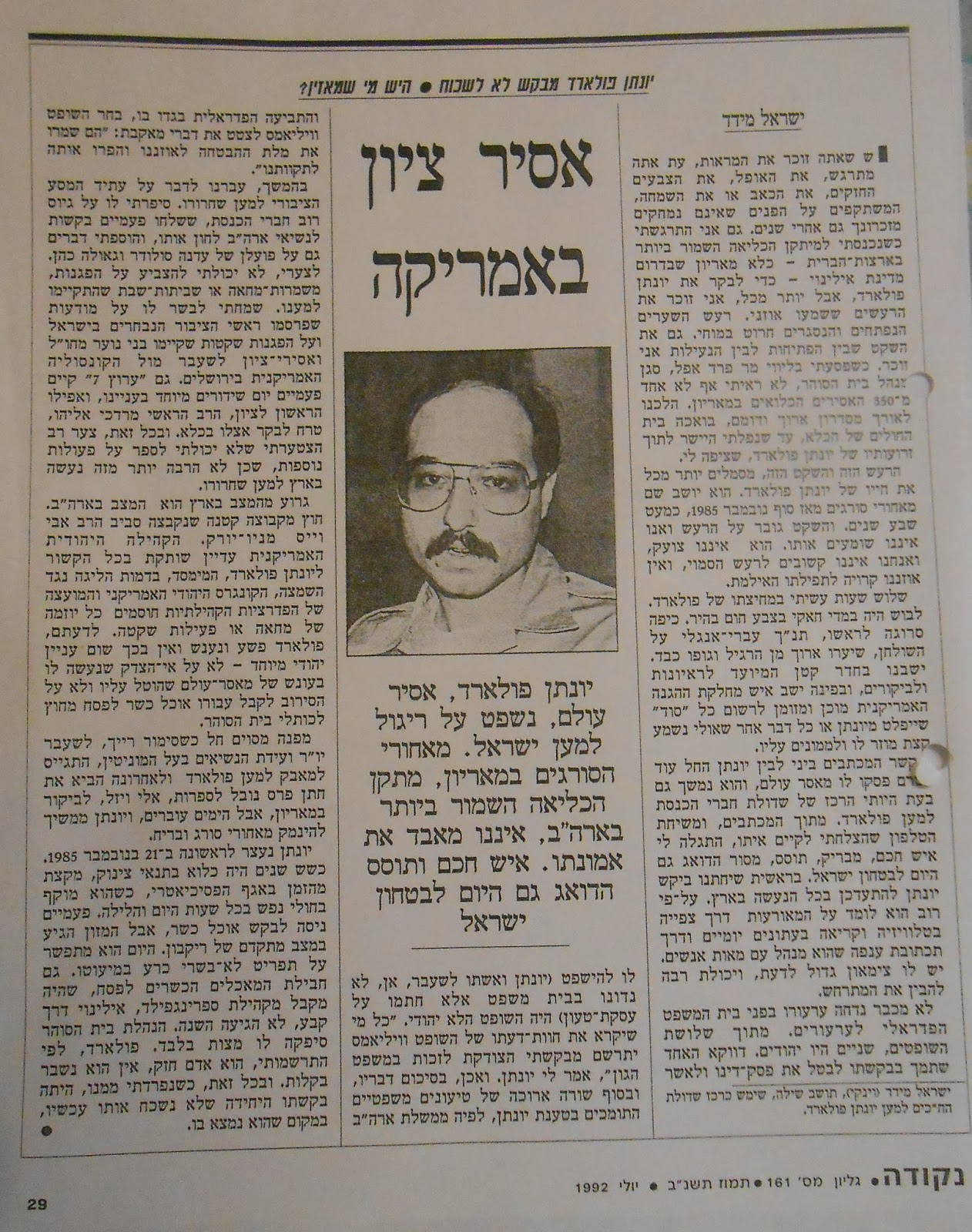
c) A Hebrew-language article I wrote published in Nekuda, entitled "A Prisoner of Zion in America" -


There's a lot of dust but I will process the material and find them a home so that they will be available for research purposes.

^

Wednesday, April 02, 2014

Pollard at the State Department Press Conference (Transcript)

Here, from yesterday's State Department press conference (thanks to Lori):


QUESTION: Do you want to give us some kind of readout on how it was that the Pollard release was put back up on the table? I know there’s been a lot of conflicting information over the last week, when these reports first surfaced in the Israeli press. We’d like a little clarification on exactly when and why and how, and whether or not Pollard’s release is still on the table, given that Abbas looks like he – that is what’s making him negative on the process right now.
MS. HARF: Well, a few points on that. First, the President has not made a decision to release Jonathan Pollard. I want to be very clear about that. Jonathan Pollard was convicted of espionage and is serving his sentence. I don’t have any further update on his status to provide today.
In terms of this being a topic, it should be northern Syria in Kasab and in – around the region?
MS. HARF: I donRet into any of the details of the discussions that they’ve had with Secretary Kerry.
QUESTION: There’s a fundamental difference here. I mean, as we’ve talked before, the Israelis have raised the issue of Jonathan Pollard’s release annually, perennially, quite frequently.
MS. HARF: Consistently. Mm-hmm.
QUESTION: Right. The difference here is that it is now not being pushed off the table by the Americans. I think previous presidents have said thanks for bringing it up, we’re not going to consider it, or whatever. Even two – I think a couple of months ago or some time ago President Obama made a similar statement, saying we’re looking at his case and thanks for your – thanks for playing, basically. This seems to be a different situation.
MS. HARF: Well, I’m not going to characterize what the discussions consist of on this or any other topic that are going on right now or sort of further characterize them in any way than I just said. Obviously, the team on the ground is talking to both sides about a variety of issues, and on this I just think we’re not going to have much more today.
QUESTION: Would you agree that this seems to be a different situation than it has been in the past when the Israelis have raised it?
MS. HARF: I – in terms of Pollard?
QUESTION: Yes.
MS. HARF: I don’t want to characterize it that way. Obviously, in any peace process – this is a peace process that’s going on – been going on for decades now. Broadly speaking, not specific to Pollard, it’s different every time you take a look at it. The issues – the issues don’t change, but how you get to final agreement is obviously a topic that there’s still some work to be done on, because we clearly haven’t gotten there yet. So I don’t want to compare it to any previous situation, don’t want to further characterize the conversation in any other way.
QUESTION: Okay. Would you care to respond to experts and former U.S. officials who have been involved in these types of negotiations who question the wisdom of bringing this up at this point in the negotiations, just to even continue the talks as opposed to a final agreement or a final settlement, which is, I think in the past with Wye River, is what was the concern then?
MS. HARF: Well, again, as I said, the President has not made a decision to release Jonathan Pollard, and I would caution anyone not involved in the talks from presuming to know what’s going on in them, even if people have been involved in them in the past. So I guess there’s a lot of analysis out there. Quite frankly, that’s not what we’re focused on. What we’re focused on right now is the teams on the ground. They are talking to both sides. They are trying to make progress. And we are looking forward to the Secretary going back tomorrow.
QUESTION: Marie, is --
MS. HARF: Mm-hmm.
QUESTION: -- you said the President has not made his decision. But is the Administration actively discussing and thinking about springing Pollard?
MS. HARF: I don’t have any more details for you on what discussions on any issue look like on the ground.
QUESTION: And one follow-up to your question, Lara, was in terms of this being unprecedented. Why is the United States as a mediator in this discussion actively taking such an active role? And shouldn’t this – shouldn’t it be between the Palestinians and the Israelis? Why is the United States having to put something like a prisoner release on the table?
MS. HARF: Well, I haven’t confirmed one way or the other what is or isn’t on the table as part of these negotiations. You’re right in that we do play a facilitation role, but it’s a very active facilitation role between the two parties. You’ve seen that throughout the now eight months we’ve been at the negotiating table. In fact, it’s because of Secretary Kerry, I think in large part his efforts and the courage we saw on both sides, both the Israeli and the Palestinian sides, that we actually even got back to the table. So I’m just not going to confirm one way or the other any issue that’s being discussed, or quite frankly, what our internal discussions look like.
QUESTION: During negotiations – and I’m not an expert – but does the facilitator normally put something into the deal?
MS. HARF: Well, again, that would be getting into a discussion about issues that I’m just not going to discuss in detail from here. Discussions are ongoing.
Yes, Nicolas. And then we’ll go to --
QUESTION: Can I try again on Pollard?
MS. HARF: You guys can keep trying.
QUESTION: So you said you don’t want to compare with previous situations --
MS. HARF: Mm-hmm. I don’t want to compare this negotiation writ large to any previous negotiation. It’s different times. We’re just --
QUESTION: Okay. But is it --
MS. HARF: -- it’s different people involved. I just don’t think it’s useful to compare it.
QUESTION: Okay. So would you say that it’s – the topic, the issue ,is more on the table this time that it used to be?
MS. HARF: I’m not characterizing the issue one – in any way, whether it’s on the table, how it’s on the table. I’m just not characterizing it. It was a good try though.
QUESTION: Aside from the negotiations that are currently happening and have happened, I’m curious also to see if you care to respond to those in the intelligence community who are also concerned about the merits of releasing Pollard and the message that would send to folks like him that you can do this kind of thing and be released. But obviously, there have been a lot of warnings from past CIA directors and various folks in the intelligence community who weren’t against the wisdom of releasing him.
MS. HARF: Well, again, the President has not made a decision to release him, so I don’t want to get ahead of things. I’m not going to get into the details of the discussions on the ground. Obviously, I’m aware of the history but don’t have any further comment on it...

...QUESTION: Okay. Now, Palestinian sources say that Abbas has agreed to continuing the talks beyond the 29th of April. Could you share with us something on that?
MS. HARF: I don’t have anything to announce for you, any further details about what the discussions look like. The Secretary will be speaking to – in general to these topics in his avail, which should be shortly.
QUESTION: Are you expecting that when the Secretary returns tomorrow that such an announcement would be made?
MS. HARF: I don’t have any predictions for you on when anything might be announced or not announced.
QUESTION: And finally, are we looking at a larger number of prisoners to be released, Palestinians prisoners to be released, like 420 maybe?
MS. HARF: I don’t have any details on the discussions that are underway right now.
QUESTION: And I’m sure that you didn’t really add anything to the Pollard situation, have you?
MS. HARF: What I said was – and I’ll repeat it again – the President has not made a decision to release Jonathan Pollard. He was convicted of espionage, is serving his sentence. Also it should come as no surprise to anyone that these – the Israelis – excuse me – have frequently raised this issue. But in terms of discussions that are going on on the ground right now, nothing to share.
QUESTION: Okay. And --
QUESTION: Can I actually follow up on that?
QUESTION: Yeah.
QUESTION: Because Carney said something, I think, probably word-for-word similar to what you just said about --
MS. HARF: We’re linked up like that.
QUESTION: -- no decision has been made. It just kind of occurs to me: Why would the U.S. even allow Pollard, the issue of Pollard’s release to be put on the table if no firm decision had been made on whether or not to release him?
MS. HARF: Well, I’m not confirming what issues are on the table or what aren’t. But obviously, in terms of that issue, we know the Israelis have raised it throughout many years. That’s not a surprise to anyone.
QUESTION: Is it the Israeli Government balking at the number of prisoners released that brings up Pollard?
MS. HARF: I don’t have any more details on the discussions.
QUESTION: But --
QUESTION: Yeah, you said --
MS. HARF: Wait. Let me go here, and then to you – back to you, Said.
QUESTION: You said the President hasn’t made his mind yet.
MS. HARF: No, he said – no, no, I said the President has not made a decision to release Jonathan Pollard.
QUESTION: To. So that’s mean the issue is under consideration.
MS. HARF: I did not say that. I said the President hasn’t – there are reports out there that are all over the place, so I want to be very clear in saying the President has not made a decision to release Jonathan Pollard. He was --
QUESTION: But in other word, he’s going to look at it?
MS. HARF: I didn’t say that. I said I’m not going to get into any of the discussions that are happening on the ground or any internal discussions that are going on here. You can try and read the tea leaves all you want, but I’m just not going to confirm anything.
QUESTION: But – okay. So what you all are saying now is that there’s – the President has not made a decision to release Pollard.
MS. HARF: Correct.
QUESTION: That’s different from last week’s statement, which are, “There are no plans to release him.”
MS. HARF: He also hadn’t made a decision to release him last week either. (Laughter.)
QUESTION: So are we likely to --
MS. HARF: No --
QUESTION: You are discussing his release.
MS. HARF: -- that’s true.
QUESTION: Right. But --
MS. HARF: I am not confirming that in any – I’m not confirming what’s under discussion.
QUESTION: So all these Israeli reports about the fact that Mr. Pollard is ailing, he’s up for a parole hearing next year, 2015, and so on, and all these things are being factored into an early release are not just founded, right?
MS. HARF: I’m not commenting in any way on the internal discussions going on right now, either within our government or with the parties on the ground.
QUESTION: So --
QUESTION: Let me ask you something. If Mr. Pollard is released, is that a – what kind of precedent will that set? I mean, what is likely to happen to someone like another convicted spy, like Walker and others, and so on?
MS. HARF: Said, the President has not made a decision to release Jonathan Pollard. I am not going to speculate on any hypothetical situation at all.
QUESTION: So just because you use a lot of times the words, “I don’t want to characterize,” so how do you characterize the reports that are quoting and the quotes by some U.S. Administration official about this case, that it’s on the table now? How do you characterize the reports and officials?
MS. HARF: I don’t have any characterization of the reports. What I’ve said is I’m not going to read out details of the discussions one way or the other. We’ve done – this should be no surprise to you guys. For eight months I have refused to speak about any specific items under discussion in any way....

...QUESTION: Pollard – just one last one?
MS. HARF: Yeah.
QUESTION: Are you aware that he waived his parole hearing today?
MS. HARF: I saw those reports.
QUESTION: Okay. Did the State Department have any involvement in that?
MS. HARF: I don’t have anything else for you on that.
QUESTION: Okay.
MS. HARF: Thanks, guys. I think the Secretary is about to come on, so we managed to get a briefing in first.
(The briefing was concluded at 2:21 p.m.)

^

Tuesday, January 14, 2014

Fickle Fachler

Jonathan Pollard is not championed in this op-ed - published in Haaretz, of course, 


David Fachler thinks that

The spy saga's critical lesson has still not been learnt: Israel can't take Diaspora Jews for granted while trampling on their rights when convenient.

He asserts that

...many American Jews, some staunchly Zionist, failed to understand how Israel could use one of their own to spy on an ally. Did Israel not realize that many Americans would equate its actions with those of the Jewish community? Did the Jewish state not realize that it was opening the organized Jewry to the charge of dual loyalty? Many were furious at what they viewed as a betrayal by Jerusalem and publicized their anger in American and Israeli broadsheets and in meetings with Israeli officials.

That is surely a consideration when one reviews the situation but given American engagement in secret surveillance, things are to be viewed in a slightly different perspective.

Fachler is being fickled by 


...the reaction of academic and one-time director general of the Foreign Ministry, Shlomo Avineri. Instead of empathizing with his American co-religionists he accused them of “reacting with a degree of nervousness, insecurity, and even cringing like trembling Israelites in the shtetl." Israel, he argued had no reason to regret their actions, rather it was the American Jews who “had to be free from Galut." Thus like a guilty school bully who had just beaten up his weaker classmate Israel reprimanded its closest ally in the Diaspora for being hypersensitive.

And gets dangerously close to adopting anti-Semitic buzz terms:

...his words did not come in a vacuum; they were the product of an unrepentant "Israel First" Zionism, which blames the Diaspora for problems that it itself inflicted. Indeed for the Jewish state there is only one interest that counts, and that is its own...To secure the invaluable assistance of American Jewry, not only should it ask for Pollard the individual to be let go, but it should also beg the Jewish community to forgive its transgressions in perpetrating the Pollard affair. This may not bring us any closer to peace, but it is the right thing to do.

I am not at all sure what "peace" is doing there since American Jewry and Israel, except for a Peter beinart here and a few others there, are not in battle, unless Fachler thinks otherwise, or wants otherwise.

Israel let down Pollard.  And the American Jewish community let him down even more because American justice was not served.

If Fachler doesn't grasp that and can only vent his almost-anti-Zionism, I suggest he review not only the facts of the Pollard case but also the needs and requirments of Israel as well as America's behavior in the affair.

^

Sunday, August 11, 2013

Obama Apologizes to Israel for Demanding Prisoner Release

No, he didn't. 

You knew that.

What did happen was this:

U.S. law enforcement officials expressed outrage over the release from prison of Mexican drug lord Rafael Caro Quintero and vowed to continue efforts to bring to justice the man who ordered the killing of a U.S. Drug Enforcement Administration agent.

Caro Quintero was sentenced to 40 years in prison for the 1985 kidnapping and killing of DEA agent Enrique Camarena but a Mexican federal court ordered his release this week saying he had been improperly tried in a federal court for state crimes.

The 60-year-old walked out of a prison in the western state of Jalisco early Friday after serving 28 years of his sentence.

The U.S. Department of Justice said it found the court’s decision “deeply troubling.”

“The Department of Justice, and especially the Drug Enforcement Administration, is extremely disappointed with this result,” it said in a statement.

The Association of Former Federal Narcotics Agents in the United States said it was “outraged” by Caro Quintero’s early release and it blamed corruption within Mexico’s justice system for his early release.

“The release of this violent butcher is but another example of how good faith efforts by the U.S. to work with the Mexican government can be frustrated by those powerful dark forces that work in the shadows of the Mexican‘justice’ system,” the organization said in a statement.

The DEA, meanwhile, said it “will vigorously continue its efforts to ensure Caro-Quintero faces charges in the United States for the crimes he committed.”


In Hebrew, we say, 'what goes around, comes around' or middah k'neged middah.


P.S.  Did someone mention Jonathan Pollard?

P.S.  Seems someone did.  Sort of.

Pollard’s fate was not raised in the formal part of the meeting with Secretary of State John Kerry, but Jewish leaders brought him up in informal discussions before and after the official discussion. The source declined to reveal which of the participants mentioned Pollard.

“People sincerely brought up the issue, but not in a way to make it uncomfortable for the secretary,” the source said.


^

Tuesday, July 30, 2013

Mr. President, Just Do It!

.


It's easy.

He's just one.

Benjamin Netanyahu is releasing over 100 who have actually killed innocent civilians.


Bennett, Lipman disappointed Pollard not freed


Consider:


A military judge Tuesday acquitted Pfc. Bradley Manning of aiding the enemy — the most serious charge the Army intelligence analyst faced for leaking hundreds of thousands of classified military reports and diplomatic cables.
If he isn't a traitor, Pollard surely isn't.

^

Monday, July 01, 2013

Mr. Kerry, Tell That to Jonathan Pollard

US Secretary of State John Kerry has responded to allegations that the US bugged the offices of its allies, saying its activities were "not unusual" in international relations.
...He continued: "Every country in the world that is engaged in international affairs of national security undertakes lots of activities to protect its national security, and all kinds of information contributes to that."

Mr. Kerry, so why is Jonathan Pollard still in jail?

^

Tuesday, July 17, 2012

Hillary Throws the Key Away on Pollard

At yesterday's press conference in Tel Aviv:-

MS. NULAND: Next question (inaudible) Channel 2, please.

QUESTION: Madam Secretary...On the matter of Jonathan Pollard, we’ve been here for a long time. Don’t you think it’s a matter of justice and even a humanitarian issue that after almost 27 years in jail he should be released?

SECRETARY CLINTON: ...with respect to Mr. Pollard, he was, as you know, convicted of spying in 1987. He was sentenced to life in prison. He is serving that sentence, and I do not have any expectation that that is going to change.

Whose expectations?

^

Thursday, July 05, 2012

Pro-Pollard at the WSJ (and Anti)

Two letters over at the Wall Street Journal, one from former CIA head Woolsey:-

It's Time to Commute Jonathan Pollard's Sentence


Regarding Martin Peretz's "The Mendacious Movement to Free a Convicted Spy" (op-ed, June 25): I recommended against clemency for Jonathan Pollard early in the first Clinton administration when I was director of Central Intelligence, but now, nearly two decades later, I support his release. What would I say has changed? The passage of time.

When I recommended against clemency, Pollard had been in prison less than a decade. Today he has been incarcerated for over a quarter of a century under his life sentence.

Of the more than 50 recently convicted Soviet bloc and Chinese spies, only two—Aldrich Ames and Robert Hanssen—also received life sentences, and two-thirds of these some-50 enemy spies served or have been sentenced to less time than Pollard has already served.

The recently convicted spies for such countries as Saudi Arabia, Ghana, Ecuador, Egypt, the Philippines and South Korea are serving less than a decade. One especially damaging Greek-American spy, Steven Lalas, received a 14-year sentence, just over half of what Pollard has already served.

Pollard has cooperated fully with the U.S. government, pledged not to profit from his crime (e.g., from book sales), and has many times expressed remorse for what he did.

There is absolutely no reason for Pollard to be imprisoned for as long as Ames and Hanssen, and substantially longer than spies from other friendly, allied, and neutral countries. For those hung up for some reason on the fact that he's an American Jew, pretend he's a Greek- or Korean- or Filipino-American and free him.

R. James Woolsey
Washington

Jonathan Pollard agreed to a plea bargain in return for a lighter sentence, saving the government the cost of a trial. The government reneged on this agreement and gave Pollard a harsher sentence for spying for an ally than it had given to any other spies guilty of comparable offenses, or to many of those spying for hostile nations. In 1991 Pollard asked for a new trial. He was denied one because of technical reasons resulting from mistakes made by his lawyer. In a dissenting opinion, Court of Appeals Judge Stephen Williams called the case "a fundamental miscarriage of justice" and wrote in 1992 that he would have ordered that Pollard's sentence be vacated.


Judge Williams asserted that Pollard should be granted a new sentencing hearing before a new judge because the U.S. prosecutors violated the spirit and the letter of the agreement they had made with Pollard when he gave up his right to a trial and agreed to plead guilty to spying for Israel.


Margot Gardner
Bloomfield Hills, Mich.


My comment that I left there:


Dear Nonsensesuch,

where exactly is that street named after Pollard in Israel.  I live here and would love to see it.  Some kook by the name of Barry Chamish claims its in Mitzpeh Ramon but the map claims it isn't there.  Maybe this is a hoax and that anti-Zionists and anti-Semites pick up on these things and implicitly beieve them due to their natural tendency to trust conspiracy theories and anything anti-Jewish and anti-Israel without even checking?  You wouldn't be one of those, would you?

By the way, if your name is real Lemuel (which it isn't but who cares?), can we call you lemming for short?

In any case, Laird Wilcox is wrong.  Nothing went to the USSR but ask a good American like Walker or Aimes about that.  The only millions that have died are his brain cells.

(k/t=IMRA)

^

Tuesday, April 10, 2012

Pollard and Me

From one of my wife's posts:


Early on after Pollard had been jailed by the Americans, then MK Geula Cohen was among the first prominent Israelis to support him. My husband worked for her at the time and was sent to visit him in prison. They became friendly, and if Pollard had been released during that time, he very possibly would have had been our guest at a Passover Seder.

Actually, I started to coordinate the Pollard Knesset Lobby in 1987 and held the position until about 1995 or so.

I visited Jay twice.  Once in his Marion, Illinois jail in 1990 and again, in 1993, at Butner, North Carolina.

^

Friday, February 17, 2012

McFarlane: Pollard Was Result of Weinberger's Injustice,Bias, Hatred

From the Jonathan Pollard committee:

REAGAN'S FORMER NATIONAL SECURITY ADVISOR SLAMS WEINBERGER FOR HIS "EXTREME BIAS AGAINST ISRAEL;" CALLS POLLARD'S LIFE SENTENCE A "GREAT INJUSTICE"

Former National Security Advisor Robert C. "Bud" McFarlane, who served under President Ronald Reagan from 1983-1985, recently wrote to President Obama and asked that he commute Jonathan Pollard's sentence to time served (the full text of the letter appears below and a copy is attached). In his
correspondence to the President, McFarlane calls former Secretary of Defense Caspar Weinberger's affidavit in the Pollard case part of the "manifestation" of Weinberger's "recurrent episodes of strong criticisms and
unbalanced reasoning when decisions involving Israel were being made
."

Similar criticism of Weinberger had been made by former Assistant Secretary of Defense Lawrence Korb, who stated that Pollard's life sentence was due to Weinberger's "visceral hatred of Israel."

In his letter to President Obama, McFarlane cited Weinberger's inaccurate affidavit as the primary cause for Pollard's disproportionate sentence. McFarlane noted to the President that Weinberger's well-known bias toward Israel undoubtedly led him to file the damaging affidavit that essentially sealed Pollard's fate...

^

Tuesday, November 22, 2011

Jonathan Pollard Is Not On Obama's List

This list:

The White House

Office of the Press Secretary

For Immediate Release November 21, 2011

President Obama Grants Pardons and Commutation

WASHINGTON, DC – Today President Barack Obama granted pardons to five individuals and commutation of sentence to one individual:

PARDONS:

• Lesley Claywood Berry Jr. - Loretto, Ky.

Offense: Conspiracy to manufacture, possess with intent to distribute, and distribute marijuana, 21 U.S.C. §§ 841 and 846.
Sentence: April 29, 1988; District of Minnesota; three years in prison.

• Dennis George Bulin - Wesley Chapel, Fla.

Offense: Conspiracy to possess with intent to distribute in excess of 1,000 pounds of marijuana, 21 U.S.C. §§ 841(a)(1) and 846 and 18 U.S.C. § 2.
Sentence: March 10, 1987; Middle District of Alabama; five years of probation and $20,000 fine.

• Ricky Dale Collett - Annville, Ky.

Offense: Aiding and abetting in the manufacture of 61 marijuana plants, 21 U.S.C. § 841(a)(1) and 18 U.S.C. § 2.
Sentence: March 7, 2002; Eastern District of Kentucky; one year of probation conditioned on 60 days of home detention.

• Martin Kaprelian - Park Ridge, Ill.

Offense: Conspiracy to transport stolen property in interstate commerce, 18 U.S.C. § 371; transporting stolen property in interstate commerce, 18 U.S.C. § 2314; concealing stolen property that was transported in interstate commerce, 18 U.S.C. § 2315.
Sentence: Feb. 1, 1984; Northern District of Illinois; nine years in prison, five years of probation.

• Thomas Paul Ledford - Jonesborough, Tenn.

Offense: Conducting and directing an illegal gambling business, 18 U.S.C. § 1955.
Sentence: June 12, 1995; Eastern District of Tennessee; one year of probation conditioned on performance of 100 hours of community service.

COMMUTATION:

• Eugenia Marie Jennings - Alton, Ill.

Offense: Distribution of cocaine base, 21 U.S.C. § 841(a)(1).
Sentence: Feb. 23, 2001; Southern District of Illinois; 262 months in prison, eight years of supervised release, $1,750 fine.
Terms of commutation: Prison sentence to expire on Dec. 21, 2011, leaving intact and in effect the eight-year term of supervised release with all its conditions and all other components of the sentence.

No room for Pollard.

^

Monday, November 07, 2011

Petition Push for Pollard

(thanks to IMRA)

BI-PARTISAN GROUP OF SENATORS ISSUES HISTORIC CALL TO THE PRESIDENT TO RELEASE JONATHAN POLLARD

Four Former Chairmen Of The Senate Select Committee on Intelligence Call For
Clemency For Pollard

In a historic display of bi-partisanship, a group of eighteen prominent former United States Senators recently wrote to President Obama and asked that he commute Jonathan Pollard’s sentence to time served. This letter, which marks the first time that a group of Senators have united to request clemency for Pollard, is an indicator of the solid support for Pollard’s release as a matter of justice. In particular, retired senior
American legislators and officials, no longer bound by party goals or political considerations, are now overwhelmingly in support of Pollard’s release. The signatories on the letter to the President include Senator Steven Symms (R-ID); Senator Dennis DeConcini (D-AZ); Senator Alan Simpson (R-WY); Senator Arlen Specter (D-PA); Senator and Secretary of Energy Spencer
Abraham (R-MI); Senator Birch Evans Bayh II (D-IN); Senator Robert Bennett (R-UT); Senator Donald W. Stewart (D-AL); Senator Connie Mack (R-FL); Senator Joseph Davies Tydings (D-MD); Senator Conrad Burns (R-MT); Senator Timothy E. Wirth (D-CO); Senator Larry Pressler (R-SD); Senator Robert Burren Morgan (D-NC); Senator David Durenberger (R-MN); Senator Byron Dorgan
(D-ND); Senator Donald Nickles (R-OK); and Senator Larry Craig (R-ID).

“We do not condone espionage, nor do we underestimate the gravity of Pollard’s crime,” wrote the Senators in their letter to the President. “But it is patently clear that Mr. Pollard’s sentence is severely disproportionate and (as several federal judges have noted) a gross miscarriage of justice.”

“After more than two decades in the harshest prison conditions, Mr. Pollard’s health is declining...Commuting his sentence to time served would be a wholly appropriate exercise of your power of clemency – as well as a matter of basic compassion and American justice.”

Four of the Senators who signed the letter are former Chairmen of the Senate Select Committee on Intelligence...

The Senators’ letter to President Obama comes in the wake of numerous calls for clemency for Pollard from prominent government officials, high-ranking individuals in the national intelligence arena, leading professionals in the legal world, and renowned religious and communal leaders.

Former CIA Director James Woolsey, former White House Counsel Bernard Nussbaum, and former Deputy Attorney General and Harvard Law Professor Philip Heymann, each of whom is fully aware of all of the contents of Pollard’s classified file and with the facts and circumstances of this case, have long been on record calling for Pollard’s release.

...Pollard’s life sentence is grossly disproportionate when compared to the sentences of others who have spied for allied nations. Despite the fact that Pollard entered into a plea agreement and fully cooperated with the prosecution in his case, he nonetheless received a life sentence and a recommendation that he never be paroled, which was in complete violation of
the plea agreement he had reached with the government...

That, now, is something.

^