Monday, April 24, 2023

Restoring the Jews

The Christian theological conceptualization of the Jewish people's restoration to their national home dovetailed with the Biblical and Talmudic idea of the return to Zion. There is another meaning to "restoration" which is interpreted as the "restoration of the Israelites, who were formerly rejected, and the bringing them back to the communion of God in Christ". As is recorded: "In July of 1696, the New England Puritan Cotton Mather wrote in his diary: “This day, from the dust, where I lay prostrate, before the Lord, I lifted up my cries […] For the conversion of the Jewish Nation, and for my own having the happiness, at some time or other, to baptize a Jew, that should by my ministry, be brought home to the Lord.”"

This concept of Jewish restoration to Palestine as was argued by some of its proponents "for Jewish supremacy over Gentiles in the millennial period." For those who promoted the idea, there was an element of "Judeo-centrism".


I have extracted a considerable amount of quotations from this source to show that the idea of Jews going home ot the Land of Israel was a constant throughout the centuries, from the 13th on. (The footnotes can be found at the source)

one who held to a Jewish restoration is Gerard of Borgo San Donnino (around 1255). He taught that some Jews would be blessed as Jews in the end time and would return to their ancient homeland.18  John of Rupescissa (ca. 1310–1366) could most likely be viewed as a Christian Zionist. “For him the converted Jews would become God’s new imperial nation and Jerusalem would be completely rebuilt to become the center of the purified faith. For proof he drew on a literal exposition of the Old Testament prophecies which until then had been read by Christian exegetes to apply either to the time of the incarnation or to the heavenly Jerusalem in the beyond.”19

it was out of the English Puritan movement that this belief sprung. “Starting with the Puritan ascendancy,” notes Tuchman, “the movement among the English for the return of the Jews to Palestine began.”32 Why the Puritan? Puritans were not just dissenters, they were a Protestant sect that valued the Old Testament to an unprecedented degree in their day.

One of the first Englishman to put forth the view that the Jews should be restored to the land of Israel was a scholar who had taken two degrees from Cambridge named Francis Kett. In 1585 he had published a book entitled The Glorious and Beautiful Garland of Mans Glorification Containing the Godly Misterie of Heavenly Jerusalem (one of the shorter titles of the day). While his book primarily dealt with other matters, Kett did have a section in which he mentioned “the notion of Jewish national return to Palestine.”

As the 1600s arrived, a flurry of books advocating Jewish restoration to their land began to appear. Thomas Draxe released in 1608 The Worldes Resurrection: On the general calling of the Jews, A familiar Commentary upon the eleventh Chapter of Saint Paul to the Romaines, according to the sense of Scripture. Draxe argued for Israel’s restoration based upon his Calvinism and Covenant Theology.38

Two great giants of their era were Thomas Brightman (1552–1607), (likely a Postmillennialist) and Premillennialist Joseph Mede (1586–1638) who both wrote boldly of a future restoration of Israel. Brightman’s work, Revelation of the Revelation appeared in 1609 and told “how the Jews will return from the areas North and East of Palestine to Jerusalem and how the Holy Land and the Jewish Christian church will become the centre of a Christian world.”39  Brightman wrote: “What, shall they return to Jerusalem again? There is nothing more certain; the prophets do everywhere confirm it.”40

Joseph Mede’s contribution was released in 1627 in Latin42 and in 1642 in English as The Key of the Revelation. 43 The father of English premillennialism was also an ardent advocate of Jewish restoration to their homeland. Following Mede in many ways, Thomas Goodwin (1600–1680) also saw the Jews one day returning to Israel. In An Exposition of the Book of Revelation (1639), he taught that the Jews would be converted to Christ by 1656.44 Momentum was certainly building toward widespread acceptance of English belief in Jewish restoration, but a few bumps in the road still lay ahead. Giles Fletcher (1549–1611), a fellow at King’s College, Cambridge and Queen Elizabeth’s ambassador to Russia wrote a work advocating Restorationism. Fletcher’s book, Israel Redux: or the Restauration of Israel; or the Restauration of Israel exhibited in two short treatises (shortened title) was published posthumously by the Puritan divine Samuel Lee in 1677.45 Fletcher cites a letter in his book from 1606 as he argues for the return of the Jews to their land.46 Fletcher repeatedly taught the “certainty of their return in God’s due time.”47 A key proponent for Israel’s future restoration was Henry Finch (1558-1625) who wrote a seminal work on the subject in 1621, called The World’s Resurrection or The Calling of the Jewes. A Present to Judah and the Children of Israel that Ioyned with Him, and to Ioseph (that valiant tribe of Ephraim) and all the House of Israel that Ioyned with Him. 48 Finch, at the time of the publication of his book was a member of Parliament and the most highly respected legal scholars in England at the time…Finch taught that the biblical “passages which speak of a return of these people to their own land, their conquest of enemies and their rule of the nations are to be taken literally, not allegorically as of the Church.”51 King James of England was offended by Finch’s statement that all nations would become subservient to national Israel at the time of her restoration.52 Finch and his publisher were quickly arrested when his book was released by the High Commissioner (a creation of King James), and examined.53 Finch was striped of his status and possessions and then died a few years latter. “The doctrine of the restoration of the Jews continued to be expounded in England, evolving according to the insight of each exponent, and finally playing a role in Christian Zionistic activities in the latter part of the nineteenth and in the first of the twentieth centuries.”54 Many Puritans of the seventeenth century taught the restoration of the Jews to the Holy Land.55 One of the greatest Puritan theologians in England was John Owen (1616–1683) who wrote, “The Jews shall be gathered from all parts of the earth where they are scattered, and brought home into their homeland.”56

There were a number of Restorationists in Holland during the time of the Puritan movement. Isaac de la Peyrere (1594–1676), who served as the French Ambassador to Denmark, “wrote a book wherein he argued for a restoration of the Jews to Israel without conversion to Christianity.”59 In 1655, Paul Felgenhauever, wrote Good News for Israel in which he taught that there would be the “permanent return of the Jews to their own country eternally bestowed upon them by God through the unqualified promise to Abraham, Isaac and Jacob.”60 The Dane, Holger Paulli (1644–1714) “believed wholeheartedly in the Jewish Return to the Holy Land, as a condition for the Second Coming.”61 He even “lobbied the kings of Denmark, England, and France to go and conquer Palestine from the Ottomans in order that the Jews could regain their nation.”62 Frenchman, Marquis de Langallerie (1656–1717), schemed with the Turkish Ambassador in the Hague on a plan defeat the Pope and trade the papal empire for a return of the Jews to the Holy Land. Langallerie was arrested in Hamburg, tried and convicted of high treason and died in prison a year later.63 Other European Restorationists of the era include: Isaac Vossius, Hugo Grotius, Gerhard John Vossius, David Blondel, Vasover Powel, Joseph Eyre, Edward Whitaker, and Charles Jerran.64 The mid-1600s witnessed “the sudden explosion of millenarian publications,”65 which predisposed the British to also consider the future fate of the Jews in the holy land. James Saddington lists the following seventeenth century English individuals as holding to Restorationist views: John Milton, John Bunyan, Roger Williams, John Sadler and Oliver Cromwell.66 “The doctrine of the restoration of the Jews continued to be expounded in England, evolving according to the insight of each exponent,” concludes Ehle, “and finally playing a role in Christian Zionistic activities in the latter part of the nineteenth and in the first of the twentieth centuries.”67

Perhaps the most influential of the early Puritan ministers in New England was John Cotton, who, following the postmillennialism of Brightman held to the restoration of the Jews to the Holy Land.68 According to Ehle, in addition to John Cotton (1584–1652), early Restorationists included: John Davenport (1597–1670), William Hooke (1601–1678), John Eliot (1604–1690), Samuel Willard (1640–1707), and Samuel Sewall (1652–1730).69 Ephraim Huit, a Cambridge trained early minister in Windsor, Connecticut believed that the Jews would be regathered to their homeland in 1650.70 One of the standout advocates of the restoration doctrine was Increase Mather (1639–1723), the son of Richard and father of Cotton. Increase Mather wrote over 100 books in his life and was a president of Harvard. His first work was The Mystery of Israel’s Salvation, which went through about a half dozen revisions during his life.71 His support of the national restoration of Israel to her land in the future was typical of American Colonial Puritans and was generally widespread.

President John Quincy Adams expressed his desire that “the Jews again [were] in Judea, an independent Nation, . . . once restored to an independent government and no longer persecuted.”74 President Abraham Lincoln in a meeting with Canadian Christian Zionist, Henry W. Monk, in 1863 said, “Restoring the Jews to their homeland is a noble dream shared by many Americans. He (the Jewish chiropodist of the President) has so many times ‘put me on my feet’ that I would have no objection to giving his countrymen a ‘leg up’.”75

The wave of premillennialism is what produced in Britain a crop of Christian Zionists that led to political activism which culminated in the Balfour Declaration. Anthony Ashley Cooper (1801–1885), later Lord Shaftesbury…“Oh, pray for the peace of Jerusalem” were the words engraved on a ring that he always wore on his right hand.84 Since Lord Shaftesbury believed that the Jews would return to their homeland in conjunction with the second advent, he “never had a shadow of a doubt that the Jews were to return to their own land. . . . It was his daily prayer, his daily hope.”85 In 1840, Shaftsbury was known for coining a slogan that he would often repeat throughout his life, that the Jews were “a country without nation for a nation without a country.”86 Shaftesbury greatest contribution to the Restoration movement was his attempt to accomplish something in the political realm in order to provoke England to develop a policy in favor of returning the Jews to their homeland. He succeeded in influencing England to adopt that policy, but England failed, at that time to influence the Turks. In 1838, in an article in the Quarterly Review, Shaftsbury put forth the view that Palestine could become a British colony of Jews that “could provide Britain with cotton, silk, herbs, and olive oil.”87 Next, Shaftsbury “lobbied Lord Palmerston, the Foreign Secretary, using political, financial and economic arguments to convince him to help the Jews return to Palestine. And Palmerston did so. What was originally the religious beliefs of Christian Zionists became official British policy (for political interests) in Palestine and the Middle East by the 1840s.”

While British foreign secretary in 1840, Henry John Temple Palmerston (1784–1865) wrote the following letter to his ambassador at Constantinople in his attempt to advocate on behalf of the Jews: There exists at the present time among the Jews dispersed over Europe, a strong notion that the time is approaching when their nation is to return to Palestine. . . . It would be of manifest importance to the Sultan to encourage the Jews to return and to settle in Palestine because the wealth which they would bring with them would increase the resources of the Sultan’s dominions; and the Jewish people, if returning under the sanction and protection and at the invitation of the Sultan, would be a check upon any future evil designs of Mehemet Ali or his successor. . . . I have to instruct Your Excellency strongly to recommend [the Turkish government] to hold out every just encouragement to the Jews of Europe to return to Palestine.

One time governor of Australia, Colonel George Gawler (1796–1869) was one of the most zealous and influential Restorationist, next to Shaftsbury, in the 1840s.93 “Colonel Gawler was a senior commander at the Battle of Waterloo.”94 When he returned to England in 1841 he became a strong advocate of Jewish settlements in the land of Palestine. Gawler’s Restorationism, like most of his day, was sparked by his religious convictions, but he argued for Jewish return to their land upon geopolitical grounds. Gawler stated the following: [England] urgently needs the shortest and safest lines of communication. . . . Egypt and Syria stand in intimate connection. A foreign hostile power mighty in either would soon endanger British trade . . . and it is now for England to set her hand to the renovation of Syria through the only people whose energies will be extensively and permanently in the work—the real children of the soil, the sons of Israel.95 Working with Sir Moses Montefiore (a British Jew) Gawler provided an agricultural strategy for Jewish resettlement of the Holy Land. One of these Montefiore-Gawler projects resulted in “the planting of an orange grove near Jaffa, still existent today and known as Tel Aviv’s ‘Montefiore Quarter.’”96 Charles Henry Churchill (1814–1877), an ancestor of Winston Churchill, was a British military officer stationed in Damascus in 1840. “He was a Christian Zionist and he supported the Jews against the non-Zionist Christians of Damascus.”97 It was through his efforts that he helped acquit the Jews accused of the infamous charge of blood libel. Col. Churchill was honored a banquet hosted by a grateful Jewish community where he spoke of the “hour of liberation of Israel . . . that was approaching, when the Jewish Nation would once again take its place among the powers of the world.”98 In a letter to Jewish philanthropist Sir Moses Montefiore (1784–1885), dated June 14, 1841, Churchill said, I cannot conceal from you my most anxious desire to see your countrymen endeavor once more to resume their existence as a people. I consider the object to be perfectly obtainable. But two things are indispensably necessary: Firstly that the Jews themselves will take up the matter, universally and unanimously. Secondly that the European powers will aid them in their views.99

Laurence Oliphant (1829–1888) was an evangelical “British Protestant, an officer in the British Foreign Service, a writer, world-traveler and an unofficial diplomat.”103 Oliphant was passionate about the Jewish Restoration to their land that came from his intense religious convictions, which “he tried to conceal them behind arguments based on strategy and politics.”104 In 1880 he published a book, The Land of Gilead, “proposing Jewish resettlement, under Turkish sovereignty and British protection, of Palestine east of the Jordan.”105 Even then, he foresaw the agricultural potential and the possibilities of developing the resources of the Dead Sea.

A German Lutheran, C. F. Zimpel, who “described himself as Doctor et Philosopiae, member of the Grand Ducal Saxon Society for Mineralogy and Geognosy at Jena,” published pamphlets in the mid-1800s entitled “Israelites in Jerusalem” and “Appeal to all Christendom, as well as to the Jews, for the Liberation of Jerusalem.”123

Frenchman, Charles-Joseph Prince de Ligne (1735–1814) advocated Jewish Restorationism. He called upon the Christians of Europe to lobby the Turkish Sultan so that the Jews could return to their homeland. De Ligne’s appeal was used by Napoleon in his efforts to establish a Jewish homeland in Palestine. “Among those French Restorationists were theologians and authors, but also, increasingly, politicians.”125 Some of them included Ernest Laharanne, Alexandre Dumas, and Jean-Henri Dunant (1828–1910), who was also the rounder of the International Red Cross.126 Restoration proposals were put forth by a number of Europeans in the nineteenth century. A Swiss theologian named Samuel Louis Gaussen who wrote a book advocating a Jewish return to their land in 1844.127 Italian, Benedetto Musolino (1809–1885) wrote a book, after a visit to the Holy Land, in which he argued “that the restoration of the Jews would allow European culture into the Middle East.”

^

An Appreciation of Jabotinsky

 From this appreciation of Ze'ev Jabotinsky of Vladimir Frenkel:

"Jabotinsky:

“We have nothing to apologize for. We are a people, like all peoples; we have no pretensions to be better. As one of the first conditions for equality, we demand that we recognize the right to have our scoundrels, just like other peoples have them.

This is from the article "Instead of Apology", written back in 1911. It is clear that there is not a word about the future Jewish state. Of course, Jabotinsky does not “dream” about his own criminals - he simply recognizes the possibility of their presence in his people, as in any other people, and does not consider that this is a tragedy, that it is necessary to justify himself to someone because of this. In fact, the article was devoted to the "Beilis case" and the "blood libel", but its problems are much broader, and therefore it is interesting and relevant for us now.

Jabotinsky raises the question: why, in fact, do we Jews behave so strangely? He writes:

“For several years now, Jews in Russia have been sitting tightly in the dock. It's not their fault. But here's what is undeniably their fault: they behave like defendants. We make excuses all the time. […] Tell me, friends, aren't you tired of this rigmarole yet? […] Who are we to justify ourselves before them, who are they to interrogate us? What is the point in all this comedy of the trial of an entire people, where the verdict is known in advance? With what joy should we willingly participate in this comedy, consecrate the vile procedure of mockery with our defensive speeches? Our defense is useless and hopeless, the enemies will not believe, the indifferent will not listen. Apologies have outlived their time.

It is useful to re-read Jabotinsky. It's like it's written now. Helpful and sad. For the same reason. And it’s not so much that the world has not changed in relation to the Jews: they are still judging a whole nation, now a whole state, they are no longer judging in a figurative sense, but for real - shamelessness has gone so far . But that's not the point. This was to be expected. The fact is that the Jews themselves have not changed. Jabotinsky wrote that instead of excuses, at least contempt is necessary. Otherwise, disaster cannot be avoided.

“Our habit of constantly and diligently reporting to all sorts of rabble has already brought us great harm and will bring even more.”

Now the Jews have a state. But the habit remained. I would still formulate this habit differently: an irrepressible and stupid desire to appear before the whole world as “good” and the fear of being branded as “bad”. It has become commonplace to say that Israel does almost no explanatory work in the world media, that we lost the information war without even starting it. Which, in general, is true. Less indisputable is the assertion that it is precisely this, i.e. ignorance, and explains the hostile attitude towards Israel in European countries. But let's not be naive.

An adult is quite capable of distinguishing terror from defense, bandits from soldiers and even more so from civilians, rioters from demonstrators. If he can't , then he doesn't want to. So is it worth it to "explain" something?

The trouble is that when the Jews nevertheless begin to explain something, they still, as in the days of Jabotinsky, not so much explain as justify themselves: no, we are not Nazis, no, we do not have Auschwitz. What the hell! When a person speaks vile things against Israel, he does it not from “ignorance”, but from the fact that he wants to say an abomination, i.e. from hate. “They don’t like us not because all sorts of accusations have been leveled at us: they are accusing us because they don’t like us,” this idea clearly formulated by Jabotinsky should become the standard of our attitude towards everyone who likes to loosen their tongues, whether they are public figures, foreign ministers or conscienceless Nobel laureates.

Do not make excuses where you need to use power: in the time of Jabotinsky we did not yet have such an opportunity. What kind of power? Well, at least personally ban these gentlemen from entering Israel until the end of their lives. It won't make them any better, but at least others will hold their tongues. But no, we cannot do that, we are humanists, i.e., as Jabotinsky wrote, we curry favor with all sorts of rabble.

Here is Jabotinsky's first lesson: the woeful realization that the Jewish people lack an elementary sense of their own dignity. Of course, one can understand that the irresistible desire to appear "good" in front of the whole world was established among the Jews in the Diaspora, during the centuries when Jews everywhere and everywhere were in the minority, hated and often persecuted. It's like that. But the sad thing is that the same psychology has been preserved in their recreated country, and not even among the repatriates, but among the native Israelis.

Here the leader of some Islamic country (yes, already Islamic, although not so long ago - secular), with which Israel has diplomatic relations, does nothing but insult Israel. But what about Israel? But nothing - although any other country would at least recall its ambassador "for consultations."

So sometimes you think that if it is easier to take a girl out of a village than a village out of a girl, then it is just as easier to take a Jew out of the galut than the galut psychology - even from his descendants on their own land. Perhaps this psychology - pleasing to everyone - protected the Jews in the Diaspora, at least sometimes, but in its own state it is mortally dangerous. It seems that Jabotinsky foresaw this. And it is precisely for this that he deserved the dislike of his contemporaries, his people.

But really, why was Jabotinsky so hated by people who were by no means stupid or evil? Why does another name of his evoke an unreasonably nervous reaction even now? If we talk about his views - he was an undoubted liberal of the European persuasion, a supporter of all conceivable rights and freedoms, even, perhaps, a left-wing liberal. He even shared other delusions of his time, say, socialist ones, but at that time it was impossible for a person of the “progressive” camp to have a negative attitude towards socialist ideas. After all, one had to be a professional economist, like Boris Brutskus, in order to see even then the destructiveness of the ideas of socialism precisely for the economy."

"...“The political naivete of a Jew is fabulous and incredible,” Jabotinsky wrote, “ he does not understand the simple rule that you can never “go forward” to someone who does not want to go towards you.” I suspect that the word "naivety" was used here by Jabotinsky out of intellectual courtesy, it would be better to say - stupidity.

This is another lesson of Jabotinsky: to see things as they are, without indulging in illusions. It would seem simple, but it is, nevertheless, the most difficult. Whatever Jabotinsky wrote about, he struggled with the Jewish ability to create illusions that drove him to despair and never give them up, even at the cost of national and personal self-humiliation. Illusions that they will love us: we just need to better explain that we are good. Illusions that someone will protect our interests while we protect others, etc.

It seems to me that Jabotinsky suspected that there is some kind of hidden vice in the Jewish people, which simply will not allow this people to revive their country and their state. 

^

Sunday, April 02, 2023

Update on Cordoba: "cultural reductionism"

Spanish Church ‘accused of glossing over Muslim identity of Cordoba’s Great Mosque’

February 28 2023, 

The Catholic Church has been accused of glossing over the Muslim identity of the Great Mosque of Cordoba with a visitor centre that emphasises its Christian origins.

The Church’s planned centre for the mosque, which has served as a cathedral since the Spanish city’s reconquest by Christian forces in 1236, aims to “correct” what it deems to be an overly Islamic vision of the city’s past.

“The need to redesign the entire space [of the mosque area] derives from the finding that Cordoba is marked with a very powerful cultural label: that of a Muslim city,” said a report by Demetrio Fernandez, the Bishop of Cordoba.

The mosque has served as a cathedral for hundreds of years and is used for traditional processions at Easter

“The cultural reductionism is so strong that it has the capacity to eclipse the brilliant Visigoth, Roman and Christian [periods]..."

So, Muslims are engaged in cultural reductionism of Jerusalem as the capital of Judea, where the Temple stood on Mount Moriah?

^

Wednesday, February 01, 2023

This Took Place In Israel?

Reported:

MORE BLOODSHED IN _____: Following the killing of a _____ woman in _____ yesterday, the _____ rulers of the _____ have embarked upon a fury of vandalism and terrorism against the _____ residents of _____, resulting in the deaths of six men by beating and a 12-year-old girl, _____, who is said to have died of heart failure or nervous collapse when _____ soldiers burst into her family’s house by breaking down the door. A total of 250 people have been killed. Hundreds of people have been arrested and subjected to terrible abuse. Eventually about 50 people aged from 15 to 50 years old were held, to be paraded before 18-year-old _______, the daughter of the murdered _____ woman who was with her mother at the time of the attack, but was herself uninjured. Yesterday, a 17-year-old ______,  _____ _____, succumbed to injuries sustained in an attack by _____ soldiers.

No.

The full story:

MORE BLOODSHED IN CYPRUS: Following the killing of a British woman in Cyprus yesterday, the British rulers of the island have embarked upon a fury of vandalism and terrorism against the Greek residents of Famagusta, resulting in the deaths of six men by beating and a 12-year-old girl, Ioanna Zachariadi, who is said to have died of heart failure or nervous collapse when British soldiers burst into her family’s house by breaking down the door. A total of 250 people have been killed. Hundreds of people have been arrested and subjected to terrible abuse. Eventually about 50 people aged from 15 to 50 years old were held, to be paraded before 18-year-old Margaret Cutcliffe, the daughter of the murdered British woman who was with her mother at the time of the attack, but was herself uninjured. Yesterday, a 17-year-old Greek Cypriot, Andreas Louka, succumbed to injuries sustained in an attack by British soldiers.

October 4, 1958


But
this does remind us of Mandate Palestine under British rule - and that they learned nothing from that experience:

According to declassified documents, EOKA was on the brink of defeat in March 1957 but staged a spectacular recovery by summer the following year, partly due to the repressive measures against the population that made it harder to recruit informers, which in turn produced no usable intelligence.

It was at that point, July 1958, Britain began its biggest push until then against EOKA with Operation Matchbox – one intelligence report of which is only marked for declassification after 120 years. The operation involved collective punishment with mass arrests, detentions, roadblocks, searches censorship, curfews and general heavy handedness, or what Bell described as “harassment of the Greek population” with a “staggering lack of humanity”.

EOKA pushed back with a wave of reprisals against the British with 45 killings in October 1958 including a sergeant’s wife, Catherine Cutliffe, who was shot dead in broad daylight near Famagusta on October 3.

The backlash brought more sledgehammer tactics against the Cypriots and in a number of cases British army discipline completely broke down as enraged soldiers took out their anger on the population.

Governor Foot had warned against the operation and of its consequences, which had come to pass.

“I admired the Governor, a humane and decent man with the right instincts; but his motto of ‘firmness with courtesy’ fell on deaf ears,” Bell says. Foot was surrounded by hardliners keener on the firmness than the courtesy. “I stopped making excuses for the methods being used and recognised armed repression when I saw it. It was an assault upon the people.”


^

Monday, January 23, 2023

When the 'Right' Had Problems Rallying in Tel Aviv

On February 26, 1948, in the evening, the Irgun Tzvai Leumi sought to gather for a rally in support of raisaing funds for jtheir military operations against the Arabs.

The Hagana would not allow the event to pass quietly and intervened with the result that stun grenades were thrown and fisticuffs broke out.

Newspaper reports:


^


Even Then I Was on the Mark

A good friend reminded me recently of some correspondence we had, as follows (edited):

On Tue, Jan 19, 2016 at 10:44 AM, < > wrote:

Dear Yisrael,

I haven’t written to you for a while, and I hope all is well with you.

I have an academic question to you.  I don’t know whether I have told you that I am writing an academic book on _______ (in Hebrew, also to be translated into English). At the moment I am writing about the phenomenon of legislation designed to change the status quo in Israel, in terms of the definition of the state, the power and make-up of the Supreme Court, “problematic” human rights organizations etc. Some of this legislation is initiated by Private Members, others by the Government (especially the current Government).  I was wondering whether you know of any serious, academic article or book that defends this legislation.  Most of what is written on the subject comes from the Left, which defines the legislation as anti-democratic. Yariv Levin has on occasion spoken of the need for the Right “to finally start ruling”. I shall be talking to him about this in a few weeks’ time, but in the meantime I am seeking some serious academic literature on the subject.  Can you help?

My answer was:

From: Yisrael Medad 

Sent: Tuesday, January 19, 2016 11:53 AM

To: 

Subject: Re: request

http://kohelet.org.il/

          With best regards, 

P.S.  Now see here and here.

^


Thursday, January 19, 2023

Sharif Hussein ibn Ali and "Palestine"

Sharif Hussein ibn Ali was an Arab leader from the Banu Hashim clan, Sharif and Emir of Mecca from 1908 and, after proclaiming the Great Arab Revolt against the Ottoman Empire with Lawrence of Arabia, King of the Hejaz from 1916 to 1924 and, quite briefly, Caliph in 1924. With the Hejaz invaded by the Saudis, he had to flee and be exiled. He claimed he was a 37th-generation direct descendant of Muhammad, as he belonged to the Hashemite family.

His son was Abdullah I and his great-great-grandson, Abdullah II (son of Hussein, son of Talal), is the current King of Jordan.

In January 1924, he arrived in Amman, then TransJordan, here seen received by Lt.-Col.  Frederick Peake Pasha, the British Resident Representative (and creator of the Arab Legion):


and another picture during that time:

On March 11 he received pledges of fealty from local Arabs, Arabs from west of the Jordan River and neighboring Arab countries.

But what did he think of "Palestine"?

As this article, "Sharif Husayn ibn Ali and the Hashemite Vision of the Post-Ottoman Order: From Chieftaincy to Suzerainty", details, he seemed to think it shouldn't exist:


So, it isn't that some pro-Israel/Zionism advocates think an 'Arab Palestine' wasn't and shouldn't be.

^

Wednesday, January 18, 2023

1921 - First Political Demo on the Temple Mount

"On the following day, Tuesday March 29, Abdullah went to the Temple Mount to visit the Mosque of Omar, a seventh-century Moslem shrine. The Emir tried to speak with a group of Arabs who gathered near him. They greeted him with hostility. “Down with the Zionists,” shouted the Palestinian Arabs, “Palestine for the Arabs.” The Arabs then started a demonstration against the Balfour Declaration."

Winston Churchill in Jerusalem, 1921 by David Semple


^


Wednesday, January 04, 2023

The Exact Uri Tzvi Greenberg Temple Mount Quotation

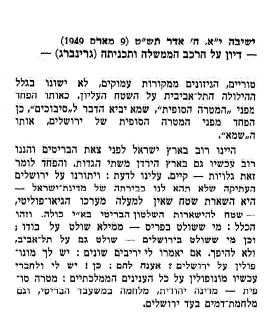
Many quote from a speech Uri Tzvi Greenberg, then a MK representing Herut, 

during a Knesset plenum debate but 'enhance' it.

Here is the headline from the Herut newspaper two days after, March 11, 1949:


and it reads:

"He who rules in Jerusalem, rules in Tel Aviv".

And from the Knesset record:


It need be recalled that at that time, Jerusalem was not yet the official capital of Israel. It became so only in December 1949 when David Ben-Gurion passed a government decision. That was why he mentioned Tel Aviv.

Another section of the speech:

^

Saturday, November 05, 2022

What Does 'Slamming' Mean?

Esther Solomon is editor of the English edition of Haaretz.

Follow the dialogue:

@EstherSolomon

Australian Jews Exec Council: Congratulates Netanyahu, then (correctly) slams the far right Religious Zionism party who will sit in his coalition as 'populist extremist politicians with an openly racist, homophobic agenda' 'incompatible both with our religion and with Zionism'

The @ECAJewry's statement on the results of the Israeli elections, available on our website here: https://bit.ly/3E1TnY4

12:01  4 בנוב׳ 2022

---

@ymedad

Can't wait until we slam them.

Then we'll see who can take it.

---

@EstherSolomon

What does 'slamming' a major Diaspora Jewish community mean?

---

@ymedad

I don't know.

You used the term:

"Australian Jews Exec Council: Congratulates Netanyahu, then (correctly) slams..."

---

And then, silence. 

^

Friday, August 19, 2022

What's With the Money?

In the past, I have published multiple blog posts and a few opeds (2014) on the funding provided by the United States and connected groups to the Arab population in Judea and Samaria which specifically ignores or discriminates against Jewish residents in that same geographical area.

Some examples: here; here; here; and here. There ae many more, going back years. And they include monies for student grants, programs, events, etc.

I had the opportunity recently to engage with an aide to a member of the House Appropriations Committee and I raised the issue, pointing out, besides the discrimination, that getting the two populations to work together on non-politial onerns and interests could possibly lead to a coexistence breakthrough and ultimately, achieve the goals of the programs. My impression was that the matter wasn't seen to be all that the important and moreover, that the discrimination has been dealt with.

So I checked at the website of the Palestinian Affairs Unit which is the former East Jerusalem American Consulate under another name. The Embassy-sponsored programs are separate.

Here are the details of one such aid program, the American Palestinian Arts, Culture, and Sports Initiative. Its objectives they have defined as

the U.S.OPA-PD mission: to advance a comprehensive and lasting peace through a negotiated two-state solution [no other option exists?] to the Israeli-Palestinian conflict and the development of a vibrant, representative, and responsive Palestinian civil society, private sector, and governing institutions through substantive engagement with American people, institutions, ideas and ideals in order to improve American-Palestinian relations and create greater opportunities for mutually beneficial partnership and cooperation.

So, to improve "Palestinian-Israeli/Jewish residents" is outside the purview of the initiative?

What is its "Priority Region"? Jerusalem, West Bank, and Gaza or a combination of two or three of them. The goal, though, really is to "increase understanding and collaboration between Americans and Palestinians" only.

Eligible primary applicants for grant funding must be not-for-profit Palestinian and/or American organizations working with Palestinians in Jerusalem, the West Bank and/or Gaza.

Another, now closed, funded program involves Journalism Capacity Building. Participants must be "Journalists, media professionals, social media professionals, journalism university students from the West Bank, Gaza, and Jerusalem." Does that include Jewish residents of those areas? Probably not as we read that a goal of the program is to: 

"Improve writing skills for journalists in specialized fields such as gender issues, entrepreneurship and business, economics, technology, foreign policy, democracy, and human rights, environmental issues, and other issues of interest to the United States and Palestinians;" 

as well as to 

"Increase awareness and understanding of American culture, media, society, history and/or current events, as well as of shared American-Palestinian values and interests.

"Palestinians" are who exactly?

This third recent example truly highlights the point I am making: its all about 'forget about the Israelis and the Jews living amongst the Arab population of Judea and Samaria'. It is named the: U.S. Public Diplomacy Palestinian Peacebuilding Program

It is "designed to partner with Palestinian, American, and International non-profit/non-governmental to implement activities which advance the applicant’s goals and the U.S.OPA-PD mission: to advance a comprehensive and lasting peace through a negotiated two-state solution to the Israeli-Palestinian conflict 

The Priority Region, again, is: Jerusalem, West Bank, and Gaza or a combination of two or three of them

The goals are to: Promote negotiation, non-violence, social change, and civic education; Build capacity of peacebuilding institutions and organizations led by Palestinians; Advance equity with respect to race, ethnicity, religion, income, geography (!!!) 

And who are the eligible Participants and Audiences?

Palestinians in East Jerusalem, West Bank and Gaza. Preference will be given to Palestinian organizations when possible.

I do see that what is not eligible for funding inludes projects relating that support specific religious activities or promote only one faith/religion. But only when type of resident is what is at the basis of this all. 

No mixing. No mingling. Who knows what it might lead to?

Other programs: Advancing Palestinian Women’s Entrepreneurship ProgramMedia Literacy Training and so on like a joint dance show in Bethlehem between Palestinian and American dancers that was preceded by a joint workshop (Palestinian = no Israeli Jews).

If that is what the US wants to be, there'll be no coexistence, no empathy, no cooperation and no compromise, no solution and no peace.

_________

UPDATE    from August 19-26, 2022

In the West Bank, Senior Official Allen will discuss U.S. support for English language teaching and meet Palestinian alumni leaders of U.S. exchange programs.  Senior Official Allen will also join the visit of a U.S. Sports Envoy and participate in their skills-building program for youth.

In Jerusalem, Senior Official Allen will visit the U.S. Embassy’s American Center Jerusalem and learn more about public diplomacy programming innovations in science, technology, education, and entrepreneurship.  She will meet with alumni of U.S. exchange programs from diverse communities, including Haredi, Arabic-speaking, Bedouin, Ethiopian, and Druze.

Senior Official Allen will also meet with counterparts in the Israeli Ministry of Foreign Affairs to discuss efforts to counter public disinformation campaigns and Holocaust distortion, as well as ways to facilitate continued U.S.-Israel academic exchanges, such as the Fulbright Program.

^

Wednesday, August 17, 2022

How Did Religious Autonomy Settle Into Jerusalem in 1967?

Here is from the recollection of Rephael Vardi who was at first chief of staff to Major General Herzog  who was appointed as the commander of IDF forces in the West Bank during the Six Days War and in December 1967 became commander of the West Bank and in 1974 the Coordinator of Government Operations in the administered territories.

A Supreme Moslem Council had been established by the British Administration early in the 1920s and the infamous Grand Mufti of Jerusalem, Haj Amin el Husseini, was appointed president of the Council...After the Jordanians had annexed the West Bank in 1950, they dissolved the Supreme Moslem Council in Jerusalem. Instead they established in Amman a Ministry for Religious Affairs. This ministry was put in charge of all Arab religious matters in Jordan and in the West Bank formerlymanaged by the Supreme Moslem Council.

In 1967 the 22 local Arab leaders decided to reestablish the Supreme Moslem Council. They informed us, contrary to their earlier request, that foreigners such as ourselves, who were not Moslems (virtually heathens), could not control Moslem religious affairs, though the Jordanian law which prevailed in the West Bank obliged the military government to control and take take of all religious institutions. In addition they decided to establish an Islamic (Shari’a) religious court of appeals in Jerusalem for Jerusalem and the West Bank, and announced that hence they would nominate the justices of this court, as well as of the lower Shari’a courts in Jerusalem and elsewhere in the West Bank. The justices and other officials were employees of the Jordanian government that paid their salaries. When the Israeli administration offered to pay those salaries, they refused, contending that even salaries could not be accepted from us because we were non-Moslems. What is especially interesting to note is that only a few weeks earlier, in June, they had asked us, as the legitimate government of the West Bank and East Jerusalem, to exercise our authority according to Jordanian law and to organize and control the same religious affairs.

The Supreme Moslem Council, which still exists today, was accepted by the population in those years as the political as well as the religious leadership of Jerusalem and the West Bank. The Council led and inspired the resistance that started against the military occupation of the West Bank and the Israeli authorities in Jerusalem. Strikes started gradually in August-September 1967, and then built up to a crescendo in 1968 and 1969...

The majority of the members of the Supreme Moslem Council were secular, not religious leaders. When they started leading the resistance, we expelled some of them and restricted the movement of others. As a result the Council’s overt activities concentrated more on religious matters while their political and other anti-Israeli activities were covert...The Council, to the contrary, did recognize the authority of the military government in the West Bank and East Jerusalem and tried to involve it in matters concerning Jerusalem. The Council was consistent in its refusal to recognize the Israeli civilian authorities in Jerusalem and entirely disregarded them, but was willing to deal with the Military Government in matters concerning Jerusalem...The Council cooperated, to a certain extent and when necessary, with the Jerusalem municipality. Years later, out of necessity, they “recognized” the Prime Minister of Israel, but failed to recognize the Ministries of Interior and Religious Affairs and refused to cooperate with them.

The Supreme Moslem Council acted in religious matters with complete independence. Our policy was not to intervene because we did not want religious matters to become issues of controversy between us.

^

Monday, August 15, 2022

The Parker Expedition Postscript

Over a three year period, between 1909 and 1911,  Montagu Parker oversaw an excavation near, and then in, the Temple Mount.

In?

In April 1911 they bribed the guardian of the Haram al-Sharif to let them dig in the Dome of the Rock. They were discovered and riots and disorder broke out.

But what happened to the local officials?

We know that Governor Azmey Bey was fined $25,000 for allowing a dig in oriental disguise on the Temple grounds after dark. Historians have noted that Azmey Bey included Sheikh Khalil al-Ansari, the superintendent of the Haram, in this agreement and 'An angry crowd of Muslims and Jews', "united for this one and only time in their indignation", tried to lynch Sheikh Khalil al-Ansari and the translator Hagop Makasdar in Jerusalem. Only the arrest by Ottoman soldiers saved their lives. (Al-Ansari was later executed; Makasdar, the only member of the expedition whose authorities could get hold of him, was sentenced to prison.

More in this book.

According to Ha-Herut newspaper published in Jerusalem, in its December 11, 1912 edition, there was a trial


and we know that Khalil was given a year's imprisonment, his sons, Hassan and Said were given three months imprisonment and Anoub, head of the gendarmerie, and two other security officials were sentenced to a month each. Having been incarcerated during their trial for more than that period, they were immediately released.


^

Tuesday, August 09, 2022

Arab Rights and Jewish Rights: Jaffa 1936

In June 1936, a significant section of Jaffa was demolished due to the need for British security forces to combat growing Arab terror.

But there was a side concern: what to do with now homeless Arabs?

Here is an academic article on the matter.

And here is a parliamentary question from December:

DEMOLITIONS, JAFFA (RE-HOUSING).

HC Deb 16 December 1936 vol 318 

22. Colonel WEDGWOOD asked the Secretary of State for the Colonies whether he has authorised the expenditure of £15,000 which has been assigned from Palestine revenues to build a village for the Jaffa Arabs evicted from that town; and whether anything similar is being done for the Jaffa Jews who were forced to leave Jaffa and live elsewhere?

Mr. ORMSBY-GORE The Palestine Government has been authorised to expend £15,000 on the erection of houses, for which a suitable rent will be charged, to accommodate 100 Arab families rendered homeless by the special demolitions in Jaffa undertaken by Government in the circumstances explained in my reply to a question in the House on 24th June by the hon. Member for West Fife (Mr. Gallaeher). I understand that in consultation with the appropriate Jewish bodies the Palestine Government has agreed to contribute about £5,000 towards the cost of maintenance and rehabilitation of Jewish refugees in Tel-Aviv from Jaffa and elsewhere.

Colonel WEDGWOOD Seeing that the Jewish refugees from Jaffa outnumber the Arab refugees by about 20 to one, will the right hon. Gentleman make representations to the Palestine Government that the rebuilding which they are doing for Arab refugees should be paralleled by rebuilding for the Jewish refugees?

Mr. ORMSBY-GORE I do not think that I can accept the right hon. and gallant Gentleman's figures, nor can I accept his description of these particular Arabs as refugees. In the military interests, and in the interests of peace and order in Jaffa, it was decided to dynamite two lines through the town. The Royal Engineers blew up the houses, and I think the Palestine Government have the duty of rehousing these people elsewhere, as they are now doing.

Colonel WEDGWOOD Does the right hon. Gentleman not see that the Jews who were driven out of Palestine owing to the danger of assassination have exactly the same case for rehousing, with Government assistance, as the Arabs?

Mr. ORMSBY-GORE Then it would be the duty of the Government to re-house almost everybody who have been removed or have removed themselves during a period of disturbance and disorder which we all regret. I cannot commit the Government to that.

Colonel WEDGWOOD I am sorry to be persistent, but is it possible now for the Jews to go back to Jaffa with safety, or is the protection still inadequate?

Mr. ORMSBY-GORE I hope that when we know what the policy of the future is to be, when we have the report 2438of the Royal Commission and the whole Palestine question is cleared up, it may be possible for Jews and Arabs to live as they have up to this year in friendly accord in Jaffa.

Photos:


^

Saturday, July 16, 2022

Jabotinsky in Jerusalem


In Jabotinsky’s Footsteps in Jerusalem

In Jerusalem Magazine, Jerusalem Post, July 15, 2022

Ze’ev (Vladimir) Jabotinsky both visited and resided in Jerusalem during four all-too brief periods of his short life. 

Jabotinsky, a leader of prewar Russian Zionism, founder of the Jewish Legion of World War I as well as Jerusalem’s Hagana in 1920, member of the Zionist Executive, creator of the Revisionist wing of Zionism and “father” of the Irgun, highlighted Jerusalem in a few of his poems. He was in the country at the end of 1908 for just a few months as part of his Zionist promotion work in the Ottoman Empire but his autobiography does not mention the city. Between March 1918 and July 1920, he was an officer in the Jewish Legion and then a member of the Zionist Commission and lived in the city. He briefly visited the city in 1926 

In October 1928, he arrived, in his mind, as an immigrant. However, at the very end of December 1929, he left for a speaking tour in South Africa and the British Mandate authorities exploited his absence and banned him from forever returning citing an ‘incendiary’ speech he made in Tel Aviv. In honor of his 82nd yahrtzeit anniversary, I suggest a list of locations linked to his activities in Jerusalem from which one can create an itinerary for a walk in his footsteps.

===

Jabotinsky arrived in the then Palestine from Egypt in the last week of March 1918. Most of his fellow soldiers of the Jewish Legion, eventually to comprise three battalions of the Royal Fusiliers, arrived only in early June. He visited Jerusalem once on Zionist business in April to confer with members of the Zionist Commission, headed by Chaim Weizmann. By June 10, the troops were on the way to the front lines opposite the Ottoman and German forces between Shiloh and Abuein in the Lower Samarian Hills. Between June 20 and July 7, he was again in Jerusalem, possibly at the Allenby Barracks, Hebron Road (1), continuing the campaign to persuade local volunteers to enlist in the Legion.

On July 24, 1918, he participated in the symbolic cornerstone-laying ceremony of the the Hebrew University (2) at John Gray-Hill’s Mount Scopus mansion. For the next two weeks he was invalidated with an infected knee after cutting it on barbed wire at Abuein. The second half of August he was in Cairo and returned to Jerusalem in the second week of September. From September 13 he was in the battle for the Jordan River ford at Umm esh-Shert.

By the summer of 1919, he had been dismissed from the army for criticizing the political orientation of the military government and in August, his wife Yohanna and son Eri arrived from London to reunite in Jerusalem. After a short stay at the Amdursky Hotel just inside Jaffa Gate (3) they began residence in the Levy Building located at the corner of today’s Shimon Ben-Shetah and Ben-Sira Streets off of Shlomzion HaMalka (4). On one of their walks about the city, they ascended to the Temple Mount and managed to gain entrance to the Dome of the Rock (5). Jabotinsky and his son even walked all the way to Motza one day. After the great snowfall of February 15, Jabotinsky and his wife trudged to the American Colony (6) neighborhood to assist the Ettinger family. It was at this house, as commander of the Hagana in the city, that he was arrested for the illegal possession of arms on April 7, 1920.

Jabotinsky worked at the Zionist Commission office, rented from the Hughes Hotel situated at the top floor at 17 Jaffa Street, one of the two Armenian Buildings (7). He contributed articles to the Ha'aretz newspaper whose logo he helped create. Together with Gad Frumkin, he prepared a lecture series for the training of new lawyers. One of the lecturers was Yaakov De Haan. He was also a guest at Dr. Helene Kagan's home at 64 HaNeviim Street (8).

In late 1919, Jabotinsky was asked by Weizmann, who returned to the country in mid-October after a year's absence, to assume responsibility for a self-defense unit for Jerusalem's Jews. The anti-Zionist rhetoric of the Arabs was becoming more shrill and alarming. On Balfour Day, November 2, 1918, Jewish school pupils and adults had been assaulted by an Arab crowd protesting at Jaffa Gate (8) and led by the city's mayor.  Already, in January 1919, Jabotinsky had written to his wife, “The Arabs draw encouragement from the fact that the British do not uphold their promises; the situation is bound to end up like Kishinev.” 

On the evening of March 8, 1920, Jabotinsky addressed thousands of Jerusalemites who gathered in front of the Bet HaAm, then located in the area between today's Jaffa and Nevi'im Streets just below Davidka Square, now a parking lot (9), commemorating Yosef Trumpeldor and his seven comrades who fell at the battle of Tel Chai. Trumpeldor had assisted Jabotinsky in February 1915, when both were in Egypt, to persuade General John G. Maxwell, commander of the British forces in Egypt, to raise what became the Zion Mule Corps that later that year fought at Gallipoli with distinction.

At the beginning of 1920, two demonstrations of Arabs protesting Zionism and promoting the reunification of Palestine with Syria under Faisal took place. The first, on February 27, was a march along today's Sultan Suleiman Street (10) and the second was on March 8 at the Jaffa Gate (8). Jabotinsky had by then been holding drilling exercises and strategy instruction drilling daily behind the Lemel School (11) on Yeshayahu Street. On March 27, he marched 600 men from the school to the slopes of Mount Scopus (12) to perform field maneuvers in clear view of the British, and the Arabs. 

Nevertheless, the Arabs launched their violent attacks on April 4 during the Nebi Mussa festivities. Jabotinsky hurried to the Bachelors' Dormitory of the Betzalel School students, still standing in the yard behind 6 Hillel Street (13), to assign them and others to planned positions across the city.

Jabotinsky was arrested at his apartment on April 7, briefly detained at the Kishleh (14) then held at the Central Prison in the Russian Compound (15) for eight days as Prisoner #127 and, after a brief military trial, was incarcerated with another nineteen Hagana volunteers in Acre Prison. They were released some three months later and Jabotinsky subsequently left for England, disappointed with the policies of the British Military Administrations and the Zionist Commission as well. In January 1923, he resigned from his membership in the World Zionist Executive.  

^^^

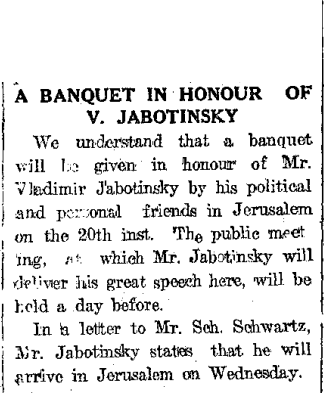
On October 3, 1926, Jabotinsky returned to Mandate Palestine, arriving at Jaffa Port, intent upon mobilizing for his recently-founded opposition Revisionist Party. His public appearance in Jerusalem was on Tuesday, October 19 at the Maccabi sports field, today, the site of Pomerantz House off of Magen Ha'Elef Street near Eretz Hafetz Street in the Shmuel HaNavi neighborhood (16), where he delivered an address beginning just after 4:30 PM. Incidentally, the Hebrew University refused to permit him to appear on its grounds and he protested to Norman Benwitch that he was being boycotted. The Palestine Bulletin reported that “An extraordinary spirit of enthusiasm pervaded the Jerusalem public yesterday afternoon when Vladimir Jabotinsky…delivered a striking address on the situation in Palestine. All classes of the Jewish population were represented…six thousand people forming an audience that Rose…and accorded him a rousing ovation.” Jabotinsky, writing to his wife in Paris, claimed only 4,000 were present.

Later that evening, at 10 p.m., a banquet was given in his honor in the New Central Hotel. The newspaper described his speech as “a brilliant piece of oratory, comprising a personal confession of the speaker's attitude in Zionism and a deep analysis of the situation in Zionism and Jewish character.” The hotel, belonging to the Amdursky Family, was located at the corner of today’s Ben-Yehuda and Ben-Hillel Streets (17). On November 3 he was back in Jerusalem briefly for two days to obtain visas from various consulates and sailed on November 16 back to Europe.

^^^

Returning to Jerusalem, for what he hoped would be for good, on October 10, 1928, he assumed the editorship of the Doar HaYom daily at the end of December, whose editorial offices were at the bottom of HaSolel Street (18) and lived in the Even Yisrael neighborhood (19). And the telephone number was 45.

He shared rooms with an Orthodox man and recalled that during that time, strictly kept kashrut and Shabbat restrictions in respect of his flat mate. For income, he was first manager, then Vice-President of the Board of Directors of the Judea Insurance Company branch in Palestine whose offices were on Jaffa Road off Ben-Yehuda Street (20). His Post Office Box number was 828.

After some six weeks abroad in Vienna, Paris and London, he was back in Jerusalem by the beginning of February 1929. On July 22, he was on a boat, traveling, as many other Zionist personalities in Palestine to the Zionist congress in Zurich and was not in the country during the August riots. He stayed in Paris until returning to Palestine in the first week of December. On the 25th of that month, he sailed for Egypt and that was the last time he set foot in Eretz-Yisrael alive as in his absence, the High Commissioner cancelled his residency rights.


Map credit: Yair Assaf-Shapira


^