Showing posts with label Arab terror. Show all posts

Tuesday, August 09, 2022

Arab Rights and Jewish Rights: Jaffa 1936

In June 1936, a significant section of Jaffa was demolished due to the need for British security forces to combat growing Arab terror.

But there was a side concern: what to do with now homeless Arabs?

Here is an academic article on the matter.

And here is a parliamentary question from December:

DEMOLITIONS, JAFFA (RE-HOUSING).

HC Deb 16 December 1936 vol 318 

22. Colonel WEDGWOOD asked the Secretary of State for the Colonies whether he has authorised the expenditure of £15,000 which has been assigned from Palestine revenues to build a village for the Jaffa Arabs evicted from that town; and whether anything similar is being done for the Jaffa Jews who were forced to leave Jaffa and live elsewhere?

Mr. ORMSBY-GORE The Palestine Government has been authorised to expend £15,000 on the erection of houses, for which a suitable rent will be charged, to accommodate 100 Arab families rendered homeless by the special demolitions in Jaffa undertaken by Government in the circumstances explained in my reply to a question in the House on 24th June by the hon. Member for West Fife (Mr. Gallaeher). I understand that in consultation with the appropriate Jewish bodies the Palestine Government has agreed to contribute about £5,000 towards the cost of maintenance and rehabilitation of Jewish refugees in Tel-Aviv from Jaffa and elsewhere.

Colonel WEDGWOOD Seeing that the Jewish refugees from Jaffa outnumber the Arab refugees by about 20 to one, will the right hon. Gentleman make representations to the Palestine Government that the rebuilding which they are doing for Arab refugees should be paralleled by rebuilding for the Jewish refugees?

Mr. ORMSBY-GORE I do not think that I can accept the right hon. and gallant Gentleman's figures, nor can I accept his description of these particular Arabs as refugees. In the military interests, and in the interests of peace and order in Jaffa, it was decided to dynamite two lines through the town. The Royal Engineers blew up the houses, and I think the Palestine Government have the duty of rehousing these people elsewhere, as they are now doing.

Colonel WEDGWOOD Does the right hon. Gentleman not see that the Jews who were driven out of Palestine owing to the danger of assassination have exactly the same case for rehousing, with Government assistance, as the Arabs?

Mr. ORMSBY-GORE Then it would be the duty of the Government to re-house almost everybody who have been removed or have removed themselves during a period of disturbance and disorder which we all regret. I cannot commit the Government to that.

Colonel WEDGWOOD I am sorry to be persistent, but is it possible now for the Jews to go back to Jaffa with safety, or is the protection still inadequate?

Mr. ORMSBY-GORE I hope that when we know what the policy of the future is to be, when we have the report 2438of the Royal Commission and the whole Palestine question is cleared up, it may be possible for Jews and Arabs to live as they have up to this year in friendly accord in Jaffa.

Photos:


^

Thursday, January 20, 2022

The 'In-Between' Mandate Period Arab Terror

Most anyone who has read opeds or non-academic articles knows that when tracing the subject of Arab anti-Jewish terror during thye years of the British Mandate, the time frame usually appears as

the riots of 1920, 1921, 1929 and 1936-1938

Of course, to the unknowledgeable, that would imply that outside those years, everything was peaceful and calm. Arab terror was restricted only to those years. Nothing much, if at all, happened inbetween. The terror came it uncontrollable, as iut were, outburts and were a result of something the Jews did, as if a reaction to a provocation.

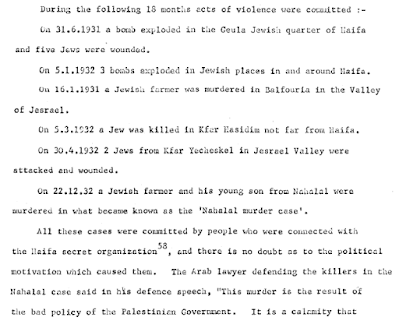
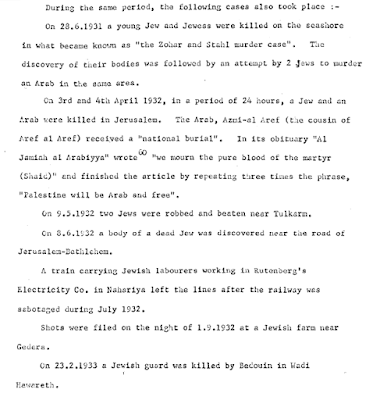
Reading a paper on the Mufti's activities, I spotted the examples I reproduce below as incidents from outside or inbetween those seemingly fixed time frames of Arab terror:


And there is so much more.

^


Tuesday, December 08, 2020

More Names of Jews Murdered Before 1920

Back in 2014, I published a post dealing with Jewish victims of Arab violence prior to 1920, the year generally assumed to be the start of Arab political-motivated terror against Jews residing in the Land of Israel.

I did so as there are propagandists who maintain Arab anti-Jewish violence was a result of the Zionist movement and the Balfour Declaration. And that relationships between the communities prior to these developments was amenable. Of course Haaretz published a criticism of seeing these earlier victims of Arab violence as part of the 'long story' of Arab terror.

That previous post's list had 31 Jews murdered between 1873 and 1920 prior to the Tel Hai incident in March and the Jerusalem riots of April. And it mentioned the first Jew killed on the background of purchasing property, Avraham Shlomo Zoref, which was in 1851 and added there:

I have not yet located a site to find names from 1851 to 1873. The list should be considered incomplete.

I have now found an additional list which was published in the Davar newspaper on July 17, 1936, three months into the "Disturbances" which began in April that year and, eventually, lasted (with interruptions) until the Arab terror had forced Gt. Britain to issue the infamous May 1939 White Paper. Here it is:


I have attempted to confirm, as much as possible, from contemporary periodical accounts, the details in the above item.

I can now add names to the original list and, doing more research, add details to those I included in the first listing (so if you are counting, please review both lists as there are repeats):

Avraham Abba Zilberstein March 15, 1880 stabbed to death by robbers near Mishkenot Shaananim, Jerusalem. He was 17 and only 6 months married. Interestingly enough, he held American citizenship and the American Consulate involved itself in the murder. Here, from Havatzelet, March 


Nissan Menachem, son-in-law of the Rishon L'Tzion Avraham Ashkenazi, was murdered near Lifta on Jerusalem's outskirt, 25 Tishrei 1879

Yisrael Haim Sheinbaum fought with an Arab intruder who sought to rob him on March 13, 1881 in Meah Shearim. Critically wounded by knife stabs, he died on April 9.

Shlomo Telze, June 13, 1882, killed by robbers in his bed. His wife was critically injured.


Yechezkel Zacharin who exited his apartment on Friday night, June 28, 1884, was set upon by robbers, murdered and thrown into a water cistern, leaving a widow and small children:


Eliezer Epstein set out from Jerusalem by donkey for Jaffa after attending a court session, trying to obtain the return of loans that he had given but was waylaid on the road on the evening November 17, 1886 returning home. He was found about a hour's time outside the city, havng been shot. His head was sliced off:


On Friday night July 23, 1887, two women were found slain in their beds in Jerusalem, their throats cut, a Mrs. Shmuel Dov Yurist and Mrs. Yitzhak Poch.

On May 6, 1889, Yisrael Horowitz was beaten in his Jerusalem home in the Beit Yaakov quarter with iron bars , and died on May 29, 1889.

On October 28, 1899, Nissan Makanotof was killed in his bed in Jerusalem.

In Jerusalem, on December 2, 1899, Shmuel Aharon Goldberg and his wife Vita were killed, beaten and smothered to death.

Shalom Fischel Farber was murdered on March 21, 1900 while returning to his home in Gedera from Rechovot, near Zarnoga. He was a shoemaker.

Yaakov Tabah was killed on December 16, 1908 while accompanying two Arabs on a business trip on the road leading to Shchem in the north of Jerusalem.

____________

UPDATE

Yisrael Mogilevitz Rozeman was the first martyr of Gedera, shot while on guard duty in late July 1890 and dying on the 13th of August.

Yisrael Korngold and Shimon Melamed were shot to death by Arabs on April 12, 1909 near Sejera.

On October 2, 1909, Yonah (Hamami) Kapra was killed in Rechovot, the moshava's first martyr. Returning from Gedera after collecting a debt for work done, 3 'Napoleans', he was robbed and shot in the head.

Avraham Berl was shot dead by Arab thieves who raided Sejera on June 6, 1910.

On July 15, 1911, Tzvi Bortanovsky was shot and killed by raiding Arabs at Sejera while on guard duty.

On February 23, 1913, Yehezkel Nissanov left Merchaviah in the company of Tzvi Nadav to distribute arms in Yavnael. They were ambushed by an Arab band and in the ensuing gun fight, he was shot dead. His daughter was born later that day and named Yehezkealah.

David Levytan was killed on August 4, 1913 in an almond grove near Rehovot, shot by Arab raiders where, four years later, another pioneer would be murdered.

On August 22, 1913, Shmuel Friedman was killed, stabbed to death near Zarnoga, on his way to assits pioneers at Rishon L'Tzion who owere being attacked by Arabs.

Moshe Barsky, for who Moshe Dayan was named, was killed by Arabs on November 11, 1913 returning to Degania bringing medicants for the sick Shmuel Dayan. As he had killed an Arab during the struggle, the Arabs conducted a revenge raid and murdered Yosef Saltzman of Kinneret on November 24, 1913 at Beitanya. Informed of his son's death, the Barsky's father wrote, "We are sending to you our second son to take the place of our son who has fallen. Moshe's death is bringing us all to ascend to the Land."

On February 12, 1915, responding to an attack by Arabs on M'lachamiah (to become Menachamia), Dov-Berl Klay Kolatshinsky set out to Yavnael for reinforcements and, upon returning with two others, they were ambushed and he shot and died. His body was tossed into the Jordan River and found only four days late.

Elazar Finkelstein, while guarding the fields of Ben Shemen, was shot by Arab marauders and died on April 20, 1916.

On June 29, 1916, two Jews, Yosef Amozig and Moshe Mallal, as reported in the following day's HeHeruth newspaper, were among those hanged by the Turkish Ottoman authorities for avoiding the military draft:


Mordechai Zohar, while guarding the almond grove east of Rechovot near Ramlah, was shot and killed by thieves on July 21, 1917.

On June 20, 1918, Moshe Segelovitz was shot dead by Arabs while guarding the fields of Merhaviya.

Michael Zeidelman was shot and killed while going to Rosh Pinna from Machanayim on September 7, 1918 in order to obtain more arms against maruading Bedouin from the Arab El-Haib tribe who were taking advantage of the vacuum left by the retreating Turkish army.

Schneour Shapushnik was in the fields of Tel Hai on December 12, 1919 when Bedouins attacked the community. The attack was thwarted but Schneour was shot dead where he worked.

^

Sunday, November 01, 2020

A 1922 Castration

 I came across this news item from March 28, 1923 about the religious Hebrew poet, Yosef Tzvi Rimon (short bio)


Intrigued, I sought out information. His Hebrew Wikipedia entry includes this

בשנת ה'תרפ"ג (11 באוקטובר 1922) נפצע קשה על גדות הירקון בידי פורעים ערבים. רימון הגלה עצמו מביתו למשך כ-15 שנים ועשה בעיקר בצפת ובגליל. גלותו הייתה קשורה לכך שהפורעים פגעו באזור חלציו וסירסו אותו. לפי ההלכה, פגיעה כזו יכולה להפוך אותו לפצוע דכא וכרות שופכה האסור לבוא בקהל. החל משנת ה'תרצ"ו (1936) התגורר עם משפחתו בתל אביב. יש אומרים ש"ההגנה" נקמה את פציעתו המבישה, ופגעה קשות באלה שפצעוהו.

On October 11, 1922, he was severely wounded on the banks of the Yarkon by Arab rioters. Rimon exiled himself from his home for about 15 years and did so mainly in Safed and the Galilee. His self-imposed exile was connected to the fact that the rioters had castrated him. The Halacha would indicate such an urethral wound could cause him to be considered as one who is forbidden to come in public - "maimed in his privy parts" [Deuteronomy 23:2]. From 1936 he lived with his family in Tel Aviv. Hagana" avenged his shameful injury, severely injuring those who injured him.

Researching further, I managed to find an earlier news item in Haaretz of October 16, 1922:


which informs that Rimon left for Petah Tikva from Jaffa to sell Simchat Torah flags in that moshava during Succot. He returned by foot early on the Wednesday morning, the fourth day of the holiday, and the first wagon leaving Petah Tikva for Tel Aviv came upon him, naked and writhing in pain in the Yarkon River. They extricated him and transferred him to the Jaffa Hospital.

The attackers came from thal-Jammasin encampmentAnd I also succeeded in locating the item upon which the JTA report was based:


More details in Hebrew here which claims that an Arab from Abu Kabir was castrated and murdered in revenge.

_______________________

UPDATE

I persevered and found in Doar Hayom of October 18th an item on the reaction of the Vaad Leumi:


Yitzhak Ben-Zvi and Yaakov Tehon met with the High Commissioner and amongst the agenda items was the attack on and the mutilation of Tzvi Rimon as well as an incident involving Frumkin from Degania who was sentenced to six months imprisonment.

^

Sunday, September 01, 2019

Jabotinsky, Jerusalem, Jewish Defense, 1920

I am getting prepared for the upcoming centenary of the formal outbreak of political organized Arab terror and violence directed at the Jewish community in Palestine to thwart the Balfour Declaration and the future Mandate which occurred during Passover 1920.

Following the April 1920 riots in Jerusalem, when Arabs, having been agitated for the past few months and demonstrating against Zionism (as in the case of the Balfour Day dust-up of November 2, 1918* and the exploiting of the April 2, 1920 Nebi Mussa Festival), 


fell upon Jews in the city and murdered 7 while injuring 211, 18 seriously and another 193 of various degrees, the British established the first of their many inquiry commissions, named after Major-General PC Palin.

Already, in January 1919, Jabotinsky had written to his wife

"The Arabs draw encouragement from the fact that the British do not uphold their promises; the situation is bound to end up like Kishinev." 


and on February 1 that year, he resigned from the Zionist Commission. He also sent a letter to General Allenby because of "the heavy burden of disappointment, despair, breached promises and anti-Semitism". Alllenby was furious that a junior officer would criticize him, and immediately released Jabotinsky from military service. 
When Jabotinsky understood that Colonel Storrs, Governor of Jerusalem, was ignoring his warnings that the Arabs were planning to carry out a massacre of Jews on the Festival of Nebi Musa, he organized some 600 demobilized soldiers, legion veterans and volunteers, along with Pinhas Rutenberg, thereby establishing the first defense unit in Eretz Israel. 
The Palin Commission's treatment of Ze'ev Jabotinsky is in part misinformed and prejudiced that I thought it proper to lay it all out.
Russian Bolshevism is undoubtedly working underneath the surface both southwards from the Caucasus to Damascus and in Palestine itself in the very heart of Zionism. Large numbers of the Jewish immigrants hold Bolshevist views and the Paola Zion Club of which Lt. Jabotinsky is said to be the organiser, is a definite Bolshevist institution. Attention is particularly drawn to the remarkable circular issued by this club and printed by Volpert and Company of Jaffa, subsequent to the riots, which definitely throws over the Zionist leaders and declares for the "world Proletariat and the Social Revolution." The appeal is to the Arab fellah and worker and it is said that the same kind of appeal is being made to the same classes on the other side of the Jordan.
All through the early years of the Mandate, charges of Zionism as Communism ('Jewish Bolshevism') were regular staple in the British Mandate administration. Anti-Semitism, as well, was rife. One of the leading officers of the British Military Administration, General Money 
made several remarks which would have to be considered prejudicial, claiming that the Jews "... were as a class inferior morally and intellectually to the bulk of the Muslim and Christian inhabitants of the country," and on another occasion referring to the "special characteristics of the Zionist Jewsthemselves, particularly to their exclusiveness, and to the fact that while other communities are ready to act for the common weal, the Jewish view is invariably to their own advantage..."
As even Weizmann was aware, writing in late March 1920 to the Zionist Commission in London: 
Relations between the Jews and the Administration have gone from bad to worse. […] In view of possible outbreaks of hostility against us, the Military Authorities have found it necessary to take measures, but the order which has been issued to the troops is in my opinion almost a direct provocation not to do anything in case outbreaks do take place. Weizmann, according to his own definition, was actually predicting a pogrom.
Even American Jews knew this later that year as evidence in this item from September 3, 1920:

To return to Jabotinsky's treatment by the Commission on this issue, while Jabotinsky was friends with Poale Zion members, for after all, they served in the Jewish Legion, and as he was a semi-member of the Zionist Commission and was in contact with all Yishuv elements, he was no Bolshevik.

And now, back to the story of the Jewish defense.
A singular incident was the offer by Mr. Jabotinsky and Mr. Ruthenberg to place at the disposal of the local authorities the volunteer bands which had recently been raised by these two gentlemen in anticipation of some such catastrophe as had occurred that day. The whole history of this movement is extremely unsatisfactory. It seems scarcely credible that the fact that these men had been got together and were openly drilling at the back of the Lemel School and on Mount Scopas should have been known as it undoubtedly was, to the population during the month of March - it was organised after the demonstration of the 8th [by the Jaffa Gate - YM]- 


Matson Collection
and yet no word of it reached either the Governorate or the Administation until after the riots. Yet this is what is alleged and this ignorance can only be attributed to the curious defects in the intelligence system which the evidence occasionally reveals. 
There also was a demonstration in February. Tel Chai had fallen in March. The British lied to the Commission about the preparations for and the knowledge of Jewish defense.
There was no attempt at secrecy. Mr. Ruthenberg actually went to Brig. General Waters Taylor in March and asked permission to arm the force [!!! - YM]. Brig. General Waters Taylor's answer to this is that he understood Mr. Ruthenberg to be referring to the question of arming outlying colonies of Jews. He admits that towards the end of March [Lt.] Colonel [Percy B.] Bramley [formerly Deputy Inspector-General of Police of the United Provinces of India,an assistant to Storrs and, later, until 1923, Head of Public Security and which time he was fired due to anti-Zionist opinions] reported that the Jews were drilling on Mount Scopas [sic], but neither of them appear to have associated this with the idea of a defence force. At any rate as the result of his interview, Mr. Ruthenberg appears to have understood that he must not arm his force. After this, Lieut. Jabotinsky asked Colonel Storrs for permission to arm the force - he was at the time drilling daily behind the Lemel School - but he also appears to have left Colonel Storrs under the impression that what he wanted was arms for outlying colonies and to have failed to have made it clear that he had raised a defence force. Dr. Eder in backing this application apparently made it no clearer. The organisers decided to arm their men in spite of the Administration although they were unable to raise more than about thirty pieces - so convinced were they that trouble was coming. It is claimed that the force kept guard in the city on the 2nd, but the police deny all knowledge of this.
On Sunday morning [April 4], as soon as they heard of the trouble, Messrs. Ruthenberg and Jabotinsky went to the Military Governor and offered the services of themselves and the force they had raised to assist in restoring order. What actually took place is narrated by Mr. Ruthenberg and as Colonel Storrs admits its general accuracy, it may be accepted. In the course of conversation both men admitted having arms; Mr. Jabotinsky as an ex-British officer - Mr. Jabotinsky was principally concerned in raising the Jewish Battalions which served with the Egyptian Expeditionary Force in Palestine - surrendered his arm when ordered to do so. Mr. Ruthenberg was persuaded to give his up and it was not returned to him. A discussion ensued in which Ruthenberg and Jabotinsky refused to surrender the arms their men possessed but asked for the men to be armed by the Administration and used. Colonel Storrs said he must refer the matter to the Chief Administrator and arranged a meeting for the afternoon. 
At 4 p.m. they again met and Colonel Storrs tried to restore confidence in the Administration by relating the measure taken to protect the Jews. Messrs. Ruthenberg and Jabotinsky approved, but insisted on the Arab police - against whom by this time there were many complaints - being disarmed and the Jewish youth being armed under their responsibility if the Administration considered it necessary. As a compromise Colonel Bramley suggested the formation of a body of special constables to which Ruthenberg and Jabotinsky agreed, but Colonel Storrs refused. A number of other propositions were discussed and agreed on. During the evening and night the Jewish leaders made use of their men in a limited way as Colonel Storrs had promised that nobody should be arrested if they did not collect in bands. (It is only fair to state that Colonel Storrs denies giving any such promise), They patrolled the city and collected information. The events on Monday and Tuesday decided the authorities to use the force and on Tuesday Mr. Ruthenberg was summoned to the Governorate and informed by Colonel Storrs and Colonel Beddy O.O. Troops, that the Administration had decided to use his men and asked how many he could produce. It was explained they were to be used as special constables not armed. 
Late that night Mr. Ruthenberg was asked for a hundred men to be presented at 8 a.m. the next day. These they succeeded in presenting at the time and place named. Two companies of about fifty men were actually sworn in when the Administration decided to suspend the order and it was not proceeded with. It was Mr. Jabotinsky who selected the men and he was in constant consultation with the officials up to the time of his arrest on April 7th. On the 18th April Mr. Ruthenberg writes to Colonel Storrs stating that calm having been restored to the city, he had demobilised the "Self Defence", to which Colonel Storrs replied with the decidedly disingenous letter of the 21st April, asking what was meant by "Defence Corps" as the Administration had no cognisance of such a body. Mr. Ruthenberg admits that in arming the corps "the wishes of the Administration were disregarded for the reasons already alleged - but subsequent events proved we were right". The Administration disclaims all responsibility for Mr. Jabotinsky's arrest and places the onus upon the Military - yet the Legal Officers of the Administration were employed to draw the charges. This Court is unable to extend its mission into an inquiry into the conduct of the subsequent Military Court; but in view of the preceding circumstances into which the Court has been obliged to probe very thoroughly: the undoubted cause for anxiety among the Jewish Community, the admitted purely defensive intention of the organisers of the force, the constant consultation into which both the local officials and the Military entered with its leaders after the disturbances had broken out, the actual enrolment of a portion of the force as special constables with the active help of Mr. Jabotinsky: taking all these matters into account, together with Mr. Jabotinsky's record as the organiser of the Jewish Battalions for the service of the British Army, the Court feels itself obliged to record its opinion that the arrest and prosecution of Mr. Jabotinsky was ungenerous. No doubt the persistent impression that the Jews were in some way concerned as aggressors as well as the Arabs, in spite of the fact that the Arab casualties were practically negligible, is largely responsible for the attitude of the Military Authorities;
Jabotinsky spent the rest of April, having been arrested on April 7, 


all of May and June in Acco Prison with another 19 of his fellow self-defense activists.

They were released on July 7:


Here is a report on his speech after returning to Jerusalem:


Description from the Hebrew press, Haaretz, of the riots:


_____________

* From Jabotinsky's letter to Weizmann of November 12, 1918:

But all came to a head on the 2nd November. As you know, we had orders from you to celebrate the day – I must confess I personally was not in a mood for celebration, but since it was desired in London, efforts were made to arrange the thing decently. In both Jerusalem and Jaffa, Arab notables made representations to the government protesting against the proposed festivities. In Jerusalem, the Mufti, the Mayor and the Inspector of Education told Col. Storrs  that there was a “movement” among the Arabs to attack the procession. He answered that offenders would be put in prison and made wear prison garb whoever they might be. So they promised to discourage the “movement”. No one of the Arab notables came to the manifestations either in Jerusalem or in Jaffa. The procession was advised by Major Hadad Bey not to pass the Jaffa Gate, which they obeyed, but two schools – all children living in the Old City – had to go that way anyway. They were attacked by a group of Arabs, children and teachers were beaten and blue-white banners torn. Two of the ruffians were arrested and sentenced to 4 months imprisonment...But in the meantime the same Arab notables made a step of much greater importance. On the morrow of the celebration a deputation of about two hundred Arab leaders, Moslem and Christian, headed by the Mayor of Jerusalem Kazim Husseini  (the Mufti did not go this time) presented to the Governor a petition..."
UPDATE:


^

Sunday, December 02, 2018

The Arabs Started Shooting on November 30, 1947

The newspapers in Mandate Palestine reported in the editions of December 1, 1947 that the previous evening Arabs had attacked Jews, shooting and killing and injuring them.

In Jerusalem, as Davar reported, at 8:45 PM, nurses being transported to Hadassah Hospital on Mount Scopus were shot at while driving through the Nashashibi neighborhood:


The bus was riddled with eight bullets. The Nashashibi neighborhood is today's Sheikh Jarrah. The first Nashashibi clan house was built where now the Ambassador Hotel stands. They were driving along the road that later would be the site of the Hadassah Convoy Massacre, now called Derech Har HaZeitim*.

The Palestine Post reports, it would seem, an additional incident in Jerusalem as well as the major terror attack on Tel Aviv's border with Jaffa:


*
There were Nashashibi houses near St. Stephens' (Flowers) Gate so it may have been along today's Suleiman Sultan Street.

^

Saturday, February 17, 2018

Using Civilians As Cover is a War Crime

First, we had this warning alert (h/t: YV):

EXCLUSIVE – Palestinian Terror Groups Mull Plan to Storm Israeli Border with Protesters

Palestinian terrorist groups have been considering the possibility in recent days of organizing mass protests by Palestinian residents of the Gaza Strip at the border with Israel to try to break into Israeli territory to demonstrate against the worsening humanitarian crisis in the enclave, a senior official in the Popular Front for the Liberation of Palestine terrorist organization told Breitbart Jerusalem.

...The proposal seeks to bring large numbers to protest along the length of the border with Israel with the goal of trying to get over the security fence and put pressure on the Israeli authorities...

Hani Sawabteh, a spokesman for the Popular Front for the Liberation of Palestine, refused to confirm that any specific plans are being made...

(UPDATE: EOZ informs that there is a "The Great Return March" coming.)


Then, this past Friday, as the Jewish Press reported:

On Friday, during an Arab riot near the border fence, which takes place almost every Friday, a terrorist force took advantage of the confusion to approach the border and bury the explosive charge right next to the fence, opposite Ein Hashlosha. The same terrorists apparently hung up a flag on the fence in order to draw IDF forces to that point...

The JPost added


The incident occurred around 4 p.m. in southern Gaza east the city of Khan Younis when a patrol from the Golani infantry brigade arrived to neutralize a suspicious flag that was spotted on the Palestinian side of the fence following protests which broke out along the border fence on Friday.
While the flag to which the IED was attached was spotted on the Palestinian side of the fence, the troops were on the Israeli side of the fence when it detonated.


And today, as the IDF Spokeman reports:


Moments ago, an explosive device detonated on IDF troops adjacent to the security fence in the southern Gaza Strip

and then continued to provide details:


Four IDF soldiers were wounded in the attack, two severely. Evacuated and treated, families have been notified.

I suggest to the IDF to mine the area on Israel's side of the fence.*

If explosive devices are okay to be used by the Arabs in offense, they can surely be use by Israel in defense.

Using civilians as cover for terror is a war crime.


*
What happens when you ignore warnings:
Two Gaza Teens Killed by Israeli Fire After Approaching the Border


^

Sunday, February 04, 2018

A Polish Victim of Arab Terror - In 1937

Stanisław Sluga (or Sludze)*


was a Polish Christian.  He came to Mandate Palestine as a migrant worker. He had been employed in other countries in the Middle East also.

While working in Nes Ziona, he was shot and died a few days later of his wounds. A victim of indiscriminate, anti-Jewish Arab terror.

From an entry in a book on the first two years of the 1936-1939 riots ("Disturbances"):


He arrived in Palestine in 1933 and was an agricultural worker in Rehovot and Nes Tziona. He even joined the Histadrut (who paid his burial costs). He also visited Ethiopia and the Hejaz including Mecca (a spy?).  He then returned to Mandate Palestine and worked in Nes Ziona. 

He was shot at Bet Oved on March 5th by an Arab who approached him and asked for an orange.  He died five days later.

He was married and had a daughter.  He was planning on traveling to South America.  He had been previously beaten by Arabs while working in Lydda.  He became very suspicious of Arabs and could not understand his fellow Jewish laborers who sought out understanding and solidarity with the Arabs based on principles of socialism.

I am seeking any and all information about him, his family, his background, etc.

Were there any newspaper clippings in Polish newspapers at the time?

What happened to his descendants?  Do Poles today know about him?

Is there a memorial dedicated to him?

In fact, if there is none, on the background of the current tension between Israel and Poland, establishing one might be helpful.

He came from Piotrków, which is south-east of Lodz.  The Jewish memorial book of the town asserts that while in Palestine he


urged his Jewish friends to organize a defense against the Arab rioters.

Here are the clippings I managed to collect.

In English:


Three blood transfusions donated by Jews.


And in Hebrew.

Sluga provided testimony from his hospital bed:


A claim he recognized his killer when the police arranged a confrontation in the hospital:


His funeral, in Jaffa:


Davar's editorial on March 11:


A trial report:


The suspected murderer is set free due to lack of corroborating evidence:


In Polish Hungarian:


If anybody can locate contemporary Polish newspaper reports or can contact anyone in Piotrków and discover any item, it would be appreciated.


*
I have been informed by a Polish contact that

Sługa (means servant in Polish), Słudze - result of declension in Polish language. 

So now we have to find out his real name. 

And the mystery continues.

Thanks to Ievgen Matseliukh this clipping from the front page of a local newspaper has been found:


It reads:

"New turmoil in Palestine. Arab shot Polish citizen.Jerusalem. Stanisaw Sługa, Polish worker and citizen of Poland, was shot by an unknown Arab in Ness Ziona region, near Tel-Aviv. In serious condition, he was taken to the hospital in Tel Aviv and immediately operated on. The Arab, who shot Sługa, managed to escape. Consul-general of the Republic of Poland in Jerusalem Hulanicki went to Tel Aviv in order to personally check victim’s health condition.Yesterday morning an armed assault was committed on Jew by unknown perpetrators near the Wailing Wall in Jerusalem. Victim was severely wounded.In the afternoon new incidents between Jews and Arabs happened, one Arab was killed, another – wounded.Tension grows by every hour in the outskirts of Jerusalem, more disorders are likely to happen."
^