Is it possible that a great number of Arabs who fled Mandate Palestine in 1948 actually were Arabs from across the Middle East who had recently arrived for better employment opportunities?


^

Is it possible that a great number of Arabs who fled Mandate Palestine in 1948 actually were Arabs from across the Middle East who had recently arrived for better employment opportunities?
^
Is Jerusalem a 'Jewish city'?
Today's anti/non-Zionists refuse to acknowledge Jerusalem's Jewish history and status or the fact that a concept of "East/West Jerusalem", at the most, was a 19 year aberration in the city's 3000 year history.
One measure is demography. What was the percentage of the city's Jewish community amongst the various populations prior to the city becoming "Israeli"? The city, by 1870, already had a Jewish plurality. And the succeeding years?
For reference:
The first table presents the growth of Jerusalem's population and as it is in Hebrew, we need read from right to left.
The years are 1880, 1900, 1910, 1931 and 1948.
In the walled Old City, the population dropped from 19,000 to 2,000 and of course, on May 28, 1948, the Jewish Quarter, the last of the areas where Jews still lived, surrendered.
In the New City, the Jewish population grew from 2,000 to 98,000.

The lower table focuses on the Old City with its Jewish and Arab population in 1880, 1910, 1922 and 1931, the last two years from the official British census counts (here and here). hy there are slight differences, do not know.
In any case, the Arab terror riots of 1929 and then 1936-39 quite clearly caused an ethnic cleansing result of Jews from the city where Jews had lived consistently since the 12th century and in previous centuries, from 135 CE, at the will of foreign subjugators and rulers as feasible.
A second reference source of Jerusalem populations figures broken down to Arabs and Jews:

^
When, in 1946, the term "Palestine Resistance" meant the Jewish fight for freedom and liberation from the repressive British mandatory regime:


^
From A Compulsive Perfectionist by Colin B. Bailey
The most dramatic—and saddest—aspect of Degas in the 1890s relates to his increasingly outspoken anti- Semitism and his reaction to the efforts to rehabilitate Captain Albert Dreyfus, who had been found guilty of espionage in December 1894 and sentenced to life imprisonment on Devil’s Island.8
As evidence tending to exonerate Dreyfus and implicate the highest echelons of the French military came to light in 1897, Degas’s relations with the Halévy family became more and more fraught. The Halévys’ elder son, Élie, noted in November 1897, “I have a Jewish name, even though I am Protestant.” (Degas also harbored an irrational dislike of Protestants.) The Halévys associated with journalists and intellectuals committed to proving (and publicizing) Dreyfus’s innocence. At their Thursday dinner on November 25, 1897, the day on which Le Figaro published Émile Zola’s first article in support of Dreyfus, Ludovic expressly forbade any discussion of the topic (“Papa was very annoyed, Degas very anti- Semitic”). Although no one knew it at the time, the last family dinner that Degas attended at the Halévys took place on January 13, 1898, the day on which Zola’s “J’accuse” appeared on the front page of L’Aurore. Their ebullient younger guests, whose company Degas usually relished, offended him with their pro- Dreyfusard opinions. He canceled the following week’s dinner on the day itself, writing to Louise:
You will have to excuse me tonight, and I would rather tell you right away that I am asking you to do so for some time. You could not have thought that I would have the heart to continue being cheerful and entertaining. The time for laughter is over. You kindly introduced me to these young people, but I constrain them and they are unbearable to me. Let me remain in my corner. I’ll be happy there. There are many good moments to remember.
The decision must not have been easy for Degas to take. Unaware of this crisis, on the evening of January 20 nineteen- year- old Julie Manet— another anti- Dreyfusard who would contribute funds to La Libre Parole for the repatriation of Jews to Jerusalem— went to Degas’s apartment to invite him to dinner. “We found him so worked up into such a terrible state against the Jews,” she noted in her diary, “that we left without asking him anything at all.” “To live alone, without any family, it is really too hard,” he had confided to Madame Giuseppe De Nittis in May 1877. In his rupture with the Halévys, Degas administered a selfinflicted wound.
...Degas, who initially appeared to Kessler like “an elegant grandfather . . . an apostle, untouched by the world,” became agitated when conversation turned to the Bernheim family, who dealt in his work. Referring to the father, Alexandre, who had established the business, Degas exclaimed, “How can one chat with people like that? Let’s see, with a Jewish Belgian who is a naturalized Frenchman! It’s as if one wished to speak with a hyena, a boa. Such people do not belong to the same humanity as us.”
Kessler recorded that Degas’s most deranged invective was reserved for compulsory education:
“It’s the Jews and the Protestants who do that” [Degas said] . . .Degas became completely angry, thundering against the popularization of art and the unrestrained increase in exhibitions, pictures, and artists...?
Amused and horrified in equal measure, Kessler left the dinner concluding that the artist was “a deranged and maniacal innocent.”
8 For what remains the best introduction, see Linda Nochlin, “Degas and the Dreyfus Affair: A Portrait of the Artist as an Anti- Semite,” in The Dreyfus Affair: Art, Truth, and Justice, edited by Norman L. Kleeblatt (University of California Press, 1987). Degas was joined by Renoir (and to a lesser degree Cézanne) in their at times violent anti- Dreyfusard positions; Monet and Pissarro were ardent supporters of Dreyfus’s cause. Degas and Renoir both broke with Pissarro over the Dreyfus Affair.
^
After I read something Peter Beinart published at the New York Review of Books back at the end of January, I initiated corrspondence with the NYRB by first submitting a short letter-to-the-editor:
From: Yisrael Medad
Sent: Sunday, January 31, 2021 9:02 AM
To: Editor
Subject: Letter for PublicationPeter Beinart asserts that "Those Palestinians who can [vote in Israeli national elections] —the 'Arab Israelis' who hold Israeli citizenship—mostly vote for Arab parties that are, by custom, barred from Israel’s coalition governments" (What the Lincoln Project Gets WrongAbout Israel-Palestine, NYRB, Jan. 27). That assertion needs to be corrected.
Arabs have been enfranchised to cast their ballots in Israel's elections since 1949. In fact, the parties that traditionally received the most votes usually were Communist. That Israel, even until today, tolerates Communist parties supported mainly by the Arab minority, as well as pan-Arab nationalist factions, is a testament to its vibrant democracy. Moreover, these parties are not so much "barred" as not invited to join due to their principled ideological position which is anti-Zionist. It is not a racist policy as Arabs, as well as Druze, have served in government as ministers and deputy-ministers when members of other parties. Members of these anti-Zionist parties have been member of the Knesset Presidium.
The reply within two days:
February 2
Dear Yisrael
Thanks for this communication, but we do not believe there is any need to correct Beinart’s assertion. Further, I am afraid you are misinformed.
First, one of two leading parties in the Arab Joint List is Hadash, which supports a two-state solution and is thus, by definition, not anti-Zionist. Second, many governing coalitions in Israel in the past have included non-Zionist ultra-orthodox parties representing, in some cases, Jews who do not recognize the state of Israel. In short, it is a canard that Arab parties are not admitted to coalition governments of Israel because they do not pass some ideological test of Zionism. The salient political fact is simply this: that no Israeli Jewish politician is willing to govern in coalition with the elected representatives of Arab citizens of Israel.
In other words, Beinart's assertion was completely correct, and the counter-assertion is incorrect.
Best wishes,
Matt Seaton
Editor, nybooks.com
February 2
Dear Matt,
I think you have been misinformed.
Hadash is Communist and thus, by definition, anti-Zionist. It may recognize Israel as a state but that is not the same.
The Joint List comprises, as you surely know, four parties. "Leading" or not is an irrelevancy. But just as an aside, if the Ra'am Party pulls out, according to tonight's news, it will drop from 15 to 9 so how can one even judge what "leading" means?
As for the ultra-Orthodox parties, they define themselves as Zionist but claim their Zionism is Torah-based, whatever that means. Most actually do get to serve in the IDF in one form or another, something Arabs, the vast majority anyway, are loath to do. They even refuse in the main (I am sorry but exact figures are not at my fingertips) to do national service.
Moreover, to assert that "no Israeli Jewish politician is willing to govern in coalition with the elected representatives of Arab citizens of Israel" is a "salient political fact" is wrong as I pointed out that Arabs, elected in Arab lists as well as Jewish lists have served in coalitions.
I am sorry for disputing this so strongly but my suspicion is that you were provided that information and the person that did it either is ignorant or is purposely beclouding the issue.
As I have had letters previously published in the NYRB, I find it odd not to take a chance on me by publishing my letter, it isn't that long at all, and have Peter Beinart respond, you know, an element of open debate in his own name.
I trust your sense of 'fair play' would actually work in my favor.
Thank you for your reconsideration.
Yisrael
On February 11, I checked the latest issue and then wrote the following:
I see the new issue has appeared. My letter is not visible.
Can I assume my letter will not ever be published? Or is Peter still composing a response?
Yisrael
And the conclusion is:
Hi Yisrael
I'm afraid we don't publish letters in response to online-only pieces, unless the matter at dispute rises to the level of meriting a full Exchange between a correspondent and the author, and this didn't.Best wishes, Matt
So, I made a pitch:
From: Yisrael Medad
Sent: Thursday, February 11, 2021 2:41 PM
To: Matt Seaton Subject: Re: Fw: Letter for PublicationThanks.Would submitting a piece to the online edition be a possibility for me then?
Thu, Feb 11, 2021 at 9:44 PM Matt Seaton wrote:Of course, you may submit. But I would advise you against offering a right-to-reply type response piece to the Beinart; it's not something we do, and we simply would have to turn that down flat.
We are now in an era, 45 years on since the UN General
Assembly Resolution 3379 was adopted determining “that Zionism is a form of
racism and racial discrimination" and 30 years since it was rescinded,
when presumed intellectual conversation can call for the
dismantling of the Zionist project, openly suggest in one of
America’s leading newspapers there is no
need that a Jewish ‘home’ be a Jewish state in that it be replaced by an entity
called “Israel-Palestine”, a senior level church
officer can echo
a New Testament blood curse, applying it to Israel and a Congresswoman can retweet
a meme that Israel be eliminated by applying to it borders that
delineate another state if afterwards in was deleted. As the conversation gets
less intellectual and progressively ideological, even theological, the demands
made in relation to Israel worsen in tone, become malefic and eventually,
generate a sense of freedom for acts of illegality and eventually terror. This
is not marginalization but cancellation.
It is not that anti-Zionism has never been a
legitimate topic of debate. Of course it has. Indeed, a very small minority of
fanatic obscurantist Jews, inheritors of the Satmar Hungarian rejection of all human
efforts to re-establish a Jewish state, are quite active and find solace in
misrepresented Talmudic sources. There are Jews who support and promote all
forms of national identity, including one termed Arab Palestinian, but deny the
same to those, Jews and non-Jews, who wish to see Israel continue to exist and
flourish. There are anti-nationalist Jews steeped in progressive or communist
or socialist theories who cannot bring themselves to identify with Zionism.
A century ago, some 300 American Reform Rabbis attempted,
in
a letter published in the New York Times, to abort President Woodrow
Wilson’s approval of Palestine becoming reconstituted as the historic Jewish
national home. The American Council for Judaism took up the anti-Zionist baton
following the 1937 Reform Judaism’s decision rejection of the same. The Jewish
Bund prided in its anti-Zionism. The ultra-Orthodox Agudah preferred to see
themselves as the true Zionists, refusing to acknowledge full legitimacy of the
World Zionist Organization even while eventually forming an awkward coalition
with it.
These days, we witness the endeavours
of a plethora of Jewish anti-Zionist groups, including the
backing of a sham Twitter account of a long-dead anti-Zionist Rabbi, but it
need be made clear that anti-Zionism, once a position of theoretical debate, is
an historical fossil. At this time, with Israel's establishment and continued
flourishing, if actively advanced, it is no longer a philosophical matter but
one of eliminationist ideology (as illustrated by a
Congresswoman’s T-shirt) that promotes staticide,
that is the destruction of a state and endangering lives of upwards of 9
million humans as well as millions of Jews who would (not might) need to flee
to it due to an upsurge in anti-Semitism. An op-ed
recently published at the New York Times argues against sanctions that are in
place against Iran, a state sponsoring regional and even global terror that
also views a need to eliminate Zionist Israel, even through an
act of legislature, yet its author supports sanctions on Israel due to Jews
residing in Jerusalem suburbs, Hebron, the burial place of the Jewish people’s
patriarchs and matriarchs or my community village, Shiloh, where scientific
archaeological excavations conducted over a century by Danes, British, Israelis
and Americans, have proven the Biblical narrative.
Moreover, in the immediate sense, persons and institutions
who might also be non-Israeli such as Jewish and non-Jewish students who do
support Israel, find themselves under verbal, psychological and even physical
attack on campuses not only from fellow students or off-campus radicals but
their lecturers as well. Already in 1990, pro-Palestinian promoters were aware
of the need for progressive political support even as the messaging - “they
[Jewish Americans] control Capitol Hill…they have big money and fear on their
side” (at
2:38-43 in the clip) – is blatantly adoptive of anti-Semitic memes. We have now reached the point when
the moderator of an international affairs commission of a Christian fellowship
of 350 churches from more than 110 countries, representing over 500 million
Christians worldwide stated, falsely, that people are killed every day as a
result of the Israel-Palestinian conflict adding “the blood of the people of
Palestine will be sought from” Israel’s supporters thus employing a meme of
classic anti-Semitism.
Bret Stephens, who thinks that hard-core anti-Zionism
is indeed a form of anti-Semitism, penned,
“If anti-Semitism is a form of racism, and racist language is intolerable…might
we someday forbid not only advocacy of anti-Zionist ideas, but even refuse to
allow them to be discussed?” In connection with what can and what cannot be
discussed, I wish to take Stephens question one step further and ask: if the
negation of a people’s national identity and aspirations is legitimate, indeed,
if it is acceptable to even refuse to acknowledge that an ethnic community also
possesses national characteristics – as does anti-Zionism – cannot another
people’s claim to national identity undergo scrutiny, debate and even negation?
As an example, British Secretary of State for Foreign
Affairs Ernest Bevin, himself quite unsympathetic to the idea of a Jewish
state, nevertheless had no compunction, in his
words in the House of Commons on 18th February, 1947, to admit
that “the Arabs...are therefore unwilling to contemplate further Jewish
immigration into Palestine. They are equally opposed to the creation of a
Jewish State in any part of Palestine”. Is it possible to express that point of
view today, especially as regards the position of Hamas?
Can one point out that the term “historic Palestine”,
geographically, always encompassed the territory that Jordan occupies? Can one
point out the Jordan was the occupier of the West Bank until 1967? Can one note
that the term “West Bank” was created only in April 1950 when Jordan annexed
that area? Can it be recalled that in the
United Nations Partition proposal of November 29, 1947, when delineating
the borders between the Arab State and the Jewish State, a recommendation that
was dashed when Arab-initiated violence broke out, never employed the
then-unknown term “West Bank” but rather “Judea” and “Samaria”?
Is it possible to recollect that between 1920-1948, a
Jewish population of several thousands who had been, in part, residing in Judea
and Samaria for centuries, in Hebron, Gaza, Nablus and Jerusalem’s Old City and
environs, as well as newer communities in the Etzion Bloc and on the shore of
the Dead Sea, were ethnically cleansed in a terror campaign instigated and led
by the most senior Islamic cleric in the country, a campaign which included
murder, rape, burnings and pillaging?
Is it allowed to point to the uniqueness of UNRWA, the
United Nations agency that provides humanitarian care for Arab refugees from
Mandate Palestine? That all the world’s millions of refugees have one agency
and the relatively few from Palestine have another? That to have been a “refugee”
all one needed was to have lived in Mandate Palestine for but two years
previous to May 1948? That the status of refugee is applied solely to the
descendants of males and also includes adopted children? That the true figure
of actual refugees is less than
200,000 according to a US State Department July
2018 report?
Is it permissible to know what topics are mentionable
and what are to be banished from all mention? And why? Are there any agreed
upon definitions of such? Or is but one narrative the accepted framework while
the other is denounced and deprecated?
Are acts of destruction committed by Arabs at
locations of Jewish legacy sites, such as was found after the 1967 war on the
Mount of Olives and over 30 synagogues in Jerusalem’s Old City discussable?
Hasmonean Palaces outside of Jericho, additional archaeological
sites or at the Temple Mount when a new, underground mosque was carved out
of Solomon’s Stables? Moreover, is the claim of a 10,000 year
old Natufian origin of the contemporary Arabs, made by the late Saeb
Erekat, open for discussion or to do so would be causing major
micro-aggressions?
If one is to hurl a charge of “illegal occupation”, is
it permissible to bring up the 19-year occupation and annexation of Jordan or
does one simply accept the proffered explanation that that occupation was
entirely legal in that the Arabs of Palestine requested to be ruled by Abdullah
I, even if the Mufti Al-Husseini had the monarch assassinated in 1951? When is
a narrative a genuine reflection of history and when is it but a cover-up for
bad politics or even plain revisionist history?
Zionism is, the narrative has it, a settler-colonial
enterprise. But did not the Arabs come out of the Arabian Peninsula in the
first third of the seventh century and, in a wave of conquest, subjugation and
occupation, overrun many lands including, in 638 CE, the Land of Israel, ruled
by the Persians who had conquered it in 614 CE from the Byzantine Empire, the
continuation of the Roman Empire that had conquered Judea in 135 CE and
altering its name to Palestina? What is a narrative, what is propaganda
and what is the historical truth?
Having long abandoned anti-Zionism, Isaac
Deutscher admitted in 1954 that that anti-Zionism “was based on a
confidence in the European labour movement, or, more broadly, a confidence in
European society and civilisation which that society and civilisation have not
justified.” Does there exist among too many contemporary Jewish progressives a
similar presumption of over-confidence? Or does their psychological and
ideological opposition to the concept of Jewish national identity overcome
rational incisiveness to what is actually occurring around them?
The more, it would appear, Israel strengthens its
position including diplomatic successes with Arab Islamic states, significant economic
advances and major contributions to the rest of the world in the fields of
science, health, agriculture, engineering and the like, the more the verbal
abuse increases. Bristol University professor David
Miller raged, “It's not enough to say Zionism is racism, Israel is a
settler colonial society...The aim of this is…to end Zionism as a functioning
ideology of the word.” Jews, who have long suffered from racist ideologies of Aryan
and White supremacism, have now been turned into people who benefit from a ‘white
privilege’ while the majority of Israel’s population is basically brown and
black and Israelis
are out-and-out “white supremacists”. Furthermore, university students
are being told “Zionism isn’t about self-determination, it’s about Jewish
supremacy” and that “white supremacy [equates] with Jewish supremacy.” This is
not solely verbal abuse but incitement to violence. It is the new form of the
oldest hate, now practiced by so-called progressive leftists.
Israel is not a state à condition que. It is a
state, as the 50-member
League of Nations decided in 1922, that once existed and need be
reconstituted, based on the historical connection of the Jewish people with the
territory of their national home. Two fundamental rights were recognized for
the Jews in their Land of Israel: the facilitation of Jewish immigration and
the encouragement of “close settlement by Jews on the land, including State
lands and waste lands”. For sure, the rights and position of other sections of
the population should not be prejudiced but those rights of the existing
non-Jewish communities in Palestine were defined as “civil and religious”, not national
nor political. Simply, Israel is.
No longer can there be suppression of discussion. No
longer improper application of academic terminology. No longer ignoring the
problems with the rival people claiming a more supreme right to the territory
on the eastern shore of the Mediterranean Sea. The debate over Zionism and the
activities intended to oppose Israel as the Zionist state, the result of a
3,000-year old national identity legacy of the Jewish people, has evolved into
a violent one, whether on campus or at work places. It does not solely target “Zionists”
but seeks to highlight Jews as Jews, which, incidentally, proves, if
backhandedly, that Zionism is indeed authentic Judaism.
Yisrael Medad is Research Fellow at the Menachem Begin Heritage Center in Jerusalem, resides in Shiloh and comments on political, cultural and media affairs.
But the response was:
Hi Yisrael
Thanks for a look at this submission. I'm afraid I will have to decline it as we already have a piece assigned and in the pipeline about Hebron and the related political, territorial, and archaeological disputes, and this would clash too much with that. I hope you are able to find the right platform for your piece.Best wishes,Matt
Editorial discretion is a wonderful tool.I look forward to see how much I clash.Yisrael
This letter-to-the-editor of the New York Review of Books was sent off on January 28:
David Shulman writes in his review of Sylvain Cypel's "The State of Israel vs. the Jews" (NYRB, Feb. 10), regarding reported acts of violence perpetrated by Jews against Arabs in the territories of the Palestine Mandate which were at first annexed by Jordan and then came under Israel's administration after 1967, that"these events—a random selection—are [not] aberrations or exceptions to the rule. They are now the norm...Settler violence,backed up by Israeli soldiers, happens every day...The goal, by no means a secret, is to expel Palestinians from their homes and lands and, eventually, to annex as much of the West Bank as possible to Israel. Any means to achieve this goal isacceptable."They do not happen daily but I fear Shulman would not believe that. His shared ideological outlook with Cypel will not permit it. Given that it is no secret that since 1920 the Arabs residing in that area have been killing Jews and expelling them from their homes to prevent them from reconstituting their historic national homeland there, if only had Shulman noted the daily occurrences of rock throwing, firebomb tossing, the occasional stabbings, car-rammings and shootings committed by Arabs, we would have been provided with a slightly more balanced record of the reality, one which would allow us a better appreciation of the book under review.Yisrael Medad
Shiloh, Israel
It does not appear in the next edition. Nor the next.
Is it me? My views? Or the subject matter?
Or the editor?
^
Sent on March 3:
In Isabel Kershner's despatch regarding Israel's High Court decision on property ownership in a Jerusalem neighborhood, she wrote "Israel captured the eastern part of the city, including Sheikh Jarrah, from Jordan in the 1967 war, then annexed it" ("Palestinians Threatened With Eviction Can Stay in Their Homes — for Now", March 1).
The term "annexation", as defined in international law, means "the forcible acquisition of territory by one State at the expense of another State". In 1967, the eastern districts of Jerusalem had been illegally occupied by Jordan, which had invaded the city in 1948. Israel but reunited the city, in a defensive war against Jordanian aggression, which, except for those 19 years of Jordanian occupation, had been but one city, not two, for some 3000 years.
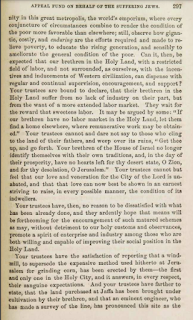
The report on charity endeavors for Jews in Eretz-Yisrael in the year 1862, including Hebron, from the Occidental - American Jewish Advocate:




For the Record
PALESTINE (OUTRAGES)
HC Deb 19 April 1948 vol 449 cc117-8W117W
Mr. Sorensen asked the Secretary of State for the Colonies whether he has any further statement to make about the capture of the Arab village of Deir Yassin in Palestine by Jews on 9th April.
Mr. McNeil I have been asked to reply. My right hon. Friend has now received additional information from the High Commissioner. The figure of Arab casualties given to the House on 12th April has been confirmed by a visit to the village by a representative of the International Red Cross, who has stated that in one cave he saw the heaped bodies of some 150 Arabs, men, women and children, whilst in a well a further 50 bodies were found. The approaches to the village are strongly held by Hagana and the Palestine Police could not enter to conduct investigations without a considerable show of force. The terrorist groups claim that Hagana facilitated the mounting of their attack on Deir Yassin, although the Jewish Agency issued a statement on 12th April expressing118W horror and disgust at the barbarity of the manner in which this action had been carried out by the terrorists. The Zionist General Council, however, meeting in Tel Aviv on the same day, ratified an agreement for co-operation between the Hagana and the Irgun Zvai Leumi. Units of the Hagana have now taken over occupation of Deir Yassin from the members of the terrorist groups who originally attacked the village.
Invitations to the Press conference given by a Jewish spokesman for the Irgun Zvai Leumi and the Stern Group, which took place in the heavily guarded Jewish settlement of Givat Shaul, near Deir Yassin, were issued by telephone to selected American and Jewish correspondents. The fact that this conference had taken place was not known to the authorities until the following day. No correspondents of British newspapers were invited.
In view of the difficulties of military operations against the village, which would probably be very costly in British lives, the High Commissioner, in consultation with the Air Officer commanding arranged for an air strike against the terrorists, with the object of turning them out of the village. Before the attack could take place it became known, beyond the possibility of doubt, that the members of the terrorists' groups who had originally occupied the village had left. In these circumstances it was decided not to proceed with the air operations.
It must be realised that with the progressively reduced strength of our Armed Forces as our withdrawal proceeds, intervention in every instance of violence between Arab and Jew is not practicable. Within the limited resources available, however, every possible action will be taken to prevent the spread of civil conflict and to punish those responsible for such barbarous acts.
^
If you do that while reading this abstract, you'll realize the media is not all that dependable.
Taking sides: Translators and journalists in the Spanish civil war
Marcos Rodríguez-Espinosa, University of Málaga, Spain
Abstract
Soon after the uprising of General Franco in July 1936, the elite of international journalism turned its attention to the political undercurrents of the emerging Spanish Civil War, a historical period which would become a ‘golden age’ for foreign correspondents, and a conflict where women would for the first time play a leading role in global war reporting. Their battlefield accounts often reflect a biased understanding of the ideological confrontation of the two warring factions, referred to in Anglosaxon media as ‘Loyalists’ (Republicans) and ‘Nationalists’ (Francoists), whereas domestic reporters preferred the more categorical ‘rojos’ (reds) or ‘fascistas’ (fascists).
For many foreign journalists, sending their chronicles back home meant paying a heavy toll, since correspondents were only allowed on the frontline when accredited and any journalist held prisoner could easily be mistaken for a spy. Drawing on a selection of historical, journalistic, media and translation studies research sources, as well as on a number of memoirs, personal accounts and biographies, in this article we discuss some up to now uncharted issues arising from the symbiotic connection between translation and journalism during the Spanish Civil War:
(a) their lack of proficiency in Spanish and their unfamiliarity with the country made it necessary for many correspondents to rely on the assistance of interpreters, fixers, guides and press officers, recruited for their ideological commitment to the rebel military uprising or to the Republican Government; (b) the role of translation in the Press and Propaganda Offices set up by the incipient Nationalist government, the Spanish Republic and the Catalan and Basque autonomous governments; and (c) the complex relationship between foreign correspondents and translators working for the censorship departments set up by Francoist and Republican Press Offices in order to prevent journalists from revealing information which might undermine the morale of civilians or troops, and the international reception of the narratives they sought to disseminate abroad.
^
From "The Zionist Leaders’ Fear: Perception of, Comparison with, and Reactions to the Armenian Genocide" by Martina Berli:
The first attack on the Yishuv had already taken place in December 1914, when a large number of Jews were expelled from Palestine. Entering the war, Turkey faced the problem of having thousands of non-Ottomans living in the empire, a great number of them from hostile countries. The backbone of Jewish colonization was built of non-Ottomans, of whom 50,000 were Russians. According to Zionist perception, Talât could not bear having a “Russian vilayet in Palestine”80 and gave the Jews two options: either to become Ottomans or to leave. Having secured Cemal’s support, Behaeddin Bey, the kaymakam (governor) of Jaffa, who had a rigid anti-Jewish attitude, expelled several Jewish families on December 17. He forced 600 persons to board a boat that brought them to Egypt. The amount of time set for the Jews to become Ottomans was not respected, and the expulsion was not limited only to Jews from hostile countries. The expelled Jews were mistreated, beaten, and their belongings were stolen; some fell into the water, and because the ship could not take all those being expelled on board, many families were separated.81
This, however, marks only the beginning of the persecution of the Yishuv. Was this course predictable? For Ruppin, stationed in Jaffa, it was: “If this school of thought [the xenophobia of Behaeddin and Cemal Pasha] is the dominant one in the Young Turk party, we will have to make ourselves ready for serious opposition in our further work in the country.”82 The eviction of Jews continued during the entire summer of 1915. Unremittingly during the war, the Jewish population was exposed to house searches, arrest, expulsion, and deportation. The Jewish arbitral court and the Anglo-Palestine Bank were closed. Zionist flags and weapons owned by Jews were confiscated, and the latter were distributed among the Arabs. Furthermore, the use of Hebrew in correspondence was prohibited.83 In all these repressive measures, the Zionists saw Cemal’s intention to halt the Jewish colonization work in Palestine.84
In fact there was considerable disparity between the central government’s order to facilitate the Ottomanization of foreign Jews and its implementation by local officials. The Turkish authorities in the Jaffa district especially caused difficulties, whereas Constantinople often asked the local authorities in Palestine why, in specific cases, Ottoman citizenship was refused to Jews.85 In the end a great number of individuals left the country, discouraged by the process of naturalization. The total number of Jews who left––whether they were expelled or left of their own accord––between December 1914 and the end of 1915 amounted to 11,277.86
In spring 1917 a major incident—the evacuation of Jaffa—provoked international attention, as the expulsion in December 1914 had already done. Prior to this event, however, attempts to harm Jewish colonization had already been discussed by Cemal and Talât. According to a telegram addressed to Cemal Pasha on August 25, 1915, Talât was already considering the deportation of foreign Jews living in the empire.93
Even the Jews who applied for naturalization were to be placed outside Palestine.94 The Zionists were alarmed. The chief rabbi in Constantinople, Haim Nahum Effendi, with whom the Zionist leaders were in touch, was visiting Talât to discuss the deportations of the Jews from the Marmara region,95 when Talât commented:
“What would you think if we were to cast out the Jews from Palestine too?”96 During that time Talât informed Cemal that “it is certain that one must agree to the brutal expulsion of Zionists, who are undoubtedly harmful to the homeland, in order to clean it.”97 This growing tension was noticed by the Zionists, as Lichtheim’s report from the end of November 1916 reveals. In his opinion Cemal “undoubtedly in recent times again considered measures against the Palestinian Jews.”98
The Zionists saw Cemal as the main actor of the anti-Jewish and anti-Zionist campaigns. Their reports convey that there was talk of “cleansing” all suspicious elements in Palestine and that these talks were initiated and led by Cemal.99 They also claimed that he was acting with malicious intent against Zionism and had influenced the central government with his anti-Zionist attitude and his mistrust of all Jews. In the end the Zionists had to assume that the Turkish government was harboring a “hostile attitude” toward them.100 In the Zionists’ interpretation this was exactly the attitude shown toward them by the decision to evacuate Jaffa’s Jewish population, which consisted of some 10,000 Jews and was the center of the Yishuv.
With the arrival of the British forces in Gaza in March 1917, the evacuation of the population of Jaffa was ordered. Cemal explained this as an “unfortunate military necessity,” which had to happen “for the good of the fatherland and the population.”101 The evacuees could go wherever they wanted, but those without means would be transported into the Syrian hinterland.102 The movement of the refugees was under constant Ottoman surveillance.103 Gaza, with its mostly Muslim inhabitants, had been evacuated some weeks earlier. This had also been done on Cemal’s order, for military reasons and to relieve the army of the burden of civilians.104
The first British attack on Gaza was repelled. This military success brought with it the justification for the evacuation of Jaffa.105 The Jews and newly appointed Journal of Levantine Studies 101 German Consul Karl Freiherr von Schabinger interpreted this evacuation as an act directed against the Yishuv because the German and Austrian non-Jewish nationals were allowed to remain at their own risk. It also seemed that the mutasarrif, the administrative authority of the district, showed some consideration with respect to the Muslim orange-grove owners but not to their Jewish neighbors.106 Finally, about 9,000 Jews were deported.
^
From this book, Akram Khater, Inventing Home: Emigration, Gender and the Middle Class in Lebanon, 1870–1920 (Berkeley: University of California Press, 2001)
"In 1871 two men left the coast of Lebanon for the United States. We do not know their names, or why they chose such a lonely and unprecedented endeavor. Moreover, for over a decade after, few followed in their footsteps to either North or South America. In fact, until 1886 only a few hundred emigrants were recorded to have left the Mountain, and most went to South America.[1] Yet, in 1887 hundreds began to emigrate to the United States, Brazil, and Argentina, and by the middle of the 1890s the yearly recorded numbers were in the thousands.[2] By the time World War I erupted on the European continent, almost one third of the population of Mount Lebanon had left their villages and towns seeking fortunes in unfamiliar lands. For a people who thought a trip to neighboring Damascus was at once a courageous and foolhardy act, emigration across the seas could not have been an undertaking entered into lightly.[3] Accentuating these willful acts of departure from the norm is their sheer magnitude as a phenomenon. Collectively these peasants marked history in an indelible manner that prompts us as latter-day observers to take note and ask why they left their homes for unknown futures.

Figure 1. Rate of Lebanese emigration to the United States. Figures from Immigration Commission, Reports of the Immigration Commission: Statistical Review of Immigration, 1820-1910, 61st Cong., 3rd sess., 1911, S. Doc 756, and Reports of the Immigration Commission, 63rd Cong., 3rd sess., 1915.
The Persecution Theory
Some historians have attributed this human movement to the persecution of Christians—who made up the overwhelming majority of the emigrants at the hands of the ruling Ottoman administration—and by neighboring Muslims. This myth, as it were, was developed originally by some of the newcomers themselves, particularly those of Maronite background. To understand the reasons behind such a fabrication, it is important to note that throughout the nineteenth century various Maronite intellectuals and elites—secular and religious—were concerned with establishing a “Maronite nation.”[4] To bring such a project to successful fruition, it was necessary to enlist the support of external Western powers by appealing to them along the assumed common lines of Christianity. Writers like Abraham Rihbany, George Haddad, and Philip Hitti portrayed Christians in Mount Lebanon as defenseless victims of persecution, oppressed by ruthless “Turks” who extorted money from them.[5] Such narratives were “corroborated” by articles published in the popular Western press and written by missionaries returning from Lebanon. One such report appeared in 1896 in the New York Times. The author referred to the Muslims in Lebanon as “non-speakable” Turks who were bent on expelling all the Christians from the Holy Land.[6] That Lebanon was not quite the “Holy Land” and that Muslim-Christian tensions there did not derive from one-sided persecution were niceties that somehow did not matter. Even the emigrants themselves were prone to embellish their personal stories with horrific tales of massacres and persecution. Yusuf Bey, the Ottoman consul in Barcelona, remarked on this tendency in a 1889 report to the Porte: “When questioned why they had to leave their homes in such large numbers, they invent ridiculous stories about the massacre of their wives and children . . . all to increase the compassion and thus the alms they can elicit.”[7] What is striking about this myth is its durability. As late as 1992 some scholars were attributing Lebanese emigration to “banditry, economic decay, poverty and religious and social conflict. In times of religious strife, the Christians were apt to suffer massacre at the hands of their better armed Druze and Muslim neighbors.”[8]
Belying this mythology are various contemporary sources, indigenous and otherwise. Documents from the Ottoman archives show that Ottoman policy toward the Lebanese in general, and toward their emigration in particular, was hardly uniform or oppressive. Allowing for the presence of corruption within the Ottoman administration of the Mountain and the city of Beirut, these documents illustrate two things. First, various Ottoman governors of the Mountain had different agendas and attitudes toward the inhabitants, who in turn had different reactions to these Mutasarrifs. Franko Pasha, the governor of Mount Lebanon from 1868 to 1873, was well liked and remembered by many observers for his cordial relations with the Maronite church and the European consular corps, as well as for his efforts to bring prosperity to the people of Lebanon. One measure of his popularity with the Maronite of the Mountain is their support for the nomination of his nephew, Naum Pasha, for the position of governor in 1892. However, Rüstem Pasha (who was governor between 1873 and 1883) was neither fondly remembered nor particularly receptive to the demands of the Maronite religious and secular elites. Rather, he “made a point of establishing cordial but equidistant and formal relations with all major groups and institutions wielding influence in the Mountain, including the Maronite Church and the French Consulate.”[9]
Second, establishing that different governors had different agendas, varying by small or large degrees, leads to another (self-evident) observation. Ottoman governors, as well as more minor officials, were hardly omnipotent in Mount Lebanon. Rather they had to constantly contend with the intervention of European consuls, the machinations of local politicians, and the distant demands of the Sublime Porte. Dealing with these conflicting currents, the governors had to play a balancing act that precluded any notion of complete control. If anything, it appears at times that the local elites were successful not only in blocking an Ottoman action but also in forcing the resignation of the governor over that action. One such instance occurred during the governorship of Muzaffer Pasha (1902–1907). Among the various changes he tried to effect was an increase in taxes by 30 piasters on every dirhem of cultivated land. This money was supposed to fund, among other things, seventeen new positions of inspector for various governmental departments. However, the popular outcry against the taxes and “unnecessary” expenditures forced Muzaffer to rescind his appointments and return the tax rates to their previous levels.[10]
On balance, most evidence that we have shows that the Ottoman administration tried to accommodate the needs of the population of the Mountain. Except in a few instances, the governors kept from even trying to raise the artificially low taxes in the Mountain. To wit, the 1861 Règlement gave the Ottoman administration the right to collect 1.75 million piasters in taxes from the Mountain's inhabitants. This figure was based on a cadastral survey of the lands completed in 1861 which grossly underestimated the true extent of agricultural plots in the Mountain, particularly those held by the Maronite Church. Even after the extent of cultivable lands increased over the following fifty years, the tax base could not be revised because of the standing objection of the Lebanese. Moreover, expenditures of the administration of Lebanon outpaced income by over 2 million piasters, a difference that the central government in Istanbul supplied over a twenty-year period before its patience ran out. In 1910, when the male population had reached—at least—the 200,000 mark, the personal tax was still being collected on the basis of the 1861 census, which counted 99,843 adult males (above fifteen years of age) in the Mountain.[11] In addition to these glaring tax advantages, the inhabitants of the Mountain enjoyed improvements in transportation (length of roads increased from 38 kilometers to 1,104 between 1860 and 1912), the right to avoid conscription into the Ottoman army during times of war, as well as greater freedoms of expression. It thus becomes quite clear that neither were the Ottomans quite the “monsters” they were drawn as, nor were the Lebanese “oppressed.”
But one need not depend solely on Ottoman sources to reach this conclusion. Reports by various French, English, and U.S. consuls, based in Beirut and unsympathetic to the Ottomans, contradict reports of persecution of Christians in Lebanon. Shortly after the civil war of 1860, Lord Dufferin, who was in the region to investigate the causes of that conflict at the behest of the British government, wrote:
When I first came to this country I was under the impression of those natural sentiments of indignation [against] the atrocities perpetrated by the Druses on the Christians. . . .To my surprise however I soon began to discover . . . that there were two sides to the story. . . . I am now in a position to state, without fear of contradiction, that however criminal may have been the excesses to which the Druses were subsequently betrayed, the original provocation came from the Christians.[12]
A later, and perhaps more neutral commentary, came from U.S. consul general Ravndal about the state of unrest gripping the city of Beirut during the fall of 1903.[13] His report painted a picture of a city in transition from being a traditionally Muslim stronghold to one dominated demographically and economically by Christians newly descended from the Mountain. While he faults the Muslims of the city for not accepting this change, he also places part of the blame for continued conflict at the door of a “weak and indecisive” Ottoman administration that was incapable of arresting Christian suspects implicated in various violent incidents. Moreover, he reported that the Maronites of northern Lebanon “seem to be prominently identified with the policy of sowing distrust and accentuating existing differences between the Moslems of the city [Beirut] and the Christians of the mountains.” Finally, he noted that as a result of the “troubles” over thirty thousand Christians had left the city for the mountains.[14]
From this one glimpses an intricate political life in Lebanon around the time of the emigration movement. For Christians to leave the city in search of security indicates that the mountains were considered a safe haven of sorts, even by those who later spoke of persecution at the hand of Ottoman authorities. In turn, these authorities—while biased against the Christians—do not appear to have been capable of persecuting that community, even if one accepts the idea that they intended to do so. Standing between these authorities and the population at large were the European powers, among whom the Maronites singled out “Our Mother France” for protection. In one instance after another, the Ottoman authorities would retreat from decisions in the face of local opposition backed by European sponsors. In practice, then, Christians were not persecuted in Mount Lebanon, even if they felt at odds with Ottoman administrations and wary of their Muslim neighbors."
^
Z. gave much thought to the place of education in a mobilized society: “There is only one goal before us, which is providing excellent teaching and an excellent education.” But what was the aim of education? Consensus remained somewhat vague. Z. defines it as “safeguarding the homeland.” In that context he pondered the futility of too much gymnastics and too many parade-ground drills, in the spirit of the German turnen (group gymnastics) that inspired the Hareali gymnasium. He wondered how such activities helped shape skilled warriors. When Arab gunmen terrorized Hebrew society, the most pressing aim was to prevent daily killings. Z. asks himself “how an empty-handed man could catch an armed person.”
January 29, 1939
^
I just came across this article:
The Balfour Declaration in International Law
which concludes so:
"The Balfour Declaration may have continuing legal relevance—not as a promise of a Jewish national home, which has already been fulfilled, but as a promise for Palestinian rights."
If the term used to describe other persons than Jews was simply "non-Jewish communities", which indicated Arabs, Armenians, Syrians, Moslems, Christians and what not, and in the subsequent League of Nations Mandate, that phrase becomes "the inhabitants of Palestine, irrespective of race and religion" while the terms "the Jewish national home" and "a national home for the Jewish people" are used, and if, in the 1919 agreement between Faisal and Weizmann we find the use of "the Arab State and Palestine", what would provide you any basis for assuming there were/are "Palestinan rights" that apply specifically to a social or national group of Arabs?
To be continued.
^
Over a decade ago, I tried to counter the propaganda line then popular hat there are "apartheid roads" in Judea and Samaria. I think this was my first blog attempt. I even brought a PowerPoint to show at Limmud UK on the theme and to disprove it.
Then in 2015, after the NYTimes' Roger Cohen spoke of Jews driving down highways in fancy cars while Arabs drive donkey carts, my friend Ezri Toubi did this.
And now, my friends Josh and Caleb Waller have done this fabulous clip.
But I am sure the pro-Pals will come up with some other theme soon.
^
Most anyone who has read opeds or non-academic articles knows that when tracing the subject of Arab anti-Jewish terror during thye years of the British Mandate, the time frame usually appears as
the riots of 1920, 1921, 1929 and 1936-1938
Of course, to the unknowledgeable, that would imply that outside those years, everything was peaceful and calm. Arab terror was restricted only to those years. Nothing much, if at all, happened inbetween. The terror came it uncontrollable, as iut were, outburts and were a result of something the Jews did, as if a reaction to a provocation.
Reading a paper on the Mufti's activities, I spotted the examples I reproduce below as incidents from outside or inbetween those seemingly fixed time frames of Arab terror:
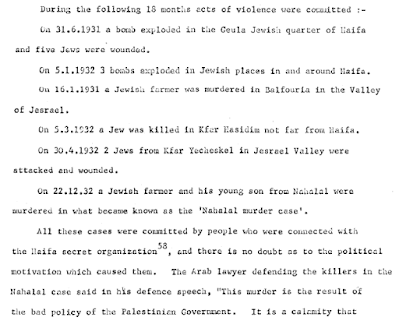
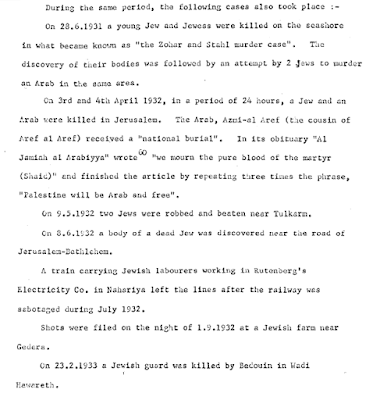
I found myself directed to Walter Laqueur's A History of Zionism, p 267, where he mentions two of the many assassinations of Arabs who opposed the Mufti Amin Al-Husseini, espeially if they were binationalists.
Jewish minimalists, after Brit Shalom, now the Ihud led by a ‘Committee of Five’ - Magnes, Szold, Buber, Smilansky and Simon, and other groups sought out a partner (see here for all the convoluted history).
Lacquer writes that "with the blessing of the Jewish agency", contacts were made by them with leading Arab personalities to find a common language. They met and talked and prepared more blueprints, only to realize in the end that in spite of all the outward civilities there was no common ground.
On July 15, 1947, a binationalist testified to the UN Special Committee on Palestine that
Mr. COHEN (Interpretation from Hebrew): Concerning the question of the programme of the League, it was presented to you in the memorandum which was given before the hearing. This programme was crystallized after direct contact with certain Arab groups. These negotiations which have taken place between certain groups of Arabs and Jews have proved more than once that this programme has considerable chance of success,
Success?
The Ihud found Fawzi Darwish Hussaini, a labor activist and a cousin of the mufti. He was willing to sign an agreement with his Jewish friends providing for a bi-national state based on the principle of no domination of one nation over the other. He suggested the immediate establishment of political clubs and a daily newspaper to combat the influence of the Arab war party.
On 11 November 1946, five members of Young Palestine, Fawzi’s group, signed an agreement concerning common political action with Ihud representatives, but this promising initiative came to a sudden and tragic end. Twelve days later Fawzi was killed by Arab terrorists and his group dispersed. ‘My cousin stumbled and received his proper punishment’, Jamal Hussaini, one of the leaders of the extremist party, declared a few days later.

Laquer goes on and relates that in September 1947, Sami Taha, a prominent Haifa trade resident, was killed. His society had declared itself in favor of a Palestinian, not an Arab state, acknowledging that Jews too had certain rights. He had become a target for extremists.


They should be saluted, not as much as for their politics as for simply trying to be independent thinkers.
____________
UPDATED
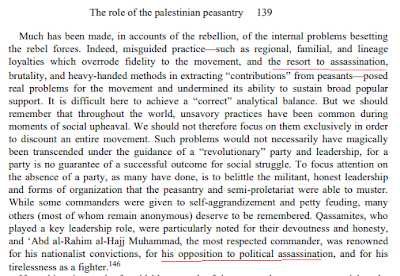
Even the NYTimes knew, early on, of the Mufti's political assassinations of Arab rivals:




 Posts
Posts


