Showing posts with label Mufti. Show all posts

Tuesday, January 18, 2022

Saluting Two Arab Palestinian Martyrs

I found myself directed to Walter Laqueur's A History of Zionism, p 267, where he mentions two of the many assassinations of Arabs who opposed the Mufti Amin Al-Husseini, espeially if they were binationalists.

Jewish minimalists, after Brit Shalom, now the Ihud led by a ‘Committee of Five’ - Magnes, Szold, Buber, Smilansky and Simon, and other groups sought out a partner (see here for all the convoluted history).

Lacquer writes that "with the blessing of the Jewish agency", contacts were made by them with leading Arab personalities to find a common language. They met and talked and prepared more blueprints, only to realize in the end that in spite of all the outward civilities there was no common ground. 

On July 15, 1947, a binationalist testified to the UN Special Committee on Palestine that

Mr. COHEN (Interpretation from Hebrew): Concerning the question of the programme of the League, it was presented to you in the memorandum which was given before the hearing. This programme was crystallized after direct contact with certain Arab groups. These negotiations which have taken place between certain groups of Arabs and Jews have proved more than once that this programme has considerable chance of success, 

Success?

The Ihud found Fawzi Darwish Hussaini, a labor activist and a cousin of the mufti. He was willing to sign an agreement with his Jewish friends providing for a bi-national state based on the principle of no domination of one nation over the other. He suggested the immediate establishment of political clubs and a daily newspaper to combat the influence of the Arab war party. 

On 11 November 1946, five members of Young Palestine, Fawzi’s group, signed an agreement concerning common political action with Ihud representatives, but this promising initiative came to a sudden and tragic end. Twelve days later Fawzi was killed by Arab terrorists and his group dispersed. ‘My cousin stumbled and received his proper punishment’, Jamal Hussaini, one of the leaders of the extremist party, declared a few days later. 


Laquer goes on and relates that in September 1947, Sami Taha, a prominent Haifa trade resident, was killed. His society had declared itself in favor of a Palestinian, not an Arab state, acknowledging that Jews too had certain rights. He had become a target for extremists. 

More names:


They should be saluted, not as much as for their politics as for simply trying to be independent thinkers.

____________

UPDATED

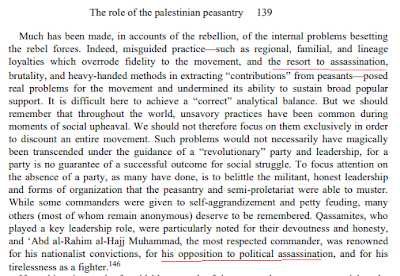
Even the NYTimes knew, early on, of the Mufti's political assassinations of Arab rivals:


From THE ISRAEL/PALESTINE QUESTION
Edited by Ilan Pappé 


^


Tuesday, December 15, 2020

The October 1938 'Ultimatum'

I was asked by a Menachem Begin Heritage Center employee to help research an item he came across via a poem by a Warsaw Ghetto poet, Władysław Szlengel, who was close to the Revisionist thinking. It referred to an "ultimatum".

I was not aware of the event but set about doing what I could.

It seems that during 1938, the Mufti Haj Amin Al-Husseini had ensconced himself in Syria and was promoting his violent reign of terror (that he had begun in April 1936) from Damascus. The Peel Partition Plan had been made a year earlier and now the British had set up the Woodhead Commission.

The Arabs were convening in Cairo and this 

'World Parliamentary Congress of Arab and Muslim Countries for the Defense of Palestine' convened in Cairo in October 1938, it marked Egypt's assuming a central place in unofficial Arab-Muslim efforts to assist the Palestinian Arab cause

On it briefly:


What set off my colleague's interest was this:


an editorial of the Davar newspaper on October 14 which blasted an "ultimatum" directed to Chaim Weitzmann. 

But what was the ultimatum?


It was that the Arabs, even if they would be completely destroyed, they would not allow Jews to settle in and build a majority in Arab Palestine.

Haaretz had a Reuters report from October 10


which I found in Chicago The Sentinel as "dire calamities":

Some further background:


and the author of that book further pointed out:


It seems that Haaretz was very concerned about the ramifications of the 'ultimatum' publishing, on October 12, that "the threat issued this past week by one of the nationalist Arab groups in Damascus to the Zionist movement that revenge will be taken against Jews residing in Arab countries":-


In other words, what occured as a result of the 1947-1948 war, when hundreds of thousands of Jews were set up and forced to flee from the Arab states they had lived in for centuries, even before they became states, was in th Arab mind a decade earlier. The man behind all this was staunch Syrian Arabist Nabih al-Azma (in the middle)


who, already in 1925, "convinced...al-Hajj Amin al-Husaini, to establish a special finance committee for the Syrian Revolt in Jerusalem". In 1931, he was living in the Palestine Mandate  and then, when the Mufti fled to Damascus, reciprocated.  As a  leaders of the Istiqlal party, Nabih al-Azma, with others, took over the Palestine Defense Committee in Damascus. Money was collected in Syria and it was transferred through al-Azma, who lived in Palestine, to the AHC leadership. Weapons were also procured by Istiqlal members in Transjordan and smuggled into Palestine. In July 1936, the Palestine Defense Committee dispatched about 700 Arab volunteers to fight in Palestine under the command of Fawzi al-Qawuqij. An Arab congress took place in Bludan, Syria in September 1937 and its the main organizer of the event was Nabih al-Azma, then a member of the Syrian National Bloc party, who received payments from the Italians. It was well-attended by leading Arab nationalist and pan-Islamic politicians and would prove instrumental in internationalizing the Arab-Zionist dispute in Palestine and in mobilizing Arab and Muslim public opinion. Seems he's mentiond in here.

The French eventually arrested al-Azma and others of the Palestine in March 1939 and two of their newspapers banned. The Committee was moreover discredited by the publication of evidence showing that Nabih al-Azma had been embezzling funds from the Palestine Defense Committee.


^

Monday, September 21, 2020

Rolling Back the Pan-Islam Anti-Peace with Zionism

The original article was published at JNS.

Here I have added some details as well as visual materials.
____________

There are several convincing factors as to why Israel, its supporters – both Jews and non-Jews – as well as all men and women of reason should be satisfied with the signing of two arrangements for peaceful relations between Israel and the United Arab Emirates and Bahrain. One of them is the historical handicap the conflict between Arabs and the state of Israel and its Zionist character has been cast for a century. 

Indeed, the frame of reference of the “Palestine conflict” has always been one that includes the entire Muslim world. That world’s identification with and sympathy for the “plight of Palestine” is now, in a sense, dissolving.

What was the historical backdrop to that phenomenon?

As Suleiman Mousa, writing in the International Journal of Middle East Studies, Vol. 9, No. 2, notes that already in July 1922, at the time of the Haj,

a Palestine delegation arrived in Mecca to explain to the king [Hussein ibn Ali] the dangers inherent in the policy of the Jewish National Home. The British government of Palestine, perturbed at the activities of the delegation, sent a letter to the Hijaz government refuting its complaints and claiming that the Arabs in Palestine were faring well and prospering. The Hijaz government refused to accept this statement and insisted that the Balfour Declaration should be canceled.” (and see PRO, FO 686/110) for the correspondence)

Already in 1921 we see the theme of the Haram in danger being pushed:


The head of that 1922 delegation was Abdelqader Al-Muzaffar (arrested in 1930) who had led previous Haj pilgrimages to Mecca.  Its members sailed to Sudan and from there to Jeddah, arriving on July 11. It established pro-Arab Palestine committees at all the stops and sought meetings with leading political and religious personalities. Their theme was “Defend Al-Aqsa” 

"Defend Al-Aqsa" Banner on the Wall, 
Third Arab Congress, 1920

over which, supposedly, the Zionist flag flew


The 1922 delegation's report

As Doar Hayom reported on July 23, 1922, 


the Zionist Organization in Egypt published a response to the claims of the delegation in the al-Muqaṭṭam newspaper. It also dealt with the remarks of Alfred Mond 


as if he proposed in early 1921 during a visit in Jerusalem* an immediate rebuilding of "Solomon's Temple" 
remarks also reported in 1922:

LORD MELCHETT (then SIR ALFRED MOND) has declared in public (1922) that the day of the reconstruction of the Temple was very near.

purposely misrepresented by the Mufti  (see below)


and as how Haaretz reports, he was speaking figuratively that the new construction of the reconstituted Jewish national home will replae Solomon's edifice:


as well as the criticism directed at Norman Bentwich, the mandate’s Jewish legal secretary, who the Mufti considered as being too Zionist as he said "Palestine should be Jewish", as it were. This propaganda ploy by the Supreme Muslim Council was a repeat of the efforts that Chaim Weizmann had to counter in Egypt in April 1918, while on his was to Palestine, when it was asserted that the British had granted the Zionists the right to replace the Dome of the Rock with the Jewish Temple. 


Three days earlier, the Vaad Leumi in Jerusalem was forced to publish a denial that the Zionist flag had been unfurled from the top of the Golden Dome, a calumny to be revived in 1929.  Even the local Arabs denied it:


On July 17, the High Commissioner Herbert Samuel himself declared, as carried in Doar Hayom of July 19, 


that he was forced to address rumors that Omar and Al-Aqsa are in danger, a charge repeated throughout the years.


and would be removed from Muslim control, unfounded rumors spread by the delegation that was now in Mecca seeking assistance to “defend Muslim rights”. 


Two additional delegations followed the following year, one to the Hijaz again and another to India.  This third on consisted of Jamal Al-Husseini, a Haifa mufti, Imam Mohamed Rashid Reda, and Sheikh Ibrahim al-Ansari, a Temple Mount preacher.

They remained in India all during November 1923–June 1924, raised money and engaged in anti-Zionist activity. Oddly, Nicholas E. Roberts ignores the 1922 delegation as does Yehoshua Porath although Porath does include a fourth delegation in 1924. A huge sum was collected for major renovation work and construction within the Haram A-Sharif compound.

This charity was a significant instrument which tied Moslems across the world in a religious sense to an Arab Palestine as well as acting as a political mobilizing tool.

The selection of India was astute. As P.R. Kumaraswamy researched, India was quite able to recognize and admit the religious dimension of the Palestine question. In April 1921, a year before the Palestine Mandate confirmation at the League of Nations, Mahatma Gandhi observed: “The Muslim claim Palestine as an integral part of Jazirat-ul-Arab [the Islamic land of Arabia]. They are bound to retain its custody, as an injunction of the Prophet” (CWMG, 2000, p. 530). He continued and argued: “The Jews cannot receive sovereign rights in a place that has been held for centuries by Muslim powers by right of religious conquest. The Muslim soldiers did not shed their blood in the last war for the purpose of surrendering Palestine out of Muslim control.”

In other words, according to Gandhi, the non-Muslims could not acquire sovereign jurisdiction over Palestine.

The Indian National Congress similarly adopted an anti-Zionist position at a meeting in Lucknow in June 1921. Its All-India Congress Committee declared that “unless Jazirat-ul-Arab are freed from all non-Muslim control, there can be no peace and contentment in India” (Zaidi, 1985, p. 30) and a few years later, the party demanded “the removal of alien control from the Jazirat-ul-Arab” (Zaidi, 1985, p. 32). The Mufti Haj Amin El-Husseini met the Ali Brothers during the 1924 and 1926 Hajj pilgrimage (Kupferschmidt, 1987, p. 129), had Muhammad Ali, the head of India’s Muslims, buried in the Haram wall in January 1931. Shaukat (Shawkat) Ali was a central figure in the convening of the Jerusalem Conference in December that same year.

Thus, within a decade of being selected by Herbert Samuel to be the Mufti, El-Husseini had established a firm financial base throughout the Middle East and beyond, had created a dominant political force in the Mandate itself which disallowed any dissent from his violent and extremist line, had forced the British to create a new status quo at the Western Wall, had initiated the campaign of terror in 1920, 1921 and 1929 that would, until this day, serve as the sole means of “negotiating” with the Jews and had formed a support bloc of all the Arab states and countries with Moslem majorities.

One additional external reliance of the Mufti was the arrangement in 1937 with British assistance to have their regional Arab allies, Amir Abdullah of Transjordan, King Ghazi of Iraq, and King Abdul Aziz ibn Saud of Saudi Arabia, the “Arab Kings”, mediate an end to the revolt the Arab Higher Committee (AHC) had initiated in April 1936. Unfortunately, their involvement created serious pressure on Gt. Britain and by 1939, pan-Arab pressure led to the White paper that reneged on the original intent to reconstitute the Jewish national home carried increasing weight in London.

In 1948, Arab state invaded Israel and ever since then, the issue of Palestine has always been regional rather than a local conflict.

Recalling this history and grasping what the previous 100 years had fashioned, one can realize that the signing of the Abraham Agreements on the White House Lawn on September 15 with the abrogation of the boycott against Israel and the pledge “to establish peace, diplomatic and friendly relations, co-operation and full normalization of ties between them and their peoples”, is a major reverse of the Mufti’s and Yasser Arafat’s legacy and an opportunity for a promising future.

_________

On Mond and his remark in the House of Commons:

HC Deb 05 April 1921 vol 140 cc108-9108

§58. Commander BELLAIRS asked the Prime Minister whether his attention has been drawn to the proposal put forward at a meeting of the Palestine Foundation Fund to erect a great temple on the site of the Temple of Solomon; whether he is aware that the site is now occupied by the Mosque of Omar; and whether, in view of the difficulties which such proposals cause to the Mandatory Powers, he will state that in no circumstances will Mohammedan institutions be interfered with?

§Mr. AMERY My attention has been drawn to a passage in a speech delivered by my right hon. Friend the Minister of Health [Alfred Mond], to which the hon. and gallant Member apparently alludes. I think it is clear that my right hon Friend was speaking figuratively and did not intend so literal an interpretation to be given to his words. In any case, I would draw attention to Article 13 of the draft Mandate for Palestine, which clearly sets forth the policy of His Majesty's Government with regard to all holy places, religious buildings, or sites in Palestine.

§Lieut.-Commander KENWORTHY Is the hon. and gallant Gentleman aware that there is no intention whatever of interfering with any mosques by the Palestine Committees, and also that King Solomon is held in equal reverence by Mohammedans, Jews, and Christians?

§Earl WINTERTON Will my hon. and gallant Friend make it clear that so far from His Majesty's Government wishing to interfere with the holy places, a Mohammedan guard has always been placed over the Temple; and will he convey to the Minister of Health the un-desirability of making the sort of figurative speech which he did, in view of Mohammedan susceptibilities?


§Mr. AMERY I cannot be responsible for the extent of misinterpretation which may be put on figurative speeches, but it is certainly the case, as my Noble Friend stated, that a guard has been on the Mosque of Omar ever since the occupation, and there is every intention of safeguarding the holy places of every religion.

____________

*
By A.W. Lloyd, 'Punch', January 19, 1921


^

Tuesday, May 12, 2020

Revisiting Netanyahu on the Mufti’s Holocaust Role

Remember the contretemps when, five years ago, Binyamin Netanyahu attacked the Grand Mufti of the Palestine Mandate?

Examples:


Anger at Netanyahu claim Palestinian grand mufti inspired Holocaust

Israeli PM accused of trivialising the Holocaust for saying grand mufti of Jerusalem gave Hitler idea of exterminating Europe’s Jews


Netanyahu Denounced for Saying Palestinian Inspired Holocaust

Israeli historians and opposition politicians joined Palestinians in denouncing the Israeli prime minister


Netanyahu: Hitler Didn't Want to Exterminate the Jews

Prime minister tells World Zionist Congress that Hitler only wanted to expel the Jews, but Jerusalem's Grand Mufti convinced him to exterminate them, a claim that was rejected by most accepted Holocaust scholars.

And then there is this:

...at a war crimes trial on 26 July 1946 Adolf Eichmann’s deputy Dieter Wisliceny testified that “the Mufti was one of the initiators of the systematic extermination of European Jewry and had been a collaborator and advisor of Eichmann and Himmler in the execution of this plan.”   

which is from Joseph B. Schechtman, The Mufti and the Fuehrer: The Rise and Fall of Haj Aminel-Husseini (New York: Thomas Yoseloff, 1965), p. 160.  

In the British Foreign Office file, 371/52585/E1984/515/31, F.O. minute, October 6, 1946, you can find this quotation of Wisliceny:

"According to my opinion, the Grand-Mufti who has been in Berlin since 1941 played a role in the decision of the German Government to exterminate the European Jews."

Phillip Mattar describes those affidavits as unreliable yet Eichmann himself, in his testimony at his trial, confirmed that the Nazis had "an agreement with the Grand Mufti" to prevent emigration to Palestine (The Eichmann Trial: Proceedings, Session No. 58, p. 1053).
But the British did not feel confident to place him on trial.  Other historical surviews of the Mufti disagree with the Mufti not bein involved firectly in the Holocaust.  Here. And here.

Rafael Medoff took to task those who had an interest in downplaying the Mufti Nazi links.  He notes a 1990 study of American Zionism during the Holocaust years. Its author


claims that American Zionist organizations exaggerated the Mufti's crimes and sought his indictment as a war criminal on the false premise that he had a role in formulating the Final Solution

What they did seek to charge the Mufti was this

the Mufti's organizing the Arab Legion, his role in the pro-Nazi revolt in Iraq in 1941, and the Yugoslavia atrocities — but not the genocide.

Medoff includes, in a footnote,  reliable evidence of a Nazi link to Palestinian Arab violence before the outbreak of World War II during 1938 based on five original British police documents proving such a link that were published in Efraim Dekel, Shai: The Exploits of Haganah Intelligence, New York, 1959.

More from Medoff:


A specific link between the Mufti and the Final Solution became known in early 1946 when a prominent American journalist, Edgar Ansel Mowrer of the New York Post, cited documents revealing Husseini's effort to interfere in ransom negotiations over European Jewish refugees. The documents referred to a proposal by the British in the spring of 1943 to permit 4,000 Jewish refugee children from Hungary, Rumania, Bulgaria and Slovakia, accompanied by 500 adults, to enter Palestine, in exchange for the release of 20,000German prisoners of war. The Germans were interested in the scheme and entered into negotiations with the British, but later withdrew after the Mufti protested...Surely the Mufti knew something about the Final Solution from the visit by his top aides to the Sachsenhausen concentration camp, near Oranienburg. David Yisraeli long ago uncovered German Foreign Office correspondence documenting how the Mufti arranged, in 1942, for several of his assistants to undergo training by the SS, including a visit to Sachsenhausen,adjacent to the headquarters of the Inspectorate of Concentration Camps, in order "to learn how to deal with the enemy, particularly the Jews."

And

Eichmann himself confirmed that the Mufti's aides were given SS training, and that he himself briefed them on the genocide process. He testified at his 1961 trial that on one occasion, three of the Mufti's Arab associates "came to work in my Section for their information for a day or two."  He recalled: "I received the order to open everything to them, to let them look everywhere, also state secrets."  In his testimony, Eichmann also acknowledged that the Mufti's aides were given training, in his department and others, to "recondition [them] into experts for any Gestapo to be set up in the Near East" in the event that the Nazis conquered that region.

The 1943 Himmler congratulatory telegram to the Mufti is, alas, too non-specific although being friendly enough with Himmkler to receive such a missive is interesting.

At the time of the Netanyahu-Mufti affair, Time Magazine had this to offer from 
David Kaiser on the Mufti:


He proposed an Arab revolt all across the Middle East to fight the Jews...He also wanted to form an Arab legion, using Arab prisoners from the French Empire who were then POWs inside Germany. He also asked Hitler to declare publicly, as the German government had privately, that it favored “the elimination of the Jewish national home” in Palestine.Netanyahu uttered a half-truth when he referred to Hitler’s supposed desire to expel, rather than murder, the Jews. 


Nevertheless, the Holocaust was not the brainchild of the Grand Mufti of Jerusalem although he had plans for crematoria in the Dotan Valley in northern Samaria.  And let us not forget this from Bernard Lewis' 1999 book, "Semites and Anti-Semites: An Inquiry Into Conflict and Prejudice", pages 146-47, that I posted five years ago


^

Sunday, September 29, 2019

We Blew It: On The Prohibited Sounding of the Shofar

These names might not be recognizable to most:

Eliel Lofgren. Charles Barde. C.J. Van Kemken. Stig Sahlin.

Those were the three members of a committee that reviewed the issue of the Western Wall following the August 1929 riots, and its coordinating secretary


Matson Collection


In a short 2010 blog post I recalled their activity and I want to return to them and that period, as has been noted, we will soon be marking 90 years to the ban on the blowing of the shofar at the Western Wall by the British, which was vigorously protested by the Chief Rabbis immediately on the day following Yom Kippur 1929:


.

I need present some necessary history and will use material from the Report of the that three-man Commission which had been appointed by His Majesty's Government in the United Kingdom of Great Britain and Northern Ireland, with the approval of the Council of the League of Nations, to determine the rights and claims of Moslems and Jews in connection with the Western or Wailing Wall at Jerusalem.  

As shown, there was a constant struggle of Jews against attempts by the Moslems to deny any legitimacy to customs and even simple decency of comfort of Jewish worshippers:
On 19th February, 1922, the acting Governor of Jerusalem received a letter from the Supreme Moslem Council, asking for the removal, according to the Palestine Government's previous instructions, of seats and benches from the Wall. As the Jews had again begun to place the seats there, the Council wrote again to the Governor on 16th April, 1922, asking him to restrain the Jews from bringing benches or seats to the place. Then the Council, at the request of the inhabitants of the private dwellings near the Pavement, in a letter dated 8th January, 1923, complained of a repeated trespass on the part of the Jews in the same respect. A reply was given by the acting Governor on the 3rd February, 1923, informing the Council that orders had been given for due observance of the earlier instructions.
That was 1922-1923.

Next, 1925-1926
After a certain time had elapsed the guardian of the Waqf of the Moghrabis protested again against the Jews for precisely the same reason and on that account in a Ietter dated 28th September, 1925, the Council lodged a complaint with the Governor, referring to the promise contained in his letter of 3rd February, 1923. As the Council did not receive any written answer for some time, they wrote again to the Governor on the 7th June, 1926, asking for a reply and entreating him to prevent the Jews "from repeating this act of theirs so as to abide by the status quo." Along with the said letter, however, there was enclosed a copy of a petition from the guardian of the Moghrabi Waqf, in which complaints were made "that Jews place benches, mats, tables, chairs, and lamps when they have not been previously allowed to do so." The guardian of the Waqf goes on to say that "this has caused a nuisance to passers by, as the road leads to the houses of the Waqf. They have therefore trespassed on part of the Waqf land, because the width of the passage does not exceed 2-1/2 metres. We are in continual quarrels with them as they insist on placing these things."
In other words, the Moslems, who built houses right up to the wall, leaving but a dozen feet or so for Jewish worshippers, then get upset they cannot walk by.

To continue:
Upon an answer being received from the Governor's Office dated the 28th of June, 1926, to the effect that "the matter was under investigation," the Council through their President wrote again on 20th July, 1926 repeating its request of 7th June, but without mentioning any particular appurtenances. As the result of the promised investigation was not forthcoming, the President of the Council sent a letter to the Deputy District Commissioner on the 4th of August, 1926, informing him that the Jews were again endeavouring to put out seats at the Wall. This information, he stated, had reached the Council from the guardian of the Moghrabi Waqf and his repeated request for action on behalf of the Council was dictated by those complaints. This time, however, the Council concluded their letter by saying: "The aim of the letter dated 20th July, 1926, was that the necessary steps be taken to prevent the Jews from putting anything in the Buraq, especially on Saturdays and Jewish feast days." On 25th August, 1926, the District Officer wrote to the President of the Council in reply to the above letter as follows: "That the measures referred to in the last paragraph of your quoted letter have been taken, and that no change in the status quo will take place."
And you wonder where Moshe Dayan got his idea about a "status quo".
After that nothing of any special interest happened up to the beginning of November, 1926, at which date the inhabitants of the Moroccan Quarter complained to the Supreme Moslem Council about the Jews bringing "small portable chairs" to the Wall, under the presence that they had been promised leave to use such chairs by the District Police Officer. Quarrels had arisen between the Moroccans and the Jews on account of that, and the guardian of the Waqf asked that the Jews might be prevented from placing anything there that was not sanctioned by old practice. The said petition caused the Council to write to the Deputy District Commissioner on 7th December, 1926, informing him about the quarrels that had just arisen about the small chairs which were " contrary to the ancient usage and practice," and he concluded his letter in the following way: "We do not believe that the Government desires to alter the ab antiquo state which has been enforced on to the present." (Italics inserted by the Commission.)
On to 1927-1928:
At the end of 1927 the Deputy District Commissioner advised the President of the Supreme Moslem Council that, in his opinion, it was desirable in the interests of public security that during certain hours of the day when Jews were wont to congregate at the Wall for praying purposes, tourists should not be permitted to go there. He, therefore, proposed to give orders to the policemen stationed near the Wailing Wall to refuse admission to tourists during those particular hours of the day.

This letter was written on the 2nd of December, 1927, and was answered very fully by the President of the Council, on the 15th of January, 1928. The Council objected to prohibiting tourists from approaching the Pavement, because any such prohibition amounted to "granting the Jews new rights in the same place, and, moreover, would arouse the feelings of the Moslems." In this letter the view was consequently advanced which came to light later in the proceedings before the Commission, viz., that "several incidents and many problems caused by the Jews around the question of the Buraq plainly indicate that they have laid down a plan of gradually obtaining this place.

Thereafter, the Deputy District Commissioner by letter of 30th March, 1928, informed the President of the Council that he would post a notice in the area of the Western Wall for the information of the tourists stating the special hours of prayer and "requesting the public to respect the privacy of those engaged in prayers at such times." In his answer to that letter on the 3rd of April the President of the Council stated that he could not agree to that notice being put up and repeated his assurance that every attempt by the Jews to extend their claims in the Buraq would be received with the utmost anxiety by the Moslems and would be flatly refused.

Not until the 24th of September, 1928, i.e., on the same day as the disturbances described in the Shaw Commission Report (page 29) took place, did the President of the Moslem Council himself make a direct and detailed protest against the Jews' habit of bringing appurtenances of worship to the Wall. He then specified "a wooden room covered with cloth, screens, mats, a large table in the middle and also the Ten Commandments placed on a chair which should not be there."

There is more but the above is more than sufficient. And it is important to see the development of the issue. The Mufti had his eye on turning the conflict into a religious one early on, prior to 1928 and "Jewish provocations".

The prohibition on sounding the shofar was already in place for Yom Kippur 1929, some two months after the riots, as reported in the Yiddish newspaper the Grodna Express:


and thanks to Bella Bryks-Klein for confirming my presumption that that what was reported.

The Committee concluded in its Report in connection with the shofar sounding:
It forms a part of the Jewish service in the Synagogue to blow the Shofar (ram's horn) on New Year's Day and on the Day of Atonement and the Jews have claimed the right on the said occasions to carry out this ceremony of theirs in front of the Wall too.

That is a claim that has not been recognised in the present administrative regulations or otherwise in actual practice, and the Commission has not found any sufficient reason for assenting to it.
And decided:
The Jews shall not be permitted to blow the ram's horn (Shofar) near the Wall nor cause any other disturbance to the Moslems that is avoidable;
Jews didn't have a chance with the Mandatory Government:


Already, back on November 28, 1928, the British published a 'forgotten' White Paper that was issued after the infamous "Prayer Partition" incident to re-established the principle of a status quo at sacred sites which included that 
a protocol could be mutually agreed upon between the Moslem and Jewish authorities regulating the conduct of the services at the Wall without prejudies to the legal rights of the Moslem owners and in such a way as to satisfy normal liturgical requirement and decencies in matters of public worship.
In that White Paper, it was made clear as reported in the Palestine Post of December 5, 1928, anything the Moslem Waqf and the Supreme Muslim Council considered as an act that infringes on the status quo would be opposed:
His Majesty 's Government regard it as their duty and it is their intention, to maintain, the established Jewish right of access to the pavment in front of the Wall for the purpose of their devotions and also their right to bring to the Wall those appurtenances that they were allowed to take to the Wall under the Turkish regime. It would be inconsistent with their duty under the Mandate were they to endeavour to compel the Moslem owners of the pavement to accord any further privileges or rights to the Jewish community. 
A previous post of mine on the subject.

Some other historical background here

___________________

P.S. Despite the ban, from 1930 until 1947, members of Betar, Brit Habiryonim and the Irgu blew the shofar, some being subsequently detained for up to 6 months in prison. In 1944, the Irgun warned the British not to think of coming into the alleyway in front of the Wall, a suggestion with which they complied.


^