Tuesday, February 22, 2022

On The Turkish Expulsion of the Yishuv's Jews

From "The Zionist Leaders’ Fear: Perception of, Comparison with, and Reactions to the Armenian Genocide" by Martina Berli:

The first attack on the Yishuv had already taken place in December 1914, when a large number of Jews were expelled from Palestine. Entering the war, Turkey faced the problem of having thousands of non-Ottomans living in the empire, a great number of them from hostile countries. The backbone of Jewish colonization was built of non-Ottomans, of whom 50,000 were Russians. According to Zionist perception, Talât could not bear having a “Russian vilayet in Palestine”80 and gave the Jews two options: either to become Ottomans or to leave. Having secured Cemal’s support, Behaeddin Bey, the kaymakam (governor) of Jaffa, who had a rigid anti-Jewish attitude, expelled several Jewish families on December 17. He forced 600 persons to board a boat that brought them to Egypt. The amount of time set for the Jews to become Ottomans was not respected, and the expulsion was not limited only to Jews from hostile countries. The expelled Jews were mistreated, beaten, and their belongings were stolen; some fell into the water, and because the ship could not take all those being expelled on board, many families were separated.81

This, however, marks only the beginning of the persecution of the Yishuv. Was this course predictable? For Ruppin, stationed in Jaffa, it was: “If this school of thought [the xenophobia of Behaeddin and Cemal Pasha] is the dominant one in the Young Turk party, we will have to make ourselves ready for serious opposition in our further work in the country.”82 The eviction of Jews continued during the entire summer of 1915. Unremittingly during the war, the Jewish population was exposed to house searches, arrest, expulsion, and deportation. The Jewish arbitral court and the Anglo-Palestine Bank were closed. Zionist flags and weapons owned by Jews were confiscated, and the latter were distributed among the Arabs. Furthermore, the use of Hebrew in correspondence was prohibited.83 In all these repressive measures, the Zionists saw Cemal’s intention to halt the Jewish colonization work in Palestine.84

In fact there was considerable disparity between the central government’s order to facilitate the Ottomanization of foreign Jews and its implementation by local officials. The Turkish authorities in the Jaffa district especially caused difficulties, whereas Constantinople often asked the local authorities in Palestine why, in specific cases, Ottoman citizenship was refused to Jews.85 In the end a great number of individuals left the country, discouraged by the process of naturalization. The total number of Jews who left––whether they were expelled or left of their own accord––between December 1914 and the end of 1915 amounted to 11,277.86

In spring 1917 a major incident—the evacuation of Jaffa—provoked international attention, as the expulsion in December 1914 had already done. Prior to this event, however, attempts to harm Jewish colonization had already been discussed by Cemal and Talât. According to a telegram addressed to Cemal Pasha on August 25, 1915, Talât was already considering the deportation of foreign Jews living in the empire.93 

Even the Jews who applied for naturalization were to be placed outside Palestine.94 The Zionists were alarmed. The chief rabbi in Constantinople, Haim Nahum Effendi, with whom the Zionist leaders were in touch, was visiting Talât to discuss the deportations of the Jews from the Marmara region,95 when Talât commented:

“What would you think if we were to cast out the Jews from Palestine too?”96 During that time Talât informed Cemal that “it is certain that one must agree to the brutal expulsion of Zionists, who are undoubtedly harmful to the homeland, in order to clean it.”97 This growing tension was noticed by the Zionists, as Lichtheim’s report from the end of November 1916 reveals. In his opinion Cemal “undoubtedly in recent times again considered measures against the Palestinian Jews.”98

The Zionists saw Cemal as the main actor of the anti-Jewish and anti-Zionist campaigns. Their reports convey that there was talk of “cleansing” all suspicious elements in Palestine and that these talks were initiated and led by Cemal.99 They also claimed that he was acting with malicious intent against Zionism and had influenced the central government with his anti-Zionist attitude and his mistrust of all Jews. In the end the Zionists had to assume that the Turkish government was harboring a “hostile attitude” toward them.100 In the Zionists’ interpretation this was exactly the attitude shown toward them by the decision to evacuate Jaffa’s Jewish population, which consisted of some 10,000 Jews and was the center of the Yishuv. 

With the arrival of the British forces in Gaza in March 1917, the evacuation of the population of Jaffa was ordered. Cemal explained this as an “unfortunate military necessity,” which had to happen “for the good of the fatherland and the population.”101 The evacuees could go wherever they wanted, but those without means would be transported into the Syrian hinterland.102 The movement of the refugees was under constant Ottoman surveillance.103 Gaza, with its mostly Muslim inhabitants, had been evacuated some weeks earlier. This had also been done on Cemal’s order, for military reasons and to relieve the army of the burden of civilians.104

The first British attack on Gaza was repelled. This military success brought with it the justification for the evacuation of Jaffa.105 The Jews and newly appointed Journal of Levantine Studies 101 German Consul Karl Freiherr von Schabinger interpreted this evacuation as an act directed against the Yishuv because the German and Austrian non-Jewish nationals were allowed to remain at their own risk. It also seemed that the mutasarrif, the administrative authority of the district, showed some consideration with respect to the Muslim orange-grove owners but not to their Jewish neighbors.106 Finally, about 9,000 Jews were deported. 

^

Emigration from Mount Lebanon in the Late 19th Century

From this book, Akram Khater, Inventing Home: Emigration, Gender and the Middle Class in Lebanon, 1870–1920 (Berkeley: University of California Press, 2001)


"In 1871 two men left the coast of Lebanon for the United States. We do not know their names, or why they chose such a lonely and unprecedented endeavor. Moreover, for over a decade after, few followed in their footsteps to either North or South America. In fact, until 1886 only a few hundred emigrants were recorded to have left the Mountain, and most went to South America.[1] Yet, in 1887 hundreds began to emigrate to the United States, Brazil, and Argentina, and by the middle of the 1890s the yearly recorded numbers were in the thousands.[2] By the time World War I erupted on the European continent, almost one third of the population of Mount Lebanon had left their villages and towns seeking fortunes in unfamiliar lands. For a people who thought a trip to neighboring Damascus was at once a courageous and foolhardy act, emigration across the seas could not have been an undertaking entered into lightly.[3] Accentuating these willful acts of departure from the norm is their sheer magnitude as a phenomenon. Collectively these peasants marked history in an indelible manner that prompts us as latter-day observers to take note and ask why they left their homes for unknown futures.


Figure 1. Rate of Lebanese emigration to the United States. Figures from Immigration Commission, Reports of the Immigration Commission: Statistical Review of Immigration, 1820-1910, 61st Cong., 3rd sess., 1911, S. Doc 756, and Reports of the Immigration Commission, 63rd Cong., 3rd sess., 1915.

The Persecution Theory

Some historians have attributed this human movement to the persecution of Christians—who made up the overwhelming majority of the emigrants at the hands of the ruling Ottoman administration—and by neighboring Muslims. This myth, as it were, was developed originally by some of the newcomers themselves, particularly those of Maronite background. To understand the reasons behind such a fabrication, it is important to note that throughout the nineteenth century various Maronite intellectuals and elites—secular and religious—were concerned with establishing a “Maronite nation.”[4] To bring such a project to successful fruition, it was necessary to enlist the support of external Western powers by appealing to them along the assumed common lines of Christianity. Writers like Abraham Rihbany, George Haddad, and Philip Hitti portrayed Christians in Mount Lebanon as defenseless victims of persecution, oppressed by ruthless “Turks” who extorted money from them.[5] Such narratives were “corroborated” by articles published in the popular Western press and written by missionaries returning from Lebanon. One such report appeared in 1896 in the New York Times. The author referred to the Muslims in Lebanon as “non-speakable” Turks who were bent on expelling all the Christians from the Holy Land.[6] That Lebanon was not quite the “Holy Land” and that Muslim-Christian tensions there did not derive from one-sided persecution were niceties that somehow did not matter. Even the emigrants themselves were prone to embellish their personal stories with horrific tales of massacres and persecution. Yusuf Bey, the Ottoman consul in Barcelona, remarked on this tendency in a 1889 report to the Porte: “When questioned why they had to leave their homes in such large numbers, they invent ridiculous stories about the massacre of their wives and children . . . all to increase the compassion and thus the alms they can elicit.”[7] What is striking about this myth is its durability. As late as 1992 some scholars were attributing Lebanese emigration to “banditry, economic decay, poverty and religious and social conflict. In times of religious strife, the Christians were apt to suffer massacre at the hands of their better armed Druze and Muslim neighbors.”[8]

Belying this mythology are various contemporary sources, indigenous and otherwise. Documents from the Ottoman archives show that Ottoman policy toward the Lebanese in general, and toward their emigration in particular, was hardly uniform or oppressive. Allowing for the presence of corruption within the Ottoman administration of the Mountain and the city of Beirut, these documents illustrate two things. First, various Ottoman governors of the Mountain had different agendas and attitudes toward the inhabitants, who in turn had different reactions to these Mutasarrifs. Franko Pasha, the governor of Mount Lebanon from 1868 to 1873, was well liked and remembered by many observers for his cordial relations with the Maronite church and the European consular corps, as well as for his efforts to bring prosperity to the people of Lebanon. One measure of his popularity with the Maronite of the Mountain is their support for the nomination of his nephew, Naum Pasha, for the position of governor in 1892. However, Rüstem Pasha (who was governor between 1873 and 1883) was neither fondly remembered nor particularly receptive to the demands of the Maronite religious and secular elites. Rather, he “made a point of establishing cordial but equidistant and formal relations with all major groups and institutions wielding influence in the Mountain, including the Maronite Church and the French Consulate.”[9]

Second, establishing that different governors had different agendas, varying by small or large degrees, leads to another (self-evident) observation. Ottoman governors, as well as more minor officials, were hardly omnipotent in Mount Lebanon. Rather they had to constantly contend with the intervention of European consuls, the machinations of local politicians, and the distant demands of the Sublime Porte. Dealing with these conflicting currents, the governors had to play a balancing act that precluded any notion of complete control. If anything, it appears at times that the local elites were successful not only in blocking an Ottoman action but also in forcing the resignation of the governor over that action. One such instance occurred during the governorship of Muzaffer Pasha (1902–1907). Among the various changes he tried to effect was an increase in taxes by 30 piasters on every dirhem of cultivated land. This money was supposed to fund, among other things, seventeen new positions of inspector for various governmental departments. However, the popular outcry against the taxes and “unnecessary” expenditures forced Muzaffer to rescind his appointments and return the tax rates to their previous levels.[10]

On balance, most evidence that we have shows that the Ottoman administration tried to accommodate the needs of the population of the Mountain. Except in a few instances, the governors kept from even trying to raise the artificially low taxes in the Mountain. To wit, the 1861 Règlement gave the Ottoman administration the right to collect 1.75 million piasters in taxes from the Mountain's inhabitants. This figure was based on a cadastral survey of the lands completed in 1861 which grossly underestimated the true extent of agricultural plots in the Mountain, particularly those held by the Maronite Church. Even after the extent of cultivable lands increased over the following fifty years, the tax base could not be revised because of the standing objection of the Lebanese. Moreover, expenditures of the administration of Lebanon outpaced income by over 2 million piasters, a difference that the central government in Istanbul supplied over a twenty-year period before its patience ran out. In 1910, when the male population had reached—at least—the 200,000 mark, the personal tax was still being collected on the basis of the 1861 census, which counted 99,843 adult males (above fifteen years of age) in the Mountain.[11] In addition to these glaring tax advantages, the inhabitants of the Mountain enjoyed improvements in transportation (length of roads increased from 38 kilometers to 1,104 between 1860 and 1912), the right to avoid conscription into the Ottoman army during times of war, as well as greater freedoms of expression. It thus becomes quite clear that neither were the Ottomans quite the “monsters” they were drawn as, nor were the Lebanese “oppressed.”

But one need not depend solely on Ottoman sources to reach this conclusion. Reports by various French, English, and U.S. consuls, based in Beirut and unsympathetic to the Ottomans, contradict reports of persecution of Christians in Lebanon. Shortly after the civil war of 1860, Lord Dufferin, who was in the region to investigate the causes of that conflict at the behest of the British government, wrote:

When I first came to this country I was under the impression of those natural sentiments of indignation [against] the atrocities perpetrated by the Druses on the Christians. . . .To my surprise however I soon began to discover . . . that there were two sides to the story. . . . I am now in a position to state, without fear of contradiction, that however criminal may have been the excesses to which the Druses were subsequently betrayed, the original provocation came from the Christians.[12]

A later, and perhaps more neutral commentary, came from U.S. consul general Ravndal about the state of unrest gripping the city of Beirut during the fall of 1903.[13] His report painted a picture of a city in transition from being a traditionally Muslim stronghold to one dominated demographically and economically by Christians newly descended from the Mountain. While he faults the Muslims of the city for not accepting this change, he also places part of the blame for continued conflict at the door of a “weak and indecisive” Ottoman administration that was incapable of arresting Christian suspects implicated in various violent incidents. Moreover, he reported that the Maronites of northern Lebanon “seem to be prominently identified with the policy of sowing distrust and accentuating existing differences between the Moslems of the city [Beirut] and the Christians of the mountains.” Finally, he noted that as a result of the “troubles” over thirty thousand Christians had left the city for the mountains.[14]

From this one glimpses an intricate political life in Lebanon around the time of the emigration movement. For Christians to leave the city in search of security indicates that the mountains were considered a safe haven of sorts, even by those who later spoke of persecution at the hand of Ottoman authorities. In turn, these authorities—while biased against the Christians—do not appear to have been capable of persecuting that community, even if one accepts the idea that they intended to do so. Standing between these authorities and the population at large were the European powers, among whom the Maronites singled out “Our Mother France” for protection. In one instance after another, the Ottoman authorities would retreat from decisions in the face of local opposition backed by European sponsors. In practice, then, Christians were not persecuted in Mount Lebanon, even if they felt at odds with Ottoman administrations and wary of their Muslim neighbors."

^

How Could An Empty-Handed Man Catch...

Excerpt:

Z. gave much thought to the place of education in a mobilized society: “There is only one goal before us, which is providing excellent teaching and an excellent education.” But what was the aim of education? Consensus remained somewhat vague. Z. defines it as “safeguarding the homeland.” In that context he pondered the futility of too much gymnastics and too many parade-ground drills, in the spirit of the German turnen (group gymnastics) that inspired the Hareali gymnasium. He wondered how such activities helped shape skilled warriors. When Arab gunmen terrorized Hebrew society, the most pressing aim was to prevent daily killings. Z. asks himself “how an empty-handed man could catch an armed person.”

January 29, 1939

Palestinian Rights in the Balfour Declaration?

 I just came across this article:

The Balfour Declaration in International Law

which concludes so:

"The Balfour Declaration may have continuing legal relevance—not as a promise of a Jewish national home, which has already been fulfilled, but as a promise for Palestinian rights."
I was so taken aback that I wrote the author so:
If the term used to describe other persons than Jews was simply "non-Jewish communities", which indicated Arabs, Armenians, Syrians, Moslems, Christians and what not, and in the subsequent League of Nations Mandate, that phrase becomes "the inhabitants of Palestine, irrespective of race and religion" while the terms "the Jewish national home"  and "a national home for the Jewish people" are used, and if, in the 1919 agreement between Faisal and Weizmann we find the use of "the Arab State and Palestine", what would provide you any basis for assuming there were/are "Palestinan rights" that apply specifically to a social or national group of Arabs?

To be continued.

Wednesday, January 26, 2022

Those "Apartheid Roads", Take Two

Over a decade ago, I tried to counter the propaganda line then popular hat there are "apartheid roads" in Judea and Samaria. I think this was my first blog attempt. I even brought a PowerPoint to show at Limmud UK on the theme and to disprove it.

Then in 2015, after the NYTimes' Roger Cohen spoke of Jews driving down highways in fancy cars while Arabs drive donkey carts, my friend Ezri Toubi did this.

And now, my friends Josh and Caleb Waller have done this fabulous clip.

But I am sure the pro-Pals will come up with some other theme soon.


^

Thursday, January 20, 2022

The 'In-Between' Mandate Period Arab Terror

Most anyone who has read opeds or non-academic articles knows that when tracing the subject of Arab anti-Jewish terror during thye years of the British Mandate, the time frame usually appears as

the riots of 1920, 1921, 1929 and 1936-1938

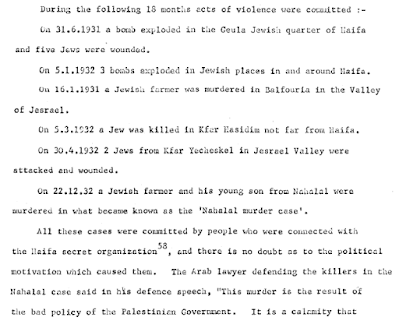
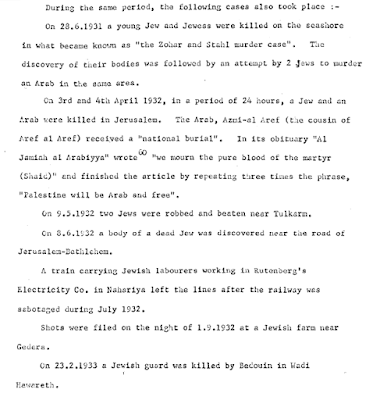
Of course, to the unknowledgeable, that would imply that outside those years, everything was peaceful and calm. Arab terror was restricted only to those years. Nothing much, if at all, happened inbetween. The terror came it uncontrollable, as iut were, outburts and were a result of something the Jews did, as if a reaction to a provocation.

Reading a paper on the Mufti's activities, I spotted the examples I reproduce below as incidents from outside or inbetween those seemingly fixed time frames of Arab terror:


And there is so much more.

^


Tuesday, January 18, 2022

Saluting Two Arab Palestinian Martyrs

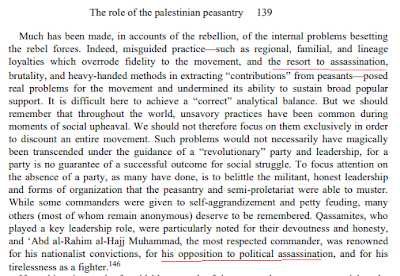
I found myself directed to Walter Laqueur's A History of Zionism, p 267, where he mentions two of the many assassinations of Arabs who opposed the Mufti Amin Al-Husseini, espeially if they were binationalists.

Jewish minimalists, after Brit Shalom, now the Ihud led by a ‘Committee of Five’ - Magnes, Szold, Buber, Smilansky and Simon, and other groups sought out a partner (see here for all the convoluted history).

Lacquer writes that "with the blessing of the Jewish agency", contacts were made by them with leading Arab personalities to find a common language. They met and talked and prepared more blueprints, only to realize in the end that in spite of all the outward civilities there was no common ground. 

On July 15, 1947, a binationalist testified to the UN Special Committee on Palestine that

Mr. COHEN (Interpretation from Hebrew): Concerning the question of the programme of the League, it was presented to you in the memorandum which was given before the hearing. This programme was crystallized after direct contact with certain Arab groups. These negotiations which have taken place between certain groups of Arabs and Jews have proved more than once that this programme has considerable chance of success, 

Success?

The Ihud found Fawzi Darwish Hussaini, a labor activist and a cousin of the mufti. He was willing to sign an agreement with his Jewish friends providing for a bi-national state based on the principle of no domination of one nation over the other. He suggested the immediate establishment of political clubs and a daily newspaper to combat the influence of the Arab war party. 

On 11 November 1946, five members of Young Palestine, Fawzi’s group, signed an agreement concerning common political action with Ihud representatives, but this promising initiative came to a sudden and tragic end. Twelve days later Fawzi was killed by Arab terrorists and his group dispersed. ‘My cousin stumbled and received his proper punishment’, Jamal Hussaini, one of the leaders of the extremist party, declared a few days later. 


Laquer goes on and relates that in September 1947, Sami Taha, a prominent Haifa trade resident, was killed. His society had declared itself in favor of a Palestinian, not an Arab state, acknowledging that Jews too had certain rights. He had become a target for extremists. 

More names:


They should be saluted, not as much as for their politics as for simply trying to be independent thinkers.

____________

UPDATED

Even the NYTimes knew, early on, of the Mufti's political assassinations of Arab rivals:


From THE ISRAEL/PALESTINE QUESTION
Edited by Ilan Pappé 


^


Behind the Diplomatic Scene

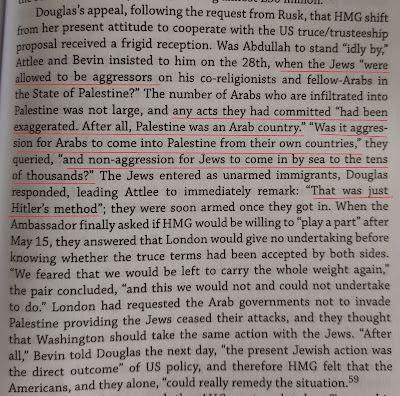
This is from Monty Penkower's latest book, Israel: As A Phoenix Ascending (I will be reviewing it in depth) on page 203. Explanation follows below.


The meeting took place in London on April 28, 1948.

Playcard:

Douglas is Lewis Williams Douglas, American Ambassador to the United Kingdom.

Rusk is Dean Rusk, director of the Office of Special Political Affairs in the State Department.

Attlee is Clement Attlee, UK Prime Minister.

Bevin is Ernest Bevin, Secretary of State for Foreign Affairs.

HMG is His Majesty's Government.

Source here.

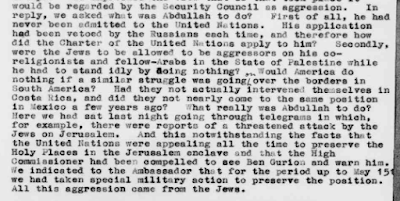
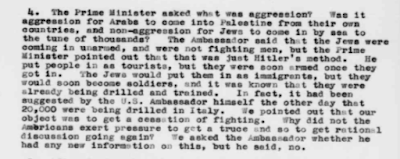
From the original document:


Background:

After the US had reneged on support for partition at the UN, which recommended a Jewish state be established, by suggesting a trusteeship, President Harry Truman came around to supporting the original vote. Tasked by Rusk, Douglas meets Attlee and Bevin in London.

As the minutes show, the two most senior British politicians display bias, prejudice, antisemitism and anti-Zionism in their thinking about the future Jewish state.

Jews, attacked ever since on the morrow of the November 29, 1947 Partition Plan vote, not to mention the terror from 1920 on, are the "aggressors".

Palestine, the land the League of Nations recognized as having a long historical connection with the Jewish people, is an "Arab country".

They justify the invasion of the Mandate territory.

Jews who arm themselves, after coming in as refugees from Hitler's Holocaust, are following "Hitler' method".

This was the behind-the-scene thinking of the top British diplomats directing the Mandate just prior to Israeli statehood.

^


Wednesday, January 05, 2022

The Naked Archaeologist and I

Thanks to Uri Gobey, who screen-snapped this picture and inquired if it was, indeed, me,


I can relate a tale.

I am acquainted with Simha Jacobovici, having first met him decades ago at a meeting of the World Union of Jewish Students at which, although not a student then, I attended. It was at Kiryat Moriah I recall.

Anyway, when he was producing this 2008 episode of his "Naked Archaeologist", he was on Emeq Refaim Street in Jerusalem and was talking about belief in hard-to-believe-in Biblical themes. I worked at the Begin Center and while out getting something (either a pizza or a book), I stopped to observe.

During a break, I stepped over to introduce myself and say hello. He remembered me and asked if he could film me while asking a question. I agreed.

He went on about the Refaim, mythical creatures for all intents and purposes, and then asked me at 5:45 if I believed that Og, King of Bashan, was nine cubits tall? (See Deutoronomy 3:11).


Luckily for me, I remembered that the exact quotation is:

his bedstead was a bedstead of iron;...nine cubits was the length thereof, and four cubits the breadth of it

and so, on the spur of the moment, and with a bit of cheeky wit, I answered,

or may he had a very big girlfriend?


That stumped him and almost brought out an on-camera laugh, I think.

^

Sunday, January 02, 2022

An Attack on Tel Shiloh and the Biblical Narrative

I think I may have missed this hit piece on Shiloh's archaeological value at the time.

Excerpts:

About 20 kilometres (12.4 miles) north of Ramallah in the occupied West Bank, just west of the Israeli settlement Shiloh, lies Tel Shiloh, an archaeological site that attracts tens of thousands of evangelical Christians every year.

There, Scott Stripling, an evangelical pastor from Texas, heads a dig...

...Stripling calls Tel Shiloh Israel's "first capital", based on the idea that Shiloh was the first capital of the Israelites for close to 400 years from the 15th century BCE. ...Biblical scholars beg to differ.

"Properly credentialed biblical scholarship does not assume the historicity of anything prior to King David [ca. 1010-970 BCE]," says Southern Methodist University Professor of Old Testament Susanne Scholz. "That Stripling projects the biblical stories into the historical record exposes him as a Christian fundamentalist. That's the origin of his drive to do archaeology at Tel Shiloh."

Scholz also points out that the claim that Shiloh was the capital of ancient Israel is "utter nonsense".

"Such statements are used to advance geopolitical goals," she says.

The first question an academic like her should be asked is: have you reviewed any of the results of the dig? After all, to depend on a news media site is really an inadequate source.

Has she reviewed the previous results of any earlier digs? The pottery? The walls? Etc.

Some of the studies:

- Buhl, Marie-Louise, & Svend Holm-Nielsen, Shiloh--The Danish Excavations at Tall Sailum, Palestine, in 1926, 1929, 1932 AND 1962: The Pre-Hellenistic Remains. Copenhagen: The National Museum of Denmark, 1969.
- Finkelstein, Israel, et al. Shiloh: The Archaeology of a Biblical City. Tel Aviv, 1993.
- Hizmi, Hananya, and Reut Livyatan-ben-Arie. “The Excavations at the Northern Platform of Tel Shiloh the 2012-2013 Seasons [Translated from Hebrew].” Edited by D. Scott Stripling and David E. Graves. Translated by Hillel Richman. Near East Archaeological Society Bulletin 62 (2017): 35–52.
Kaufman, Asher S. “Fixing the Site of the Tabernacle at Shiloh.” Biblical Archaeology Review 14.6 (Nov-Dec1988): 42-49.
- Schley, Donald G. Shiloh: A Biblical City in Tradition and History, Sheffield, 1989, 2009. 
and this from Stripling:
- Stripling, Scott. “The Israelite Tabernacle at Shiloh.” Bible and Spade 29.3 (Fall 2016): 88-95.
Or even a semi-academic presentation, as here.

Even Finkelstein accepts Shiloh as site of the Tabernacle (religion is not his driving force) and as 
"the sacred religious center of the Israelite population of the hill country"
More from Finkelstein, no Christian fundamentalist, here.

And in this article, evidence of Carbon-14 is presented dating a major conflagration at Shiloh at 1050 BCE, plus or minus 25 years, which corresponds with the Biblical narrative.

According to her CV, her archaeological experience is minimal:
Susanne Scholz is Professor of Old Testament at Perkins School of Theology at Southern Methodist University (SMU) in Dallas, Texas. As a diasporic German-American feminist post-Holocaust scholar, she researches, writes, and teaches in the area of sacred text studies, primarily in Hebrew Bible studies.

Dr. Scholz holds a Ph.D. from Union Theological Seminary in the City of New York. Born and raised in Germany, she studied at the University of Mainz and the University of Heidelberg while preparing for the equivalent of the Master of Divinity. She also studied in a one-year study program at the Hebrew University of Jerusalem, Israel, prior to coming to the United States. During these years, she participated at an archaeological dig at Tell el-Oreme/Tel Kinrot on the northwestern shore of the Sea of Galilee, led by one of her professors in Mainz.

I would suggest that perhaps it is Scholz who has an agenda rather than an independent objective body of knowledge.

The ongoing excavation and the investigation of the artifacts discovered are impressive and present real evidence and not just theories.

Maybe, when she gets the opportunity, she should visit Tel Shiloh?

^

An Anti-Semite on Jewish DNA

This came into my mailbox:

Dear White Fake Hebrew Racist Thieving Invading Jew-Nazi Yisrael Medad,

Regarding ... https://www.ynetnews.com/article/b1q82zvok

Nazi-Israel will Burn for its Crimes in Palestine, Iran, Syria, Lebanon, Iraq.

Most Jews alive today have no DNA connection to the Ancient Hebrew or the Levant ...

Semitism is Racism ... https://www.merriam-webster.com/dictionary/Semitism ... "policy or predisposition favorable to Jews"

https://www.docdroid.net/vdJhN97/the-geography-of-jewish-ethnogenesis-pdf

https://en.wikipedia.org/wiki/Eran_Elhaik

https://www.ncbi.nlm.nih.gov/pmc/articles/PMC4974603/

https://www.frontiersin.org/articles/10.3389/fgene.2017.00087/full

https://www.frontiersin.org/articles/10.3389/fgene.2017.00101/full

Thanks,

Steve Benassi

Minneapolis Minnesota


My reply:

Dear Ben-Assi​,

If there is any problem with Jewish DNA and links to the ancient Hebrews, it is probably due to Jewish women being raped by your ancestors although conversions of other peoples into the Jewish nation probably also account for any
genetic deviations.

Thank you for your attention.


Wednesday, December 22, 2021

Bucky

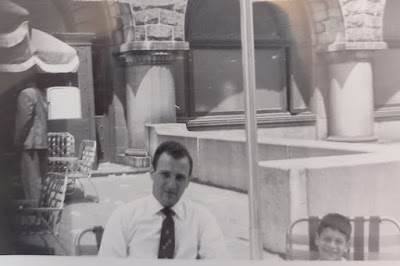
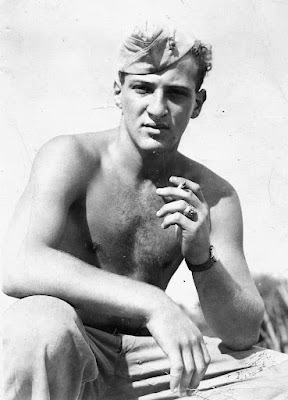
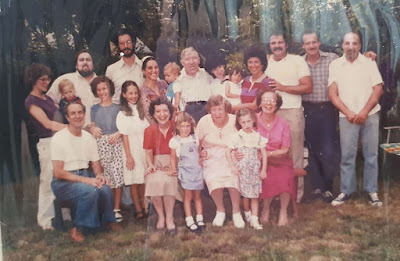
My uncle, Arthur D. Bachner, “Bucky”, died this week and the funeral is today. He was two days past his 97th birthday. 


Despite his age, it seems he suffered no known long-term illness besides being old. But he woke up, complained of stomach pain and perhaps had a stroke. Who knows?  A short while after, despite emergency medical attention, overseen by my cousin, quite a qualified nurse, he passed away. My condolences to Sindy and my other cousin, Evan, his life-partner Ed, their children, Daniella, Michael and Rebecca and their children’s children.

Bucky was married to my dearest Aunt Selma, my mother’s youngest sister, 


of the Nadel-Steckler family and their love story made it into the New York Times. I even was part of it, the 'toddler':

“And so her brother-in-law talked privately with Arthur. Then he asked Selma to babysit at his apartment while he and her sister went to the movies. She was reading on their couch, her toddler nephew fast asleep, when the bell rang. “I didn’t say ‘Who is it?’ or anything,” she said. “At the time, you just opened up the door. And Bucky was standing there.” “She had a smile on her face, and I knew that I had a chance,” he said. Six months later, they were married.”

Bucky was special in many ways. He and Selma were the ones responsible for treating me on my early birthdays. The Statue of Liberty, museums, NY Public Library. New York culture. 


One of my very first life lessons I learned from him.

Walking all the way up the Statue of Liberty he was behind me but going down, he was in front. I may have been 6 or 7 but I didn’t get the change of order. He explained that going up, if I tripped, I would fall backwards and he would be there to prevent any injury. And if I tripped descending, again, being in front, he would be there. One always needs someone to be there even if not doing anything or if anything is at that moment wrong. And now he isn’t there.

He was in the Marines* and fought in the South Pacific. 


He was in the refrigerator business and to me, he was strong and powerful. And he could prove it. 

At my Bar Mitzva, he was given the honor of raising up the Torah scroll (hagb'a) after the weekly portion had been read. It was a heavy scroll, big and with the old-fashioned wood rollers (etz chaim). As those who know, to lift it, one drops the bottom portion over the edge of the table (bima) a bit, and then one employs leverage by slowly raising it up and then, when you feel you control the balance of it, raising it up. Bucky walked up, grabbed the handles and just lifted the Torah scroll straight up, stiff-armed.

My childhood is, to my chagrin, a longways back, but I still have a vivid memory and good retention, if not perfect, and the news of his death revives so much: of the West Bronx (when I was born, it was almost 50% Jewish), until I was 7 and then later Queens where we already were, when they moved to Corona. He was funny. Quite funny. He could write backwards and I needed a mirror to read it. He did the NYTimes crossword puzzle with a pen.

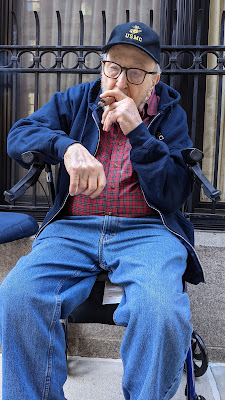
He smoked, early on, a pipe (which he one let me hold while he took a dip in the sea at the Rockaways and which drew stares from people wondering why a youngster was nonchalantaly holding a pipe) and last November had a cigar.


After my cousins followed me into Betar, he and Selma provided a support group at marches, demos, overnight vigils (showing up around midnight to make sure we were okay and to supply all with hot drinks and munchies on a Manhattan sidewalk). And at Camp Betar in the Catskills. Bucky was unabashedly liberal and, perhaps, the only argument we had was over FDR. We, shall we say, discussed the Rosenbergs, too. But he was always reading and learning. I am sure reducing his library when they moved out of their New Jersey home was a painful task. Once, I, my father and Bucky were on the same couch and reading different sections of the Sunday New York Times. My aunt said to her sister, my mother, ‘the house would burn down and they wouldn’t move’.

A lot of the previous generation is gone. In fact, Bucky was the last survivor in my family of that generation. No more grandparents; no more uncles and aunts.


I last saw him end of 2019, November. 


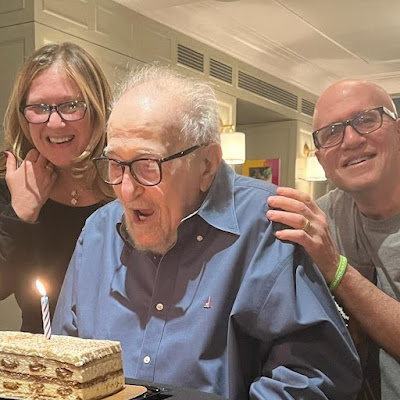
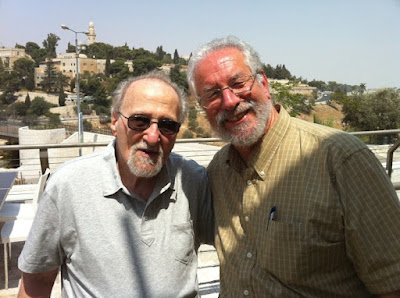
And here we are during his 2010 trip to Israel:


My cousins took care of him well.


I could, and maybe, I should go on, but I have to get ready for the Zoom of his funeral service.


אברם דוד בן שעיה נפתלי וחיה הלוי
___________

* and they had an honor contingent at his funeral:


^


Saturday, December 18, 2021

Was 'Arab Palestine' Thought of by Arabs As A Separate Country?

Did the idea that "Palestine" for the Arabs was not really thought of as a separate country a 'Zionist plot'?

Or...?

Page 35:


^

Sunday, December 12, 2021

How Important Was It for Jordan to Keep Jews from the Western Wall?

How important was it for Jordan to keep Jews from the Western Wall is perhaps a long question.

The short answer is here:

Instead of fulfilling their obligations as per the Armistice Agreements of 1949, Article VIII, 2, to provide

free access to the Holy Places and cultural institutions and use of the cemetery on the Mount of Olives

and thereby benefiting their own citizens, Jordan preferred to be anti-Jewish.

^


The Gartel Supervisor

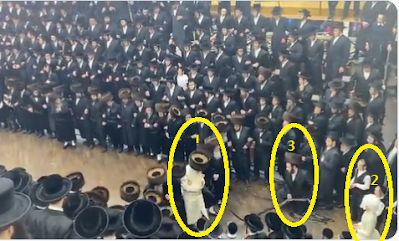
I found a clip showing some dancing at the wedding of the grandson of the Williamsburg Satmar Rebbe, Zalman, the other one, not Aharon of Kiryas Joel.

What I found interesting was not the Rebbe (1), nor, interestingly enough included, the Kallah (2) but someone (3) who was in charge of the gartel* used to connect the Rebbe to the Kallah.


He would pull it in as the Rebbe approached and then let it out as the Rebbe, along with the Chatan and other honorable persons, distanced themselves. That way, no tripping will occur.

As explained,

The mitzvah tantz, or mitzvah dance, is the chassidic custom of honorable men (related to the chosson or kallah) dancing before the bride, after the wedding feast. Commonly, the bride, who usually stands perfectly still at one end of the room, will hold one end of a gartel, while the one dancing before her holds the other end. Many consider this to be a very special and holy practice, while others feel that this practice should not be performed

* and, yes, there's an academic article on it. 

^

Thursday, December 09, 2021

And That German Knight Then Visited the Temple Mount (Another, Too)

See my previous post on the book, "The Pilgrimage of Arnold von Harff / Knight / from Cologne, through Italy, Syria, Egypt, Arabia, Ethiopia, Nubia, Palestine, Turkey, France and Spain, which he Accomplished in the years 1496-1499

Starting on page 207.

we came to the Temple of Solomon® which stands one hundred and sixty paces from the temple of Christ. Item, by means of gifts and other friendly help, I was taken by a Mameluke into this temple. But no Christian or Jew is suffered to enter there or draw near, since they say and maintain that we are base dogs, and not worthy to go to the holy places on pain of death, at which I was frightened. But this Mameluke instructed me that if I would go with him one evening, dressed in his manner, he would take me into the Temple, and that if I was recognised I was to reply like a heathen with the words and speech, and to use the words and make the signs which I was forced to use when it happened that I was imprisoned at Gazera, as I have related above, ^ whereupon the heathen would show me honour and suffer me to go, as indeed happened. Item the Mameluke fetched me one evening from the monastery at Mt. Sion and took me to his house, in pretence that I should have spent the night -with him, where he dressed me in the clothes and apparelled me like a Mameluke. Thus we both made our way at evening towards the Temple of Solomon which, by his direction, was opened and forthwith closed so that we should not be crowded: for this I had to give four ducats. 

Item this Temple of Solomon is a fine round and lofty church roofed with lead. Around it is a churchyard, without buildings, which is all paved with large white marble stones, as it is also within. I measured the inside of the church. In length it is seventy-two paces and fifty wide. In the Temple there are thirty-two fine marble pillars, which support the vaulting of the church. In this Temple, eastwards, is a small round tabernacle or chapel five feet long and broad, placed on twelve pillars, a spear’s height from the ground, in which the heathen priests now pray and hold their services. It is held in great reverence and regarded as a holy place, and many ampullae burn there continually. Formerly the Jews held this tabernacle or chapel in great honour and reverence, and regarded it as a holy place, for on it stood the Ark of God, in which was their holy treasure, namely the two tables which Almighty God gave to Moses on Mt. Oreb, on which were written the Ten Commandments, also Aaron’s rod. Therein lay also the written word of God, also the rod with which Moses smote the Red Sea and it was divided, with many other holy things, which the Jews held in great reverence before the birth of Christ. Item beneath this tabernacle is a small piece of rock enclosed with an iron railing, called the holy rock,^ on which many wonders and miracles of God have been performed, for instance Melchisedek, the Priest, offered on this rock wine and bread to the God in Heaven. Also Jacob, the Patriarch, lay sleeping with his head on this rock, and saw a ladder set up from this rock to heaven, upon which the angels of God ascended and descended. When he awoke he said: ‘surely this is a holy place, and I knew it not.’ On this rock King David saw an angel standing with an outstretched naked sword. Further the Jewish priests made their sacrifices to God on this rock. Our Lord Jesus also wrought many miracles on this rock, which the Mameluke could not declare to me. The heathen hold this rock in great reverence, and have very many lamps burning there. 

Item on the left in this Temple there is an altar almost like ours, for it is open on all sides. Here formerly the Jews made their sacrifices, offering doves, hens and turtle-doves to God in heaven. But the heathen have now set a compass [dial] on the rock so that by it, in their manner, they may know the hours. Beside this altar Zacharias was slain. 

Item this Temple of Solomon has four doors by which one may enter. The doors are all made of ancient cypress wood and are carved with ancient histories. Item by the door, to the north, is a square cistern in which the heathen wash the members with which they have sinned by day or night, thinking to cleanse themselves daily by washing, and they do this before they pray, thinking that otherwise their prayers would not be acceptable to God in heaven. This is the cistern or fountain mentioned in the holy writ, wherein it is said ‘I saw the water go in and out’ . Item I saw in this Temple no pictures or figures, as we have in our Churches, but it is a beautiful Temple with many lamps burning, at least five hundred, as I was in fact told and saw with my eyes. Item in this Temple of Solomon our Lord Jesus preached often to the Hebrews, and taught and wrought many miracles there. Here also he drove out the buyers and sellers because they did not observe the Sabbath. Item this is where our Lord Jesus was tempted of the devil and suffered himself to be carried to the summit of Solomon’s Temple. Here also the Jews threw down St. James the Less from the summit of the Temple to his death. 

Item from this Temple, southwards, we came from here to the courtyard of the Temple, through a door called by us Christians Porta Speciosa,^ through which St. Peter and St. John passed when St. Peter healed the lame man, as is told in the Evangelium. Item we went from this Temple eastwards, some twenty-six paces, into a very fine mosque or church called Porticos Salomonis.^ When the Christians possessed Jerusalem it was called the Church of Our Blessed Lady, where for a long time she went to school. 

Item this church, Porticus Salomonis, is much longer than the temple of Solomon. It is finely built and roofed with lead, and has within it forty-two marble pillars and eight hundred lamps, which bum there daily. Since the heathen have this church in great reverence, no Christian or Jew may approach it. 

Item at the end of this church we went down a great staircase into a vault, which was a stable of the Sultan or the Mamelukes, with accommodation for some six hundred horses.® Since the church is wholly vaulted below we could see well, from its appearance, that in Christian times it was a crypt in which Mass was celebrated, as can be seen from the many altars which are still there. Item we went from this crypt into a beautiful little mosque or church, which is built quite close to the church Porticus Salomonis. This was built by the old Sultan Kathubee, who died five years ago and is honourably buried there. A hundred lamps bum there daily 

Item from this church we went some thirty paces to the right hand, westwards, across this fine courtyard which is paved with marble, fifteen paces from the temple of Solomon. We came then to the Golden Door® through which our Lord Jesus rode in on Palm Simday, sitting on an ass. This gate is of cypress wood covered with copper, and is much cut and mutilated. Therefore the heathen guard the doorway closely, so that no Christian may approach it. They have also their cemetery outside the gate towards the Vale of Jehoshaphat, where they bury their dead. Therefore they guard the gate closely against Christians and Jews, whom they regard as more filthy than dogs, lest they should tread on their graves. We broke and cut off many pieces of the wood and copper which I carried back with me. At this gate there is plenary absolution from all sins, both penalty and guilt. 

Item we went from this Golden Gate, westwards, from the courtyard of Solomon’s temple, and came to a pool of standing water, called Probatica Piscina,® where our Lord Jesus worked many miracles. No Christian or Jew may approach it except by secret help. 

Item we went westwards and came to St. Anne’s House,* which the Christians in former times made into a beautiful church, but now the heathen have turned it into their praying house or mosque, so that the Christians cannot enter, but by means of secret help and gifts we were allowed to go in. We went through the transept, and at the side of the church we climbed through a narrow hole in the arch of a large window, being forced to carry lighted candles so that we could see, and came to a little vault in which St. Anne, the mother of our blessed Lady, departed from this earth. We went then to another vault in which our blessed Lady was born. Here is forgiveness of all sins both penalty and guilt. Item next day the Mameluke took me from the church back to Mt. Sion, and no one knew that I had slept the night at the Mameluke’s house. 

The Dome of the Rock was known to medieval travellers as Templum Domini. Most travellers (including Boldensele, p. 261) speak of the lead roof. Von Harff ’s critics have denied the truth of the story of his entry, but he was not the only fifteenth-century traveller to get in. Tafur (p. 61) entered, disguised as a renegade, and describes it as * a single nave, the whole ornamented with gold mosaic work. The floor and walls are of the most beautiful white stones and the place is hung with so many lamps that they all seemed to be joined together’. It was doubtless a dangerous and expensive escapade, but not perhaps as dangerous as was thought. Fabri (ii, p. 257; cp. ii, p. 242 f.) knew a knight who would have got in, if his courage had not failed him at the last moment. Guylforde (p. 44) looked into the vaults through a back door. Cp. Ludolph, p. oB; Casola, pp. Rdhricht-Meisner, p. 30, note i. Mandeville (p. 54) also claims to have entered the Templum Domini, but he had letters under the Sultan’s great seal. There is a long and interesting note in Warner’s edition of Mandeville, p. i8i.  The large edifice on liie S. side of the Temple area, called in the Middle Ages indiscriminately Palatium, Porticuscu Templum Salomonis (Robinson, 1, p. 44a), now the Aksa mosque. For a description, see Gabriel von l^ttenberg (1527), Rdhricht-Meisner, p. 406. * On these extensive vaults, see Robinson, i, p. 446.  ^ The Madrassa (teaching mosque) el Ashrafiya, which stands on the W. boundary of the Haram enclosure. Vincent & Abel, Jirusalem Nouvelle, PT. IV, 1926, p. 981. But Kait Bey was buried in Cairo. ^ Fabri (i, p. 459) says that the Saracens cut off pieces of the plates and nails and sold them to the Christians, who often risked their lives by going there at night and tearing off little pieces. The relics were said to be proof  against apoplexy, falling sickness and plague.  ® Casola (p. 248) saw vestiges of the 5 porches mentioned in John v, 2. Many pilgrims drank the water. Casola adds: ‘When I saw the filth I left it alone, it was enough for me to wash my hands there.* 

* Guylforde (p. 30) notes that the Saracens suffered none to enter except ‘pryvely or for brybes*. Cp. Rohricht, p. 20, note 248, for references to other pilgrims who got in. Breydenbach (1483-84) carried away portions of the stonework which was believed to be good for pregnant women (26 July).  For a description, see De Vogu6, Eglises^ p. 233. It is the best preserved of the crusading edifices.

And here is from the book, The Travels of Sir John Mandeville, a travel memoir which first circulated between 1357 and 1371

And from the church of the sepulchre, toward the east, at eight score paces, is Templum Domini.  It is right a fair house, and it is all round and high, and covered with lead.  And it is well paved with white marble.  But the Saracens will not suffer no Christian man ne Jews to come therein, for they say that none so foul sinful men should not come in so holy place: but I came in there and in other places there I would, for I had letters of the soldan with his great seal, and commonly other men have but his signet.  In the which letters he commanded, of his special grace, to all his subjects, to let me see all the places, and to inform me pleinly all the mysteries of every place, and to conduct p. 55me from city to city, if it were need, and buxomly to receive me and my company, and for to obey to all my requests reasonable if they were not greatly against the royal power and dignity of the soldan or of his law.  And to others, that ask him grace, such as have served him, he ne giveth not but his signet, the which they make to be borne before them hanging on a spear.  And the folk of the country do great worship and reverence to his signet or seal, and kneel thereto as lowly as we do to Corpus Domini.  And yet men do full greater reverence to his letters; for the admiral and all other lords that they be shewed to, before or they receive them, they kneel down; and then they take them and put them on their heads; and after, they kiss them and then they read them, kneeling with great reverence; and then they offer them to do all that the bearer asketh.

And in this Templum Domini were some-time canons regulars, and they had an abbot to whom they were obedient; and in this temple was Charlemagne when that the angel brought him the prepuce of our Lord Jesus Christ of his circumcision; and after, King Charles let bring it to Paris into his chapel, and after that he let bring it to Peyteres, and after that to Chartres.

And ye shall understand, that this is not the temple that Solomon made, for that temple dured not but 1102 year.  For Titus, Vespasian’s son, Emperor of Rome, had laid siege about Jerusalem for to discomfit the Jews; for they put our Lord to death, without leave of the emperor.  And, when he had won the city, he burnt the temple and beat it down, and all the city, and took the Jews and did them to death—1,100,000; and the others he put in prison and sold them to servage,—thirty for one penny; for they said they bought Jesu for thirty pennies, and he made of them better cheap when he gave thirty for one penny.

And after that time, Julian Apostate, that was emperor, gave leave to the Jews to make the temple of Jerusalem, for he hated Christian men.  And yet he was christened, but he forsook his law, and became a renegade.  And p. 56when the Jews had made the temple, came an earthquaking, and cast it down (as God would) and destroyed all that they had made.

And after that, Adrian, that was Emperor of Rome, and of the lineage of Troy, made Jerusalem again and the temple in the same manner as Solomon made it.  And he would not suffer no Jews to dwell there, but only Christian men.  For although it were so that he was not christened, yet he loved Christian men more than any other nation save his own.  This emperor let enclose the church of Saint Sepulchre, and walled it within the city; that, before, was without the city, long time before.  And he would have changed the name of Jerusalem, and have clept it Aelia; but that name lasted not long.

Also, ye shall understand, that the Saracens do much reverence to that temple, and they say, that that place is right holy.  And when they go in they go bare-foot, and kneel many times.  And when my fellows and I saw that, when we came in we did off our shoes and came in bare-foot, and thought that we should do as much worship and reverence thereto, as any of the misbelieving men should, and as great compunction in heart to have.

This temple is sixty-four cubits of wideness, and as many in length; and of height it is six score cubits.  And it is within, all about, made with pillars of marble.  And in the middle place of the temple be many high stages, of fourteen degrees of height, made with good pillars all about: and this place the Jews call Sancta Sanctorum; that is to say, ‘Holy of Hallows.’  And, in that place, cometh no man save only their prelate, that maketh their sacrifice.  And the folk stand all about, in diverse stages, after they be of dignity or of worship, so that they all may see the sacrifice.  And in that temple be four entries, and the gates be of cypress, well made and curiously dight: and within the east gate our Lord said, ‘Here is Jerusalem.’  And in the north side of that temple, within the gate, there is a well, but it runneth nought, of the which holy writ speaketh of and saith, Vidi aquam egredientem de templo; that is to say, ‘I saw water come out of the temple.’

And on that other side of the temple there is a rock that men clepe Moriach, but after it was clept Bethel, where the ark of God with relics of Jews were wont to be put...

...And from that temple towards the south, right nigh, is the temple of Solomon, that is right fair and well polished.  And in that temple dwell the Knights of the Temple that were wont to be clept Templars; and that was the foundation of their order, so that there dwelled knights and in Templo Domini canons regulars.


Temple Mount Fiction: Murder and Mystery

I wondered: how more more books have been published since this review article of mine that appeared in 2008.

Well, there's

Temple Mount by Keith Raffel

---

Murder Calls on the Temple Mount by Alan Herman

---

The Temple Mount Code by Charles Brokaw

---

Alpha and Omega by Harry Turtledove

---

The Last Secret of the Temple by Paul Sussman

---

Ah, another I had noted. And another.

Have I missed any you know?

^

Tuesday, December 07, 2021

A German Knight Learns Hebrew - in 15th Century Jerusalem

From

The Pilgrimage of Arnold von Harff / Knight / from Cologne, through Italy, Syria, Egypt, Arabia, Ethiopia, Nubia, Palestine, Turkey, France and Spain, which he Accomplished in the years 1496-1499 / Translated from the German and edited with notes and an introduction / by Malcolm Letts. 1946. Pages xxxv, 325

Page 218-219

I found also three German Jews in Jerusalem, as also in all heathen and T urkish places. I kept company with them often on account of the language and learnt to write the alphabet, and retained also certain words from their daily speech, as they are written here:

hee delech gymel hath aleph 

pe ayn samech nun nun 

men men lamed kafif kaff 

taff schyn resz kuff 

zodick zodick ffe 

leherxi, 

jojen, 

moim, 

boissar, 

befinna, 

betzim, 

hometz, 

semeii, 

tangol, 

taiigoles, 

daegim, 

meela, 

toeff, 

va, 

onoge, 

emmes, 

kysiff, 

Arnold von Harff (1471 in Castell Harff, Bedburg – January 1505) was a German traveler from the 15th century, from Köln. He went on pilgrimage to many countries, collecting both languages and cultural information.

^

Friday, December 03, 2021

On Jerusalem's Old City Chabad Synagogue

When we lived in the Old City, a 90-second walk away was the Chabad Synagogue in which Rav Moshe Segal lived in the first year after the 1967 war, to reclaim it.

Here is its story in a new book I recently found:


^