Showing posts with label Zionist history. Show all posts

Friday, August 30, 2019

Palestine Arab Rejectionism: The Beginning

The Arabs who resided in the area to become the Mandate of Palestine, intended originally to become, through the historic connection of the Jewish people to that country, the Jewish national home, adopted from the very beginning a diplomatic pose and policy of rejectionism. In essence, the later 1967 Khartoum Resolution adopted by the Arab League, of "no recognition", no peace" and "no negotiations", was the consistent framework of Arabs in their response to Zionism for the past century.

Already in late 1919, April 1920, May 1921 and November 1921, they were agitating, demonstrating, rioting and, of course, employing murderous terrorism, to further their political goals.

In those early years, these were the most prominent examples of that rejectionism.

1922: 

When the League of Nations awarded Great Britain the Mandate to reconstitute the Jewish National Home in Palestine, Article 25 separated from the territory the Zionist presumed they would be permitted to settle in in accordance with previous discussions. All the area east of the Jordan River would become an apartheid state for Jews.

Despite a loss of 75% of the land, the Arabs, instead of accepting that first partition, which had excluded much of the area of historic Palestine, denying Jews the right to purchase land there and creating a fake monarchy, instead, they insisted they wanted all the remaining territory west of the Jordan River also to be transformed solely into an Arab state.

The Arabs of Palestine, who preferred to be termed Southern Syrians and demanded that "Palestine" be joined to the French Mandate over Syria, rejected any "territorial compromise" and were unsatisfied with a possible "two-state solution". They wanted the Jews to completely "withdraw".

1923: 

Herbert Samuel, the first High Commissioner, following the Mandate decision to  foster the "development of self-governing institutions", proposed in August 1922 the establishment of a legislative council. It was to be made up of 23 members: 11 British, all appointed, and twelve elected members — eight Muslims, two Christians and two Jews. Despite the fact that this make-up would have doomed Jews to a permanent minority status in any future government, Arabs declared participation in the council as acceptance of the British mandate and Balfour policy as well as considering they should be granted further limitations on Jewish immigration. 

A boycott campaign of the council elections, scheduled for February 1923, was launched. The Jews, by the way, had accepted the proposal. The very low turnout dashed the proposal.

The Arabs rejected a possible political resolution of the conflict, based on democratic values.

1926: 

A dampening of the religious element of the focus was possible, one that could have avoided the later 1929 riots, when serious attempts were made to purchase or lease the Western Wall courtyard area. In fact, already in 1919, an offer was made.

As sourced here:
In 1919 Zionist leader Chaim Weizmann approached the British Military Governor of Jerusalem, Colonel Sir Ronald Storrs, and offered...approx. £5m in modern terms to purchase the area at the foot of the Wall and rehouse the occupants. Storrs was enthusiastic about the idea because he hoped some of the money would be used to improve Muslim education. Although they appeared promising at first, negotiations broke down after strong Muslim opposition. Storrs wrote two decades later:

"The acceptance of the proposals, had it been practicable, would have obviated years of wretched humiliations, including the befouling of the Wall and pavement and the unmannerly braying of the tragi-comic Arab band during Jewish prayer, and culminating in the horrible outrages of 1929"

In early 1920, the first Jewish-Arab dispute over the Wall occurred when the Muslim authorities were carrying out minor repair works to the Wall's upper courses...In 1926 an effort was made to lease the Maghrebi waqf, which included the wall, with the plan of eventually buying it. Negotiations were begun in secret by the Jewish judge Gad Frumkin, with financial backing from American millionaire Nathan Straus...However, Straus withdrew when the price became excessive and the plan came to nothing. The Va'ad Leumi, against the advice of the Palestine Zionist Executive, demanded that the British expropriate the wall and give it to the Jews, but the British refused
The Arabs leaders and their followers preferred to run a zero-sum game.  All rejection. No compromise.

They lost.

^

Tuesday, January 24, 2017

The Vagaries of Minor Zionist Hisory


Jabotinsky’s Clothing is Stolen by Burglars
London (Dec. 18)

Burglars last night broke into the London residence of Vladimir Jabotinsky, head of the world Zionist Revisionist organization, and escaped with practically his entire wardrobe.

Other property was also taken. As a result Mr. Jabotinsky will have to re-outfit himself completely to attend a Revisionist conference in Poland before his departure for the United States later this month.

^

Tuesday, December 06, 2016

Lost Zionist History Lesson


Who was Robert Frier Jardine?


From THE LONDON GAZETTE, 6 APRIL, 1937


So why should he, even being in charge of land settlement registration during the Mandate period, be interesting and even important?


^

Monday, May 09, 2016

Yikes. Lawrence and Sykes-Picot


I found this document, and accompanying explanation here.  Just in time for the JCPA conference on Sykes-Picot (and here) next week* (and read their paper).

On Septembert 7, 1917, prior to the Balfour Declaration and the official establishment of the Jewish Legion, T.E. Lawrence dealt with the issue of whether the Jews will have a future in the area of the Arab Middle East that they wished to reconstitute their ancient historic homeland.  Obviously, he was aware of the divisions that were to be of the Ottoman Empire territories if England won the war, if not their exact delineations.


As the commentary makes clear, Lawrence writes to his superior at the Arab Bureau, General Clayton, to ask whether he should send a letter he has composed to Sir Mark Sykes. In it, he asks about the aims of the Zionists. He knows already that an area of the regiom, "the Jewish section" exists and needs to be "cleared up" just as there is a "French section" which he nevertheless feels "we may (if we win) clear up...ourselves.” 

Clayton advised Lawrence not to forward his letter to Mark Sykes – but a record of the unsent letter survived nonetheless. 


Again, as per the commentary, the letter is crucial to understanding exactly why Lawrence wanted the “Jewish section cleared up” – and addresses, en passant , Lawrence’s conflict with the Zionist pioneer Aaron Aaronsohn and, by extension, those Zionist converts within the British establishment, like Sykes (and Balfour, Orsmby-Gore, Deedes and Meinertzhagen), whom Aaronsohn had influenced.

The text:

“General Clayton showed me a letter from you which contained a message to myself - and this has prompted me to ask you a few queries about Near East affairs. I hope you will be able to give me an idea of how matters stand in reference to them, since part of the responsibility of action is inevitably thrown on to me, and, unless I know more or less what is wanted, there might be trouble. “About the Jews in Palestine, Feisal has agreed not to operate or agitate west of the [Wadi] Araba-Dead Sea-Jordan line, or south of the Haifa-Beisan line . . . 

This is quite important because it puts the lie to the Arab claim that the area that was to become the Palestine Mandate was somehow stolen from them without their knowledge as in the infamous McMahon-Hussein correspondence.

Lawrence continues:

“You know of course the root differences between the Palestine Jew [that is, the Sefaradi, who originates from an Arab country - YM] and the colonist Jew: to Feisal the important point is that the former speak Arabic, and the latter German Yiddish. He is in touch with the Arab Jews (their H.Q. at Safed and Tiberias is in his sphere) and they are ready to help him, on conditions. They show a strong antipathy to the colonist Jews, and have even suggested repressive measures against them [!]. Feisal has ignored this point hitherto, and will continue to do so. His attempts to get into touch with the colonial Jews have not been very fortunate. They say they have made their arrangements with the Great Powers, and wish no contact with the Arab Party [eventually, Weizmann & Feisal met and agreed on an outline of coexistence 16 months later]. They will not help the Turks or the Arabs. Now Feisal wants to know (information had better come to me for him since I usually like to make up my mind before he does) what is the arrangement standing between the colonist Jews (called Zionists sometimes) and the Allies . . . What have you promised the Zionists, and what is their programme? “I saw Aaronson in Cairo, and he said at once the Jews intended to acquire the land-rights of all Palestine from Gaza to Haifa, and have practical autonomy therein. Is this acquisition to be by fair purchase or by forced sale and expropriation? The present half-crop peasantry were the old freeholders and under Moslem landlords may be ground down but have fixity of tenure. Arabs are usually not employed by Jewish colonies. Do the Jews propose the complete expulsion of the Arab peasantry, or their reduction to a day-labourer class? “You know how the Arabs cling even to bad land and will realise that while Arab feelings didn't matter under Turkish rule . . . the condition will be vastly different if there is a new, independent, and rather cock-a-hoop Arab state north and east and south of the Jewish state. “I can see a situation arising in which the Jewish influence in European finance might not be sufficient to deter the Arab peasants from refusing to quit - or worse!” 

The commentary concludes:

Lawrence’s reference to Aaronsohn’s remarks is particularly interesting, inasmuch as Aaronsohn left an account of the meeting at which he made them. “This morning I had a conversation with Capt. Lawrence,” he wrote in his diary on 12 August 1917. “An interview without any evidence of friendliness. Lawrence had too much success at too early an age. Has a very high estimation of his own self. He is lecturing me on our colonies, on the spirit of the people, on the feelings of the Arabs, and we would do well in being assimilated by them, by the sons of Arab etc. While listening to him I imagined to be present at the lecture of a Prussian scientific anti-Semite expressing himself in English. I am afraid that many of the archaeologists and reverends have been imbued by 'l'esprit boche'. He is openly against us. He is basically of missionary stock.” Aaronsohn’s assessment of Lawrence as an anti-Semite stands in stark contrast to Chaim Weizmann’s opinion that Lawrence’s relationship to the Zionist movement was a very positive one, in spite of his strongly pro-Arab sympathies.


*

100 Years Since Sykes-Picot Agreement:
Lessons for the Middle East

The borders of the countries that were created artificially after the signing of the Sykes-Picot Agreement between France and Britain a hundred years ago have not withstood the test of time. The Middle East is ablaze with bitter wars between neighboring countries, between tribes, and between warring religious groups.

On Wednesday, May 18, 2016, the Jerusalem Center for Public Affairs and the Konrad-Adenauer-Stiftung will hold a conference on the lessons from the Sykes-Picot Agreement for today's Middle East. Participants include Israeli and foreign scholars from Turkey, the UK, France, the UK, Russia and the U.S.  

Conference Program
  
Opening Remarks
Amb. Freddy Eytan - Jerusalem Center for Public Affairs
Dr. Michael Borchard - Konrad-Adenauer-Stiftung Israel
Amb. Patrick Maisonnave - French Ambassador to Israel

First Session: 9:30-10:45
Historical Overview of the Sykes-Picot Agreement
Chair: Amb. Freddy Eytan - Jerusalem Center for Public Affairs
Westphalian Arab Nation-States in the Middle East: A Failed Experience
Prof. Shlomo Avineri - Hebrew University
Sykes-Picot and the Zionists
Dr. Martin Kramer - President of Shalem College
Sykes-Picot: Myth and Reality
Prof. Efraim Karsh - King’s College, London
Sykes-Picot Agreement: The French Perspective
Dr. Richard Rossin - Former Vice President of the European Academy of Geopolitics 
10:45-11:00
Coffee Break

Second Session: 11:00-12:30
The Collapse of Borders – a Future Perspective: Lessons from Other Countries
Chair: Dan Diker - Jerusalem Center for Public Affairs
How Resilient is the Current Middle Eastern State System?
Amb. Prof. Itamar Rabinovich - Tel Aviv University
Earthquakes of the Middle East
Col. (ret.) Dr. Jacques Neriah - Jerusalem Center for Public Affairs
An American Perspective on the Sykes-Picot Agreement
Dr. Scott B. Lasensky - Senior Advisor to the United States Ambassador to Israel 
12:30-13:15 Break

Third Session: 13:15-14:15
Legal Aspects and International Law
Chair: Amb. Alan Baker - Jerusalem Center for Public Affairs
Some Historical Facts about the Egypt-Israel Border
Prof. Ruth Lapidoth - Hebrew University
League of Nations Mandates and Subsequent Nation State Borders
Prof. Eugene Kontorovich - Northwestern University and Kohelet Policy Forum 

Fourth Session: 14:15-15:15
Strategic Perspectives: Then and Now
Chair: Dr. Michael Borchard - Konrad-Adenauer-Stiftung Israel
The Russian Strategic Perspective
Alexey Drobinin - Senior Counselor at the Russian Embassy in Israel
Turkish Foreign Policy and the Specter of Sykes-Picot: A Hundred Years Later
Dr. Ahmet K. Han - Kadir Has University, Turkey
Strategic and Geopolitical Aspects
Brig. Gen. (ret.) Yossi Kuperwasser - Jerusalem Center for Public Affairs


________

^

Tuesday, September 02, 2014

The "Saison" To Be Debated

There'll be a panel discussion on the "Saison" period during the pre-state Yishuv institutions when the dissidents, that is, the Irgun and to a lesser extent, the Lechi, were hounded by the Palmah, beaten, incarcerated in caves, interrogated and handed over to the British:


If I could attend, but I cannot, I would ask this in the Q & A session, if there'll be one:

Since the Palmah and Hagana engaged in activities no less morally "impure" than those they opposed, such as the assassination of a British officer, Thomas Bruce in October 1947 simply for breaking the fingers of Palmahniks from Birya, or murdering suspected collaborators with the British such as Mordechai Berger in March 1947 or the three in Haifa in 1940 suspected of informing on illegal arms held by the Hagana, was the Palmah morally superior or simply blindly obedient to a more powerful political, ideological and financial institution such as the "movement", or the "party" or the Histadrut?

The reason given for the justification of the "Saison" is threefold:

a.  Mapai and the Left are in charge, not the Revisionists or anyone else.  They were the bosses.

b.  the Irgun's policies were wrong from a political/diplomatic sense.

c.  the actions of the Irgun and Lechi were morally tainted, what was referred to as "purity of arms".

I think (b) and (c) were patently in error and all that's left is the amoral (a).

^

Wednesday, August 13, 2014

We're Always Guilty Or, That Delicate Imbalance

From the Conference Report - "The Jewish Experience of the First World War, London June 11-13, 2014" by Sharon Gordon


The third and final day of the conference opened in the Wiener Library with a panel on the experience of the war in Palestine.

Esther Yankelevitch (University of Haifa) discussed the relatively unknown expulsion of the Jews of Jaffa and Tel Aviv from their homes in the spring of 1917. She showed how the resettlement of these deportees to mixed cities, mainly in the Lower Galilee, eventually undermined the delicate balance between the Muslim and the Jewish population in these parts of the country.

So, the Turks or the expelled/displaced Jews are responsible for that delicate imbalance?

By the way, some 430 Jews died due to this explusion, a 19.3 rate of expiration.  Over 21% of those who died were of the age 10 and under. (Haaretz has a higher figure of expellees.


Monday, August 12, 2013

Away Goes the Kotel Mechitza

As reported in the HaZman journal, Ocotber 18, 1911:


The Turkish governor of Jerusalem prohibited the use of a mechitza, a prayer partition to separate the 60 men and women at the Kotel for the Rosh Hashana prayers in 1911 and it raised a protest.  But what is usually ignored is that during the prayer service, Arabs ran into the small courtyard and beat up Jews with the fists, claiming a disturbance to the peace.  The prayer was halted.

It should be recalled that

In the late 1830s a wealthy Jew named Shemarya Luria attempted to purchase houses near the Wall, but was unsuccessful, as was Jewish sage Abdullah of Bombay who tried to purchase the Western Wall in the 1850s. In 1869 Rabbi Hillel Moshe Gelbstein settled in Jerusalem. He arranged that benches and tables be brought to the Wall on a daily basis for the study groups he organised and the minyan which he led there for years.


The upper front page of Ha'Or, December 12, 1911:


which declares 'Are We a Nation of Rabbits?' and 'By the Kotel We Will Live or Die' and notes that the firman which confirms the Jewish right to hold prayer services at the Kotel and set up a partition was obtained by Baron Rothschild.


On that element:


 ...the Counsel for the Moslems produced a decree issued by Ibrahim Pasha in May, 1840, which forbade the Jews to pave the passage in front of the Wall, it being only permissible for them to visit it "as of old." The Counsel for the Moslems further referred to a decision of the Administrative Council of the Liwa in the year 1911 prohibiting the Jews from certain appurtenances at the Wall. The Counsel for the Jews, on the other hand, referred the Commission in especial to a certain firman issued by Sultan Abdul Hamid in the year 1889, which says that there shall be no interference with the Jews' places of devotional visits and of pilgrimage, that are situated in the localities which are dependent on the Chief Rabbinate, nor with the practice of their ritual. In the same connection the Counsel for the Jews also referred the Commission to a firman of 1841, stated to be of the same bearing and likewise to two others of 1893 and 1909 that confirm the first mentioned one of 1889. Translations of the decrees of 1840 and 1911 as well as of the firman of 1889 are annexed to this Report (Appendices VI-VIII). The firman of 1841 was not actually produced.

This second report from HaZman from January 11, 1912 reports on that firman and further notes that some of Jerusalem's Jews have demanded of the Hacham Bashi to protest to the Governor that his order of also prohibiting chairs and benches contradicts the firman.

The Kotel in 1911:


And from here:

Don't get this mixed up with the 1928 removal of the mechitza.

^

Tuesday, January 15, 2013

Books I Doubt You've Read

Or, perhaps books you even hadn't heard about.

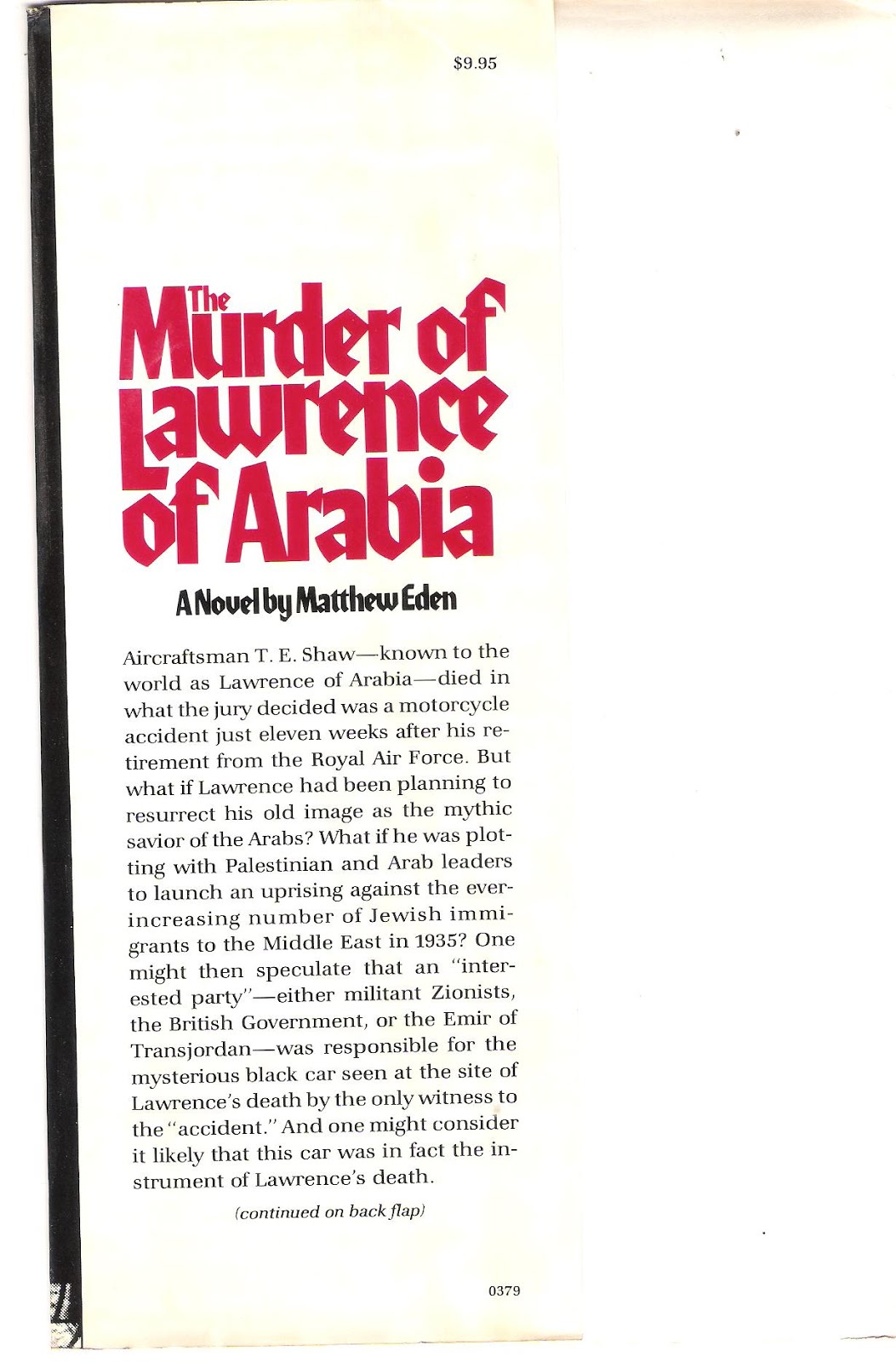
Like this 1979 one, The Murder of Lawrence of Arabia.


The flap description:


In March 1935 Lawrence left the RAF. Two months later he was involved in a serious motor-cycle accident near his home in Dorset. TE Lawrence died from his injuries six days later.

After his death rumours circulated that Lawrence had been murdered by foreign agents. Another story emerged that the secret service faked his death so as to allow him to undertake, incognito, important work in the Middle East. The supporters of this story believed he died in Tangiers, Morocco, in 1968.

More on the conspiracy theories.

This review noted of the book that
the plot will provide a sliver of tart, serviceable intrigue for patient and undemanding fans of fanciful conspiracy dramas.
-     -     -     -     -

A more fascinating novel, providing a fictional but documentary treatment of a Mandate-period event is this book on the killing of Chaim Arlosoroff, head of the Jewish Agfency's Political Depazrtment, today's equivalent of Israel's Foreign Minister, "Wall of Glass":


The most interesting aspect, even more that the topic is the identity of the author.

Intrigued, I wrote to the publisher and eventually, received this letter:


The son of the PPF officer in charge of the investigation!

If you search, you can find Rice mentioned in contemporary reports, like this one:
[Defense Attorney Horace] Samuel demanded that the police permit him to examine the file and that both Arabs be detained as material witnesses in the present investigation. He also demanded that the weapon found, the bullets from which are said to resemble the bullet found in Arlosoroff's body, be produced. Colonel Harry P. Rice, deputy commissioner of police, present in the courtroom, declared that he was unable to comply with the demands made by Mr. Samuel, since the investigation was still secret. Magistrate Bodilly, before whom the investigation is being conducted, declared that he was unable to compel the police to comply with the requests of the defense attorney and suggested that the defense subpoena the police officers in charge of the files. Later Colonel Rice, who was placed on the witness stand, declared that Abdul Majid's testimony was full of contradictions and perhaps false. The second Arab, Issad Arwish, who allegedly fired the shot which killed Arlosoroff, was arrested in July, released some time later, and then arrested once more after Abdul Majid made his confession, the Colonel declared. Originally Abdula Majid was arrested in connection with a blood feud murder in which he killed another Arab. In jail, he told fellow prisoners that he killed Dr. Arlosoroff. Later he confessed to the police that he and Issad Arwish met Dr. Arlosoroff and his wife on the beach and that he wanted to "rape the Jewess but the Jew interfered, so I shot him." Defense counsel Samuel said in the courtroom that he believed that Colonel Rice had told him that the bullets from Abdul Majid's revolver were of the same type as that found in the body of Dr. Arlosoroff. However, Magistrate Bodilly continued with the ordinary routine examination of witnesses in the hearing, paying no attention to the revelations. Joshua Glicksman of Kfar Saba where Zvi Rosenblatt, one of the three defendants, alleges he spent the night of the murder, testified that he saw Rosenblatt in Kfar Saba- that night between 9:30 and 11 P.M.
More on his testimony.

Both a good read.

^


Wednesday, May 02, 2012

Jerusalem, Sepharadim and Christians

From a book review of Abigail Jacobson's From Empire to Empire: Jerusalem Between Ottoman and British Rule. reviewed by Thomas Philipp

...Jerusalem('s) importance derived strictly from its assumed holiness...Only with the Crimean War, Jerusalem reappeared in the consciousness of the European powers and it became – via interference with various Christian communities – the object of international relations. Zionist immigration complicated [???] the picture further. The city’s population grew to more than 40,000 at the eve of World War I. This study focuses on a very few but fateful years in the long history of Jerusalem, from the Balkan Wars in 1912 to the establishment of the British Mandate in 1920...her aim (is) to provide a more differentiating picture of three presumably monolithical monotheistic communities or the simplistic dichotomy “Jews vs. Arabs”. She does that mainly by looking at the internal political discussions within each community and ethnicity...

...The hostility between Arab Christians and Jews, for instance, did not arise only with the Zionist issue but was the result of the loss of old trade routes and commercial connections by the Jews throughout the 19th century and a concomitant ascent of some Christian communities in local trade and new export trade in raw materials. Muslim commerce underwent a decline similar to that of the Jews, while European merchants were advancing and with them the Christian Arabs, hence a certain alliance between Muslims and local Jews.

Internal differences in politics within the Jewish community and in the relations to the Arabs are discussed in the third chapter. It throws new light on an aspect that the typical Zionist-Arab narrative is not aware of. At issue is the position of local and usually young Sephardic Jews who enjoyed a modern secular education, knew a variety of languages, including Arabic and Hebrew, and supported the Zionist movement in Jerusalem. But this support never let them become oblivious of the need to foster good relations with the Muslim Arabs and seek their support. There were influential Sephardic communities in other cities, especially in Aleppo, but this group in Jerusalem seems quite unique. They actively – through a newspaper, articles, speeches, and meetings with the Muslims – tried to seek their support or at least their understanding. At the same time they again and again pointed out to the immigrant Zionists that the Arab population had to be considered in their plans. Jacobson’s relational model proves its usefulness also for the period after the Balfour Declaration when a rapprochement between Muslim and Christian Arabs occurred against a newly strengthened Zionism, while the Sephardim Zionist position lost ground between the hardening fronts.


I presume, not having read the book, that the Sepharadi Jews are the heroes, even trying to cooperate with the locals where those European Jews, the 'newcomers', messed things up. Of course, this is a well-known and well-trod approach.
True, Sepharadi Jews did manage to acculturate to the Muslim general society btter than the Ashkenazim - in the early 19th century, Ashkenazi Jews from Safad trying to move to Jerusalem had to disguise themselves as Sephardim. But to employ a term like "complication"?

Nevertheless, the idea that Arab nationalism in the country owes much, if not the utmost, to Christians is to be welcomed. From Antonius on to Habash, if it were not for them, no one would have heard of Palestinianism.


P.S.  EG adds:

let's bear in mind as apparently Ms Jacobson does not, that the British occupying forces fostered "Muslim-Christian Associations" [think Ronald Storrs & Ernest Richmond, as I recall], so the rapprochement between the two groups was not simply a natural result of shared antipathy with the Jewish National Home. [in re this see Porat's book on pal Arab nationalism]. Also recall that Brit officials [Col. Waters-Taylor, etc] encouraged the Nebi Musa pogrom of April 1920.


The term "Zionist immigration" is anachronistic for any period up to 1882. Jews were already a majority in Jerusalem by 1853 but not or not yet political Zionists.

^

Tuesday, July 19, 2011

And Thank You Benny Morris

For repeating this here:

...I also believe that the emergent Jewish state, in 1947-1948, having been assaulted by the Palestinian Arab militias and, subsequently, by the armies of the Arab states, had no choice, as a matter of self-defense and survival, but to attack the villages and towns that served as the bases of their militias.  And before and during these attacks, most of the inhabitants fled; some were expelled; others were ordered or advised by their own leaders to flee.  Subsequently, Israel decided not to allow the refugees to return, rightly viewing those who had just attacked the Jewish community as a potential fifth column and enemies.  They launched the war (which the Jews believed aimed at their annihilation); they suffered the consequences.

^

Sunday, July 17, 2011

Haaretz and Anything to Do With Rightwing Zionism

First, Haaretz really did not like that an invitation described Deir Yassin

as 'abandoned Arab village'

The former Arab village of Deir Yassin whose residents engaged in gun-smuggling already in 1920, participated in murderous anti-Jewish riots in 1929 and 1936-39 and permitted irregular Arab forces to establish a base of operations in the village despite signing a peace arrangement with the nearby Givat Shaul Jewish neighborhood and in a battle on April 9, 1948 was conquered after sniping from the village was directed at Bayit VaGan and Bet HaKerem Jewish neighborhoods, with the approval of the Hagana and support of the Palmah, by the Irgun and Lechi joint operation with the loss of 5 Jewish combatants and over 40 injured was in the news recently.

So, Akiva Eldar complained that

Jewish paramilitary organizations' massacre of about 100 villagers is glossed over in case of selective memory

and the details:

In the invitation to commemorate the 60th anniversary of the establishment of the Kfar Shaul psychiatric hospital, set up on the remains of the village of Deir Yassin, the Arab village is described as such: "In the outskirts of Jerusalem, hidden from sight, the abandoned Arab village of Deir Yassin stands in isolation; a veritable treasure for the health and welfare services seeking housing for the hundreds who require physical and mental healing."

For Eldar, who won't let historical facts cloud his ideological outlook,

Deir Yassin was the site where members of the Irgun and Lehi paramilitary organizations massacred about 100 villagers.

The event, "Kfar Shaul: Yesterday, Today, Tomorrow" took place at the Begin Heritage Center.

And a second context is that by Tom Segev, in his column:

The Makings of History / White and blue, and named all over

He begins with this story

During the first half of 1950, a number of young Americans settled on the ruins of an abandoned Arab village, not far from Jerusalem. They belonged to the Betar youth movement and called themselves by the name Had-Nes, a name that had its origin in Ze'ev Jabotinsky's poem "Ha'neder" ("The Vow" ), which contains the words: "Had-nes - lavan-tachol ve'ein sheni" ("One flag - white and blue, and no other" ). The poet meant: Only one banner is worthy of being raised and that is the national flag, the blue and white one, not the red flag of the workers' movement. Yehuda Ziv, a Land of Israel geographer and chairman of the government committee for settlement names, wrote in the journal Et-Mol, published by Yad Ben Zvi, that the Had-Nes folks wanted their new moshav to receive that name as well, but the government naming committee turned them down. According to Ziv, this happened because Prime Minister David Ben-Gurion opposed the request, doubtless to avoid commemorating the doctrine of his rival, Jabotinsky.

One member of the Had-Nes group was Moshe Arens, who would go on to become an Israeli defense minister. According to Arens, this story isn't true. He and his friends wanted to call the moshav Mevo'ot Betar, not in honor of their movement, but because of the moshav's proximity to Betar, the center of the revolt against the Romans. The committee tried forcing on them the name Batir (the name of an adjacent Arab village that was evidently built on the ruins of Betar ). The settlers didn't want to forgo "Betar"; the committee wanted to protect its honor, and so they compromised on Mevo Betar.

The goes on in a disparaging way:

The acronym Betar - bet, yod, tav, resh - was conceived in sin. It would ostensibly also have been possible to include Joseph Trumpeldor's name in the acronym bet, yod, tet, resh. Switching the first letter of his name from a tet to a tav enabled two heroic symbols to be united into one myth: the heroism of the city Betar and the heroism of Tel Hai, where Trumpeldor was killed in march 1920. Ever since then, Trumpeldor's name has symbolized the principle that you do not abandon a settlement in the Land of Israel. Jabotinsky had special cause to nurture this myth, because shortly before the battle for Tel Hai he had suggested evacuating the settlement, because he did not believe it was defensible. The deaths of Trumpeldor and his friends gave rise to the Yizkor poem written by Berl Katznelson, and as on many an occasion in the past, it is once again at the center of a political and emotional dispute, over the question of whether to say "Yizkor am Israel" or "Yizkor Elohim" ("May the people of Israel remember," or "May God remember" ). This argument merged with a new argument surrounding the affair of the Altalena, the ship whose name commemorates Jabotinsky: It was his pen name.

Jabotinsky knew how to be more realistic and less militaristic than his rivals presented him as being. Alongside his poem "The Vow," he also wrote the Betar oath, to which the movement's members are held, which included the words: "I will ready my arm to defend my nation, but only to defend it." In 1935 these words were changed to: "I will lift my arm to defend my nation and conquer my homeland." The revision was made at the suggestion of one of the movement's young members, Menachem Begin.

Jabotinsky is well commemorated; throughout the country there are more streets bearing his name than ones named for Herzl. This happened possibly because many municipal governments in the Land of Israel were controlled by the right wing, not by Mapai (a precursor to today's Labor Party). A few cities have both a Betar Street named for the city Betar and one named for the movement, in acronym form. It is not always possible to tell which Betar is being referenced: In Jerusalem there is a Betar Street, without apostrophes, and also a Beitar Street with apostrophes, named after the soccer team.

We are reliving the pre-state intra-parties wars.

But it won't help our lefties. They lost then, they'll lose again.

^

Tuesday, May 03, 2011

Moshe Sharett's "Surrender" of Trans-Jordan

Found in Tom Segev's review of a colloection of letters composed by Moshe Sharett, "Yerahim Be'emek Ayalon" - "Behind Barbed Wire in the Ayalon Valley":-

Sharett was arrested as part of a comprehensive plan of action that was designed to break the resistance to British rule; the day it was carried out became known in Hebrew as "Black Shabbat." At the time Sharett was serving as head of the Jewish Agency's political department, and was the most prominent Zionist leader in the country; Ben-Gurion was staying in Paris.

...Sharett's time in detention at Latrun was part of a particularly dramatic period in the history of the state-in-the-making, which included the bombing of the King David Hotel by the Irgun pre-state underground, in which more than 90 people were killed. When Sharett heard about this he was shaken to the depths of his soul; he termed the terror attack "a holocaust."

Decision time was nearing on the future of Palestine: Sharett sent Eliyahu Sasson to Egypt to persuade that country's prime minister, Ismail Sidqi, to agree to partition. Sharett offered to give up any Jewish claim to territories east of the Jordan -in other words, to establish the Jewish state on all of the land west of the Jordan, including the West Bank. He described the arrangement as an Israeli concession of "half of the whole loaf of bread." He also promised the country's Arabs full equality but stated that whatever the Arabs had already lost to Jewish settlement - they would not get back.

Sharett was considered one of the more moderate and cautious statesmen, but his letter to Sidqi was worded in cold political language, with an occasional threatening tone. By all signs it was not meant for Arab eyes alone, but rather was also meant to withstand all political criticism should the letter become public. The establishment of a Jewish state would cause the Arabs "minuscule damage," and they would do well to accept reality, lest the Jews demand more, he wrote.

Sharett, remember, was a 'moderate'.

^

Thursday, February 03, 2011

Italian Wine in Jerusalem

I purchased a new wine last night while attending the 500th Year Commemorative Event in Honor of Donna Gracia (*) last night at the Begin Center, initiated by Geulah Cohen of the Uri Tzvi Greenberg House.

Here is the wine:-


And here are the details:


There's a new company dealing with this wine and three others (I also tasted the light sparkling Gioia which was great): Wine & Wisdom.

Too much wine can, of course, affect wisdom, but these have a wonderful taste.

(*)  And now about that lady, Donna Gracia:


Chabad leaves out her Zionism; go here and this report.

A bit here:

Jewish Life was restored in the city of Tiberias in 1558, when the Portuguese born Dona Gracia, a former Marrano, was given the tax collecting rights in Tiberias and its surrounding villages by Suleiman the Magnificent. Suleiman the Magnificent was the 10th and longest reigning Sultan of the Ottoman Empire (1520 – 1566). He showed favor to the Jews, constricting the walls that today surround Jerusalem’s Old City in order to guarantee the safety of the Jewish Population. Dona Gracia restored the city walls and built a yeshiva. The revival came to an end in 1620.


And read this from this book:


Pictures from last night:

 An actress portraying Donna Gracia

 Geula Cohen, her daughter-in-law, Randy (l) and the author Na'avah Makmel-Atir

A special song was composed for the Commemoration and sung beautifully by Adi Algazi.

^

Monday, January 17, 2011

History Lesson

Last night I attended a discussion/debate conducted at the Beit Avi Hai Center between Prof. Anita Shapira and Prof. Aryeh Naor. It was advertised thus:

BEIT AVI CHAI
Schedule of Events
January-February 2011
44 King George St., Jerusalem
Tel. (02) 621-5300 / Tickets: (02) 621-5900 http://www.bac.org.il/
Tickets are reserved until 20 minutes after the start of the event.

Wars of the Jews
Ideological debates, political disputes, and cultural rifts have been major parts of Jewish life over the generations, sometimes leading the parties to the brink of civil war. Five conversations with top historians about the roots of the major disputes that have split the nation in the modern era and still resound in the public discourse. Moderator: Liad Mudrik, IDF Radio

Part 2: An Enemy Within: The Conflict among the Underground Movements
Sunday, January 16, 8 PM
The underground movements that fought the British occupiers in the years preceding Israeli independence also fought desperately against each other. What motivated these groups and how is their conflict manifested in the contemporary Israeli discourse?
Prof. Anita Shapira, professor (emerita) of Jewish history, Tel Aviv University, and senior fellow at the Israel Democracy Institute
Prof. Arye Naor, Ben-Gurion University and Jabotinsky Institute

Here's a picture of the two discussants and the moderator:


I was disappointed.

No real new facts, research reviews or reconsidered frameworks. They two were much to friendly towards each other although Anita was the more biting of the two even though Aryeh got some digs in.

Both made a few errors. I managed to correct a few by shouting from the back as no questions were permitted. The chutzpah.

Anita, for example, tried to correct Aryeh when he said there was a "shell barrage on the Altalena" and asserted "one shell is not a barrage". He said even one is a barrage and had to yell out: 'four shells were fired but only one hit. it was barrage'.

She kept insinuating that the violence somehow started with the Revisionists and I had to remind her of an article she published over 30 years ago in 1978 as

הוויכוח בתוך מפא"י על הימוש באלימות 1932 - 1935 הציונות, כרך ה'.

in its English translation it was "The debate in Mapai on the use of violence, 1932–1935", A Shapira - Journal of Israeli History, 1981 - Routledge (and her book, too).
 
I then had to remind her of what she knew about Dr. Zamir's discoveries of French Intelligence records that had indicated that already in mid-1944, the British were trying to pull Syria out of the French orbit and had promised them that a Jewish state would never arise. In other words, without knowing what was going on, Begin was on the right course by declaring a Revolt against the British and had Ben-Gurion joined then in February 1944, instead of November 1945, the historical record could have been different.
 
Historians.
 
^

Sunday, December 12, 2010

Praise But Beware of American Consuls-General

Otis Allan Glazebrook was the US Consul-General in Jerusalem between 1914-1917; Dec. 1918-Dec. 1920. Born in 1845, he died at sea, returning from his service in Monaco in 1931.

He's at the far right side of this photograph taken just after the British conquest of Jerusalem in spring of 1918:


History from one book, "The Israeli-American connection: its roots in the yishuv, 1914-1945" By Michael Brown


from another book, "American consuls in the Holy Land, 1832-1914" By Ruth Kark:

Here he is, with an Arab anti-Zionist demonstration:

and the background to that picture, from "Christian protagonists for Jewish restoration" By Selig Adler, Adolf Augustus Berle:


So, you never know.

^

Wednesday, November 24, 2010

When The Zionist Left Was Anti-Partition

Zionist politics is a complex subject.

Once upon a time, HaShomer HaTzair (the political party before it became Mapam and not strictly the youth movement) was anti-partition, seeking a binational state.

As the Anglo-American Committee of Inquiry found out:

As the result of the public hearings and of many private conversations, we came to the conclusion that the Biltmore Program has the support of the overwhelming majority of Zionists. Though many Jews have doubts about the wisdom of formulating these ultimate demands, the program has undoubtedly won the support of the Zionist movement as a whole, chiefly because it expresses the policy of Palestinian Jewry which now plays a leading role in the Jewish-Agency...Palestinian Jewry is riddled with party differences. The number of political newspapers and periodicals bears witness to the variety and vitality of this political life, and, apart from pressure exerted on Jews considered to be disloyal to the National Home, we found little evidence to support the rumors that it was dangerous to advocate minority views...Hashomer Hatzair, a socialist party which, while demanding the right of unrestricted immigration and land settlement, challenges the concept of the Jewish State and particularly emphasizes the need for cooperation with the Arabs. Hashomer Hatzair, though it did not appear before us, published shortly before we left Jerusalem a striking pamphlet in support of bi-nationalism.

And here is the poster that expresses the above view:


It's headline reads:-


Biltmore Means Partition and a Good Partition is Fata Morgana


And here is a Marxist critique:


As regards the bi-nationalism of Hashomer Hatzair, it is an untruth to say that they stand for an Arab-Jewish Republic. Against the official Zionist programme they put forward these demands:

1. To open the doors of Palestine for Jewish immigration.
2. To establish in Palestine a political regime under international control which will give the Jewish Agency the right t carry out Jewish immigration according to the full economic absorptive capacity of the country.
3. To grant the Jewish Agency the necessary authority for the development and building up of the country, including settlement of all government owned lands and uninhabited spaces, in the interests of the two sectors of the population, which will make dense Jewish colonisation possible, and the development of the Arab economy.
4. To establish in Palestine after the war a regime based on the political equality of both peoples; which will enable Zionism to realise its aims undisturbed and will advance Palestine towards political independence in the frame of bi-nationalism. (Against the Stream, Collection of Articles and Speeches, Tel Aviv, 1943, Hebrew).

All matters of immigration and settlement, according to Hashomer Hatzair, must be dealt with by the Jewish Agency, which will be concerned – as it has been concerned until today – with the “development of the Arab economy.”

Of course has Hashomer Hatzair is ready to co-operate with the Arabs on such a basis. They only forget one small question: will the Arab masses accept this as a basis for collaboration? Is not control over immigration and colonisation in such a country as Palestine control over the most important functions of the state? Does the programme of has Hashomer Hatzair differ from the Jewish State programme in other than a greater dose of hypocrisy?

But if any doubt remains as to the extreme Zionism of Hashomer Hatzair, its leaders dispel it when they explain the bi-national programme:

“we aspire to the concentration of the majority of Jews in Palestine and the neighbouring countries.”

“The problem we are all concerned with is what is the most purposeful way to cease being a minority in the country.”

“Ben-Gurion claims that Zionism is not conditioned by the agreement of the Arabs; our position has always been the same.”

“Without agreement with the Arabs, too, we will continue the Zionist undertaking.” (From the speeches of M.Yaari and Y. Chazan in the Inner Zionist Council, 15th October and 10th November, 1942).

What is the basis for agreement with the Arabs? Hashomer Hatzair gives a clear answer:

“A primary precondition for any negotiation will be a declaration and common agreement that negotiations will be a declaration and common agreement that negotiations will be carried on only on the basis of the Mandate, and the unshakable recognition of Jewish immigration into Palestine.” (On the Wall, 1.1.39)

Are not Hashomer Hatzair really enthusiastic about bi-nationalism and fraternity with the Arabs? After all, all they ask of them is consent to only two “small” points – imperialist domination and Zionism.
 ^