Saturday, July 16, 2022

Jabotinsky in Jerusalem


In Jabotinsky’s Footsteps in Jerusalem

In Jerusalem Magazine, Jerusalem Post, July 15, 2022

Ze’ev (Vladimir) Jabotinsky both visited and resided in Jerusalem during four all-too brief periods of his short life. 

Jabotinsky, a leader of prewar Russian Zionism, founder of the Jewish Legion of World War I as well as Jerusalem’s Hagana in 1920, member of the Zionist Executive, creator of the Revisionist wing of Zionism and “father” of the Irgun, highlighted Jerusalem in a few of his poems. He was in the country at the end of 1908 for just a few months as part of his Zionist promotion work in the Ottoman Empire but his autobiography does not mention the city. Between March 1918 and July 1920, he was an officer in the Jewish Legion and then a member of the Zionist Commission and lived in the city. He briefly visited the city in 1926 

In October 1928, he arrived, in his mind, as an immigrant. However, at the very end of December 1929, he left for a speaking tour in South Africa and the British Mandate authorities exploited his absence and banned him from forever returning citing an ‘incendiary’ speech he made in Tel Aviv. In honor of his 82nd yahrtzeit anniversary, I suggest a list of locations linked to his activities in Jerusalem from which one can create an itinerary for a walk in his footsteps.

===

Jabotinsky arrived in the then Palestine from Egypt in the last week of March 1918. Most of his fellow soldiers of the Jewish Legion, eventually to comprise three battalions of the Royal Fusiliers, arrived only in early June. He visited Jerusalem once on Zionist business in April to confer with members of the Zionist Commission, headed by Chaim Weizmann. By June 10, the troops were on the way to the front lines opposite the Ottoman and German forces between Shiloh and Abuein in the Lower Samarian Hills. Between June 20 and July 7, he was again in Jerusalem, possibly at the Allenby Barracks, Hebron Road (1), continuing the campaign to persuade local volunteers to enlist in the Legion.

On July 24, 1918, he participated in the symbolic cornerstone-laying ceremony of the the Hebrew University (2) at John Gray-Hill’s Mount Scopus mansion. For the next two weeks he was invalidated with an infected knee after cutting it on barbed wire at Abuein. The second half of August he was in Cairo and returned to Jerusalem in the second week of September. From September 13 he was in the battle for the Jordan River ford at Umm esh-Shert.

By the summer of 1919, he had been dismissed from the army for criticizing the political orientation of the military government and in August, his wife Yohanna and son Eri arrived from London to reunite in Jerusalem. After a short stay at the Amdursky Hotel just inside Jaffa Gate (3) they began residence in the Levy Building located at the corner of today’s Shimon Ben-Shetah and Ben-Sira Streets off of Shlomzion HaMalka (4). On one of their walks about the city, they ascended to the Temple Mount and managed to gain entrance to the Dome of the Rock (5). Jabotinsky and his son even walked all the way to Motza one day. After the great snowfall of February 15, Jabotinsky and his wife trudged to the American Colony (6) neighborhood to assist the Ettinger family. It was at this house, as commander of the Hagana in the city, that he was arrested for the illegal possession of arms on April 7, 1920.

Jabotinsky worked at the Zionist Commission office, rented from the Hughes Hotel situated at the top floor at 17 Jaffa Street, one of the two Armenian Buildings (7). He contributed articles to the Ha'aretz newspaper whose logo he helped create. Together with Gad Frumkin, he prepared a lecture series for the training of new lawyers. One of the lecturers was Yaakov De Haan. He was also a guest at Dr. Helene Kagan's home at 64 HaNeviim Street (8).

In late 1919, Jabotinsky was asked by Weizmann, who returned to the country in mid-October after a year's absence, to assume responsibility for a self-defense unit for Jerusalem's Jews. The anti-Zionist rhetoric of the Arabs was becoming more shrill and alarming. On Balfour Day, November 2, 1918, Jewish school pupils and adults had been assaulted by an Arab crowd protesting at Jaffa Gate (8) and led by the city's mayor.  Already, in January 1919, Jabotinsky had written to his wife, “The Arabs draw encouragement from the fact that the British do not uphold their promises; the situation is bound to end up like Kishinev.” 

On the evening of March 8, 1920, Jabotinsky addressed thousands of Jerusalemites who gathered in front of the Bet HaAm, then located in the area between today's Jaffa and Nevi'im Streets just below Davidka Square, now a parking lot (9), commemorating Yosef Trumpeldor and his seven comrades who fell at the battle of Tel Chai. Trumpeldor had assisted Jabotinsky in February 1915, when both were in Egypt, to persuade General John G. Maxwell, commander of the British forces in Egypt, to raise what became the Zion Mule Corps that later that year fought at Gallipoli with distinction.

At the beginning of 1920, two demonstrations of Arabs protesting Zionism and promoting the reunification of Palestine with Syria under Faisal took place. The first, on February 27, was a march along today's Sultan Suleiman Street (10) and the second was on March 8 at the Jaffa Gate (8). Jabotinsky had by then been holding drilling exercises and strategy instruction drilling daily behind the Lemel School (11) on Yeshayahu Street. On March 27, he marched 600 men from the school to the slopes of Mount Scopus (12) to perform field maneuvers in clear view of the British, and the Arabs. 

Nevertheless, the Arabs launched their violent attacks on April 4 during the Nebi Mussa festivities. Jabotinsky hurried to the Bachelors' Dormitory of the Betzalel School students, still standing in the yard behind 6 Hillel Street (13), to assign them and others to planned positions across the city.

Jabotinsky was arrested at his apartment on April 7, briefly detained at the Kishleh (14) then held at the Central Prison in the Russian Compound (15) for eight days as Prisoner #127 and, after a brief military trial, was incarcerated with another nineteen Hagana volunteers in Acre Prison. They were released some three months later and Jabotinsky subsequently left for England, disappointed with the policies of the British Military Administrations and the Zionist Commission as well. In January 1923, he resigned from his membership in the World Zionist Executive.  

^^^

On October 3, 1926, Jabotinsky returned to Mandate Palestine, arriving at Jaffa Port, intent upon mobilizing for his recently-founded opposition Revisionist Party. His public appearance in Jerusalem was on Tuesday, October 19 at the Maccabi sports field, today, the site of Pomerantz House off of Magen Ha'Elef Street near Eretz Hafetz Street in the Shmuel HaNavi neighborhood (16), where he delivered an address beginning just after 4:30 PM. Incidentally, the Hebrew University refused to permit him to appear on its grounds and he protested to Norman Benwitch that he was being boycotted. The Palestine Bulletin reported that “An extraordinary spirit of enthusiasm pervaded the Jerusalem public yesterday afternoon when Vladimir Jabotinsky…delivered a striking address on the situation in Palestine. All classes of the Jewish population were represented…six thousand people forming an audience that Rose…and accorded him a rousing ovation.” Jabotinsky, writing to his wife in Paris, claimed only 4,000 were present.

Later that evening, at 10 p.m., a banquet was given in his honor in the New Central Hotel. The newspaper described his speech as “a brilliant piece of oratory, comprising a personal confession of the speaker's attitude in Zionism and a deep analysis of the situation in Zionism and Jewish character.” The hotel, belonging to the Amdursky Family, was located at the corner of today’s Ben-Yehuda and Ben-Hillel Streets (17). On November 3 he was back in Jerusalem briefly for two days to obtain visas from various consulates and sailed on November 16 back to Europe.

^^^

Returning to Jerusalem, for what he hoped would be for good, on October 10, 1928, he assumed the editorship of the Doar HaYom daily at the end of December, whose editorial offices were at the bottom of HaSolel Street (18) and lived in the Even Yisrael neighborhood (19). And the telephone number was 45.

He shared rooms with an Orthodox man and recalled that during that time, strictly kept kashrut and Shabbat restrictions in respect of his flat mate. For income, he was first manager, then Vice-President of the Board of Directors of the Judea Insurance Company branch in Palestine whose offices were on Jaffa Road off Ben-Yehuda Street (20). His Post Office Box number was 828.

After some six weeks abroad in Vienna, Paris and London, he was back in Jerusalem by the beginning of February 1929. On July 22, he was on a boat, traveling, as many other Zionist personalities in Palestine to the Zionist congress in Zurich and was not in the country during the August riots. He stayed in Paris until returning to Palestine in the first week of December. On the 25th of that month, he sailed for Egypt and that was the last time he set foot in Eretz-Yisrael alive as in his absence, the High Commissioner cancelled his residency rights.


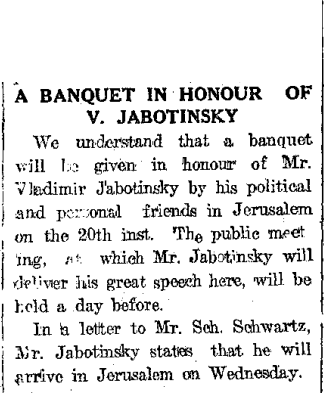
Map credit: Yair Assaf-Shapira


^

Monday, June 06, 2022

When Siegfried Sassoon was in Palestine at the Same Time as Jabotinsky

Siegfried Sassoon (1886 – 1967) was a scion to the wealthy India Jewish merchant family on his father's side with his mother being Anglican, of the Thornycroft farmers whose progeny had turned to becoming sculptors, painters and engineers. He grew up in rural Kent yet his father abandoned the family before Siegfried was five. His education was at Cambridge although he did not formally finish. He played sports, wrote poetry and developed into a homosexual.

He enthusiastically enlisted in the army when war was delcared but his war peorty became predominately critical with biting satire. While convalescing from a wound received at the Arras batle, he came in close contact with a pacifist circle and a protest of his was read out in Parliament in late July 1917 and published in The Times the following day.

And then, he returned to service and

In November 1917, Sassoon was passed fit for service. He was sent to Ireland where he served until February 1918 and was then transferred to Palestine as part of General Allenby’s army. He hated it there and described Jerusalem as ‘not a very holy-looking place’ and referred to the natives as ‘Hebrews’. His vague Jewish connections through his father meant nothing to him. After three months in Palestine, Sassoon returned to the Western Front. 

Sassoon arrived in Palestine on 12 March 1918, some 3 months after Jerusalem had surrendered to Allenby. Sassoon’s unit, the 25th Battalion of the Royal Welsh Fusiliers, was stationed north of Ramalleh, near the Jerusalem–Nablus road; by the time Sassoon reached Palestine the unit was engaged in holding the recently-secured line.

According to Siegfried Sassoon and Palestine, these lines:

On the rock-strewn hills I heard

The anger of guns that shook

Echoes along the glen.

In my heart was the song of a bird,

And the sorrowless tale of the brook,

And scorn for the deeds of men.

were written in Palestine, where he was posted for a little over a month in the spring of 1918. 

The details:

On a warm and pleasant morning in March 1918, Sassoon arrived in Gaza on a cattle truck. He had traveled all night with 12 other officers (of the 25th Royal Welch Fusiliers) from base camp in Kantara, Egypt, and was relieved to escape the ragtime tunes and tiresome ribaldry of the mess. From Gaza, whose “fine hills” reminded him of Scotland, he proceeded through almond orchards and olive trees to Ludd, the railhead where soldiers and war supplies arrived and departed. Ludd’s proper name was al-Ludd, an Arabic name because it was then a Palestinian town full of Arabs...

...From al-Ludd, Sassoon and company continued to their final destination — a hilltop village with “dusky, narrow” streets eight miles northwest of Jerusalem. Captured from “Johnny Turk” barely two months earlier and turned into the division headquarters, it was called Ramallah. There was no sound of artillery here, noted Sassoon, and the silent landscape, “hoary in the twilight,” seemed infused with a sad, lonesome air. Few knew then that the document birthing its violent future had already been written....

Jabotinsky, with his 38th Royal Fusieliers were stationed just north at Abuein. 

Sassoon was perhaps the most widely read soldier-poet in England, famous for poems that attacked the country’s incompetent, rum-flushed generals and described in pitiless detail the plight of millions of soldiers stuck in the “plastering slime” of rat-infested trenches. He was even more notorious for bravely protesting the prolongation of the war in a statement that was read out in the House of Commons on July 30, 1917, and published in The Times...

The 31-year-old Sassoon thus arrived in Palestine flushed with celebrity and notoriety. Palestine, he knew, was a “warm-climate sideshow,” and he smarted at the thought of being shunted to guard duty. By the time he arrived, the three Gaza wars had been fought and Jerusalem stormed and won from the Turks by the famous General Edmund Allenby, who, out of respect, dismounted and entered the holy city on foot. Since the action now was mostly defensive — safeguarding the Suez Canal and the oil deposits of the Persian Gulf — Sassoon spent most of his time mending roads littered with the stinking corpses of camels and trampled to “liquid mud” by ambulances and long lines of gray donkeys loaded with army blankets. It was dull, plodding work. He consoled himself by reading War and Peace, but his heavy cold and the incessant rain only worsened his mood. What he did not foresee was how deeply he would fall in love with the natural beauty of Palestine, and how loath he would be to return to the soul-deadening trenches of France when the “ghastly news” arrived that the Germans had broken through Arras.

Slowly, the landscape revealed itself to him, “and what had seemed a cruel, desolate, unhappy region, was now full of a shy and lovely austerity.” Sassoon’s diary — which has just been published online for the first time by the Cambridge University Library — ripples with mentions of wildflowers and croaking frogs, “rocks older than Jerusalem,” and young green wheat against the reddish, stony slopes. He watched the gurgling brown wadis of Ramallah and the fig trees turn into a “green mist.” He wandered the hills bird-watching, counted over 50 different species, and was thrilled when a bulbul gave him “a charming fantasia on the flute.” One day he saw a gazelle trot quietly away and envied it: “a free creature.” An Arab gardener introduced him to “ascadinias” (loquat), and he tramped through “a tangle of huge golden daisies — knee-deep and solid gold, as if Midas had been walking there.” On one serene ramble outside Ramallah he wrote, “I escaped from the war completely for four hours.”

The “anger of guns” he refers to in the sonnet quoted above, which he titled “In Palestine,” was more distant soundtrack than immediate menace. Fashioned after Wordsworth’s “Intimations of Immortality,” its first stanza tells of thyme-scented hills and rills going their way. It may not be one of his best poems, but it fuses his prewar melodic pastoral style with his bitter contempt of war. Before the war, Sassoon had been, in his own description, “a brainless fox-hunter,” who played cricket and self-published his mediocre poetry. It was the horrors of the Somme that gouged the treacle from his verse and honed him into a fine poet. Though he faced no direct fighting in Palestine, everywhere around him was the grim business of war. “C’est la guerre — in an Old Testament environment,” he noted drily.

...In Sassoon’s scorching parable, Adam stands in for the cynical old politicians who watch their young kill one another. Described as “a brown old vulture in the rain,” Adam ponders over the character of his two sons. He admires Cain, who is “Hungry and fierce with deeds of huge desire,” and despises Abel, “soft and fair — / A lover with disaster in his face.” Adam even justifies Cain’s murdering his own brother because even murder is more tolerable than weakness: “Afraid to fight; was murder more disgrace?” In the end, murder only begets murder, and the vulture finds both his “lovely sons were dead.” What makes this poem a moral grenade is its self-awareness. Sassoon knew that there were bits of Cain and Abel tussling inside him. At the start of the war, he had been a soldier filled with bloodlust, and made quite a reputation for himself for his revenge killings of Germans. But he had also sickened of the slaughter and campaigned for it to stop. In Sassoon’s case, Abel finally won, but the current war, with its far more ancient and complex metabolism, is inevitably stamped with the mark of Cain.

^

Friday, May 27, 2022

An Historical Desecration of the Haram A-Sharif

In January 1939, the London Times published documents such a letters and reports of Arab terrorists found at Bani Naim by British forces. The Palestine Post then republished the story on January 25, 1939.


The highlight was the extensive use made of the Haram A-Sharif compound as a base for the terrorist gangs, sniping positions, arms storerooms, etc. as well as the presence, within the compound, of security personnel of the Mandate.

An extract:

Rebel Arab documents seized by the troops in some recent engagements,, particularly that at Beni Na'im on December 15, when the Worcestershires. with R.A.F. cooperation, engaged a large band, provide sensational proof that the sacred Haram esh-Sharif has been the scene of murder, bomb-throwing, and rebel courts-martial, and evidence that even the rebels themselves are disgusted and alarmed at the terrorism of Arabs by Arabs which has marked the lateit stages of the campaign.

The documents are from the files of 'Abu Mansur," the nora de guerre of Abdel Khader Husseini. With such evidence as this of the Moslems' violation of their own sanctuary, and the proof , witnessed by members of the Moslem Supreme Council , after the recapture' of the old city of Jerusalem on October 19, that the Haram has been used as a vantage point for snipers. As the sheikhs have locked the old police post next to the Dome of the Rock, the present post has been placed in a sheikh's room farther from the sacred rock...

The following day, the paper's editorial read, in part:

the desecration of the Haram esh Sharif for terrorist attacks both against individual Arabs and against the police and the troops.The propaganda agents of the Mufti and their helpers in the foreign press launched a wide campaign of insinuation and slander against the security authorities in this country when the latter found themselves obliged to station a small post of Moslem and British police in the Haram area in order to prevent its being used as a point of vantage for gunmen. It is now revealed from the files of the terrorist leaders themselves that not only was the Haram turned into a haunt of snipers, but that it also served as a venue of trials by terrorist "courts" and that the "holy warriors" murdered fellow Arabs within its sacred precincts. 

From The Times Archives, thanks to EV: 


^


Thursday, May 26, 2022

'You Do to Us What the Nazis Did to You'

One of the central propaganda lines of the pro-Arab Palestine school of misleading misinformation is that the establishment of the state of Israel was made, and ageed to by Europe and America, as a form of an assuaging of their guilt for their responsibility for the Holocaust.

The line continues that the Arabs are being forced to pay for the sins of Europe which is unfair. Europe wants to placate their consciousness over the year 1939-1945, do it somewhere else.

Of course, that ignores 3000 years of Jewish national identity bound up with the Land of Israel - which the Arabs turned into 'Palestine" after conquering it and then occupying it.

But I have now found a pre-war claim on that theme in the Palestine Post's review on January 26, 1939 of Arnold Toynbee's volume Survey of nternational Affairs, 1937 in which he asserts the Mandate of Palestine "pays for Europe's sins".


Nothing new under the sun. Toynbee, of course, is infamous for this observation:

"There remains the case where victims of religious discrimination represent an extinct society which only survives as a fossil. .... by far the most notable is one of the fossil remnants of the Syriac Society, the Jews."

In fact, he continued this line and in 1955, Commentary Magazine published this in a review:

Under title of “The Modern West and the Jews,” A. J. Toynbee devotes a subsection of Volume VIII of the last four books of his Study of History to the fate of Jewry under the Nazis and to subsequent developments in Israel. His remarks therein about Zionism and Israel have, quite rightly, outraged Jews and other people. Mr. Toynbee equates the monstrous crimes perpetrated upon the Jews of Europe by the Germans with what the Israelis did to the Arabs of Palestine, and seems to find the Israelis as much at fault as the Nazis were! 

That year, he had a letter published which read, in part:

I do believe that, in the issue between the Palestinian Arabs and the Zionists, the Palestinian Arabs are in the right and the Zionists in the wrong...But the tragedy, as I see it, goes back far further than the date of the Balfour Declaration. I see earlier stages of it in the conversion of both the Zionists and the Arabs to a Western secular ideology, Nationalism. The fanatical spirit in Nationalism comes, as I see it, from Christianity; and Christian and Muslim fanaticism, as well as Christian and Muslim charity, comes, I believe, from Judaism...

...The tragedy of recent Jewish history is that, instead of learning through suffering, the Jews should have done to others, the Arabs, what had been done to them by others, the Nazis.

Though I was careful to bring out the Zionists’ innocence of the Nazis’ cold-blooded, systematic ‘genocide,’ and the disparity in numbers between the Jewish victims of the Nazis and the Arab victims of the Zionists, I am sure I am right in holding that degrees of sin and tragedy are not determined by the numbers of the souls concerned. Sin and tragedy are done and suffered by each of us individually; they are not, and cannot be, collective. Nor is the tragedy of the Palestinian Arabs’ sufferings at the hands of the Israelis a peculiarly Jewish tragedy; it is a common human tragedy, like the Jews’ own sufferings at the hands of the Nazis...

In 1961, JTA reported:

Arnold J. Toynbee, the British historian, in an address here last night, equated Zionism and anti-Semitism as representing “an identical point of view” and said that anti-Semitism will end and Judaism become “one of the great spiritual possessions of the whole human race” when Jews and non-Jews “abandon” their ethnic or national reservations” about Jews. Jewish leaders immediately took issue with his views charging him with making “distorted statements. “

Dr. Toynbee made-his statements as the principal speaker at the dinner of the 17th annual conference of the anti-Zionist American Council for Judaism. Both Zionism and anti-Semitism, he declared, assume “that it is impossible for Jews and non-Jews to grow together into a single community and that, therefore, a physical separation is the only way out. “

“The watchword of anti-Semitism,” Dr. Toynbee continued, “is back to medieval apartheid; the watchword of Zionism is back to the medieval ghetto. All the far-flung ghettos of the world are to be gathered into one patch of soil in Palestine, to create a single, consolidated ghetto.”

Asserting that Zionism “was born of a pessimism” about the prospects of Jewish emancipation, Dr. Toynbee held that “if the Jewish community in the West were to continue to be an ethnic–even if only a partly ethnic and partly religious–community, co-existing with the present State of Israel, it could hardly avoid falling, sooner or later, into the position of being a political dependency of Israel."

He manages to squeeze in a parallel to apartheid as well.

^

Should Israeli Police Enter the Haram A-Sharif?

Why not?

Their task is to uphold the peace and protect public order, to prevent riots and harm/injury being caused by miscreants.

The Ottomans did it.

So did the British, as the explained in 1939:


Saturday, April 30, 2022

Getting a 'Push' Home from an Anti-Semite, 1911

I came across this news item but had not background knowledge:


That's from The Hebrew Standard in April 1911. Phillip Steele assisted me in research.

It stemmed from anti-immigration sentiment cojoined with anti-semitism in 19th Century England.

And this is the back story:

By the end of the 19th century there was public protest about the level of immigration, especially from Eastern Europe into London. A lot of these immigrants were of Jewish heritage, and they were often fleeing from anti-semitic persecution in Europe. The protests in London took place because English workers feared they might lose their jobs to the migrants, who seemed prepared to work for less money.

A Captain William Stanley Shaw formed the British Brothers League (BBL) in 1902 to campaign in East London against immigration. The BBL was connected to the local Stepney Member of Parliament (MP), William Evans-Gordon, who led moves to pass an Aliens Act to restrict immigration.

In this move, at least not a matter of violent pogroms, Shaw followed as well as preceded others such as the notorious Gyozo Istoczy in Hungary, active especially in the 1870-80s. There was Goldwin Smith in the UK/Canada and in Poland there was Władysław Studnicki in the interwar period. 

The BBL was formed in 1901 by Shaw:

The Aliens Act 1905, which restricted immigration, was largely seen as a success for the BBL and, as a result, the movement by and large disappeared.

It officially carried on until 1923, albeit on a tiny scale, and was associated with G. K. Chesterton and the distributist movement...The League also left behind a legacy of support for far-right groups in east London and this was exploited by the British Union of Fascists

Information on the BBL an be found in chapter 6 of this book, like:


On Shaw, here:


Shaw left the group after but a year but continued to promote anti-alienism:


One can presume his 1911 scheme was an outgrowth of his distaste of Jews.

^


Thursday, April 28, 2022

Jabotinsky Parts Ways With Weizmann

 After some two years that Ze'ev Jabotinsky had come to realize that Chaim Weizmann was too docile in combatting British reneging on the Balfour Declaration and especially after Weizmann did not back Jabotinsky when he commanded the Jewish self-defense unit in Jerusalem in April 192o, the break became unavoidable.

The first step was the White Paper of 1922.

Here is a description of the lead up to the fateful vote to accept it.

Source: Jonathan Kaplan's PhD Thesis - “Weizmannism” in the Zionist Movement during the 1920s

To make matters worse, the position of Zionism in public opinion had been considerably compromised at precisely the moment when British policy in Palestine was about to be debated in Parliament. This constellation afforded Hebert Samuel, who arrived in England in early May, a unique opportunity to press home the policy that he had been advocating since his first visit to Palestine in the spring of 1920. His approach had been rejected at the conference convened in Balfour’s home back in July 1921 but now that the ratification of the Mandate seemed so close to realization and the Zionist freedom of action was severely limited, it appeared that it might be possible to leverage the situation in order to win Zionist consent to his new policy.85

This was expressed in a statement written by Shuckburgh and Samuel, and signed by Churchill, that came to be known as “Churchill Memorandum.”86 The essence of the policy was a dual commitment: to the well-being of the Arab population of Palestine as well as to the continued development of the Jewish National Home. The goal in mind was not to create a “wholly Jewish Palestine.” The country was not to be transformed in its entirety into a Jewish National Home, but such an entity would be created in Palestine. Immigration would be limited by the economic capacity of the country to absorb new immigrants. However, it was emphasized that the Jews were in Palestine by right and not on sufferance, and the Jewish National Home would continue to develop. An elected Legislative Council was to be established to represent the local population. Samuel’s overall view was that with fair treatment and good will, Jews and Arabs could live together peaceably in Palestine:

The Secretary of State believes that a policy upon these lines, coupled with the maintenance of the fullest religious liberty in Palestine and with scrupulous regard for the rights of each community with reference to its Holy Places, cannot but commend itself to the various sections of the population, and that upon this basis may be built up that a spirit of cooperation upon which the future progress and prosperity of the Holy Land must largely depend.87

An advance copy of the memorandum was conveyed confidentially to Weizmann on May 27 and to the Arab Delegation on May 30. On June 3, a letter was sent to the parties with the polite but nonetheless unmistakable ultimatum that each express its agreement to conform with the new policy.88 In one of the clearest presentations of the Palestinian Arab case, the Arab Delegation rejected the document outright.89

After receiving the draft, Weizmann met with Samuel in an effort to effect changes in the wording of the memorandum, especially the deletion of the sentence which criticized the statement that “Palestine should be as Jewish as England is English.” However, Samuel rejected any alterations and Weizmann concluded that the Zionist Organization had no alternative but to accept the memorandum as it stood.90 Upon receiving the letter of June 3, Weizmann informed Shuckburgh that the Colonial Office would receive a positive answer from the Zionist Organization. Shuckburgh wrote to Samuel of Weizmann: “He was on the whole in good spirits, and is taking his basin of gruel with a better grace than I expected.”91

Weizmann’s initial reaction emphasized the document’s positive side: It is perhaps not exactly what we want but considering the great difficulties of the situation it is a satisfactory document. It might depress some of our exalted friends but on the whole it will be accepted loyally. In this document explicit recognition is given to the Z.O. as the Jewish Agency and so the Government has definitely committed itself to this course.92

Given the situation, Weizmann saw little need to deliberate extensively over the mater in the ZE. At the meeting of June 9th he went so far as to claim that the statement “did not represent any alteration of policy, and in the present circumstances they could only accept it.” A serious delay in responding could jeopardize the ratification of the Mandate. Ultimately, it was decided to convene a special meeting of the ZE together with the executive of the Actions Committee (AC), Dr. Arthur Hantke, Rabbi Dr. Hirsch Chajes and Robert Stricker, on June 18.93 Jabotinsky, who had just returned from the United States, also participated. At the conference, Weizmann explained that the Zionist response had to be given the next day in light of the debate on the Britain’s policy in Palestine that was scheduled to take place in the House of Lords some ten days hence. A postponement of the decision would have an effect on the debate and perhaps even put the Mandate at risk. The dominant feeling, shared even by Jabotinsky, was that the memorandum was a bitter pill that had to be swallowed.94  

A special committee was formed and by the next morning an assurance that the activities of the Zionist Organization would comply with the new statement of policy had been formulated, passed and delivered to the Colonial Office.95 Despite the fact that the statement would “be interpreted by the Jewish World as a whittling down of the Balfour Declaration,” Weizmann explained to Deedes that he had agreed “under the adverse circumstances.” However, no additional concessions would be forthcoming from the Zionist Organization.96 The statement of policy, which became known as the Churchill Memorandum, appended by the government’s correspondence with the Palestine Arab Delegation and the Zionist Organization, was submitted to Parliament in the form of a White Paper (the Churchill White Paper) on July 1, 1922.97

85 Harold M. Simansky, “The Churchill Memorandum as a Product of Herbert Samuel’s Zionism,” typescript, Brandeis University (Waltham, Mass.: 1990); Friesel, “British Policy in Palestine,” 209; Reinharz, Making of a Statesman, 386-387.

86 Cmd. 1700. For an analysis of the Churchill Memorandum see: Monroe, Britain's Moment in the Middle East; Kedourie, “Sir Herbert Samuel and the Government of Palestine”; Friesel, Zionist Policy, 297-308; McTague, British Policy in Palestine, 207-215; Friesel, “Herbert Samuel's Reassessment of Zionism in 1921,” 213-237; Friesel, “British Policy in Palestine,” 190-217; Cohen, Britain’s Moment in Palestine, 129-130; Reinharz, Making of a Statesman, 388-389.

87 Cmd. 1700, 21.

88 NA CO 733/34; see Friesel, Zionist Policy, 302.

89 Musa Kazim al-Husseini and Jamal Shibli to the Secretary of State for the Colonies, 17.6.1922 in Cmd. 1700, 21-28; see Friesel, Zionist Policy, 305.

90 Minutes of the ZE, 9.6.1922, CZA Z4/302/7/I.

91 Shuckburgh to Samuel, 3.6.1922, NA CO 733/34, 25494.

92 Weizmann to Alfred Mond, 4.6.1922, WL, vol. 11, 109

93 Minutes of the ZE, 9.6.1922, CZA Z4/302/7/I. The Constitution adopted at the 12th Zionist Congress (1921) provided for an Actions Committee or broad executive body of 25 members in addition to the members of the ZE (including 3 members of the Financial and Economic Committee) and the Directors of the Zionist financial institutions – the Jewish Colonial Trust, the Jewish National Fund and the Keren Hayesod. See Stenographisches Protokoll der Verhandlungen des XII. Zionisten-Kongresses in Karlsbad vom 1. bis 14. September 1921 (Berlin: Jüdischer Verlag, 1922), 803.

94 Report of the Meeting, 18.6.1922, CZA KH 1/306; Friesel, Zionist Policy, 305-306.

95 Weizmann to Under-Secretary of State, 18.6.1922, WL, vol. 11, 117-118.

96 Weizmann to Wyndham Deedes, 29.6.1922, WL, vol. 11, 126.

97 Secretary of State for the Colonies to the High Commissioner for Palestine, Cable, 29.6.1922, Copy in WA.

And he continues:

In a private conversation in August 1922, Jabotinsky described to a friend his meeting with Weizmann earlier in the day: 

We both argued in a very intelligent, wonderful way. But, you know, I intuitively felt one thing: I cannot go in his ways, and one shouldn’t go in these ways, because they are bound to bring us to self-abdication. Weizmann believes that his way is that of a compromising realist, and mine is the way of a stubborn fantast, of a utopian; and I feel that his line is the line of renunciation, of subconscious Marannism, while mine is a difficult, stormy way, which will, however, lead more quickly to a Jewish State.3

After the AC refused on January 16-17, 1923 to vote on three of Jabotinsky’s proposals – his cri de coeur in the words of one researcher, Jabotinsky left the ZE.4 His letter of resignation called for a more forceful stance towards Great Britain, although strategic cooperation remained an underlying element of his approach.5

1 Anat Feldman notes that criticism of Weizmann’s policy served as the Revisionist party’s main ענת פלדמן, "המאבק על הנהגת התנועה הרוויזיוניסטית, זאב ז'בוטינסקי מול מאיר גרוסמן -1925 See. guideline .1933 ,"יהדות זמננו: ציונות, מדינת ישראל והתפוצות 14( תשס"א(: 100

2 Yaacov Shavit, Jabotinsky and the Revisionist Movement: 1925-1948 (London: Cass, 1988), 33; Colin Shindler, The Triumph of Military Zionism: Nationalism and the Origins of the Israeli Right (London: I. B. Tauris, 2006), 40-42.

3  ,שלמה גפשטיין, זאב ז'בוטינסקי: חייו, מלחמתו, הישגיו )תל-אביב: ההנהלה הראשית של קרן תל חי, 1941 ,)98-97 quoted in Joseph B. Schechtman, Rebel and Statesman: The Vladimir Jabotinsky Story – The Early Years (New York: T. Yoseloff, 1956), 424.

4 Jabotinsky proposed: “1. To inform both the Home Government and the Palestine Administration that the continuance of the present policy in Palestine threatens to ruin the Zionist movement financially, and to bring our enterprise in Palestine to bankruptcy. 2. To declare that the presence of anti-Zionists or anti-Semites in the British personnel of the Palestine Administration was contrary to the Mandate, and to instruct the Executive to insist on their withdrawal. 3. To proclaim, in view of the widespread  assumption that Zionism has renounced its ideal, that the Movement stands on the basis of its historic aim and that our obligations vis-à-vis the Mandatory Power admit of no other interpretation.” (JC,  .2.1923). See Shindler, Military Zionism, 42-43.

5 “…the Actions Committee has validated those tactics which threaten to wreak havoc on the movement and bankrupt the Jewish enterprise in Palestine. Underlying these tactics is the fundamental view that as long as we lack coercive measures or sanctions it is impossible to compel the British government to give us even those rights that have been officially authorized. I believe that this policy is mistaken. Whoever fights persistently and systematically for the full realization of his rights will earn the respect and the honor of the English people and its government, and after a drawn out struggle, will win justice as well. On the contrary, a policy lacking courage could cause demoralization among the authorities in both the east and the west. Therefore, I see it as my duty to struggle openly against these  harmful tactics and to thwart them though independent political actions…. It would be easier – and I have no doubt also morally justified

^

Monday, April 25, 2022

Jabotinsky on Progressivism and Nationalism

Excerpts from Ze'ev Jabotinsky's article On nationalism published January 30, 1903:

The Fatherland newspaper, referring to the Russian guardian patriots, says: “It seems to many of them that if people of non-native Russian origin show an ardent commitment to their native land, their land, to the language God gave them, and to all the features their native way of life and needs, then in this devotion to their foreign features, there is certainly some kind of malevolence against Russia "...

... it is necessary to do justice to the Russian progressives: on this point they think in exactly the same way as the Russian guards.

Complete agreement. Allow me to replace only two or three words in the tirade of the Fatherland newspaper, and this tirade addressed to the guardians can be safely attributed to the liberals: to their land, to the language given to them by God, and to all the peculiarities of their native way of life and needs, then in this devotion to their national identity lies some kind of malicious intent against progress...

...The same ordinary progressive who everywhere insists that the ideals of a decent person should be social ideals, and by no means nationalistic, and that nationalism is ugh.

I asked these persons: “Isn’t it possible, gentlemen, to somehow combine nationalist sympathies with your broad social ideals?” And the rank and file shook their heads and determined: - No way. And they proved it to me with the following comparison:

We, progressives, wish, by the way, that there would be no wars, no national persecutions, that individual nationalities would fraternally merge and forget the borders and borders separating them. And the nationalists hamper the merger, trying to preserve its isolation for each nationality. Their ideal is directly hostile to ours ...

That's why I want to say: "you don't know your own," when this same progressive in a minute falls on the guard for disrespect for a foreigner.

...Russian progressives use the word "scientific" quite liberally. And this does not prevent them from looking at the national question in a completely childish way. I'm not talking about the fact that they see the future in a rosy light. This is a perfectly legitimate optimism. For me, too, the future is drawn relatively in a rather pleasant light.

I also hope that such an order will be established in the future, when that social soil is created on which humanity will become healthier in body and spirit. And I also believe that then there will be no war and no national persecution. And that then, no matter what wilderness of a foreign country I find myself in, everywhere I will feel myself among good neighbors and comrades.

But this is not enough for a Russian progressive. He dreams of more. He wants me, having got into a foreign land in these future blessed days, not only not to feel a hostile attitude towards myself, but not even to notice any difference at all between the people there and my compatriots.

To make me feel completely at home there...What about national characteristics?

...And if this continued, if the abyss between the social strata were to deepen, then, indeed, the "vertical" divisions of humanity, i.e., national differences, would soon be completely obscured by the immensity of the "horizontal" divisions of class differentiation.

But ... but it seems that the wagon of progress is not rolling in this direction, but just in the opposite direction, and it is the progressives who should least of all forget about this. Mankind is moving towards softening and gradually completely smoothing out the class barriers. To give all citizens equally favorable conditions for the development of spirit and body.

This, in the whole sense of my faith, is the direction of history.

And the further we go along this direction, the closer spiritually the intellectual and the peasant will become to each other.

Until, finally, they find themselves next to each other and speak, as an equal with an equal, thoughts of the same range.

The whole mechanics of what we call progress is directed towards the elimination of class dissimilarity.

And when it is eliminated - then what will happen?

...But when the class dissimilarity disappears, it is precisely then that we will see the national dissimilarity with particular clarity.

For the progress of these dissimilarity cannot be eliminated.

Progress will inspire the nations with equally just views on social questions, progress will give them equally strong technical means to fight against nature. But progress will not paint the Italian sky the same color as the Finnish sky, will not bring plains to Switzerland and will not turn Russia into a mountainous country.

Natural factors create race.

A complex, seething tangle of economic factors distorts and modifies racial characteristics to such an extent that the influence of race almost completely disappears in the historical process. To the point that in our time the concept of race is almost ignored by science.

But if progress ever regulates this maelstrom of diverse economic interests, combining them in one synthesis, then the principle of race, hitherto obscured by other influences, will straighten out and flourish.

Not only will national peculiarities not be smoothed out by progress, but, on the contrary, they will receive more space, more freedom to develop ...

...The more diverse the composition of the orchestra, the more beautiful the symphony, because the violin conveys what the flute would not convey, and there are places that are not suitable for the clarinet and must be played on the harp.

For the development of sciences, arts and poetry, for this whole symphony of the creative human spirit, a rich orchestra is also needed, and the fuller and more diverse, the better.

Each instrument has its own timbre, and each nationality has its own special spiritual warehouse.

We must cherish these timbres of nations, improve them and prevent the violin from playing the trombone, so that the Czech becomes like a Frenchman.

Life is not about cutting everyone to one size, but about diversity, in harmony with myriads of dissimilar individuals.

Nationalism is the individualism of peoples.

Tuesday, April 19, 2022

Al-Aqsa and Over a Century of False Rumors

The recent spate of false reports, incomplete details and misconstrued facts about the Temple Mount is not new.

The British High Commissioner had to go the Geneva long ago to dispel the ones then being spread by the Mufti and a delegation he sent out to Mecca and other Arab capitals.

August 1922, a century ago via EOZ:


and in October a report about the "Zionist flag unfurled over Omar Mosque":


On the delegation mentioned in this 1922 report, see my article. And here:

And here.

And in 1924:


Of course, the rumors are older than that. Here is from Chaim Weizmann's letters, April 1918, when he arrived in liberated Palestine with the British and had to run to Egypt to quell similar rumors:


And this:


^

Monday, April 18, 2022

My November 1976 Trip to Moscow

In November 1976,  together with George Evnine/Yevnin,  flew off to Moscow for four days.

Just now, a letter I wrote at the time relating details was returned to me and it describes the trip to my wife's aunt:


In Red Square


^

A Perfidious Jordanian

We read that Jordan's King stresses need for Israel to cease provocative measures in Al Aqsa Mosque, calling for the respecting of the historical, legal status quo in Jerusalem

And he "reiterated that protecting Jerusalem and its holy sites will remain a priority for Jordan, directing the government to dedicate all capacities to safeguard these sites, as well as the historical and legal status quo in the holy city and its Arab, Islamic and Christian identity."

So, what have we?

A. An accusation that it is Israel that engages in provocative behavior. ot the Jordanian-funded Waqf, not the Isalmic clerics, the Palestinian Authority inciting violent behavior, the youngsters and some others throwing rocks, shooting off fireworks.

B. A complete ignoring a Jerusalem's Jewish identity.

C. A refusal to fulfill the country's obligations to Article 9 of the Jordan-Israel Peace Treaty, that

Each Party will provide freedom of access to places of religious and historical significance [and] The Parties will act together to promote interfaith relations among the three monotheistic religions, with the aim of working towards religious understanding, moral commitment, freedom of religious worship, and tolerance and peace.

D. Denial of history.

Maybe Israel should revisit that treaty?

UPDATE

Statement by PM Bennett

(Communicated by the Prime Minister's Foreign Media Adviser)

(Monday, 18 April 2022):

"Over the past week, a Hamas-led incitement campaign has been waged against Israel. Here's the truth: Israel is doing everything so that all peoples, as always, can celebrate the holidays safely - Jews, Muslims and Christians. We expect everyone not to join the lies and certainly not to encourage violence against Jews. The State of Israel will continue to keep our capital, Jerusalem, open to all.”

^

Tuesday, April 12, 2022

Ze'ev Jabotinsky at 21 - Excerpts from an Anti-Anti-Zionist Article

I present excerpts from Vladimir Jabotinsky's "Science and Common Sense" which the then not yet twenty-two-year-old published in the Odessa News newspaper of September 8, 1902. It very well may be the very first known Zionist statement by the future writer, thinker, public figure and political leader. And it predates his supposed conversion to Zionism as a result of the pogrom in 1903 in Kishinev.

Jabotinsky responds to an anti-Zionist piece by Iosif Menassievich Bikerman (1867-1942) published in the Russkoje Bogatsttwo [Russian Wealth]

Mr. Bikerman's article made a big impression...This is the experience of a real scientific assessment of Zionism...This article has scientifically proven that Zionism is a utopia. "Scientific". 

...Poems of a non-poet are album literature, these are not poems, but rhymes. And in the same way, this scientificity for fifty dollars, the scientificity of one's own home-made dressing, the scientificity arranged for a balalaika, and therefore accessible to the first person you meet - all this is landscape and toilet scientificity, suitable for flirting with young ladies, and not for a weighty conscientious dispute. To think scientifically, one must be a scientist, that is, a producer in the fields of science, and not a simple consumer of its products...enough, in fact, to be afraid of this shout: "Utopia!" Stupid word from the vocabulary of cowards. Much that a hundred years ago seemed like a utopia is now strong and marching, and advancing, and conquering.

...when a mass of people in unison embraces the whole of one ideal, this means that it was not the “feuilletonists” who whispered it to her. The power of things whispered to her. Those ideals that are whispered by the force of things are not utopias. They are a real need. They are the future reality.

...he has only one argument against Zionism:

“World history,” writes Mr. Bikerman, “does not know a case when any group of people — a clan, a tribe, a people, a horde — would have taken it into their heads to create a state one fine morning, and having thought of it, would have created it. Both in ancient and modern times, states were the result of the activity of the human masses, but never served as the goal of this activity.

I.e: “What has never happened before, cannot happen again.” I.e: - All the laws of historical movement are already known to us, and nothing that we have not yet seen and foreseen is not supposed to happen.

I don't think it's scientific...No serious theoretician of history would allow himself to state categorically that what has never happened before will never happen again. Only someone self-satisfied with semi-knowledge, not obliged to cherish either the dignity or the prestige of science, is capable of uttering such prophecies in its name ...

Examples of mass emigration were repeated both in ancient times and in the coming times. Zionism and offers mass emigration.

...Mr. Bikerman also reproaches the Zionists for trying to lure their people along the path of greatest resistance. And this is futile, because an irresistible law of nature tells all energy to follow the path of least resistance. This, of course, is correct. No energy will follow the path of greatest resistance. 

Why did the first Christians in Rome, or the same Jews in the Iberian Peninsula, or the Huguenots in France, prefer persecution and emigration instead of assimilation quietly and calmly, that is, accepting the faith of the strongest? This, of course, does not mean that they all followed the path of greatest resistance, for it is logically unthinkable to follow the path of greatest resistance. It simply means that, for many different reasons, it was easier and more profitable for them to endure persecution, die at the stake, go bankrupt and emigrate than to give in.

You can never know exactly which path at a given moment presents the greatest or least resistance.

...Another thing is purely practical objections to Zionism. They are made without a pretentious tone, they follow from the sober considerations of sane people, and it is pleasant to answer such objections. These objections are often very valid.

Will Turkey give in? Will the powers allow it? Will Palestine provide enough food? Are Jews capable of agriculture?

All these are important and complex questions, and nothing can be said categorically about them, simply because nothing can ever be confidently asserted about the future. But, in any case, there are no less practical arguments for , and good arguments, than against...will the Jews make Palestine a "land of honey and milk," if not, but, in any case, they will make it a livelier, more cultured and, therefore, more profitable region than it is now. 

...Whether the Jews are capable of agriculture, whether the soil of Palestine is capable of producing cereals in sufficient quantities - all questions could be answered only with numbers in hand. I can only remind you that in Finland there are completely bare cliffs where people have applied black soil and live on the fruits of this black soil. It is possible to adapt, not immediately, of course, but after two or three generations, to everything, not only to agriculture. Especially the Jews, who have long proved their ability to adapt to any, even the most incredible conditions of existence.

One can laugh at the money game with the term "scientific"; practical arguments should be thoughtfully and seriously considered and argued, but against the third category of objections raised by Zionism, one can only protest indignantly and uncompromisingly.

...Is nationalism regressive? To love one's nationality more than all other nationalities is as natural as to love one's mother more than all other mothers. Just as a person has the right to protect and develop his individual characteristics, so the nation has the right to cherish its national characteristics. 

– Zionism distracts the Jews from universal cultural work, from concern for the interests of all mankind.

It is a strange claim that all people must work in the same field. One can be a friend of all mankind, but work for the good of one nationality, because the good of one nationality is part of the good of mankind. Does Zionism dream of tearing the Jews away from spiritual affinity with Europe? Zionism wants to give the Jews a place where they can maintain this intimacy, develop it, enjoy it - only without being humiliated, without enduring persecution, without the risk of losing their national identity.

One can argue against Zionism—find it unworkable or undesirable. But to speak of its reactionary character, to see in its leaders traitors to the ideals of the common human good, is not to argue, but to dishonor, to dishonor crudely and frivolously the dream born of all the sobs, of all the sufferings of the Jewish people; it means to invite people to your shop not by washing, but by rolling; this means responding with a curse to the tearful prayer of the tormented Ahasuerus and slandering and slandering his centuries-old reserved ideal.

Ideals stand above ignorance and are not afraid of slander.

And Jabotinsky applying himself just a half year later: 


On Zubatov, Czarist Russian police administrator.

I decided to update this with excerpts from a second article published in June 1903

Kadimah 

I know three objections to Zionism...The third objection is:

“Your movement is calling people back to fanaticism, to misanthropy, to tribal enmity."

I consider this objection embittered, and I usually do not answer it, but fall silent and mournfully look at the one who threw this untruth to me, and I marvel, saddened, at his anger.

Strange outrage. You can be distrustful of what you find unrealizable; but indignation against someone else's ideal is understandable only when this someone else's ideal is the ideal of violence, enslavement, outrage. Meanwhile, whatever the fate of Zionism in the future, it carries in any case the noble ideal of emancipation. Where does this bitterness, this rage come from, and not from strangers or reactionaries; and from the side of blood brothers and people who boast of an advanced way of thinking?

...There is nothing else to justify all the passion of these unrighteous attacks; because on our part we have not deserved them in any way, and have always been and conscious of ourselves as honest friends of progress, freedom of spirit and brotherhood; and from the moment our movement emerged in an enlightened milieu, its motto has been Kadimàh , a beautiful and deep word that means "to the east" and at the same time "forward"...

...We are told:

“Your movement did not spring from any positive striving. It is caused by anti-Semitism: since it is difficult for Jews in the Diaspora, you want to take them to Palestine. This means that all this was not started at all in order to create a new nest of culture. Your chain is negative, not positive: flight, not striving. First of all, you need a shelter, an almshouse, a fortress, where you would be sheltered from malice, and not a factory for the production of new values. Compassion drives you, not a burst of creativity. Choose for yourself any motto you like: "pity", "intercession" - but not the word "forward". Running was never moving forward.

Well, that's right. Running was never moving forward. Flight is backward movement. Flight is the last concession. Whoever runs has already given up. Whoever runs, he already thereby says: I refuse to fight. I no longer defend what I undertook to defend. I cede to you what I wanted to consider my property.

Flight is a movement backwards and cannot be anything else, because in it lies the concession of the very principle for which the struggle was waged. This is the main thing. Without the element of concession, there is no escape. If I made a mistake with the door and ended up in someone else's apartment, then, noticing the mistake, I apologize and leave; but this is not an escape, because I had no intention of taking possession of this strange apartment. But if I deliberately burst into it in order to take possession of it, and were forced to abandon this goal and leave, then my departure would be a real flight; for he is a fugitive who, yielding to force, renounces the principle for which he stood up.

But the Jews did not then come to the lands of the diaspora in order to take possession of them or establish themselves in them. We did not even come - we were squeezed into these lands. Nineteen centuries of our history are not about what we did, but about what others did to us. Others squeezed us into Spain, forced us out of Spain and squeezed us into the east of Europe; we walked where we were pushed, and stopped when the inertia of the push stopped. Some stopped in Holland, others only in Romania; but neither one nor the other came there on purpose for the purpose of capturing or settling down. Falling from exhaustion on Romanian soil, they did not say to themselves: I want and will live here! They said: I can't go any further; I will stay here - maybe they won’t torture me here as much as in the land of Sepharad ...

We came to the countries of the diaspora, not having the goal of establishing ourselves. In our movement then there was no purpose at all, there was only a reason .

And now we see that we made a mistake with the door and got to the wrong place, where our place is, and we want to leave. This is not an escape, because when we came to these lands, we did not bring any goal with us, and now we must not give up any goal.

However, no. We brought one chain with us: the preservation of our nationality, which was then symbolized for us in religion. Spain offered us equality for apostasy; but we preferred torture and exile. So, coming from Spain, we wanted to remain Jews. This was our only goal. We carried this single goal through the fire and water of our long history. And we do not abandon this goal: we are faithful to it today more than ever: for this we want to leave forever from foreign cities, in order to remain Jews!

We have not given up or yielded in what is and has been the goal of our historical struggle; therefore our campaign will not be an escape, but a triumph. But fugitives will be those who yielded and surrendered, those who could not bear the constraints and ceased to be Jews; preaching of renunciation, calls for apostasy, invitations to humble yourselves in spirit and become Germans or Frenchmen, since it is difficult to remain Jews—this is what will truly be stigmatized with the name of cowardice and flight.

And so we come to the main point - to apostasy. Flight is apostasy. And if we needed only flight, then we would preach not Zionism, but apostasy .

The masses under the influence of the current influence are always directed along the path of least resistance. Anti-Semitism represents a strong external pressure: but in order to be saved from it, there is no need to colonize Eretz-Yisrael. There is a path much less difficult - the path of apostasy. Escape is the path of least resistance. Change your faith, and today you will acquire all rights before the law, and tomorrow or the day after tomorrow, with the help of mixed marriages, you will be recognized as your own and by society. If this merging takes time, then, in any case, it will be easier for you than buying out abandoned land and creating a new homeland on the ruins ...

Anti-Semitism could not give rise to Zionism. Anti-Semitism could only give rise to the desire to flee from persecution along the path of least resistance - that is, apostasy. But in order for a call to national self-consciousness and revival to sound instead of preaching apostasy, something was needed besides anti-Semitism, an internal stimulus, an internal and positive imperative was needed. This imperative lies in the life-giving instinct of national self-preservation, which has given us the strength to pass through the order of history.

The Arab fell asleep under a bush. At dawn he was bitten by a flea. From the bite he woke up, saw the dawn and said:

Thanks to this bug. She woke me up; now I will perform ablution and get to work.

But when he began to perform ablution, the flea bit him a second time. Then the Arab caught her and strangled her, saying:

“It is evident that you were proud of the fact that I praised you; and indeed, you helped me wake up: but not by your prodding will I pray and work ...

Here is the role of anti-Semitism in the Zionist movement. We do not deny that he helped us wake up. But only. If, on waking up, we straightened up, washed ourselves with fresh water and set to work, it was not for the sake of the miserable insect that woke us up, but for the sake of the life instinct that is inherent in us.

If we wanted to flee, we would call for apostasy; if we needed an almshouse, we would call for apostasy, because apostasy is easier and more likely to save our skins. But it is not we, but our opponents who preach this easy way of renunciation; we Zionists reject capitulation and call for the hard work of creation . We call the Jewish people to historical creativity . Pointing to the east, we do not say to the people: run, hide from persecution in this hole; we point to the east and proclaim "forward": Kadimàh .

^