
THE federal Government has denounced an Australian-born Muslim cleric for calling Jews pigs and urging children to die for Allah.
Sydney-born Sheik Feiz Mohammed, head of the Global Islamic Youth Centre at Liverpool in Sydney's west, delivered the hateful rant on a collection of DVDs called the Death Series, sold in Australia and overseas.
Acting Attorney-General Kevin Andrews said today the importation of hatred into Australia was totally unacceptable.
"The Australian Government denounces these reprehensible and offensive remarks," Mr Andrews told reporters in Adelaide.
"We particularly denounce the outrageous comments made about the Jewish community in Australia."
Thursday, January 18, 2007
That's a Good Mate
Canberra denounces cleric's jihad call

Rock-thrower Shot Dead
But not in Israel.
Actually there was a fatal shooting of a man who was throwing rocks but he was engaged in that activity from the Mexican side of the border near Andrade, California. The shots were fired by a Border Patrol agent on August 26, 2006.
Here's a report:-
Food for thought.
Actually there was a fatal shooting of a man who was throwing rocks but he was engaged in that activity from the Mexican side of the border near Andrade, California. The shots were fired by a Border Patrol agent on August 26, 2006.
Here's a report:-
Border Patrol officials said the late-night incident started on the U.S. side when agents assigned to the Yuma station investigated a suspicious car near the Andrade Port of Entry in California.
The Yuma sector straddles eastern California and western Arizona.
The driver of the car ran into Baja California and ended up in a pond near the Colorado River where he started to flail, Border Patrol authorities said.
Agents – still on the U.S. side – threw a flotation device and attempted to rescue him, said Chris Van Wagenen, Border Patrol spokesman for the Yuma sector.
Someone started throwing rocks from the Mexican side of the border, about 10 feet away from the agents, Van Wagenen said, and one of the agents was hit in the head.
An agent fired a shot when he saw that someone was about to throw another rock, Van Wagenen said. He said he wasn't sure if it was the same agent who was hit by the rock.
Food for thought.
And Her Solution Isn't Magic, Black Magic?
From an interview with Israel Foreign Minister Tzipi Livni on Japanese Television NHK
17 January 2007:-
17 January 2007:-
Q: Foreign Minister Livni, thank you very much for your time. My first question is regarding the Palestinian issue...can you tell us your basic strategy on how to promote a peace process in such a difficult situation?
FM Livni: Yes, of course. Israel has no magic solution to achieve peace and to live in peace with the Palestinians. The goal is a two-state a solution: one for the Jewish people, and the other for the Palestinians.
Carter Expressed Sympathy for Nazi Murderer
Jimmy Carter and one Martin Bartesch.
...in the spring of 1987, we deported a series of SS guards from concentration camps, whose names nobody would know. One such character we sent back to Austria was a man named Martin Bartesch.”
Bartesch, who had immigrated to the U.S. and lived in Chicago, admitted to Sher’s office and the court that he had voluntarily joined the Waffen SS and had served in the notorious SS Death’s Head Division at the Mauthausen concentration camp where, at the hands of Bartesch and his cohorts, many thousands of prisoners were gassed, shot, starved and worked to death. He also confessed to having concealed his service at the infamous camp from U.S. immigration officials.
“We had an extraordinary piece of evidence against him – a book that was kept by the SS and captured by the American armed forces when they liberated Mauthausen,” Sher said. “We called it the death book. It was a roster that the Germans required them to keep that identified SS guards as they extended weapons to murder the inmates and prisoners.”
An entry in the book for October 10, 1943 registered the shooting death of Max Oschorn, a French Jewish prisoner. His murderer was also recorded: SS guard Martin Bartesch. “It was a most chilling document,” Sher recalled.
“We kicked him out and he went back to Austria. In the meantime, his family – he had adult kids – went on a campaign, also supported by his church, to try to get special treatment. In so doing they attacked the activities of our office and me personally. They claimed we used phony evidence from the Soviet Union – which was nonsense. They claimed he was a young man of only 17 or 18 when he joined the Nazi forces, asking for some sympathetic treatment and defense from our office, which they claimed was just after vengeance.”
The family approached several members of Congress. “The congressmen would, very understandably, forward their claims over to our office and when they learned the facts they would invariably drop the case,” Sher recalled.
But there was one politician who accepted the claims without asking for any further information.
“One day, in the fall of ’87, my secretary walks in and gives me a letter with a Georgia return address reading ‘Jimmy Carter.’ I assumed it was a prank from some old college buddies, but it wasn’t. It was the original copy of the letter Bartesch’s daughter sent to Carter, after Bartash had already been deported.
“In the letter, she claimed we were un-American, only after vengeance, and persecuting a man for what he did when he was only 17 and 18 years old...
“On the upper corner of the letter was a note signed by Jimmy Carter saying that in cases such as this, he wanted ‘special consideration for the family for humanitarian reasons.’
“I didn’t respond to the letter – the case was already over and he was out of the country – but it always stuck in my craw. A former president who didn’t do what I would expect him to do - with a full staff at his disposal – to find out the facts before he took up the side of this person. But I wasn’t going to pick a fight with a former president. We had enough on our plate.”
Now, following Carter’s book, Palestine: Peace Not Apartheid, Sher has decided to go public with the hope that a public made aware of Carter’s support and defense of a Nazi SS man will help illustrate why the arbiter of the Camp David Accords came out with a book defending the Palestinians after the landslide election of the Islamist Hamas terror group.
“It always bothered me, but I didn’t go public with it until recently, when he wrote this book and let it spill out where his sentiments really lie,” Sher said. “Here was Jimmy Carter jumping in on behalf of someone who did not deserve in any way, shape or form special consideration. And the things he has now said about the Jewish lobby really exposes where his heart really lies.”
Wednesday, January 17, 2007
And Just Who Is "Barbaric", Mr. Lapid?
"Barbarians" is the title of an op-ed published in today's Ma'ariv newspaper, penned by Yosef (Tomy) Lapid. It hasn't appeared on the Internet (*).
It deals with the case of Yif'at Alkobi. She's the young woman caught on tape pestering her Arab neighbors across the way at Tel Rumeidah, calling a woman "Sharmuta", which can translate generously as "wanton slut" but usually means "whore".
Not very smart on her part. Some later footage supplied to the media by Betselem showed little kids tossing rocks on their neighbors.
Well, Lapid – a former Ma'ariv editor and previously a director of Israel Broadcasting Authority; a former panelist of the infamous "Popolitka" program; head of Israel's Chess Association and travelogue author; father of media star Yair Lapid and husband to author Shulamith Lapid (the daughter of David Gilead, a former Maariv editor too); and, incidentally to the subject at hand, former Justice Minister as well as head of the defunct Shinui party - doesn't like Yif'at.
This is what he wrote:
Lapid has made me angry.
If he is right in his metaphor and comparison, he must out of logic agree that the Jew in Hungary acted just like the Arab in Hebron does to the Jew. Otherwise his parallelism is false.
It is false because no Jews sniped at that Hungarian lady's infant as had happened in the case of Yif'at.
No Jew in Czechoslovkia stabbed a priest to death as happened with Yif'at's neighbor, Rabbi Shlomo Ra'anan.
No Jew in Poland threw Molotov cocktails at church processions.
No Jew in Germany blew himself up in a Berlin cafe.
Lapid, I might add, is the chairman of the directorate of Yad Vashem, a position that should be held by someone acceptable to all Jews, not a small-minded, anti-religious bigot whose only talent is dashing off superficial poison-pen letters that get published in the mainstream media, someone who manipulates his own unfortunate Holocaust experience to advance his biased outlook.
Lapid is our prime example of the Israeli holier-than-thou, self-righteous smug idiot.
Woe to us all.
=======================
(*)
I wrote too fast.
The Jerusalem Post decided to publish it in translation.
And thanks to RA for the help, encouragement and cleanup operation.
It deals with the case of Yif'at Alkobi. She's the young woman caught on tape pestering her Arab neighbors across the way at Tel Rumeidah, calling a woman "Sharmuta", which can translate generously as "wanton slut" but usually means "whore".
Not very smart on her part. Some later footage supplied to the media by Betselem showed little kids tossing rocks on their neighbors.
Well, Lapid – a former Ma'ariv editor and previously a director of Israel Broadcasting Authority; a former panelist of the infamous "Popolitka" program; head of Israel's Chess Association and travelogue author; father of media star Yair Lapid and husband to author Shulamith Lapid (the daughter of David Gilead, a former Maariv editor too); and, incidentally to the subject at hand, former Justice Minister as well as head of the defunct Shinui party - doesn't like Yif'at.
This is what he wrote:
"...[she] appeared to be known to me from somewhere. Slowly, out of the depths of my childhood memory, the vision of my Hungarian neighbor in Novy-Sowd, who would stand at her doorstep and curse us everytime we went out to the street, just like Yif'at Alkobi"
"The memory of Auschwitz should not serve as a reason to ignore the fact that there are among us Jews who act today towards the Palestinians exactly as the GFerman, Hungarian, Polish and other antisemites acted towards the Jews. Not ovens nor pogroms but persecution and botherings and throwing stones and harming livelihood and scaring and spitting and demeaning - all the appearances that made out lives in the Exile bitter and fearful..."
Lapid has made me angry.
If he is right in his metaphor and comparison, he must out of logic agree that the Jew in Hungary acted just like the Arab in Hebron does to the Jew. Otherwise his parallelism is false.
It is false because no Jews sniped at that Hungarian lady's infant as had happened in the case of Yif'at.
No Jew in Czechoslovkia stabbed a priest to death as happened with Yif'at's neighbor, Rabbi Shlomo Ra'anan.
No Jew in Poland threw Molotov cocktails at church processions.
No Jew in Germany blew himself up in a Berlin cafe.
Lapid, I might add, is the chairman of the directorate of Yad Vashem, a position that should be held by someone acceptable to all Jews, not a small-minded, anti-religious bigot whose only talent is dashing off superficial poison-pen letters that get published in the mainstream media, someone who manipulates his own unfortunate Holocaust experience to advance his biased outlook.
Lapid is our prime example of the Israeli holier-than-thou, self-righteous smug idiot.
Woe to us all.
=======================
(*)
I wrote too fast.
The Jerusalem Post decided to publish it in translation.
That woman, the one who it turns out is named Yifat Alkobi, the Jewish woman that confronted, cursed, spat on and threatened her Arab neighbor in Hebron, she who is imprisoned in her own home, seemed somehow familiar to me.
Gradually, from the cobwebs of my childhood memories, I dredged up the image of a Hungarian neighbor in Novi Sad, who used to stand at the entrance to her home and curse us every time we went into the street - just like Yifat Alkobi.
When we decide, and rightly so, to never under any circumstances compare the behavior of Jews to that of Nazis, we are forgetting that anti-Semitism only reached its height at Auschwitz. It had existed, was active, frightening, harmful and disgusting - exactly like Alkobi's image - in the years that preceded Auschwitz too. And behind shuttered windows hid terrified Jewish women, exactly like the Arab woman of the Abu-Isha family in Hebron.
It is unthinkable that the memory of Auschwitz should serve as a pretext to ignore the fact that living here among us are Jews that behave toward Palestinians exactly the way German, Hungarian, Polish and other anti-Semites behaved toward Jews.
I am not referring to crematoria or pogroms, but rather to the persecution, hounding, stone-throwing, undermining of livelihood, scare tactics, spitting and contempt.
It was all of these things that made our lives in the Diaspora so bitter and harrowing, even before they began the wholesale killing of Jews. I was afraid to go to school because little anti-Semites lay in wait on the way and beat us. In what way is a Palestinian child in Hebron any different?
And thanks to RA for the help, encouragement and cleanup operation.
How to Write a "Letter to the Editor" Letter
How to write a letter to the editor
Paul Russell
National Post
Monday, January 15, 2007
Paul Russell
National Post
Monday, January 15, 2007
The allure of the letters page is undeniable; it's the one place where the public can have their voices heard. But considering that hundreds of readers are competing for this space, how can you make sure your submission stands out? Here's 15 tips from our letters editor to help you get published.
- Shorter is always better To avoid taxing the editor's patience, and that of readers', submissions should be kept to 250 words. While at first it may seem difficult to express your groundbreaking thoughts in only a few paragraphs, keep in mind this limit is for your benefit. The more succinctly the point is made, the better the chance the letter will be read and remembered.
- Letters aren't mini columns Instead of trying to frame a complex argument, the best letters make a single point, convincingly yet briefly. If you can throw in a pithy observation or humorous twist along the way, all the better.
- Be topical We look for letters that address stories and issues currently on the minds of readers. You may still be angry about Jim Flaherty's flip-flop on income trusts, but unless there is a new development in this story, it's no longer an issue for the letters page.
- Appeal to readers' emotions Some of our best letters come from people dealing with difficult situations. Last week, for example, we carried a handful of passionate letters from parents of children with Down syndrome. Readers sent in notes saying they were moved to tears by these letters, which stimulated both the heart and the mind.
- Draw from your own experience Don't pen a letter that relies on quotes from outside authorities to make its point. We want to hear what you think, not what you read elsewhere.
- Your letter will be edited You could very well be the world's best writer, but be assured that your carefully selected prose will be fine-tuned by Post staff -- and probably shortened -- in the interests of clarity and space. Don't take it personally, but instead consider it a learning experience for the next missive you send in.
- Eschew obfuscation Which is to say you should keep the language of the letter as simple and unpretentious as possible.
- Tell us who you are Be sure to provide your full name, phone number and address. This crucial information is needed not only for verification, but in case we need to contact you about editing changes. And no, we will not publish letters with your name withheld, except in extraordinary circumstances that have to be arranged beforehand with our editorial staff.
- Avoid cliches like the plague It goes without saying that you have to think outside the box. In a nutshell, it's the kiss of death to rely on tried and true expressions. They are so yesterday. Honestly.
- Don't send attachments We can't work with letters we receive as PDFs and a few other formats. For everyone's sake, just paste your letter into the email message, and send it on its way.
- We need exclusivity Don't send your letter to numerous media outlets, thinking that will increase its chance of publication. That only achieves quite the opposite effect. Letters editors across the land, seeing the note is not unique to their paper, will just delete it.
- Catchy phrasing helps Instead of starting your letter with, "I'm writing to respond to Monday's editorial calling for tax hikes ?" open with, "As an overburdened taxpayer, I ask, 'Are you guys nuts?' ?"
- Play nice Don't attack the personal views of a columnist, reporter or fellow letter writer. Instead offer a thoughtful countervailing opinion and try to advance the debate, which will encourage other readers to join in.
- Know the two-week rule In an effort to allow as many readers as possible to have their say on our pages, we aim to space out contributions by letter writers by at least two weeks.
Don't We Have More Important Things to Discuss?
I saw this cabinet communique and sent it out to a few friends and asked for their comments, by writing:
What say you about her actions?
> -----Original Message-----
> From: Mailer@MFA.gov.il [mailto:Mailer@MFA.gov.il]
> Sent: Monday, January 15, 2007 9:32 AM
> To: Yisrael Medad
> Subject: Cabinet Communique - Jan 14, 2007
>
> Cabinet Communique - Jan 14, 2007
> 1/15/2007 9:53:57 AM
> Shalom, Yisrael Medad
> 2. Defense Minister Amir Peretz raised the issues of the clashes in
> Hebron, including at Tel Rumeida, between settlers and local residents
> and said that the state must provide significant legal tools to both
> the police and the security forces in order to deal with the situation.
> Prime Minister Olmert referred to the confrontation between a woman
> resident of the Hebron Jewish community and a Palestinian woman: "I
> was ashamed to see a young Jewish woman standing in front of the
> Palestinian woman and speaking to her as she did. I was ashamed of her
> aggressiveness. This was sheer provocation. I expect all those who
> support the settlers and who love the Land of Israel to completely
> disavow her because she shames this entire public. One can favor or
> oppose settlement but there is an unacceptable gap between this and
> such boorishness, condescension and contempt. I say this on behalf of
> the entire government."
> Regarding the issue of law enforcement in Judea and Samaria and the
> need to provide the police and the security forces with significant
> legal tools, Prime Minister Olmert instructed Justice Minister Tzipi
> Livni, Defense Minister Peretz, Public Security Minister Avi Dichter
> and Interior Minister Ronnie Bar-On to formulate proposals on the issue.
SB replied wonderfully -
And a second opinion from TM -
Does the cat want to add anything?
What say you about her actions?
> -----Original Message-----
> From: Mailer@MFA.gov.il [mailto:Mailer@MFA.gov.il]
> Sent: Monday, January 15, 2007 9:32 AM
> To: Yisrael Medad
> Subject: Cabinet Communique - Jan 14, 2007
>
> Cabinet Communique - Jan 14, 2007
> 1/15/2007 9:53:57 AM
> Shalom, Yisrael Medad
> 2. Defense Minister Amir Peretz raised the issues of the clashes in
> Hebron, including at Tel Rumeida, between settlers and local residents
> and said that the state must provide significant legal tools to both
> the police and the security forces in order to deal with the situation.
> Prime Minister Olmert referred to the confrontation between a woman
> resident of the Hebron Jewish community and a Palestinian woman: "I
> was ashamed to see a young Jewish woman standing in front of the
> Palestinian woman and speaking to her as she did. I was ashamed of her
> aggressiveness. This was sheer provocation. I expect all those who
> support the settlers and who love the Land of Israel to completely
> disavow her because she shames this entire public. One can favor or
> oppose settlement but there is an unacceptable gap between this and
> such boorishness, condescension and contempt. I say this on behalf of
> the entire government."
> Regarding the issue of law enforcement in Judea and Samaria and the
> need to provide the police and the security forces with significant
> legal tools, Prime Minister Olmert instructed Justice Minister Tzipi
> Livni, Defense Minister Peretz, Public Security Minister Avi Dichter
> and Interior Minister Ronnie Bar-On to formulate proposals on the issue.
SB replied wonderfully -
Iran could wipe us off the map in ten minutes, Syria is at our throat and the next war is almost guaranteed, we lost every war we have fought since 1967, and the Egyptians are shipping arms to Gaza like there's no tomorrow - so like let's get really excited about what a boorish young woman said (or didn't).
Is this the way gov't officials will make us forget that the most accomplished boors and louts sit in the Knesset and steal systematically from the public coffers. Start with that known defender of fine manners and finesse, Mr. Olmert, and it only gets better as we skip merrily to each minister (that is, those who are not yet in jail).
That's what I say about those who want to discuss her actions.
DON'T WE HAVE ANYTHING MORE IMPORTANT TO DISCUSS!!!???
And a second opinion from TM -
The reported gov't reaction is a classic communist/socialist reaction, where the gov't thinks it should act like the mother for its people's, as opposed to taking a more passive approach. However, one must ask are the gov't officials involved with this response really interested in ensuring good behavior, or more interested in denying basic human rights from a portion of its citizenship with which it disagrees.
I did not see the video clip, but I understand that we are essentially talking about one neighbor cursing out another. Firstly I highlight that I have no idea what was the background to the Hebron argument, and it is possible (and in light of past events, likely) that there were prior actions justifying the angry and rude response.
Nonetheless, even assuming the rude response was unjustified, I see neither any legal basis nor any political wisdom to outlaw the act of screaming at a neighbor. To make rude behavior illegal is democratic barbarism, politically much more dangerous than the actual rude act, and indicates absolutely no understanding of the basic freedom to speech, and no understanding of basic human freedom to allow freedom of action, even if rude. Where is the concept of "laissez faire"? If we make cursing and giving the finger illegal today, perhaps we should make nose-picking illegal tomorrow?! To make a request from gov't ministers to find a way to prosecute such behavior also indicates not so much an attempt to ensure good behavior, but rather a desire to deny basic human rights of those we don't like.
The added statement that all supporters of settlers and the Land of Israel should be embarrassed by such actions is akin to the statement "why, some of my best friends are Blacks". Does Ehud Olmert take responsibility for the actions of every rude Jerusalemite? The fact that Olmert and other government officials have dedicated so much time to this issue is more indicative of their small-mindedness, as opposed to their desire to ensure that the nation be good natured and polite.
Well, now that I got that off my chest, I think I'll go kick my cat!
Does the cat want to add anything?
Tel Shiloh Story - My Op-ed in today's Jerusalem Post
Here's my latest op-ed at the Jerusalem Post today:-
Telling the 'Tel Shiloh' story
Cross-published here.
=================
To view some 50 recent photographs of the results of the new digging, please see here.
Telling the 'Tel Shiloh' story
Twenty-nine years ago, permission was granted to establish a civilian presence near Tel Shiloh. It was termed an archeological excavation team; its arrival followed a Gush Emunim effort the previous Succot, in September 1977, codenamed "Twelve Tribes," which saw 12 settlement groups set out to Bet El, Neveh Tzuf, Bet Horin and another nine sites, including Shiloh.
Then prime minister Menachem Begin allowed himself to be persuaded by Moshe Dayan, his foreign minister, to permit only those groups that had arrived at army camps or police stations to stay. The others were forced to leave.
But the families who had joined the effort to reestablish Shiloh - 45 kilometers directly north of Jerusalem, midway between Ramallah and Nablus - persisted. Education minister Zevulun Hammer, with the help of deputy defense minister Mordechai Tzippori, facilitated the upstart archeological enterprise.
Twenty-nine years later, archeology still remains a centerpiece of Shiloh, underscoring it as a legitimate place of Jewish revenant residency.
Shiloh was, and is, an archeological location of the first order, identified by Edward Robinson in 1838. Digs were conducted there by a Danish expedition under the direction of Hans Kjaer in the 1920s and 30s, unearthing Greek, Byzantine and early Islamic artifacts.
Dr. Israel Finkelstein excavated Shiloh from 1981 to 1984 and found Late Bronze pottery. That is usually associated with the period of the Judges - but Finkelstein claimed the pottery had just been dumped there. It's his opinion that Shiloh was not occupied during the period of the Judges.
FINKELSTEIN'S other opinions are even more controversial. He maintains there is no archeological evidence for the existence of Abraham, the other Patriarchs, Moses, or the Exodus, and that the monarchies of David or Solomon were much smaller than the Bible implies.
He bases himself on a method called "low chronology," which essentially rearranges the dates of biblical events. That approach is criticized by, among others, Michael Coogan, editor of The New Oxford Annotated Bible, who contends that Finkelstein and his colleague "move from the hypothetical to the improbable to the absurd."
For Finkelstein, biblical narrative is little more than folktales, and legends: Thus there was no conquest, as presented in the Bible, of Jericho and the area of Beit El.
In a Haaretz interview, Finkelstein suggested that there were no desert nomads who invaded rapidly west, only groups of a local population that moved around the land in circular processes over hundreds of years. Finkelstein's archeology tells him there are no historical grounds for the Ark of the Tabernacle, Hannah and Samuel, and no tribal distribution of land by Joshua, as recounted in Judges XVIII.
LET US, though, return to what has been discovered at Shiloh. The most numerous and visibly obvious signs of previous occupancy are the basilicas. The first one unearthed, nicknamed the "Pilgrims' Church," now serves as the visitors center, its mosaic hidden away beneath concrete paving stones.
The second, the "Danish Church," is significant for the attempt made by the Danes to reconstruct it, utilizing floor plans which later digging proved incorrect.
This last summer's clean-up operation at a "new," third church revealed a magnificent mosaic floor with many geometric designs as well as illustrations of fauna and flora. There are crosses too.
The church itself, probably built circa 380 CE, attests to the spiritual significance Shiloh exudes for religions other than Judaism. But more importantly, an inscription was found which specifically referred to "Seilun [Shiloh] and its Inhabitants."
For us, the modern-day inhabitants of the former capital of the Israelite tribal federation, this 1,700-year-old reminder of the history of our people, the sacredness of our land and the theological significance of our presence - even if from a rival religion - is more than satisfying. Theories such as Finkelstein's are but a temporary academic fad and only strengthen our determination that the digging must go deeper.
We cannot afford to be lax in the sphere of science as we face fierce - and false - competition from an ethnic community which created a past for itself, then set out to destroy ours.
THE OSLO Accords fixed a mechanism for guarding holy sites. Article 32 of the Interim Agreement assigned responsibility over sites of religious significance to the Arab side. Both sides were to respect and protect the religious rights of all, rights that include protection of the sites, free access to them, and freedom of worship and practice. The Arabs have been singularly unfaithful in this regard, as the travesties of Joseph's Tomb and the Shalom Al Yisrael Synagogue in Jericho have shown.
There are Muslim sites at Shiloh, and those of Christian significance as well. The crosses and the mihrabs are well guarded. The Jewish artifacts and treasures are also preserved - now that we are there.
Archeology is not a science of the past, but a platform for the future: a Jewish future in the national homeland of the Jewish people.
Cross-published here.
=================
To view some 50 recent photographs of the results of the new digging, please see here.
Monday, January 15, 2007

Carter Cut Down
Carter faces revolt over book on Middle East
· Walkout by 14 members of ex-president's rights group
· Criticism of Israel seen as 'malicious advocacy'
· Walkout by 14 members of ex-president's rights group
· Criticism of Israel seen as 'malicious advocacy'
The former US president Jimmy Carter was facing a revolt from some of his own supporters yesterday after 14 members of the advisory board of his human rights organisation resigned in protest at his view on Israel and the Palestinians.
Mr Carter has faced a backlash to the argument in his latest book, Palestine: Peace Not Apartheid, for a renewed effort to kick-start the Middle East peace process. The book has been denounced by some commentators as anti-Israeli.
The 200-strong advisory board of the Carter Centre is drawn from prominent local figures in Atlanta, Georgia, where it is based. In a letter to Mr Carter explaining their decision to quit, the 14 members accused him of holding a "strident and uncompromising position". They said the book "portrays the conflict between Israel and her neighbours as a purely one-sided affair with Israel holding all the responsibility for resolving the conflict ... It seems that you have turned to a world of advocacy, including even malicious advocacy."
New Book to Raise a Storm
Judas was much misunderstood.
Says who?
Why, Jeffrey Archer
Says who?
Why, Jeffrey Archer
Jeffrey Archer, the disgraced former peer, is to publish a controversial new book entitled The Gospel According to Judas, which will attempt to rehabilitate the most reviled man in Christendom.
The book, to be released in March, will attempt to reposition Judas not as the traitor who betrayed Jesus for 30 pieces of silver, but as a seasoned politician who hands over his master as part of a plan to throw the Romans out of the Jewish homeland.
Archer has taken the unusual step of writing the book in conjunction with Professor Frank Moloney, an Australian biblical scholar.
Archer's version of the story speculates that Judas did not hang himself after betraying the son of God with a kiss. Indeed, the book is written under the pseudonym "Benjamin Iscariot", a son Judas supposedly survived to tell the story to. Archer's book is likely to rile Christians. George Curry, an Anglican priest and chairman of the Church Society, said the thesis seemed "balderdash".
Lord Carey, the former Archbishop of Canterbury, said that while he did not accept Archer's version of the Judas story, it was "a valid exercise and one which will hopefully help people to reconnect with the Bible".
And Another Rice Comment on Disengagement
QUESTION: Looking back to disengagement plan, the unilateral steps, do you think it was a mistake to do it, like many senior Israelis think? What are the
lessons from it because from the results you see quite a bad result from the plan.
SECRETARY RICE: You know, when big historical events take place, they don't always go precisely as planned and there will often be both good things and bad things that come of it. But I think that on balance the disengagement was a success.
QUESTION: Yes?
SECRETARY RICE: Yes, because it seems to me that the way that Israelis managed to pull together and to conduct themselves, I was particularly impressed with young officers of the IDF and how they managed this. It is true that security in Gaza has been really problematic, particularly between Palestinians, but indeed as they begin to solve their own political crisis one would hope that if they have a government, one way or another, that is really willing to live up to international obligations, to be internationally acceptable, then the promise of what could be in the Gaza can really be fulfilled. But I have to say that I think that Prime Minister Sharon's vision and then the execution of that is something that when we look back we will realize that that was actually a very important and good step forward for peace.
From an interview With Chico Menashe of Israel's Channel 10
A Robust Rice Understatement
QUESTION: How do you look to the fighting between the Palestinians themselves, Hamas and Fatah?
SECRETARY RICE: You know, it's a very sad thing and Palestinians should be
living together in peace.
From an interview With Mohammed Abu Khdier and Marwan Abu Zalaf of Al Quds.
Well, m'lady, if they can't live in peace among themselves, what do you expect of them vis a vis the Israelis?
Semantics
Some of my readers have found my preference for certain terms questionable.
There's "revenant" instead of "settler".
And "communities" for "settlements".
I use "Pal." for nefarious members of the Arab nation living in Eretz Yisrael.
Seems that the other side is prone to the same.
Note:-
Sarah (sic! Should be Sari) Nussibeh, an active participant in the Israel-Palestine peace process and an expert in Islamic philosophy, contributes a chapter on the absurdities and excesses of religious belief in perpetuating conflict in “Palest-El.”
There's "revenant" instead of "settler".
And "communities" for "settlements".
I use "Pal." for nefarious members of the Arab nation living in Eretz Yisrael.
Seems that the other side is prone to the same.
Note:-
Sarah (sic! Should be Sari) Nussibeh, an active participant in the Israel-Palestine peace process and an expert in Islamic philosophy, contributes a chapter on the absurdities and excesses of religious belief in perpetuating conflict in “Palest-El.”
At Work

The venerable Harry Hurwitz and I at work in the Menachem Begin Heritage Center in Jerusalem.
(Notice the view from the window)
Two Uri Porat Op-eds
I received this from CR:-
(Yediot Aharonot, 21 Tevet 5767 – 11 January 2007)
------------
And here's one that appeared on the Yedioth site:-
Kadima's spin industry working fulltime
HOW TO BUILD A WALL
Uri Porat
Ehud Olmert and Tzippi Livni are counted among the most enthusiastic supporters of the disengagement from Gaza, even more so than their leader in Kadima, Ariel Sharon. If the latter is suspected of conceiving the idea of expelling 7,000 Gush Katif residents so that the left, whom he despised, would coddle him and loosen the noose of corruption investigations tightening around his neck, his two sanctimonious disciples genuinely regarded the disengagement as a brilliant move. They positioned themselves on the front line of those disseminating the new "diplomatic vision" and squandered no effort in promoting the theory that, in the absence of a partner, Israel could negotiate with itself and map out its borders as it wished. Following the disengagement and the expulsion of 7,000 Israelis from their homes, Sharon took fright and announced that there would be no further unilateral withdrawals; but Olmert remained enamoured of this folly and, after inheriting the Kadima leadership, he even upgraded the disengagement to realignment, which is the same, only more.
The warnings of those who regarded this policy as dangerous charlatanism which would jeopardise national security went unheeded. On the contrary. After the elections Olmert was convinced that state security had been significantly improved as a result of disengagement. He therefore permitted himself to entrust the defence portfolio to the strike impresario with the megaphone, provided that, first and foremost, he defend his own regime.
Not even in the throes of the second Lebanese war a few months later did Olmert renounce the realignment plan; in fact he bragged that the war would help its implementation. Only after the great security fiasco had been exposed did he mumble for the first time something that sounded like capitulation.
The follow-up, which finally put paid to the swindle that spawned Kadima, came about a few days ago when deputy prime minister, foreign minister and acting justice minister Tzippi Livni met with heads of local councils. It was at this event that the lady changed her tune and somewhat surprisingly conceded unreservedly that the unilateral withdrawal from Gaza had been a strategic error which had strengthened the extremists in the Palestinian Authority and brought about a rise in terror.
Fine. She admitted her mistake. So what's the conclusion? Resignation?
No way! On the contrary. Here when you confess your sins, not only are they forgiven – they're rewarded. That being so, she immediately declared her intention of running for the premiership, no less.
In any normal country, when a politician admits failure and accepts responsibility for a blunder which harmed that country's most vital security interests, he announces, in the same breath, his resignation. But in Israel a politician can accept responsibility for a fatal error and not only does he not resign, he's praised and hailed as a person of "integrity". If so, why should only Tzippi Livni be hailed as having "integrity"? Why not Olmert, too?
And indeed, earlier this week, on the eve of his departure for yet another of his beloved overseas jaunts, he whined to the foreign press: A year ago I believed that we could withdraw from the territories unilaterally, but it must be said that our experience in Lebanon and Gaza is not encouraging … we returned to the international border in Gaza and look what's happening: every day they fire Kassam missiles on Israel.
Fine. He admitted that this isn't the way to build a wall. So what's the conclusion? Resignation?
No way! He went to China to learn how to build a wall.
(Yediot Aharonot, 21 Tevet 5767 – 11 January 2007)
------------
And here's one that appeared on the Yedioth site:-
Kadima's spin industry working fulltime
Olmert is living in a fictitious world, and he's having a ball
Uri Porat
Prime Minister Ehud Olmert resembles a character from a well-known Israeli skit that is always haughty and can never be depressed. Although he is constantly being plagued with tragic news, Olmert is living in a fictitious world, and he's having a ball.
On the eve of the New Year Israel needs a good sense of humor if it wishes to take pride in its achievements; however, the prime minister did so at his official residence Sunday when he drank a toast to the people along with his Kadima party members.
The backdrop to the festive gathering can be summed up as follows:
The State of Israel's President, Moshe Katsav, is under police investigation; the PM himself, Ehud Olmert, as well as Deputy Prime Minister Shimon Peres are being investigated by the state comptroller; former Justice Minister Tzachi Hanegbi is awaiting trial; Justice Minister Haim Ramon was forced to resign and his trial has already commenced.
Defense Minister Amir Peretz and IDF Chief of Staff Dan Halutz are being investigated by the Winograd Committee; Police Commissioner Moshe Karadi is being investigated by the Zeiler Commission and chairman of the coalition government Avigdor Itzchaky is being investigated by the state comptroller.
This is the state in which the country's upper echelons have become embroiled during the Kadima rule. And this is besides the escape by the skin of its teeth from the fiasco in Lebanon, the painful loss of life, the north and its smoldering forests, destroyed buildings and an abandoned population during the war that is still left licking its wounds.
This deterioration didn't ruin Olmert's state of euphoria. He was particularly festive when he informed his guests that:
"Kadima is today the most important political force in the country...Kadima has had no major failure in the last Knesset...the public's feelings towards the war do not reflect its real achievements...the nations of the world understand the great achievements of this war."
The example he managed to present as a "great achievement" during the war was a knockout: "When the president of the US decides to meet Tzipi Livni and asks her to convey to me his praise for Israel, I understand that beyond the criticism there are some real achievements."
Shall we cry or laugh? Cry, we should definitely cry. If it was just the public that could be sold the Winograd spin as though it were a State commission of inquiry, so be it. But to trick Knesset members of the "country's most important political force"? Now that's going a bit too far.
It appears that Kadima's spin industry is working at full capacity these days. It just completed the trickery of appointing investigators to investigate it and it's already onto the next spin.
How do we get through the fiasco of the war? Simply: Cabinet minister Tzipi Livni, who was not heard during the war, will meet Palestinian leader Mahmoud Abbas in New York and they will "talk peace." Just a few months ago he was viewed by her as "irrelevant", but now for Kadima to survive, she has taken him out of the closet and even ironed his suit.
Neturei Karta Crazy Hits NYTimes
New York Rabbi Finds Friends in Iran and Enemies at Home
MONSEY, N.Y. — It was a bizarre sight: a cadre of Orthodox Jews, with their distinctive hats, beards and sidelocks, standing alongside President Mahmoud Ahmadinejad of Iran last month at a conference in Tehran debating the Holocaust.
Among them was Rabbi Yisroel Dovid Weiss, spokesman and assistant director of a small anti-Zionist group with a foothold in this town in Rockland County, home to one of the nation’s largest communities of Hasidic Jews.
Unlike Mr. Ahmadinejad and most of the others present, including the former Ku Klux Klan leader David Duke, Rabbi Weiss does not deny or question the Holocaust; his grandparents died at Auschwitz, as did several of his aunts and uncles, he said. What he and the Iranian president have in common, he explained, is their belief that the Holocaust has been exploited to justify the existence of Israel.
“We went to Iran because we had to let the world know, especially the Arab world and the Muslim world, that we are not their enemies,” he said in an interview, a Palestinian flag with the phrase “A Jew Not a Zionist,” written in Hebrew, English and Arabic pinned to the lapel of his coat. Below the Palestinian flag was an Israeli flag with a red line across it.
Rabbi Weiss and four other members of his group, Neturei Karta, received a warm reception in Iran, he said, dining with state officials and posing for photographs with Mr. Ahmadinejad, whom Rabbi Weiss had met at least twice before.
Back home, Rabbi Weiss and the others were met with anger and scorn. Since their return, they have been ostracized by synagogues, denied service at kosher stores and vilified in Jewish discussion boards on the Web. Posters have surfaced in the Satmar Hasidic enclaves of Brooklyn, calling the members of Neturei Karta “rebels” and “outcasts” and asking Orthodox Jews to “totally cut off ties with this gang.”
On Jan. 7, about 300 people, most of them Orthodox Jews, including several Holocaust survivors, protested outside Neturei Karta’s base on Saddle River Road here, chanting and holding signs that read, “Neturei Crackpots, Leave Monsey.” A much smaller contingent of Rabbi Weiss’s supporters held a counterprotest nearby.
“In some ways, I feel odd; this is about Jew against Jew, after all,” said one of the protesters, Rabbi Herbert W. Bomzer, a professor of Talmudic law at Yeshiva University and the president of the rabbinical board of Flatbush, which represents about 200,000 Orthodox Jews who live in Brooklyn. “But to join together and shake hands with the mad leader of Iran is unacceptable.”
He added, “If you shake hands with a Holocaust denier, you’re on his team.”
Mordechai Levy, the national director of the Jewish Defense Organization, a militant group that helped organize the protest, said other demonstrations were being planned, with the goal of “running Neturei Karta out of town and out of America.”
Founded in the 1930s to counter the Zionist movement in what was then Palestine, Neturei Karta, which translates to “guardians of the city” in the ancient language Aramaic, has a few thousand members — in New York, the United Kingdom, Canada and in Jewish settlements in the West Bank, among other places. They believe that according to the Torah, Jews were exiled from Israel because they sinned and that God has forbidden the formation of a Jewish state until the Messiah arrives.
Many Jews who back the state of Israel abhor the group, and even ultra-Orthodox Jews who share its theological views have distanced themselves from Neturei Karta because of its vocal support of Middle Eastern leaders like Mr. Ahmadinejad, who has expressed in numerous pronouncements his disdain for Jews.
“I think they’re crazy,” said Ed Devir, founder of the online newsletter MonseyNY.com and chief executive of HireIsrael.com, a nonprofit group that finds technical jobs for United States citizens living in Israel. Mr. Devir said he supports the state of Israel. “For too long, we tried to ignore them, but that was a big mistake.
“Everyone knows that they’re a joke,” Mr. Devir added. “But the bottom line is, they support groups that want to kill Jews.”
Rabbi Weiss, 54, grew up in the Orthodox neighborhood of Borough Park, Brooklyn, the son of Hungarians who fled Eastern Europe before Hitler’s troops closed its borders to Jews. He married 18 years ago and has six children. The family moved to Monsey seven years ago, solidifying Neturei Karta’s presence in the town.
During the group’s first trip to Tehran, last March, Rabbi Weiss released a statement to Iran’s official IRIB radio in defense of Mr. Ahmadinejad, saying that “it is dangerous deviation to pretend that the Iranian president is anti-Jewish and anti-Semitic.” Rabbi Weiss also met with Mr. Ahmadinejad when he visited New York last year to speak to the United Nations General Assembly.
“He is extremely friendly and he understands the difference between the Zionists and the Jews who do not embrace the state of Israel,” Rabbi Weiss said in an interview last week.
“We don’t look at him as an enemy,” he said. “But is he a potential enemy? Well, every person who continues to be incited is one, but even when we’re dealing with an enemy, we’re supposed to approach them with dialogue and try to placate them. Aggression is not going to be successful.”
Rabbi Weiss and his group are no stranger to controversy. He traveled to France in October 2004 to take flowers to the ailing Palestinian leader Yasser Arafat, who died the next month. In the past, Neturei Karta members have attended the annual Salute to Israel parade in Manhattan, burning the Israeli flag and holding signs with messages like “Authentic Jews will never recognize the state of Israel” and “Israel is a cancer for Jews.”
About 200 people protested outside the Park House Hotel in Borough Park late Saturday, demanding the departure of one of its guests, Moshe Ayre Friedman, Neturei Karta’s leader in Austria and one of the participants at the conference in Iran. Mr. Friedman, who at the conference questioned the number of deaths during the Holocaust, left the hotel under police escort.
“We’re constantly disparaged, belittled, but we’re the ones trying to make peace with the Arabs,” Rabbi Weiss said. “But we don’t look at the Zionists with animosity. We just wished they would give us a chance.”
Literally: "Off With His Head!"
Two of Saddam Hussein's aides were hanged before dawn on Monday, the Iraqi government said, admitting that the head of his half-brother Barzan Ibrahim al-Tikriti was also ripped from his body during the execution.
A government adviser, Bassam al-Husseini, told the news conference the damage to the body of Barzan, Saddam's feared head of intelligence, was ``an act of God.''
Dabbagh said: ``In a rare case, the head of Barzan was detached from his body during the execution.''
The Word is Revenant
The last few paragraphs of P. David Hornik's article, "Stop Calling Them Settlers":-
He should have read this - "Settler? No. Revenant" - first.
Whether or not one calls them settlers, then, the Israelis living in the West Bank do not pose either a moral or a pragmatic problem. Their communities are natural outcomes of Israel’s control for almost forty years of areas that are integral to its current defensibility and/or historical heritage.
And since the word settler is loaded with negative connotations of “intruder,” it would be best to cease applying it to Israelis who live legitimately in parts of the Land of Israel that are not annexed to the state of Israel, and whose ultimate disposition remains open. And to drop the immoral paradigm of their forced removal.
He should have read this - "Settler? No. Revenant" - first.
Sunday, January 14, 2007
The Old Gang

I graduated Chofetz Chaim Yeshiva (aka Yeshiva Preparatory High School) then located on Kessel Street in Forest Hills, Queens in June 1964.
The were 19 of us in that class.
One of them was Benny Ben-David.
Benny just celebrated his 60th birthday party and among the 100 guests were the above classmates of Benny.
Left to right:
Uri Shamir (Ziegel)
Benny Ben-David
Sidney Shimshon Saltzman
Yours truly, Yisrael Medad (Winkelman)
David Frankel
Later joining us was Bennet Ostrov.
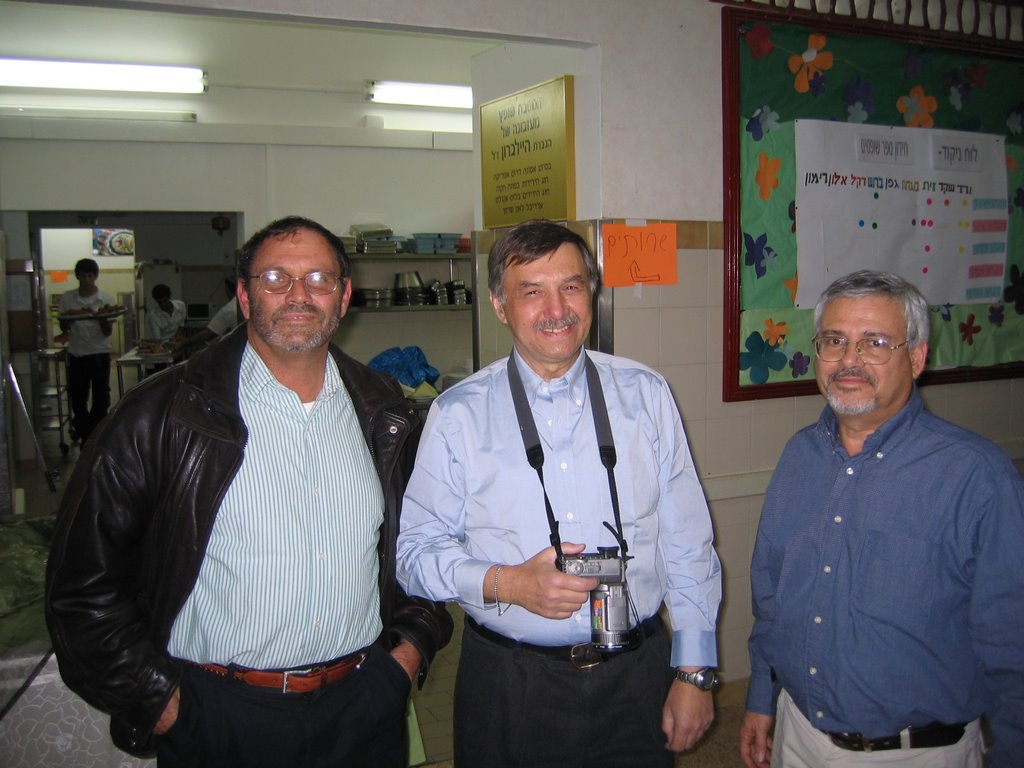
Uri is in Rego Park, Queens.
Benny is in Alon Shvut.
Sid is in Yerushalyaim
I'm in Shiloh.
David in Bet El.
Bennet in Efrat.
Subscribe to:
Posts (Atom)




 Posts
Posts


